
Being a top-tier event planner involves more than logistics; it is about turning a client's abstract vision into a tangible, memorable experience. This requires blending sharp project management skills with a creative spark, starting with a deep understanding of the client's goals. From there, the focus shifts to building a robust plan with a realistic budget, a detailed timeline and clear, measurable objectives.
Laying the Groundwork for a Flawless Event
The success of any corporate event is determined long before a single guest arrives. This initial phase is where a client's ideas are translated into a strategic, actionable plan, ensuring abstract concepts meet the hard reality of logistics. This groundwork sets the tone for the entire project.
The first task is to get to the heart of the brief. What is the core purpose? Is it to generate qualified sales leads? To create significant publicity for a new brand in a competitive market? Or perhaps it is a high-stakes internal conference for senior leadership. Without a clear "why," an event lacks purpose.
This is where you must define what success looks like from the beginning. These are known as Key Performance Indicators, or KPIs. For a product launch, a solid KPI might be securing 50 pieces of media coverage. For an internal event, it could be achieving an 85% positive feedback score on the session content. These metrics are essential for proving the event's return on investment.
Defining the Budget and Timeline
Once the objectives are established, it is time to build the financial and operational skeleton of the event. A detailed, line-item budget is non-negotiable. It must account for every conceivable cost, from major items like venue hire and catering down to details such as printing name badges and covering staff travel.
Budgets are typically broken down into core categories:
- Venue Costs: This includes hire fees, insurance and any services the venue insists are used in-house.
- Catering: The cost per head for food and drink, plus service staff.
- Technical Production: All audio-visual equipment and the crew to operate it. For this, it is often best to engage a specialist supplier like London Audio Visual Hire.
- Marketing and Promotion: The budget for digital advertising, printed materials and any PR support.
- Contingency: This is a safety net. A fund of 10-15% of the total budget should always be included to handle inevitable last-minute requirements.
This simple flow chart captures how these three core elements – vision, budget and timeline – fit together.
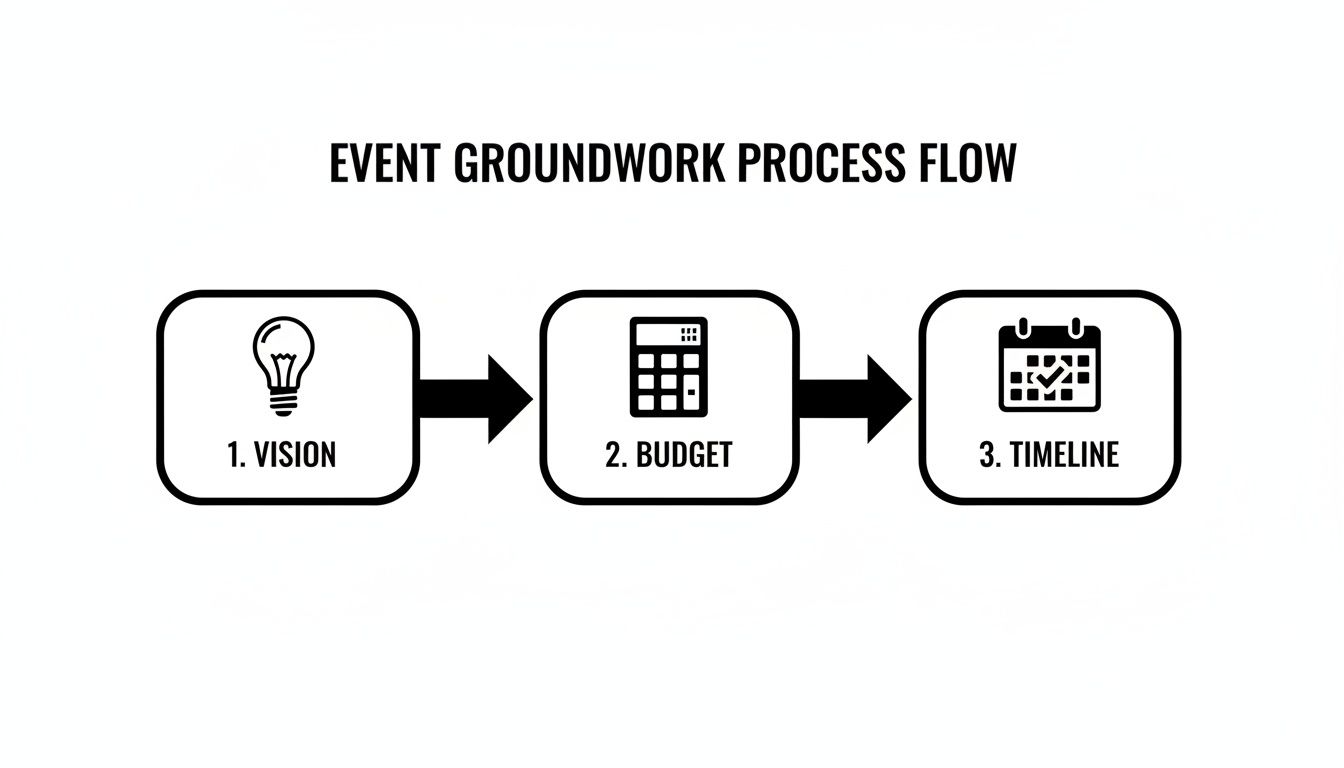
A solid budget and a clear timeline are the pillars that support the initial concept. They provide the essential structure for everything that follows.
Alongside the budget, a master timeline is created by working backwards from the event date. This creates a project plan with non-negotiable milestones for every task, from securing the venue and signing supplier contracts to launching the registration page.
This checklist summarises the essential first steps when starting any new event project.
Initial Event Planning Checklist
| Phase | Key Action | Primary Consideration | Example Metric (KPI) |
|---|---|---|---|
| Discovery | Clarify the "why" | What is the core purpose of the event? | 50 media placements for a product launch |
| Budgeting | Create a line-item budget | Account for all potential costs, including a 10-15% contingency. | Keep catering costs under £75 per head. |
| Scheduling | Develop a master timeline | Work backwards from the event date to set key milestones. | Venue confirmed 6 months prior to event date. |
| Alignment | Connect event to business goals | How does this event support wider company objectives? | Generate 200 qualified sales leads. |
Completing these initial steps ensures the plan is built on a solid foundation from day one.
Aligning with Business Goals
A corporate event is a business tool. The planner's role is to ensure it aligns perfectly with the client’s broader commercial strategy. When this is achieved, the event is elevated from a simple gathering to a powerful marketing or communications asset.
This strategic value is why there is so much investment in the industry. The UK Convention & Trade Fair Planning sector has seen a market size expansion of 14.0% CAGR between 2020 and 2025. This growth shows significant confidence in the value that professionally planned events deliver. You can explore more data on UK event industry growth to get a fuller picture of this expanding sector.
A well-defined plan is the best defence against the unexpected. Taking the time to meticulously map out objectives, budgets and timelines is not just administrative work; it is the most critical creative act in the entire event process.
By laying this groundwork properly, you create a robust foundation that makes every other decision easier. It gives the client clarity, provides a clear brief for suppliers and gives the planner a definitive roadmap to follow. This is how you deliver consistent, professional results.
Finding Your Perfect Venue and Suppliers
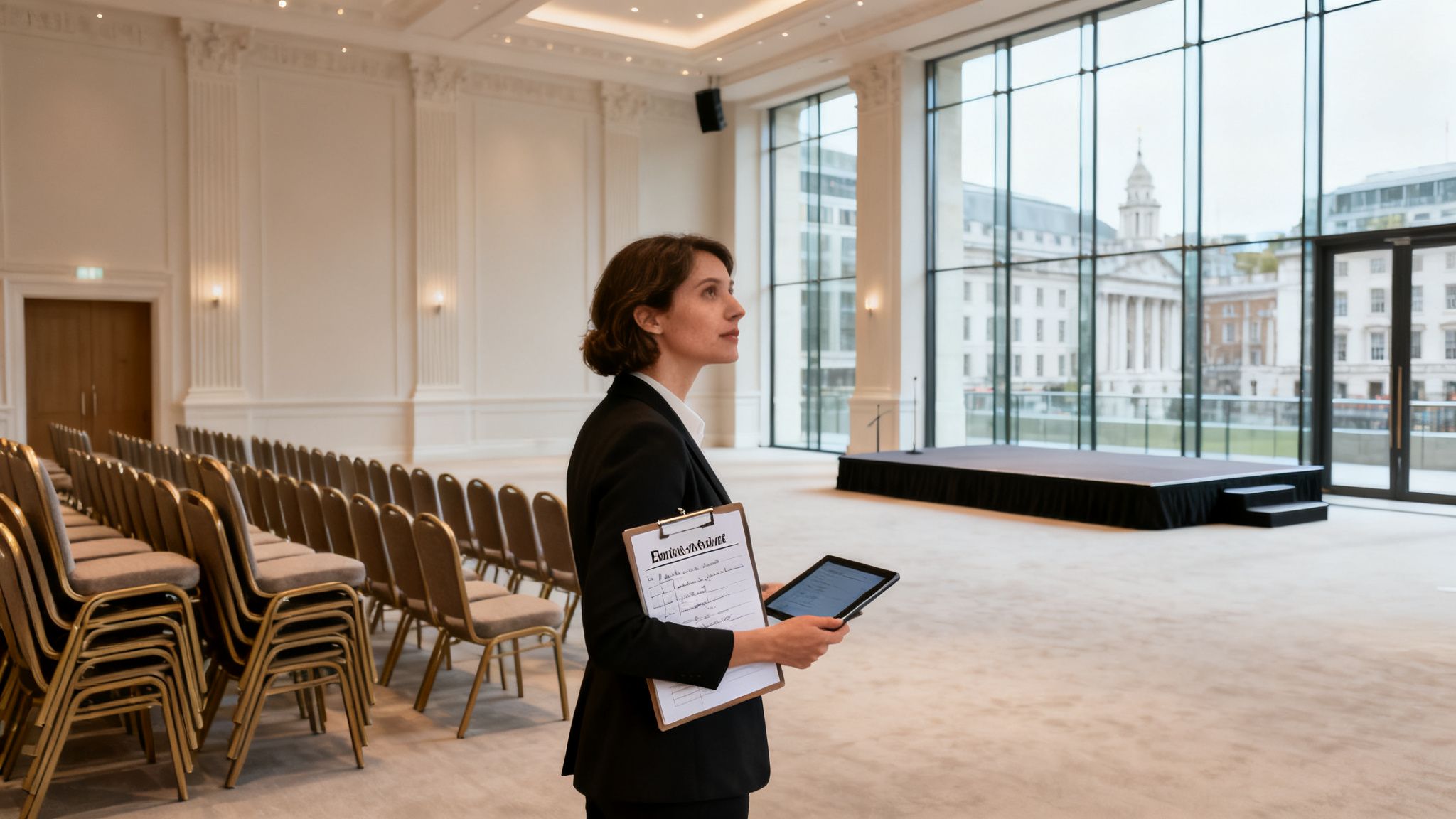
Choosing the right venue is one of the most significant decisions you will make. It is more than just a space; it sets the entire mood, dictates logistical possibilities and plays a huge part in the guest experience. In a city like London, a sharp and methodical approach is essential.
The search starts with the basics you have already defined. Capacity is the obvious first filter, but you must also consider location, public transport access and the quality of in-house technology. A beautiful venue with poor acoustics or limited power outlets can quickly become a costly problem.
Vetting Your Partners and Suppliers
Beyond the venue, an event’s success depends on the team of suppliers you assemble. These partners are an extension of your service; their performance reflects on you. This includes everyone from caterers and florists to security and the technical crew. Building a list of reliable partners is a fundamental skill for delivering excellent events time after time.
When you contact a new supplier, always start with a clear, detailed brief. Explain exactly what you need. This is the only way to get accurate quotes and avoid misunderstandings.
- Get Multiple Quotes: Always aim for at least three detailed quotes for any major service. This provides a sense of the market rate and a stronger negotiating position.
- Do Your Homework: Look for recent, relevant testimonials or case studies. Checking their company registration and public liability insurance are non-negotiable steps.
- Gauge Their Communication: How do they communicate during the quoting stage? Are they quick to respond, clear and professional? This is often a good indicator of their performance on the day.
For the technical side, expertise is everything. An AV partner who knows the quirks of London’s unique venues can save you from major issues on the event day.
Getting the Contracts Right
Once you have selected your suppliers, it is time for contracts. Never move forward on a verbal agreement. A proper contract protects you, your client and the supplier by ensuring everyone understands their responsibilities.
Your job is to read every word of the document before signing. Pay close attention to clauses that could have significant financial or logistical consequences.
A supplier contract is not just a formality; it is a critical risk management tool. Taking the time to properly review payment schedules, cancellation policies and liability clauses is essential for protecting your client's budget and your own reputation.
Here is what to look for:
- Payment Schedule: Know exactly how much the deposit is and when every payment is due. Missing a deadline could void the contract.
- Cancellation Policy: Understand what happens if you have to cancel or postpone. Most suppliers have a tiered fee structure, so the closer to the date you cancel, the more you pay.
- Scope of Work: The contract must list every service and piece of equipment included. If it is not in writing, assume it is an extra cost.
- Liability and Insurance: The agreement should clearly state who is responsible for any damage to the venue or equipment and confirm the supplier has adequate insurance cover.
As you assemble your team, understanding the specifics of security for event hire is also crucial for a safe and smooth event. This is another area where a specialist’s experience is invaluable. Building strong, trusted supplier relationships is not just good practice; it is what separates professionals from amateurs.
Getting to Grips with Technical Production and AV
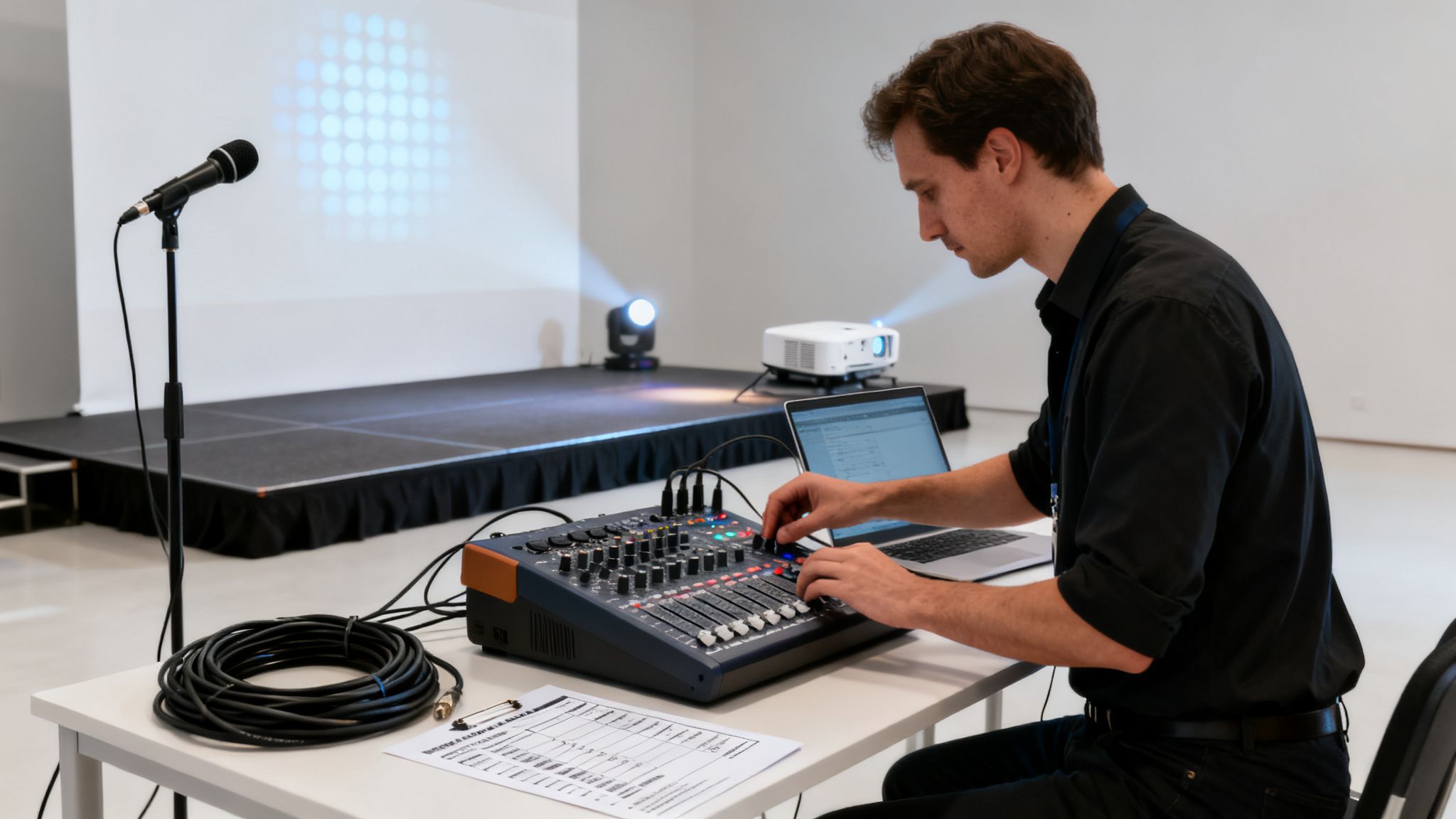
For many planners, the world of audio-visual (AV) production can feel like a foreign language filled with jargon and technical challenges. However, getting this right is what separates a good event from a great one. AV is the technical heart of your event; it is what makes everything look and sound polished, professional and seamless.
This is where you translate your creative vision into a tangible, technical reality. It is about ensuring a CEO’s keynote is heard clearly in every corner of the room, that presentation slides are sharp and that the overall atmosphere reflects the brand. A poor AV plan can undermine all your hard work, regardless of the quality of the catering or guest list.
From Event Goals to Technical Specs
Your AV brief is born directly from your event’s purpose. A fireside chat requires a completely different setup to a high-energy brand launch, and it is your job to brief your production partner on exactly what you need to achieve.
Consider a few real-world examples:
- The Panel Discussion: You will want individual lapel microphones for each panellist and the moderator. You also need a couple of handheld "roving" microphones for the audience Q&A; nothing kills momentum faster than someone shouting a question from the back.
- The Awards Gala: This is all about creating drama. You need dynamic stage lighting to spotlight winners, punchy walk-up music (known as 'stings') and large, bright screens for nominee videos and graphics.
- The Product Launch: To make a real impact, you might opt for a seamless LED video wall for a stunning, ever-changing backdrop. Add surround sound for dramatic effect and custom gobos to project the new logo onto the walls.
If you want to get a better understanding of the equipment involved, our guide on what audio-visual equipment is and how it is used is an excellent place to start.
The All-Important Technical Rider
This is one document you cannot afford to skip. A technical rider is your master plan, outlining every technical requirement for the event. It is the essential communication tool that gets you, the venue and your AV supplier on the same page. It prevents you from arriving on build day only to discover there is not enough power for the lighting rig.
Your rider must be specific. It should detail:
- Power: Exactly how many and what type of outlets are needed (e.g. 13A, 16A, 32A single-phase or three-phase).
- Rigging: Clearly state anything that needs to be hung from the ceiling, such as lighting trusses, speakers or projectors.
- Staging: Precise dimensions are key: height, width and depth. Also include needs for access stairs, lecterns and backdrops.
- Internet: Specify if you need a dedicated, hardwired connection for live streaming or event apps. Wi-Fi is rarely sufficient for mission-critical tasks.
Get your AV project manager involved from the very beginning. A seasoned professional will conduct a site visit with you, spot potential venue-specific issues you might miss and turn your creative ideas into a flawless technical plan. This is not just good advice; it is fundamental.
The scale of the UK events industry, valued at £68.7 billion, shows how critical this professionalism is. Business events alone make up £33.6 billion of that figure, with conferences contributing £16.3 billion. In a market this large, there is no room for technical errors.
Tackling Common AV Headaches in London Venues
London offers some spectacular venues, but they often come with unique quirks. You could be in a centuries-old listed building one day and a modern warehouse the next. Having an AV team that knows the city’s venues is a massive advantage.
Here are a few classic London challenges:
- Power Shortages: Many older buildings were not designed for modern event production. A good production manager will assess the power situation upfront and arrange for external generator hire if needed.
- Noise Restrictions: To maintain good relations with neighbours, many central London venues have strict sound limiters. Your sound engineer needs the skill to deliver excellent audio quality while staying within these limits.
- Tricky Load-Ins: Narrow corridors, small service lifts and congested city-centre loading bays are common challenges. Your AV partner must create a meticulous load-in and load-out schedule to navigate this.
Imagine you are in a historic livery hall in the City. The wood-panelled walls look amazing, but they can create acoustic challenges. An experienced sound engineer knows this and will solve it by carefully placing speakers and using specific microphones to reduce echo, ensuring every word is crystal clear. Confidently managing these details is the hallmark of a top-tier event planner.
Executing On-Site Logistics and Coordination
This is the event day. Months of meticulous planning, emails and spreadsheets have led to this moment. Now, your role pivots from planner to on-site director, and your mission is to orchestrate a calm, controlled and professional experience.
On the day, you are the conductor of a complex operation. From the first supplier loading in equipment to the final de-rig, you are overseeing every moving part. It is a job that demands a sharp eye for detail, clear communication and the ability to solve problems before anyone else notices them. A well-prepared planner has already anticipated potential issues, ensuring the whole operation runs smoothly.
Your Bible: The Run-of-Show Document
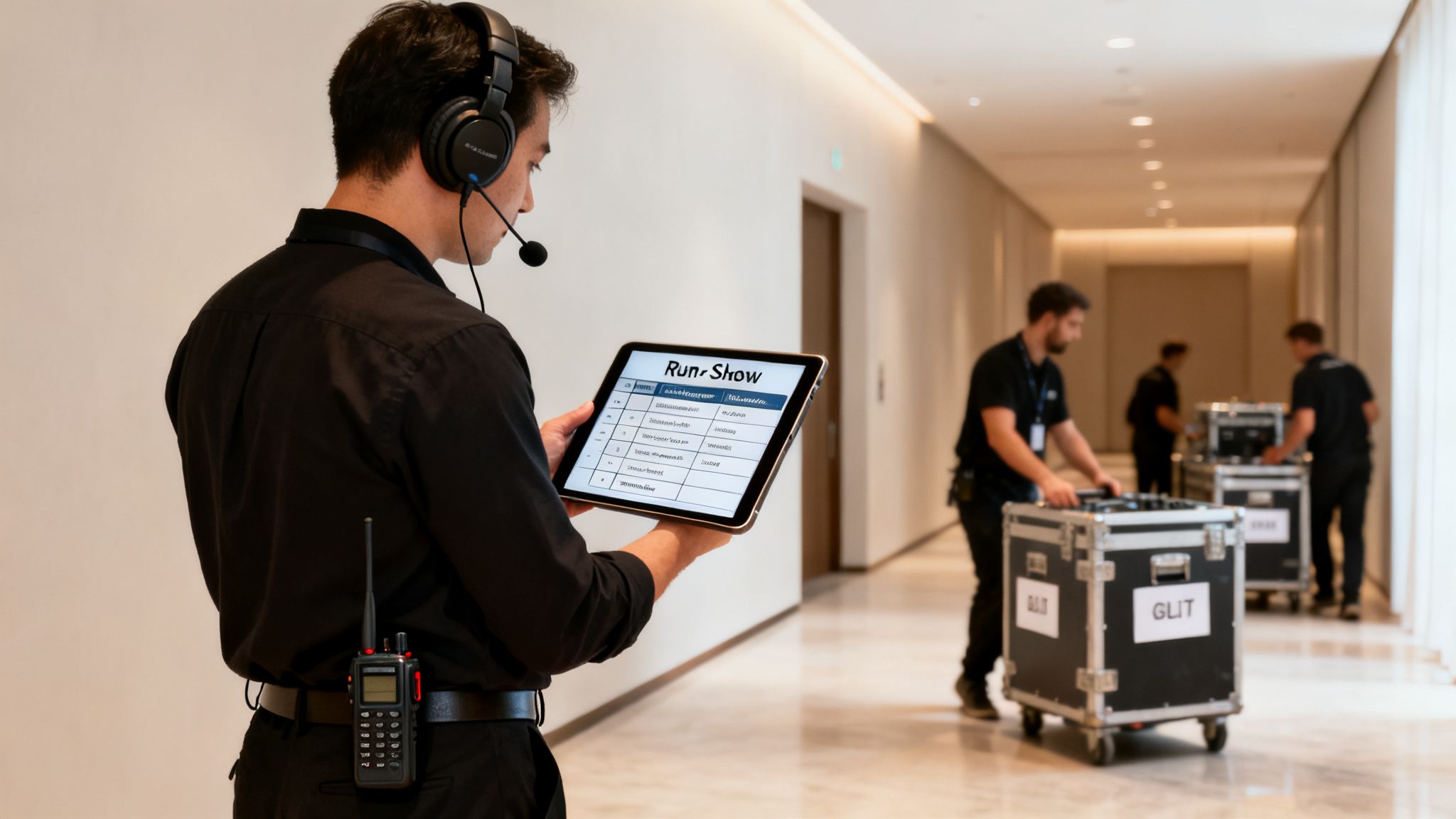
If you have one essential tool on event day, it is the run-of-show, often called the 'run sheet'. Think of it as the master script for the entire day, mapping out every cue, transition and responsibility down to the minute. This document keeps everyone, from the AV technicians to the catering manager, perfectly synchronised.
A robust run sheet needs these key elements:
- Timings: Precise, down-to-the-minute timings for every action. When do the doors open? What time does the final presentation slide appear? Everything must be included.
- Action/Cue: A simple, clear description of what is happening on stage or in the room. No jargon, just the facts.
- Responsibility: Who owns this action? Name the specific person or team, whether it is the Stage Manager, AV Technician or Catering Lead.
- Technical Notes: This is for the production crew: lighting states, sound cues, video playback instructions and anything else they need to know.
This document is your lifeline. It is how you maintain control and ensure a flawless, seamless flow from start to finish.
Walking the Ground: Site Visits and Rehearsals
Never underestimate the power of a final site visit and a full technical rehearsal. Getting key suppliers on-site before the event, especially your AV project manager, is invaluable. This is your chance to physically walk the flow of the event, spot potential snags and confirm everything from rigging points and power distribution to the final load-in schedule.
For any event with complex technical elements, a full rehearsal is non-negotiable. This means getting speakers and the production crew to run through key presentations and transitions. It is a game-changer because it:
- Builds Speaker Confidence: Letting presenters get a feel for the stage, the microphone and the clicker does wonders for their nerves.
- Tests Technical Cues: This is where you ensure the video rolls at the right second and the lighting shifts are perfectly timed.
- Refines Timings: You will get a real-world feel for how long each segment actually takes, allowing you to make crucial last-minute adjustments to the run sheet.
This is your final chance to resolve issues before the audience arrives. If you are managing a more complex setup, like a live stream, it is worth looking deeper into how to prepare for hybrid and streaming events to understand the unique challenges.
Keeping Everyone Safe: Health and Safety
As the planner, you are ultimately responsible for the safety of every person on-site. This means you must conduct thorough risk assessments to identify potential hazards, such as trailing cables, blocked fire exits or crowd-flow issues, and have a solid plan to manage them.
It is also your duty to check that every supplier has their public liability insurance in order. Do not hesitate to ask for their certificates; it is a standard and essential part of your due diligence. This simple step protects you and your client from serious liability if an accident happens.
Your calm presence on-site is your greatest asset. When challenges arise, and they will, your ability to stay composed and make clear, logical decisions sets the tone for the entire team. Your confidence is contagious and reassures suppliers, stakeholders and clients that everything is under control.
The scale of the UK event scene underscores how vital this professionalism is. The UK hosts around 1.08 million conferences and meetings annually, attracting 95.4 million delegates and generating an estimated £19.3 billion in direct spend. An industry this large is built on meticulous on-site coordination and an unwavering commitment to safety.
Ultimately, great on-site management is about leadership, not just logistics. It is about clear team briefings, proactive problem-solving and managing stakeholder expectations with grace. When you orchestrate a controlled and professional on-site experience, you show everyone the true value of an expert event planner.
Post-Event Analysis and Wrap-Up: Proving Your Value
The last guest has left and the lights are down, but the job is not over. What you do in the days following the event is as crucial as the months of planning leading up to it. This is where you prove your value, cement client trust and gather information that will make your next event even better.The wrap-up is more than just packing away banners. It is a meticulous process of closing the books, analysing data and nurturing relationships. This is your chance to demonstrate the event's return on investment and turn a successful project into a long-term partnership.
First Things First: Settle the Finances and Talk to Your Crew
Before you do anything else, tackle the budget. It is time to chase the last few supplier invoices and reconcile every penny. Meticulously compare your initial forecasts with the final spend.
Presenting a clean, transparent final budget report to your client is not just good housekeeping; it shows you are a responsible manager of their money. It builds significant trust.
This is also the perfect moment to connect with key suppliers. Call your AV team to thank them and get their perspective. What worked well from a technical standpoint? Were there any hitches behind the scenes? This candid, on-the-ground feedback is valuable for future planning and strengthens vital professional relationships.
Feedback, Data, and Measuring What Mattered
With the books settled, it is time to find out what everyone thought. To do this properly, you need to measure event success by collecting hard data and real-world feedback. The numbers you gather now are your evidence, directly linked back to the original KPIs you set with the client.
Here are a few proven ways to get the insights you need:
- Strike While the Iron is Hot: Send a simple attendee survey within 24 hours. Ask focused questions about their experience, the venue and the content. Keep it brief.
- Talk to the Key Players: A short discussion with your main client stakeholders is invaluable. What were their personal highlights? Did the event deliver what they hoped for?
- Check the Digital Pulse: Dive into social media. Track your event hashtag, look at mentions and get a feel for the online sentiment. Did you create a buzz?
- Follow the Money: Liaise with the client’s sales or marketing team. Can they trace any new leads, enquiries or closed deals directly back to the event? This is the ultimate ROI metric.
Your post-event report is the final, tangible deliverable. It is not just a summary; it is your most compelling case study. It needs to celebrate the wins, be honest about the lessons learned and use concrete data to prove the value you delivered.
This approach elevates you from a "planner" to a strategic partner. You are not just organising an event; you are delivering a calculated business result.
Crafting the Definitive Post-Event Report
The final piece of the puzzle is bringing all this information together into a polished post-event report. This document is the official record of the project and your best tool for securing repeat business. Do not treat it as an afterthought.
A professional report should cover:
- The Executive Summary: A concise, one-page overview of the event's core objectives and biggest successes.
- Performance vs. KPIs: A clear, data-driven breakdown showing exactly how you met those initial targets. Use graphs and charts to make it visually compelling.
- Final Budget Reconciliation: The complete financial picture, detailing projected costs against the final spend.
- Feedback Highlights: A summary of what attendees and stakeholders had to say, including both positive comments and constructive criticism.
- Learnings & Recommendations: Your expert analysis of what went well and what you would refine next time.
Presenting this report is your final handshake. It demonstrates your professionalism, transparency and unwavering focus on delivering measurable results. It closes this project on a high and perfectly sets the stage for the next one.
Your Event Planning Questions, Answered
When you are deep in the details of planning a corporate event, it is easy to get bogged down. You are juggling a dozen different things, and a few common questions always seem to arise. Let us tackle some of the ones most frequently asked by planners in the UK.
How Far in Advance Should I Book Venues and Suppliers?
The earlier, the better, especially for major events in popular locations like London. If you have a specific venue or a top-tier technical crew in mind, you need to move fast. Their diaries often fill up 9-12 months in advance.
Consider this timeline:
- Venues: Start looking six to nine months ahead, minimum. This is particularly true if you are aiming for the busy spring or autumn seasons. Booking early gives you more choice and a much stronger negotiating position.
- AV Suppliers: Do not underestimate how quickly the best AV teams get booked. A specialist company like London Audio Visual Hire should be on your radar at least six months out. That provides enough time for proper technical planning, site visits and creative thinking.
- Catering & Others: For other crucial suppliers like caterers or security, you can usually work on a three-to-six-month timeline, but do not become complacent.
Leaving these arrangements to the last minute is a recipe for problems. You will end up with a very short list of options, likely compromising on quality and almost certainly paying a premium.
What is the Best Way to Handle Last-Minute Changes?
First, do not panic. Unexpected changes are part of the job. From keynote speakers getting stuck in traffic to last-minute branding changes from the client, the ability to stay calm and adapt is what separates professionals from amateurs.
When a change comes in, take a moment to assess the real impact. A few extra guests is one thing; your main stage act cancelling is another entirely. The moment you understand the scale of the issue, contact your client and the suppliers it affects. Discuss the knock-on effects for the budget, the schedule and the logistics.
Your original plan is your best defence against last-minute chaos. Keep a simple change-log, be honest with everyone involved and trust your suppliers. They have seen it all before and are your best allies in finding a smart solution under pressure.
Once you have a new plan, update everything, especially the run sheet, and make sure every person on the team knows what has changed. A clear, controlled response stops a small issue from spiralling into a full-blown crisis.
What is Different About Planning a Hybrid Event?
A hybrid event is not just about pointing a camera at a stage. You are producing two distinct experiences at the same time: one for the people in the room and a separate one for your online audience.
The biggest shifts are in the technology and the content.
- The Technical Production: Your AV needs have doubled. You will need a solid streaming platform that will not crash, multiple cameras to create a dynamic broadcast (not just a static wide shot) and a dedicated crew managing the live stream.
- Engaging the Online Crowd: You have to actively work to keep your remote attendees involved. Think live polls, a moderated digital Q&A and perhaps even a dedicated online host whose job it is to make them feel part of the action, not just watching from the sidelines.
The key is to stop thinking of it as a live event with an online add-on. You need to design a bespoke digital experience that complements and runs alongside the physical one.
At London Audio Visual Hire, we work closely with event planners to deliver the technical production that makes corporate events excel. Our project managers and technicians are the calm, experienced hands you need on-site.