

So, what exactly is AV equipment? At its core, it is the ecosystem of technology (audio, visual, lighting and control systems) that brings a professional event to life. It is far more than just a few screens and speakers; we are talking about highly specialised hardware built for the high-pressure environments of conferences, product launches and awards ceremonies, where failure is not an option.
What "AV Equipment" Really Means for an Event
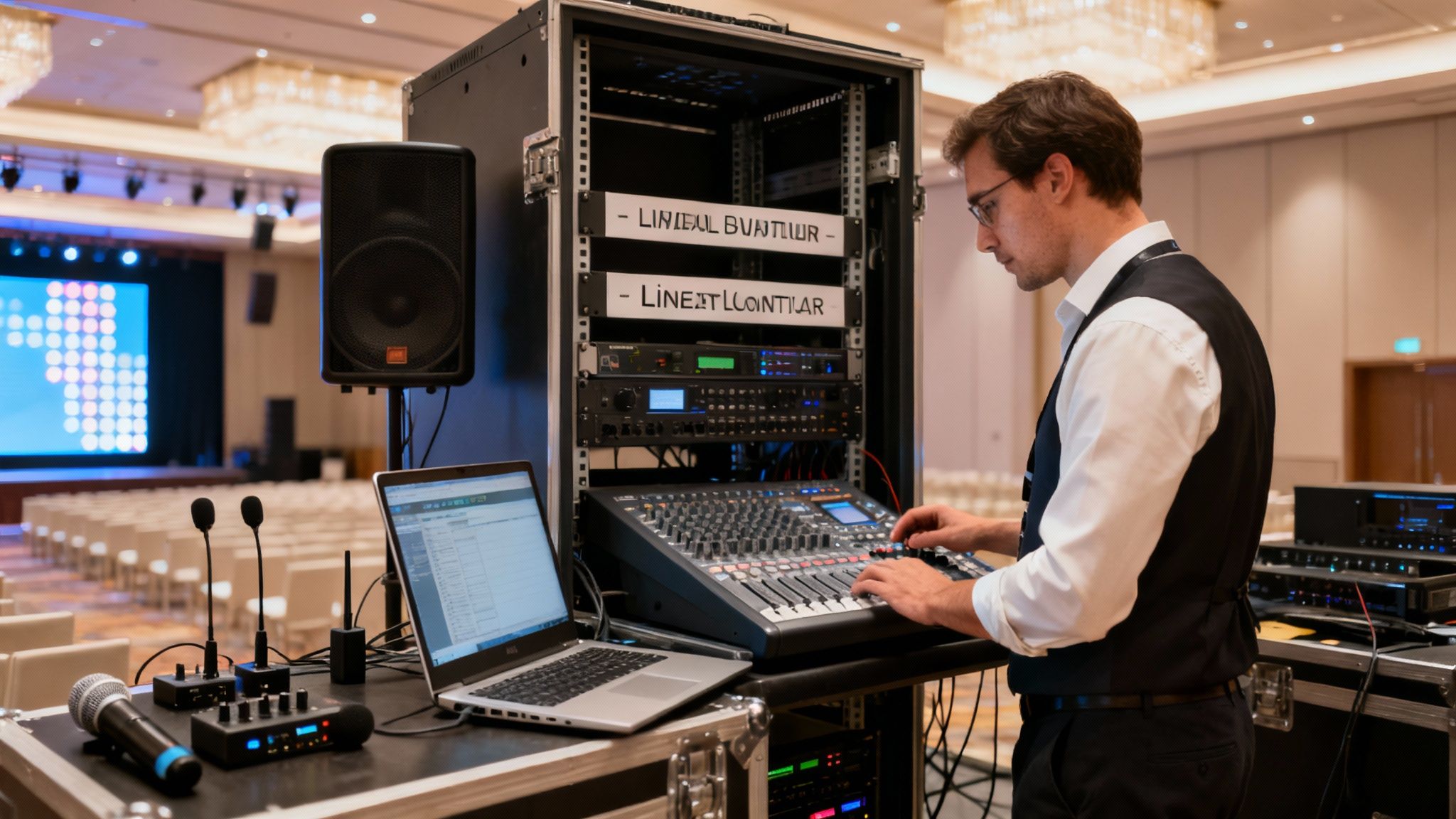
To understand professional AV, it helps to think of it less as a collection of gadgets and more as a complete, managed service. It is the combination of the technical equipment and the expert knowledge needed to design the system, install it, operate it flawlessly and dismantle it safely afterwards.
This is a crucial distinction for any event organiser. The home cinema projector in your living room or a consumer Bluetooth speaker cannot handle the demands of a live event. Professional AV equipment, on the other hand, is built from the ground up for reliability, scalability and seamless integration when the pressure is on.
It's More Than Equipment, It's a Capital-Intensive Service
The scale of the professional AV world is significant. In the UK alone, the commercial AV hardware market was valued at around USD 14.37 billion in 2023 and is expected to climb to nearly USD 20.94 billion by 2030. This is not a cottage industry; it is a mature, capital-intensive sector built on serious investment. You can read more on UK AV market trends in the full market report.
This investment funds everything from high-brightness laser projectors and large modular LED video walls to complex digital sound desks and broadcast-quality cameras.
So, when you partner with a specialist company, you are not just hiring a few pieces of equipment. You are accessing a multi-billion-pound infrastructure and, more importantly, the engineering talent that makes it all work together.
The real value of an AV hire service is not just the hardware. It is the peace of mind that comes from knowing it will be specified correctly, installed safely and operated by a dedicated technical crew who know what they are doing. This turns a potential point of failure into your most powerful communication tool.
The Core Components of an Event Setup
To make sense of it all, professional AV is usually broken down into key categories that work in harmony. Each plays a specific role in creating a polished, engaging experience for everyone in the room.
To give you a clearer picture, here is a quick breakdown of the main pillars of any event’s technical setup.
Core AV Components at a Glance
| Category | Primary Function | Common Examples for Events |
|---|---|---|
| Audio | Capturing, processing and projecting sound so every word is heard clearly. | Lapel microphones, mixing desks, line array speakers, stage monitors. |
| Visuals | Displaying presentations, videos and live camera feeds for the audience. | LED video walls, projectors, large-format screens, seamless switchers. |
| Lighting | Illuminating the stage, creating atmosphere and reinforcing branding. | Stage spotlights (e.g., Fresnels, profiles), uplighters, custom gobos, moving heads. |
| Staging & Rigging | Providing the physical structure for the event and suspending equipment safely. | Stage decks, lecterns, trussing systems for flying speakers and lights. |
| Control & Signal | The 'nervous system' connecting all components so they work in unison. | Vision mixers, signal processors, extensive cabling, control desks. |
This table should help you see how the different elements fit together. Grasping these basic categories is the first step in planning the technical side of your event and communicating your needs effectively.
For a detailed look into the specific pieces of equipment involved, you can explore the full range of AV equipment available for hire to see what a professional inventory looks like.
The Four Pillars of Professional Event AV
To fully understand AV equipment, it helps to think of it in four distinct, yet connected, areas. These are the core disciplines that underpin every professional event production, whether it is an intimate corporate seminar or a large-scale awards ceremony. Think of them as the essential building blocks for creating any event experience: Audio, Visual, Lighting, and Staging & Rigging.
Each pillar has its own function, but the real impact occurs when they all work together in harmony. Achieving the right balance between these four elements is what elevates an event from a simple gathering to a memorable, high-impact experience. It is the job of a professional AV partner like London Audio Visual Hire to integrate these pillars flawlessly.
Pillar 1: Audio Systems
Audio is arguably the most crucial part of any event where a message needs to be communicated. If your audience cannot hear the keynote speaker, the CEO's announcement or the panel discussion, the event has failed. The goal here is not just to increase the volume; it is about delivering sound with absolute clarity and consistency to every seat in the room.
Achieving this requires a sophisticated chain of equipment, with each piece designed for a specific task:
- Sound Capture: It all starts with the right microphone. A handheld wireless microphone is ideal for a presenter who moves around, while discreet lapel (or lavalier) microphones are perfect for panellists who need to keep their hands free. For a stationary speaker, a lectern microphone is sufficient.
- Sound Processing: Every audio signal is channelled into a digital mixing desk, which is the command centre for a sound engineer. From here, they balance levels, eliminate feedback and ensure all audio from microphones, videos and music blends together smoothly.
- Sound Reinforcement: This is the final step, where the processed audio is delivered to the audience through a carefully placed speaker system. In a large conference hall, you will often see a 'line array' system, a series of speakers hung from the ceiling to distribute sound evenly. For smaller breakout rooms, a pair of speakers on stands may be all that is needed.
The professional audio market is a substantial industry in its own right. The UK’s Professional Audio Visual Systems market is valued at approximately USD 21.69 billion in 2024 and is expected to reach around USD 34.03 billion by 2033. Audio equipment alone constitutes a significant portion of that, valued at about USD 1.20 billion in 2024, with speakers being the largest single product category. You can explore these insights into the professional audio visual systems market to see just how specialised it is.
Pillar 2: Visual Systems
The visual pillar covers everything the audience sees, from presentation slides and branded graphics to live video feeds of the speaker. High-quality visuals are essential for keeping an audience engaged, reinforcing key messages and showcasing your brand. The right display technology depends on the venue, audience size and the desired impact.
The key components here are:
- Display Technology: This could be a high-brightness laser projector and screen for a standard conference room, or a large, modular LED video wall for a high-energy product launch. LED walls are exceptionally bright and versatile, making them ideal for rooms with high ambient light or for creating custom-sized digital backdrops.
- Content Sources: The visuals displayed can come from various sources, such as a presenter's laptop, pre-recorded videos or live cameras capturing the action on stage.
- Signal Management: A vision mixer (or video switcher) is the visual equivalent of a sound desk. It allows a technician to switch seamlessly between different laptops and video clips, create picture-in-picture effects and control exactly what the audience sees at any given moment.
A common problem we encounter is a projector that is not bright enough for a well-lit room. A professional AV team will always calculate the required brightness (measured in lumens) based on the screen size and ambient light to ensure a crisp, vibrant image every time.
Pillar 3: Lighting Design
Good lighting does more than just help people see. It shapes the atmosphere of a room, directs the audience's focus and can transform a plain hotel ballroom into a stunning, branded environment. It is one of the most powerful tools for influencing the mood and energy of an event.
Professional lighting is about painting with light. It guides attention, creates depth and builds an emotional connection with the audience. A simple change in colour or intensity can completely alter the perception of the stage and the entire room.
Effective event lighting is built in layers:
- Stage Wash: This is the base layer, providing a general, even spread of light across the stage so that everyone on it is clearly visible.
- Key Lighting: Spotlights are then used to highlight specific people or areas, like the main speaker or the lectern, making them the centre of attention.
- Atmospheric Lighting: This is where creativity comes in. Uplighters can wash the walls with your brand colours, while 'moving head' lights can add energy and dynamic effects for awards or celebrations.
- Branding: A custom 'gobo' is a device used to project a company logo onto the stage backdrop or a wall, keeping your brand prominent.
Pillar 4: Staging and Rigging
This final pillar is the literal foundation upon which all other AV equipment is built. Staging and rigging provide the physical platform for the speakers and the heavy-duty infrastructure needed to safely hang lighting, audio and video equipment.
This is an area governed by strict safety standards and is not a place for amateurs.
- Staging: This refers to the physical stage itself, along with backdrops, lecterns and any other structures that create the event's focal point. A well-designed stage set not only looks professional but also cleverly integrates screens and branding.
- Rigging: Rigging involves using metal trussing, motors and heavy-duty cables to 'fly' (or suspend) equipment from a venue's ceiling. This is critical for positioning speakers and lights correctly for optimal coverage in large rooms. It is a highly specialised skill where safety is the absolute priority.
Without this solid foundation, none of the other elements could be implemented effectively or safely. It is the invisible but essential framework that holds the entire production together.
How All the AV Components Work Together
Having a room full of high-quality equipment is one thing, but getting it all to work together is where the real expertise lies. This is what separates professionals from amateurs. The secret is making every component (every microphone, screen and light) communicate and function as one seamless system. We call this concept signal flow.
Think of signal flow as the invisible wiring diagram for your event. It is the journey an audio or video signal takes from its source to its final destination. Understanding this path helps to see AV not just as a collection of equipment, but as an integrated solution designed to create an experience.
Tracing the Signal Path
The journey always starts with a source. This could be a microphone picking up a panellist's voice, a laptop running a presentation or a camera capturing the live action on stage. Each source creates a signal that needs to be directed.
From the source, the signal travels, usually through specialist cables or a wireless transmitter, to a processing unit. This is where real-time mixing and management happens.
- For audio: Signals from every microphone and playback device are fed into a central audio mixing console. This is a sound engineer's command centre, where they meticulously adjust volume levels, tweak frequencies and balance everything to create a perfectly clear and rich sound for the audience.
- For visuals: All video signals from laptops, cameras and other media players are routed to a vision mixer or seamless switcher. A vision technician uses this to cut smoothly between different video feeds, ensuring the right content appears on the main screen at precisely the right moment.
Once processed, the polished signal is sent out to its final destination. The perfectly mixed audio is pushed through amplifiers and then to the speakers around the room. Simultaneously, the selected video feed is sent to projectors, large LED walls or smaller repeater screens so everyone has a clear view.
This diagram helps visualise how the core pillars of an event production connect and depend on one another.
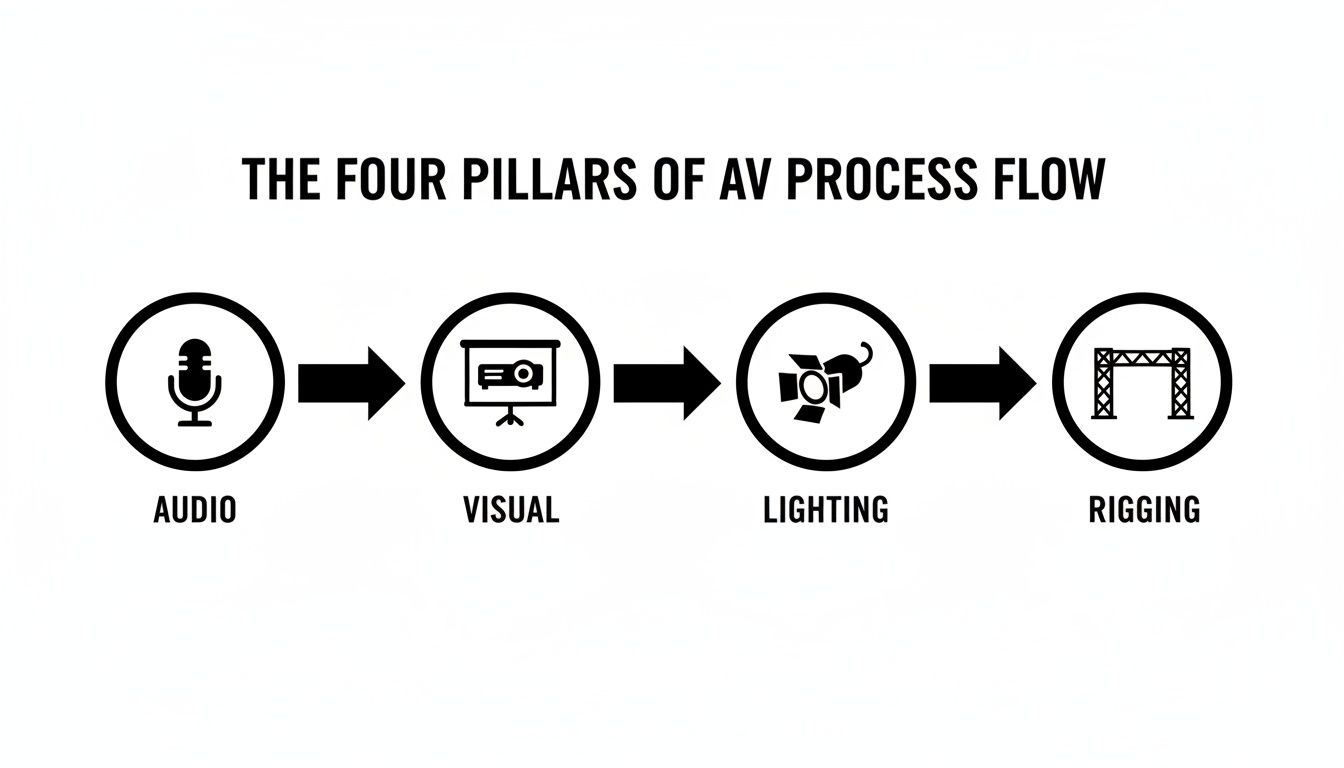
As you can see, while each element has its own job, they are all part of an interconnected system that must be managed by a skilled technical team.
The Role of Control Systems
Coordinating all these elements is the control system, often operated by a technical director or show caller. This is the brain of the entire operation. It ensures the audio, video and lighting cues all happen in perfect synchronisation. A single button press can trigger a complex sequence: the house lights dim, the walk-on music starts and the speaker's first slide appears on screen, all at the exact same time.
A well-designed signal flow is completely invisible to the audience. When it's done right, everything just works. That seamless experience is the direct result of careful planning, the right cabling and expert technicians who know how to keep a complex system running flawlessly under pressure.
You can see this same logic in a simpler context, like setting up a two-person podcast. It shows signal flow on a much smaller scale: from two microphones, into a mixer and out to headphones and a recorder. It is exactly this principle that we at London Audio Visual Hire apply to events of all sizes, ensuring every piece of equipment plays its part perfectly within the wider system.
Common AV Setups for Corporate Events
Knowing the individual components of AV equipment is useful, but seeing how they all work together in a real-world event provides true context. To give you a better feel for how AV comes to life, let's walk through three classic corporate event scenarios. Each has its own distinct challenges and requires a unique technical solution to succeed.
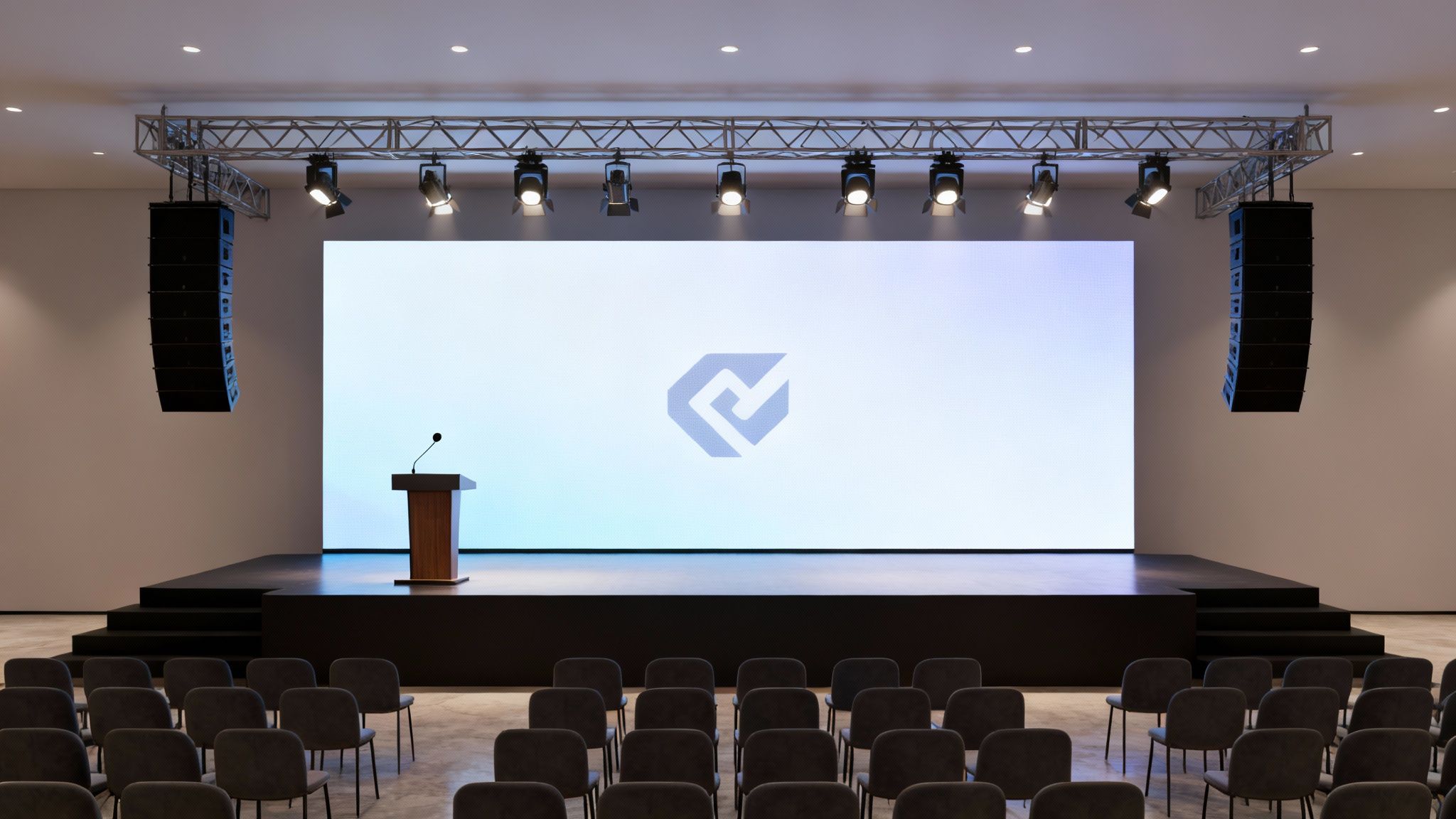
Scenario 1: The Annual Conference in a Hotel Ballroom
For a large conference, the focus is on clarity and engagement. The goal is simple: everyone, from the front row to the very back, needs to see and hear the presentations perfectly. The AV here is the workhorse, built for reliability to deliver key messages without a single fault.
Here is a typical equipment list for this kind of event:
- Dual Projection Screens: Placing two large screens on either side of the stage is standard practice. It gives everyone in the room a clear line of sight and allows you to show the main presentation on one screen while running a live camera feed of the speaker on the other.
- PA System with Delay Speakers: A professional Public Address (PA) system is essential. In a long ballroom, relying solely on front speakers is insufficient. We add 'delay' speakers further down the room to gently boost the sound, ensuring it remains crisp and clear for everyone, regardless of where they are sitting.
- Lectern and Panel Microphones: Flexibility is key. A fixed microphone on the lectern is perfect for the keynote speaker, while wireless lapel microphones are essential for a panel discussion, allowing panellists to talk naturally.
- Basic Stage Wash Lighting: The lighting here is for visibility, not drama. A simple 'stage wash' uses a bank of lights to create an even, bright wash across the stage. This ensures your speakers are always well-lit and easy to see.
Scenario 2: The High-Impact Product Launch
A product launch is pure theatre. You need to create a buzz and an unforgettable brand moment. The AV has to be dynamic, visually stunning and generate genuine excitement. This is where you deploy the most impressive technology.
The AV specification for a launch is a significant step up:
- LED Video Wall: An alternative to projectors, a massive, high-resolution LED video wall becomes the centrepiece. Its incredible brightness and vibrant colours create a powerful digital backdrop for brand videos and the product reveal.
- Dynamic Lighting Rig: This is where lighting becomes creative. A rig with moving head lights and custom gobos (stencils that project logos or patterns) helps build atmosphere and energy. The lights can be programmed to pulse with music or change colour to match on-screen content.
- Distributed Audio System: Sound is not just for speeches here. The audio system is designed for high-impact soundtracks and music. We often use subwoofers to add deep, rumbling bass that gives video content a cinematic feel.
- Live Streaming Integration: Product launches are now global events. The entire AV setup must connect seamlessly with a live stream. Achieving this requires a professional broadcast setup. You can learn more with our guide on planning and executing a hybrid streaming event.
Scenario 3: The Prestigious Awards Gala
An awards gala must feel slick, polished and professional, much like a live TV broadcast. The AV production needs to juggle multiple video clips, presenters and music cues without missing a beat. Flawless execution is the only option.
For an awards night, the AV production does not just support the event; it is the event. Every technical cue, from the walk-up music to the winner's graphic on screen, must be perfectly timed to maintain momentum and professionalism.
The essential equipment for a top-tier gala includes:
- Multiple Screens: You will typically have a main, large screen front-and-centre for nominee videos, supported by smaller 'repeater' screens located around the venue. This guarantees every table has a great view.
- Wireless Handheld Microphones: Reliable, broadcast-quality wireless microphones for the hosts and winners are non-negotiable. The last thing you want is signal dropout during an acceptance speech.
- Custom Stage Set and Branding: Often, the stage itself is a custom-built set designed to integrate screens and lighting seamlessly. Gobos are used extensively to project event and sponsor logos, reinforcing the brand identity.
- Show Control System: Behind the scenes, a technical director uses a sophisticated control system to manage everything (audio, video and lighting) from one central desk. This is the key to delivering smooth, perfectly timed transitions.
How to Choose the Right AV Hire Partner
Now you have a grasp of AV equipment basics. The next step is often the one that determines an event's success: finding the right people to supply and operate it.
Choosing your AV hire partner is one of the most important decisions you will make. It directly shapes the outcome of your event and your own stress levels. A great partner is not just a supplier; they become a crucial extension of your team.
It is tempting to compare quotes and pick the cheapest, but this is a common mistake. Real value is not about the price tag. It is found in the team's technical knowledge, the quality of their equipment and their proven ability to perform under pressure. A seasoned AV company provides more than hardware; they bring meticulous planning, risk assessment and flawless on-the-day execution.
Beyond the Price Tag: What Really Matters
When evaluating potential AV companies, you must look deeper than the initial quote. The stability and experience of a partner are significant factors, especially in a market that can be volatile. A bit of due diligence now can prevent major issues later.
The UK’s audio-visual sector has around 541 leading companies, but their performance varies widely. In a recent analysis, 249 of these firms saw their sales drop, with a staggering 101 losing over 25% of their value. You can see more details on the UK AV equipment market landscape on plimsoll.co.uk.
What does this mean for you? It highlights the importance of choosing an established, financially sound partner. By doing so, you avoid a large segment of the market that may be struggling or cutting corners. This reality makes it essential to ask tough questions about their track record, insurance and technical depth before signing anything.
Vetting Your AV Partner: A Practical Checklist
To properly assess a potential hire company, you need a plan. Your aim is to confirm they have the experience, the equipment and the safety procedures to handle your event without issue.
The following checklist provides a structured way to vet potential partners. These are not just tick-box questions; the quality of their answers will reveal their professionalism and capability.
AV Hire Partner Vetting Checklist
| Area of Enquiry | Key Question to Ask | What a Good Answer Looks Like |
|---|---|---|
| Experience & Portfolio | "Can you show me case studies or examples of events you have delivered that are similar to mine in scale and complexity?" | A confident "yes," followed by specific, relevant examples, photos and client testimonials. They should be able to prove they have done it before. |
| Venue Knowledge | "Are you familiar with my venue? Have you worked there before?" | Ideally, they know the venue well and have a good relationship with the in-house team. This inside knowledge is invaluable for logistics. |
| On-Site Team | "Who exactly will be on-site for my event? What are their qualifications and experience?" | They should name specific technicians and talk about their expertise. You want dedicated professionals, not just a delivery driver. |
| Safety & Insurance | "Could you provide a copy of your Public Liability Insurance and explain your risk assessment process?" | An immediate "of course." They should have up-to-date documentation ready and be able to clearly explain how they manage on-site safety. |
| Contingency Planning | "What happens if a key piece of equipment fails during the event? What is your backup plan?" | A detailed answer about redundant systems, on-site spares for critical items (like microphones or projectors) and a clear plan of action. "We hope it will not" is not an answer. |
By working through these questions, you get a much clearer picture of who you are dealing with. It shifts the conversation from a simple cost comparison to a genuine assessment of their ability to be a reliable technical partner.
Choosing an AV partner is an investment in your event’s outcome. The right team does not just supply equipment; they provide the technical confidence and expert support that allows you to focus on your guests and your message, knowing the production is in safe hands.
This process ensures the team you hire has the capability and professionalism to deliver a seamless event, protecting your brand's reputation and giving you peace of mind. To get a better idea of what is involved, it is worth exploring the full range of AV production services a comprehensive partner can offer.
Got Questions? Common AV Queries Answered
Now that we have covered the main categories of AV, you probably have a few practical questions. Below are some of the most common things event organisers ask us, with straightforward answers to help you plan with confidence.
How Far in Advance Should I Book AV Equipment?
For a large production like a conference or an awards night in London, you should secure your AV partner three to six months in advance. This allows sufficient time for proper planning, content checks and crucial venue site visits, while also guaranteeing you get the best equipment and senior crew members.
If you are planning a smaller meeting or something less complex, four to six weeks is usually enough time. Just remember that the corporate calendar gets very busy at certain times of the year, so booking earlier is always the safer option.
What’s the Difference Between Dry Hire and Wet Hire?
This is a classic industry term, and understanding it is key to knowing what you are paying for. It all comes down to the level of service you need.
-
Dry Hire: This is exactly as it sounds: you are just hiring the equipment. You or your team will have to collect it, set it up, operate it and return it. It is only an option if you have genuine technical experts on your own team.
-
Wet Hire: This is the full-package production service that specialists like us offer. It means you get all the equipment plus the skilled crew (the technicians, project managers and engineers) needed to deliver, install and operate everything for you.
For any corporate event where the stakes are high, a wet hire is the only sensible option. It removes all technical risk from your shoulders and ensures a professional finish, freeing you up to focus on your guests and your content.
Do I Really Need to Check the Venue's Power Supply?
Yes, absolutely. This is a non-negotiable step that any professional AV company will handle for you. Large items like LED screens, powerful projectors and complex lighting rigs draw a great deal of power, and they need it to be stable.
A good AV provider will always conduct a technical site visit or have a detailed discussion with the venue's technical manager. They will check the power distribution to ensure it can handle the load safely and identify any potential problems long before they can disrupt your event.
Should I Just Use the Venue's In-House AV System?
It can be tempting to just use the venue's built-in system, but it pays to be cautious. While convenient, in-house AV is often designed for the most basic of presentations. It might not have the quality, flexibility or impact you need for a more ambitious, brand-focused event.
When you are weighing up options, remember the financial side too. For example, understanding detailed outdoor LED sign costs can help you budget for a major brand activation. Ultimately, bringing in a specialist company means you get modern, tailored equipment and a dedicated crew. It is a smart investment in ensuring your event runs flawlessly and looks incredible.
At London Audio Visual Hire, our experienced team focuses on detailed planning and providing calm, expert support on the day. We manage every technical detail so your event runs exactly as you imagined it.
Get in touch to discuss your next event with our project managers.


