

A site survey is an in-person, physical inspection of a potential event venue. Its primary purpose is to determine if the space can accommodate the technical and creative requirements of your event. This critical step transforms a concept into a concrete, workable plan, ensuring everything from power outlets to loading bay access is confirmed long before any equipment arrives on site.
Understanding the Event Site Survey
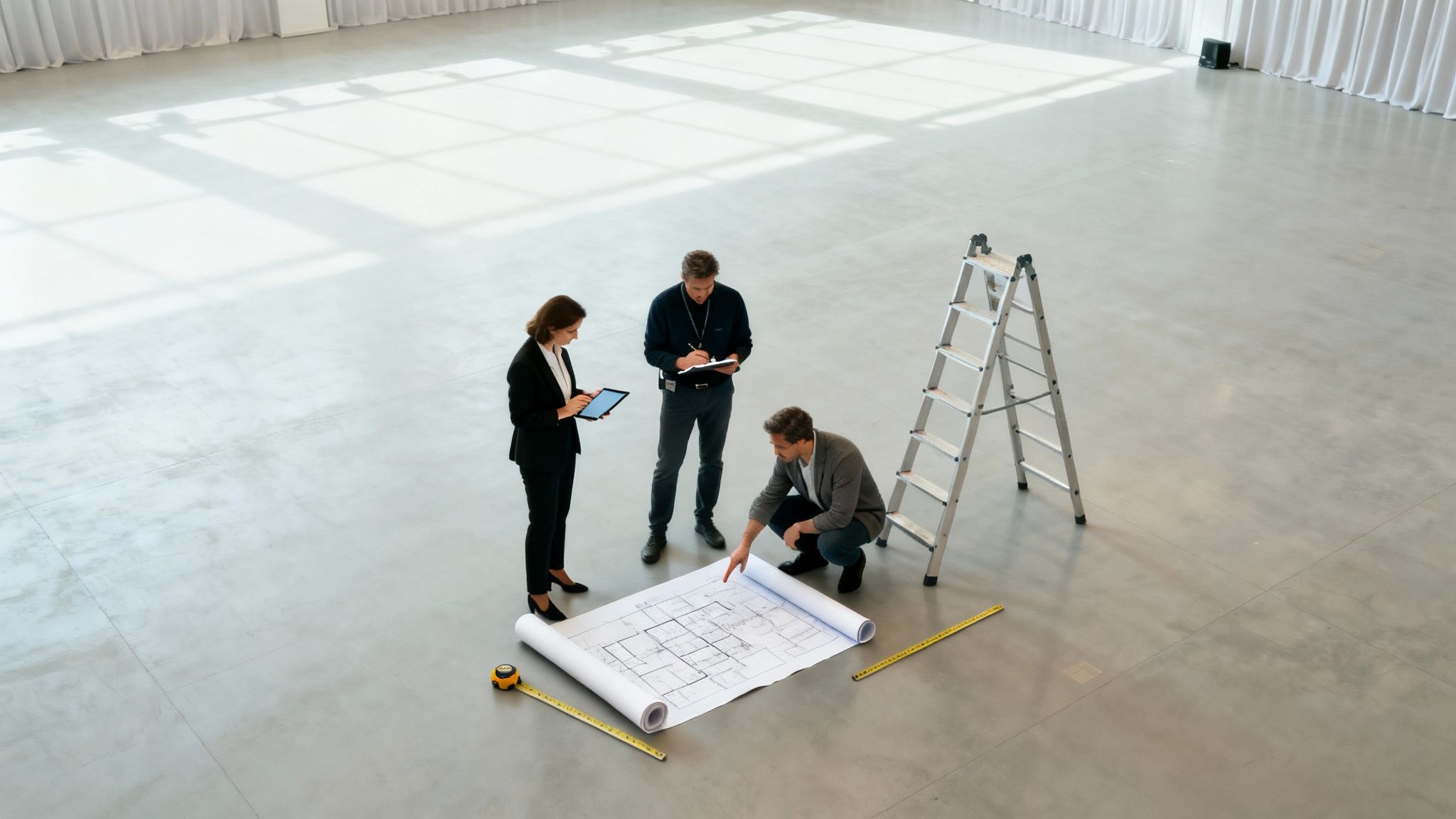
Think of the site survey as the bridge between a great idea and a flawless event. An architect would not design a building without first assessing the land, and a production team cannot map out an event without a true understanding of the space. This is not just a box-ticking exercise; it is the most important proactive problem-solving you will undertake in the entire event planning process.
This methodical inspection goes far beyond what can be seen in glossy brochures or on a 2D floor plan. It is about uncovering the practical realities of a venue, the small details that can make or break your audiovisual (AV) setup, staging, and the overall guest experience.
To provide a clearer picture, here is a quick summary of what a site survey involves.
Site Survey at a Glance
| Aspect | Description |
|---|---|
| Purpose | To verify that a venue is suitable for the technical requirements of an event. |
| Timing | Conducted after initial planning but well before finalising technical specifications. |
| Attendees | Typically includes the event planner, AV project manager, and a venue representative. |
| Focus | Assesses power, access, rigging points, room dimensions, and environmental factors. |
| Outcome | A detailed plan and report that confirms technical feasibility and identifies potential issues. |
This process ensures that by the time we reach the event day, we are working with known quantities, not guesswork.
The Blueprint for Technical Success
A professional site survey effectively creates your technical blueprint, making sure every single element is accounted for. It is a fact-finding mission designed to prevent expensive surprises and logistical challenges on the day.
This type of detailed preparation is standard in any industry where precision is key. A site survey in the UK is a formal on-site inspection to gather data before designing or installing complex systems. The construction sector, which made up 7.7% of UK economic output in 2024, relies heavily on these surveys to manage risk. Likewise, a standard commercial survey can record between 20 and 150 discrete data points, demonstrating the level of detail involved in this foundational work.
That same level of detail is essential for events. The survey confirms whether the creative vision is physically possible and, if not, what adjustments are needed to make it happen.
Beyond the Basics: What a Survey Really Uncovers
A floor plan provides dimensions, but a site survey reveals the details that truly matter. It is a deep dive that answers crucial questions you cannot get from a PDF.
Here are a few things we always look for:
- Practical Access: Can we get the equipment into the venue? We check if loading bays, lifts, and doorways are large enough for specific items like stage sections or large LED walls.
- Power Availability: We find all power sources and, more importantly, check if they can handle the high load from all the lighting, sound, and video equipment.
- Structural Integrity: Are there safe and suitable points in the ceiling to rig lighting trusses, speakers, or projectors? We need to know where they are and their load capacity.
- Environmental Factors: We assess things like bright ambient light from windows that could wash out projector screens, or acoustic issues such as echo and noise bleed from adjacent rooms.
Ultimately, a thorough site survey is the bedrock of effective conference production and live events. It replaces assumptions with hard facts, paving the way for a smooth, predictable, and successful event.
Why Site Surveys Are a Non-Negotiable Part of Event Planning
Deciding to skip a site survey is not a shortcut, it is a significant gamble with your event’s budget, reputation, and safety. When you proceed without one, you are essentially planning on a foundation of guesswork. In the world of live events, guesswork often leads to significant problems. A proper survey turns those potential issues into manageable planning points, making it one of the smartest investments you can make.
Imagine this: it is the morning of your conference, and you discover the main power supply cannot handle the lighting rig, plunging the room into darkness. Or perhaps the loading bay doors are just a few centimetres too narrow for the custom-built stage. These are the real-world scenarios that are entirely preventable.
Problems like these are not just inconvenient. They trigger a chain reaction of expensive, high-stress, on-the-day fixes that can compromise the quality of the entire production.
From Managing Risk to Saving Money
At its core, a site survey is about risk management. It is about identifying problems on paper weeks or months in advance, instead of scrambling to fix them in front of a live audience. The benefits of addressing these issues early are well-known across all technical fields.
Data shows that professional site surveys can reduce rework and last-minute change-order costs by 20–40% on complex projects. In the telecoms industry, for instance, field surveys reduce failed installations by up to 35%. When a single engineer visit can cost hundreds of pounds, those savings add up quickly. This is a clear, quantifiable reason why a survey is such a cost-effective way to manage risk. For a broader look at how these principles impact businesses across the UK, you can read the full business insights on ONS.gov.uk.
The same logic applies to events. Fixing a power issue on the day might mean hiring an emergency generator at a premium. Adjusting a stage set could involve paying for last-minute carpentry and extra crew. These unforeseen costs almost always dwarf the initial price of a thorough site visit.
A professional site survey shifts the conversation from "what if?" to "what's next?". It replaces uncertainty with a clear, actionable plan, ensuring that your creative vision is built on a solid technical foundation.
Protecting the Attendee Experience
Beyond the budget and logistics, the real victim of a poorly planned event is the attendee experience. Technical glitches that could have been easily avoided will derail the purpose of your event and leave a lasting negative impression.
Consider these common but critical failures:
- An Unreliable Livestream: The venue’s Wi-Fi may have looked fine on paper, but a proper survey would have uncovered dead zones and insufficient bandwidth to support your broadcast, leaving your online audience staring at a frozen screen.
- Poor Audio Quality: You might not have realised the venue had poor acoustics. A survey would have flagged excessive echo in a glass-walled room, allowing you to plan for acoustic draping or a different speaker setup.
- Serious Safety Hazards: Overlooking the need for cable ramps or discovering that a stage will block emergency exits are major compliance issues a survey would catch instantly.
Each of these issues directly harms how your audience perceives your event and, by extension, your brand. A site survey is your best tool for protecting the quality of the experience and ensuring the only surprises on the day are positive ones. It moves the discussion from questioning if a survey is needed to confirming when it should be booked.
Assembling Your Site Survey Team
A site survey is a collaborative effort, not a one-person task. It is a planning session where different experts bring their unique perspectives to the table. Getting the right people in the room is fundamental to making the visit worthwhile, ensuring every angle is covered and questions are answered on the spot.
This is not just about convenience; it is about preventing the last-minute miscommunications that can derail an event.
So, when is the best time to do it? The ideal window is after you have confirmed the basic event concept but before you have finalised any technical details. This timing is strategic. It allows the creative vision to lead, while retaining the flexibility to adjust the technical plan based on on-site findings.
Who Needs to Be There
A productive site survey relies on the input of a few key individuals. Each person views the space through a different lens, and their combined knowledge turns a simple walkthrough into a powerful planning session. It is about balancing creative ambition with practical feasibility.
The core team should always include:
- The Client or a Key Stakeholder: This is the person with the vision. They need to be present to see if the physical space aligns with their goals and to make final decisions if compromises are needed.
- The Event Manager: They focus on the big picture: guest flow, registration desks, catering stations, and the overall schedule. Their job is to ensure the technical plans integrate seamlessly with the rest of the event.
- The Venue Representative: This person is your inside source. They know the building's rules, quirks, and hidden potential better than anyone. They will have immediate answers on power availability, rigging points, loading bay access, and health and safety policies.
- The AV Project Manager or Technical Director: This is the technical expert from your production partner, such as London Audio Visual Hire. They assess the space to determine if it can physically and electrically support the planned sound, lighting, and video.
Knowing Your Role
Each person on this team has a specific job. The client is focused on the 'what' and 'why', while the rest of the team figures out the 'how'. This clear division of responsibilities guarantees a thorough assessment.
A site survey is where a theoretical plan meets the physical world. Having the right people present ensures that this meeting is a productive handshake, not a collision. It is the best opportunity to get everyone on the same page, literally.
For example, the client might picture where the main stage should go for the biggest audience impact. Simultaneously, the technical director is looking at the ceiling above that exact spot, checking for rigging points. Meanwhile, the venue manager points out that the proposed stage position would block a crucial fire exit.
It is this real-time, collaborative problem-solving that makes a site survey so valuable. It flags potential clashes between the creative vision, the venue's rules, and the technical requirements early on, giving the team a chance to find solutions together long before they become expensive problems on show day.
Your Essential AV Site Survey Checklist
A plan on paper is one thing, but an event's success is determined on-site. The site survey is where we bridge the gap between a brilliant idea and a flawless reality. It is about methodically transforming an empty space into a dynamic event environment, and that requires more than just a tape measure.
This is not just about ticking boxes. It is about asking the right questions that uncover potential issues long before they become last-minute, budget-breaking emergencies.
The entire process is a team effort, starting with the client's vision and bringing in the venue and technical teams to create a solid, workable plan.
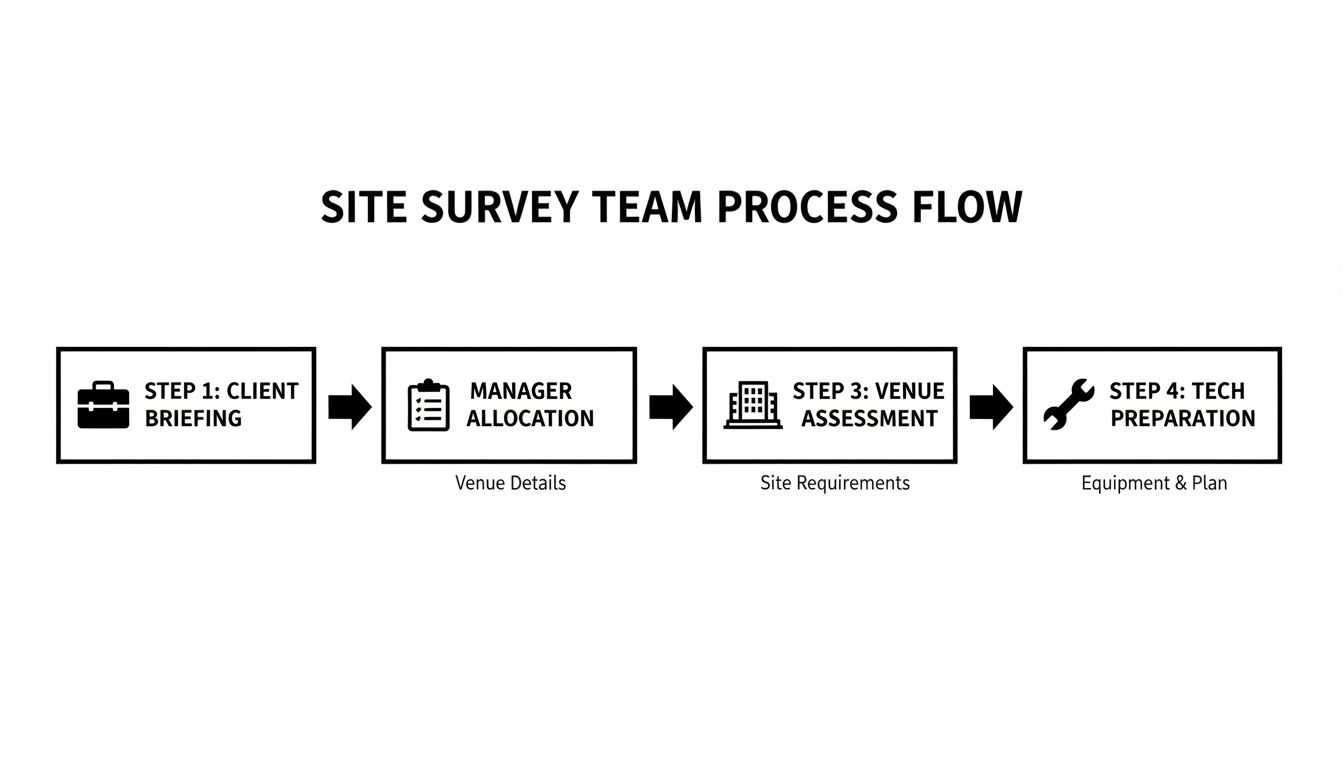
This flowchart shows how that collaboration works. Getting everyone on the same page from the beginning ensures the creative vision aligns perfectly with the practical reality of the venue.
To make this process as thorough as possible, we have put together a comprehensive checklist. Think of it as your roadmap to a technically sound event, covering everything from power outlets to emergency exits.
Critical AV Site Survey Checklist
This table breaks down the crucial areas we investigate during a site survey. Each point is designed to prevent common issues and ensure every piece of AV equipment performs exactly as it should on the day.
| Category | Key Checkpoints | Why It Matters |
|---|---|---|
| Access & Logistics | Loading bay locations, dimensions, and time restrictions. Route from loading bay to room (doorways, corridors, lifts). Lift size and weight capacity. | A miscalculation here can mean expensive equipment is stuck in a lorry. We need to guarantee a clear, safe path for every single flight case. |
| Power & Connectivity | Location and quantity of standard 13-amp sockets. Availability of high-load power (32-amp, 63-amp). Wi-Fi speed test and dead-zone check. Hard-wired data port locations. | Assuming there is "enough power" is a classic mistake. We need to map the electrical infrastructure to prevent tripped breakers or, worse, a total blackout. |
| Room & Environment | Precise room dimensions and clear ceiling height (to lowest point). Location and certified weight limits of rigging points. Amount of natural light and blackout options. Room acoustics (echo, reverb). | The room itself is part of the AV system. An echoey space can ruin a keynote, and uncontrolled sunlight can wash out a £20,000 projector screen. |
| Health & Safety | Clear, unobstructed emergency exits and routes. Planned routes for all major cable runs to prevent trip hazards. Weight capacity of the stage and any raised platforms. | This is non-negotiable. It is about protecting the crew, venue staff, and every single guest. A safe event is a successful event. |
By meticulously working through each of these categories, we can anticipate challenges and build a production plan that is both ambitious and achievable. It is this attention to detail that sets a professional production apart.
Deep Dive: Common Findings and Solutions
During a survey, we are not just measuring and ticking boxes; we are problem-solving in advance. Here is a closer look at what we are really looking for.
Access and Logistics
Before a single speaker is plugged in, we need a rock-solid plan for getting it into the building. A simple oversight here can throw the entire schedule into chaos.
We need to know: Where is the loading bay? Are there time or height restrictions? Is there enough space for a lorry to park and unload without blocking a busy London street?
From there, we trace the journey of the equipment. We measure every corridor, doorway, and tight corner. If the event is not on the ground floor, the lift becomes the most critical piece of the puzzle. What are its internal dimensions? More importantly, what is its maximum weight? An LED wall is just an expensive pile of metal if you cannot get it up to the ballroom.
Power and Connectivity
Modern events are power-hungry. Assuming a venue has "plenty of plugs" is one of the quickest ways to derail a production. A professional survey means getting forensic about the building's electrical and data infrastructure.
A site survey is not about finding problems; it is about finding solutions before they become emergencies. Discovering a venue's power limitations early gives us time to adapt the equipment list or bring in generators.
We map every single 13-amp socket to see if they are in useful locations for the stage or control desk. We identify heavy-duty power sources, such as 32-amp or 63-amp supplies, which are essential for large lighting rigs and PA systems. For connectivity, we do not just run a speed test; we walk the entire space to find Wi-Fi "dead zones" and confirm where we can get a hard-wired connection for something critical like a livestream encoder.
Room and Environment
Every room has its own character and its own challenges. The physical space directly affects how your audio and video will be perceived.
We take precise measurements of the room, especially the clear ceiling height to the lowest hanging chandelier or beam. We identify all available rigging points and, crucially, confirm their certified weight limits. You cannot just hang a tonne of lighting anywhere you choose.
We also look at ambient light. Is the room flooded with daylight? Are the blinds effective? Too much light will completely wash out a projector. Finally, we listen. A quick clap of the hands reveals a lot about the room's acoustics. A long, sharp echo in an empty room full of glass and hard floors means we might need to plan for drapes or more sophisticated audio equipment.
Health and Safety
Every decision we make is viewed through the uncompromising lens of health and safety. This protects our crew, the venue staff, and every one of your guests.
We ensure no staging, seating, or equipment will ever block a fire exit. We meticulously plan where every major cable will run, making sure we have enough ramps to cover any that cross a walkway and eliminate trip hazards. We always confirm the maximum weight capacity of the stage, ensuring it can safely handle all the people and equipment we plan to put on it.
Turning Potential Problems into Polished Solutions
A site survey is all about foresight. It is not just about spotting problems; it is about solving them weeks before they have a chance to become a last-minute panic on event day. A seasoned technical team does not see a potential issue as a roadblock. We see it as a known variable we can plan for with a clear, calm strategy. This is the real difference between a stressful, chaotic event and a smooth, controlled production.
Think of it as a walkthrough of what could go wrong, so you can make sure everything goes right. By getting ahead of common challenges, a good AV partner turns potential disasters into manageable parts of the plan, ensuring the entire event runs like clockwork.
Not Enough Power? Bring Your Own.
One of the most common issues we uncover is a venue’s power supply not being up to the task. An ambitious lighting rig or a powerful sound system requires a lot of electricity, often far more than the standard wall sockets in a hotel ballroom can provide.
-
The Problem: The dream AV specification requires more power than the venue's circuits can safely handle. Plugging it all in regardless is a recipe for tripped breakers, damaged equipment, or a total blackout mid-presentation.
-
The Proactive Solution: A site survey tells us exactly how much power is needed and how much is available. Instead of scaling back the creative vision, the answer is often to bring in our own power source. London Audio Visual Hire will calculate the precise load and arrange for a silenced, event-specification generator. A qualified electrician will handle the connection, guaranteeing a stable and safe supply for the entire event.
Suddenly, a show-stopping limitation becomes a simple logistical task. The technical ambition is met, and the risks are completely managed.
When the Door is Too Small
Another classic issue is discovering that getting equipment into the room is not as simple as the floor plan suggests. A beautiful listed building might have charmingly narrow corridors, a tiny service lift, or hairpin turns that make moving large items like stage decks or LED wall sections physically impossible.
-
The Problem: A key piece of equipment, like a large projection screen or a solid stage backdrop, literally will not fit through the door or up the stairs.
-
The Proactive Solution: Because we discovered this during the survey, we simply adapt the plan. Instead of one giant set piece, we will specify modular alternatives that can be built in the room. That single large backdrop becomes several smaller, manageable panels that are assembled on-site. This simple switch prevents a logistical nightmare on the morning of the build.
A site survey is where theoretical logistics meet physical reality. Discovering that a doorway is a few centimetres too narrow is not a disaster; it is a critical piece of data that informs a smarter, more practical plan.
Beating the Signal Blackspots
Solid communication for the production team is non-negotiable. But many venues, especially older buildings with thick stone walls or basement conference rooms, are notorious for poor mobile signal and patchy Wi-Fi. This can cripple communication between the show caller, stage manager, and the rest of the crew.
-
The Problem: The production crew is relying on mobile phones or the venue’s over-subscribed Wi-Fi for vital communications, but the signal is weak or non-existent backstage or at the control desk.
-
The Proactive Solution: During the site survey, we identify these dead zones. The fix is to set up our own dedicated, private Wi-Fi network just for the production team. By installing our own access points, we create a robust and secure communications bubble. This ensures everyone can communicate instantly, regardless of the venue’s own signal strength.
Each of these examples shows where the site survey proves its worth. It is an exercise in looking ahead, turning would-be emergencies into simple, pre-planned solutions that allow the event to be delivered with calm confidence.
Turning On-the-Ground Intelligence into a Watertight Event Plan
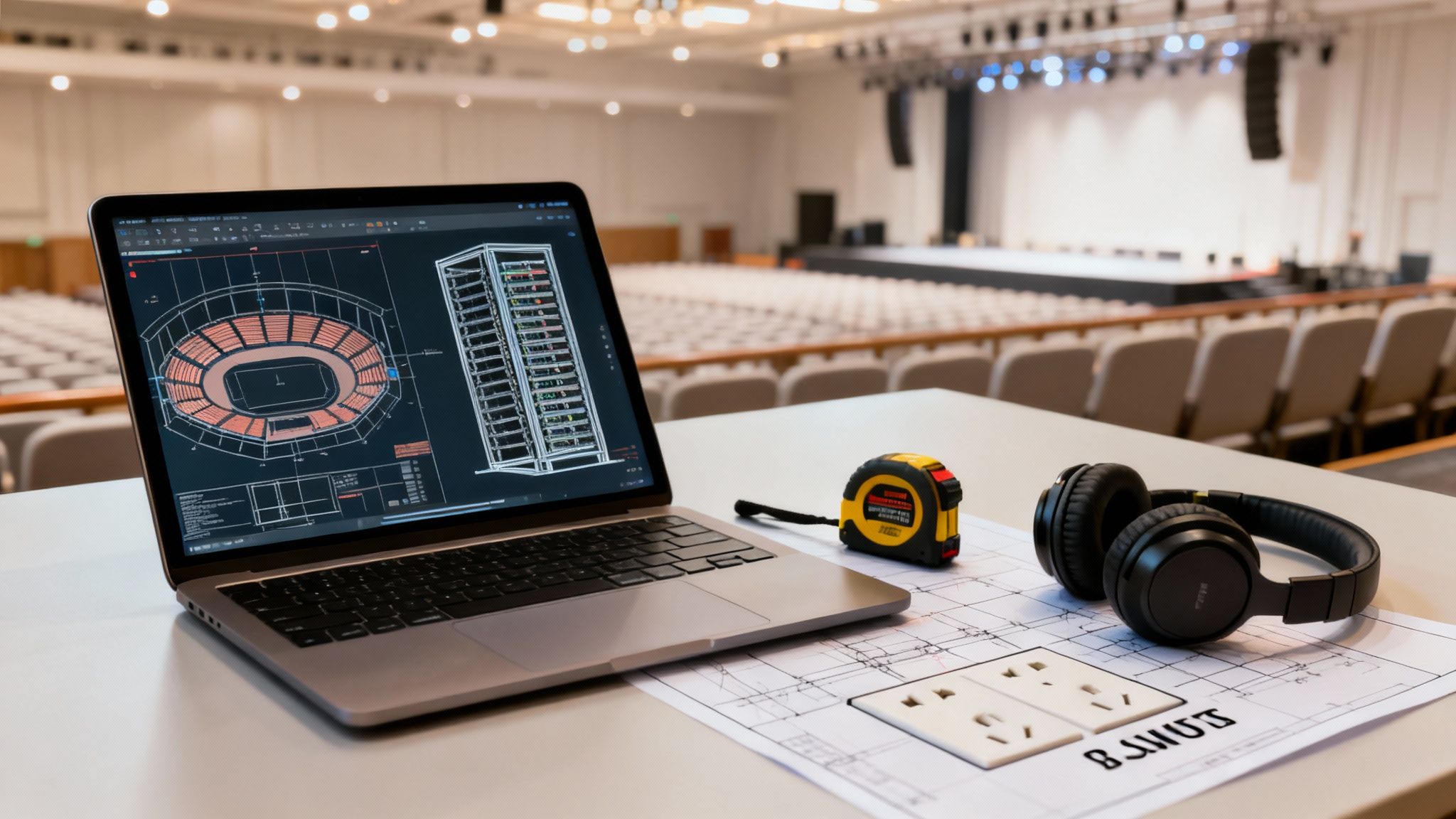
Once the laser measure is packed away and the team leaves the venue, the next crucial phase begins. A site survey is about gathering raw intelligence; the real value comes when we translate that data into a clear, actionable, and solid event plan. This is the point where rough notes and sketches evolve into the technical blueprint for your entire production.
For a professional AV team, this process is about systematically eliminating guesswork. Every finding from the survey is funnelled into a set of critical documents that create total clarity for you, the venue, and our crew on the ground. These deliverables are not just paperwork; they are the foundation for a seamless event.
What You Get After a Site Survey
After a comprehensive site survey, you should receive several key documents that crystallise all the findings. At London Audio Visual Hire, our process is built on transparency, ensuring you understand the 'why' behind every technical decision.
Here is what you can typically expect:
- A Detailed Survey Report: This is the master document. It summarises everything from power availability and loading bay access to acoustic quirks and rigging point locations. It confirms what is possible and, just as importantly, flags any potential hurdles with a ready-made solution.
- Precise Technical Drawings: Think of these as the architectural plans for your event's technology. Often created in CAD (computer-aided design), they show the exact placement of screens, speakers, lights, and staging, all perfectly to scale.
- Updated Floor Plans: We take the venue's standard floor plan and layer our technical setup over it. This shows exactly where cable runs will be, where the control desks will sit, and how backstage areas will be configured.
- A Finalised Quote: With all the unknowns removed, the initial quote can now be confirmed. Verified measurements and a confirmed equipment list mean no unwelcome surprises or last-minute cost additions.
From Measurements to Master Plans
The data we collect allows us to finalise the equipment list with absolute confidence. For instance, knowing the precise ceiling height and ambient light levels tells us exactly which projector and screen combination will deliver a punchy, vibrant image. This is vital for any presentation, but it is non-negotiable if you are planning high-quality hybrid streaming, where clarity is essential for your remote audience.
We also use our findings to map out detailed power and data distribution plans. These schematics are the unsung heroes of any event, showing where every single plug goes to ensure we do not overload a circuit. It is how we guarantee stable, reliable power and network connections for every piece of equipment.
The real output of a site survey is not just a report; it is a guarantee. It is the guarantee that the equipment will fit, the power will hold, and the entire plan is built on fact, not faith.
Finally, all this information is essential for producing the health and safety documentation. A robust Risk Assessment and Method Statement (RAMS) is impossible to write properly without the accurate, real-world knowledge gathered on-site. It is this methodical approach that builds a successful event from the ground up, resting on a bedrock of meticulous preparation.
Common Questions About Event Site Surveys
To wrap things up, let's tackle some of the questions we hear most often from event planners about the site survey process. Getting these answers straight should make it clear why this step is so crucial and help you confidently build it into your own planning.
How Long Does a Typical Site Survey Take?
This depends on the size and complexity of your event. If we are checking a single meeting room for a basic presentation, we could be finished within an hour.
However, for a large-scale event, such as mapping out an exhibition hall or an outdoor festival ground, it could easily take a full day or more. A professional AV team will never rush this part; we take whatever time is needed to measure, document, and test every detail. It is all about being thorough.
Do I Need a Survey If I Have Used the Venue Before?
Yes, absolutely. We always recommend it. Venues are constantly changing. Management teams get switched, power infrastructure might be upgraded, Wi-Fi systems get replaced, and even simple things like access policies can be revised without you knowing.
Besides, your event's technical needs are almost certainly different from the last time. Relying on old notes is a gamble you do not need to take. A fresh survey ensures every decision is based on current, accurate information that is specific to this event.
Can a Virtual Tour Replace a Physical Site Survey?
Virtual tours and 3D walkthroughs are brilliant for shortlisting potential venues from your desk. But when it comes to planning the technical production for an event, they are not a substitute for a physical, on-the-ground inspection.
A technician on-site can do what a virtual tour cannot: physically test a power outlet, run a real-world internet speed test, listen to the room's acoustics, and spot hundreds of other small details that are impossible to see on a screen. For professional-grade events, there is a reason a physical visit is the industry standard.
What Does a Site Survey Cost?
The cost can vary. Some AV companies might charge a separate fee for the survey. For our production clients at London Audio Visual Hire, the site survey is a core part of the project, so its cost is simply built into the overall quote.
The best way to think of it is as an investment in de-risking your event. The small outlay for a proper survey is nothing compared to the potential cost and reputational damage of a major technical failure on the day.
A thorough site survey is the bedrock of a flawlessly executed event. At London Audio Visual Hire, our detailed planning process ensures every technical aspect is managed proactively, giving you complete peace of mind. Find out how our expert team can support your next event by visiting us at https://londonaudiovisualhire.co.uk.


