

When you hire a sound system for an event, you are not just renting speakers and microphones; you are ensuring every word and every note lands exactly as intended. The secret is not about getting the loudest or most expensive kit. It is about finding the right system for your specific venue, audience, and the day's programme. Get that right, and your event will be a success.
Your Essential Sound System Rental Framework
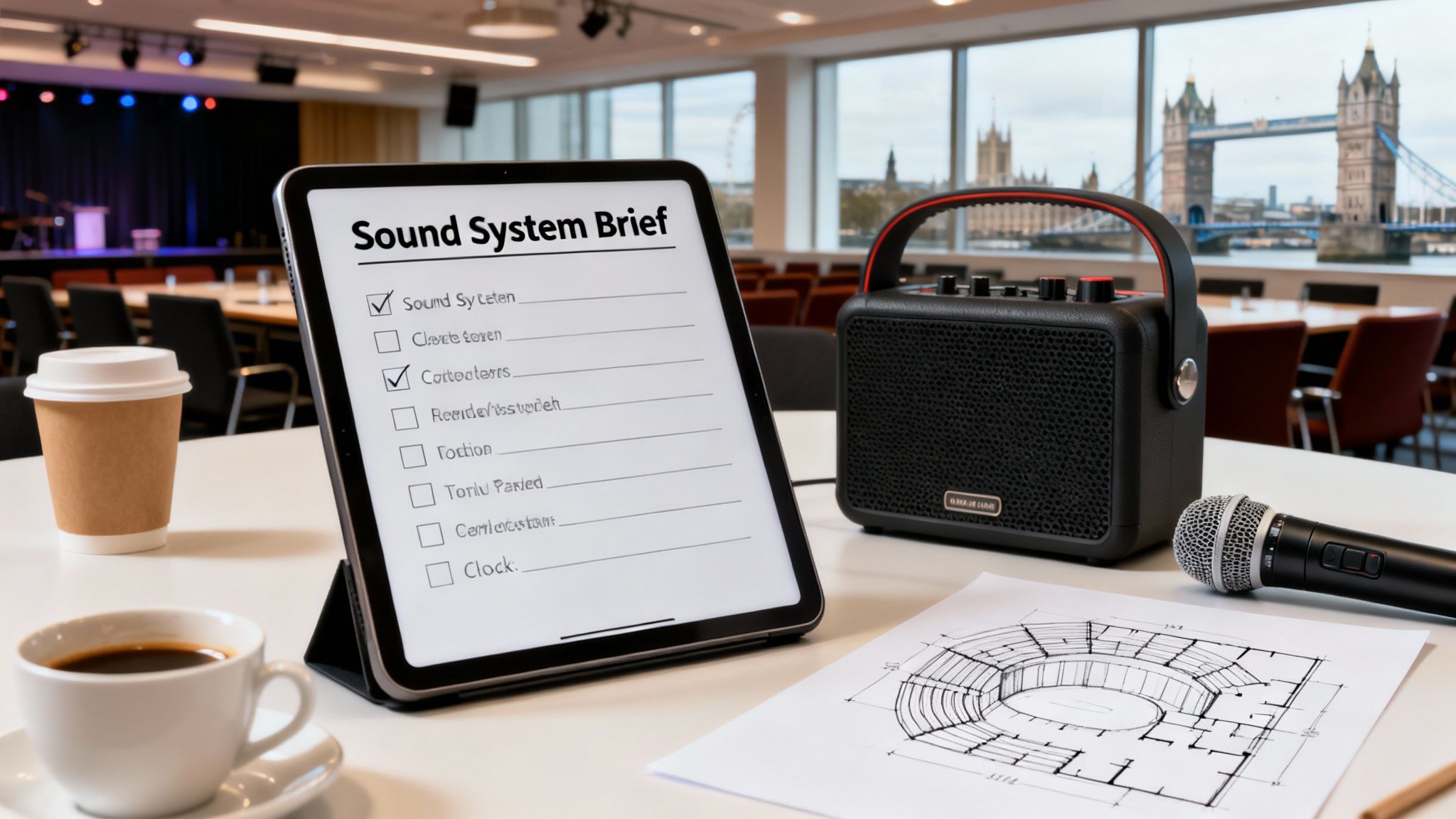
Delivering a flawless corporate event in London means getting every detail right, and the audio is non-negotiable. Great sound feels effortless and professional, while poor sound can instantly derail an otherwise perfect event, leaving guests frustrated. To guarantee clarity and reliability, you need a plan.
This framework is your playbook. It is designed for event planners and agencies who need to navigate sound system hire with confidence. We will avoid technical jargon and focus on the strategic thinking that ensures success long before you contact a supplier.
Building Your Audio Brief
First, you need to create a comprehensive audio brief. Think of this as the foundation for every conversation you will have with an AV partner. It is not a technical specification sheet; it is a clear, concise summary of what you need to achieve.
A solid brief should always cover:
- The Event Programme: Lay out a detailed schedule. Note every moment that needs audio, from the CEO's opening remarks and panel Q&As to video clips and background music during networking breaks.
- Venue Details: Be specific. Include the venue's name and address, room names, and approximate dimensions. Do not forget to mention any potential acoustic challenges you have noticed, such as high ceilings or large glass surfaces.
- Audience Size: An accurate estimate of your guest count is crucial. This directly determines the power and coverage needed to fill the space without deafening those in the front row.
- Presenter Requirements: How many people will be speaking? What are their roles? You will need to know if they prefer traditional handheld microphones for a dynamic presentation or discreet lapel microphones for a hands-free panel discussion.
Your brief is the single most powerful tool you have. A detailed brief eliminates guesswork, aligns expectations, and empowers your AV partner to design a precise, effective solution from the start.
To help you get started, here's a table summarising the key variables to establish in your planning.
Key Factors for Your Sound System Rental
| Consideration | Why It Matters for Your Event |
|---|---|
| Event Programme | Determines the number and type of microphones, inputs for laptops/videos, and transitions needed. |
| Venue Layout & Acoustics | Impacts speaker placement, potential for sound delays, and the need for acoustic treatment. |
| Audience Size & Seating | Dictates the power (wattage) and number of speakers required for even sound coverage. |
| Presenter Needs | Informs microphone selection (lapel, handheld, lectern) to match the presentation style. |
| Venue Access & Power | Crucial for scheduling setup, soundchecks, and ensuring equipment can be powered safely. |
| On-Site Technician | Essential for live mixing, troubleshooting, and ensuring smooth audio throughout the event. |
Mapping these points will make your conversations with suppliers far more productive.
Core Logistical Considerations
Beyond what is happening on stage, the practical logistics are just as important. These details directly affect the equipment choice, the number of crew needed, and, ultimately, the cost. Any professional supplier will run through these with you, but being prepared is always a good move.
Be ready to answer questions like:
- Venue Access Times: What is the earliest the tech team can get in to start setting up and running soundchecks?
- Power Availability: Are there enough standard 13A sockets in the right places? Are they dedicated, or will they be shared with catering or lighting?
- Staffing Needs: Will you need a dedicated sound engineer on-site to manage the audio live? For almost any corporate event with multiple speakers or cues, the answer should be a firm yes.
By thinking through these core components, you will walk into any supplier conversation with a clear, professional brief. This preparatory work ensures you get accurate quotes and a solution that is genuinely right for your event. If you want to get a feel for the types of speakers, mixers, and microphones involved, you can browse through a range of audio visual equipment hire options available here in London.
Defining Your Event's Audio Needs
Before you think about speakers and microphones, let us talk about what you need the sound to do. A great sound system is not about having the most advanced kit; it is about making sure your message is heard, loud and clear. The first step is always a practical assessment of your venue, your audience, and the day's agenda.
Getting this brief right from the start is crucial. It means a professional supplier, like our team at London Audio Visual Hire, can put together a quote for exactly what you need. This clarity saves you from spending the budget on equipment you do not need or, even worse, ending up with a system that cannot handle the job.
Understanding Your Venue's Acoustics
London has a diverse mix of venues. You could be in a purpose-built conference centre one day and a historic, echo-prone hall the next. The space itself will dictate much of your audio setup, so you need to have a good look around.
A room's shape, size, and even the materials on the walls and floors all play a massive part in how sound travels. Keep an eye out for these common acoustic challenges:
- High Ceilings: Warehouses, atriums, and old Victorian halls look incredible, but all that empty space can create a huge amount of echo (reverberation). This can make speech sound muddy and indistinct.
- Reflective Surfaces: Think of large glass windows, polished concrete floors, or long, flat walls. These act like mirrors for sound, bouncing it all over the place and making it hard to focus on what is being said.
- Awkward Shapes: L-shaped rooms or spaces dotted with pillars are notorious for creating 'dead spots' where you can barely hear a thing.
A good example is the difference between a conference in a glass-walled room at The Shard versus a gala dinner in a classic Livery Hall. The first needs speakers aimed with pinpoint precision to avoid bouncing sound off the glass. The second might need a series of smaller, distributed speakers to make sure the sound reaches every corner of the room evenly.
Walking Through Your Event's "Audio Journey"
Now, put yourself in your guests' shoes. Think through the entire event from their perspective, from the moment they walk in to when they leave. Every stage will have a different audio requirement.
I always recommend mapping this out as a simple timeline. This 'audio journey' becomes the blueprint for your technical brief.
- Arrivals & Networking: What is the first thing people hear? Usually, it is some low-key background music to set the mood and fill the silence.
- The Main Programme: This is the key part. List every speaker, presentation, video clip, and panel discussion. How many microphones will you need live at any one time?
- Breaks & Transitions: Do you need music for the coffee break? What about short audio clips—we call them 'stings'—to introduce a new speaker or announce an award?
- Q&A Sessions: How will the audience ask questions? You will almost certainly need a couple of handheld wireless microphones for your team to pass around the room.
Thinking in terms of an 'audio journey' changes the conversation. It is no longer just "we need speakers," but "we need to create a seamless, professional audio experience for our guests at every point."
This simple exercise ensures nothing gets missed. It gives your AV partner all the information they need to specify the right mixing desk, the correct number of microphones, and the necessary playback sources.
Sizing Up the System for Your Audience
It sounds obvious, but the number of people in the room directly impacts the power and scale of the PA system you will need. The goal is always the same: comfortable, clear sound for every single person, whether they are in the front row or right at the back.
A small workshop for 50 people in a hotel meeting room can work perfectly with a couple of well-placed speakers. But a conference for 500 people in a large exhibition hall is a different beast entirely. You will likely be looking at a more complex 'line array' system or multiple 'delay' speakers placed down the length of the room to reinforce the sound so it does not fade out.
This is where the UK's event industry really shines. The demand for high-quality audio is huge. In fact, the audio equipment rental market here is valued at around USD 739.5 million, with speakers making up the biggest segment. As this UK audio rental market analysis shows, event planners prioritise getting the PA system right above almost anything else.
By taking the time to define these three key areas—your venue, your programme, and your audience—you are not just renting equipment. You are building a comprehensive brief that allows an experienced supplier to deliver a solution that is perfectly tuned to your event.
Choosing the Right Sound System for Your London Venue
You have got your event brief sorted. Now for the next part: picking the equipment that will make your event sound incredible. This is not about becoming a sound engineer overnight. It is simply about matching the right tools to the job to make sure every attendee—from the front row to the back of the room—hears everything perfectly, whether it is a critical keynote or just some background music during a drinks reception.
At its core, any event sound system has three main parts: the loudspeakers that project the sound, the microphones that capture it, and the mixing desk that acts as the central hub. Understanding what each one does is the first step to a successful sound system rental.
To make things a bit clearer from the outset, here is a simple way to think about your initial choices.
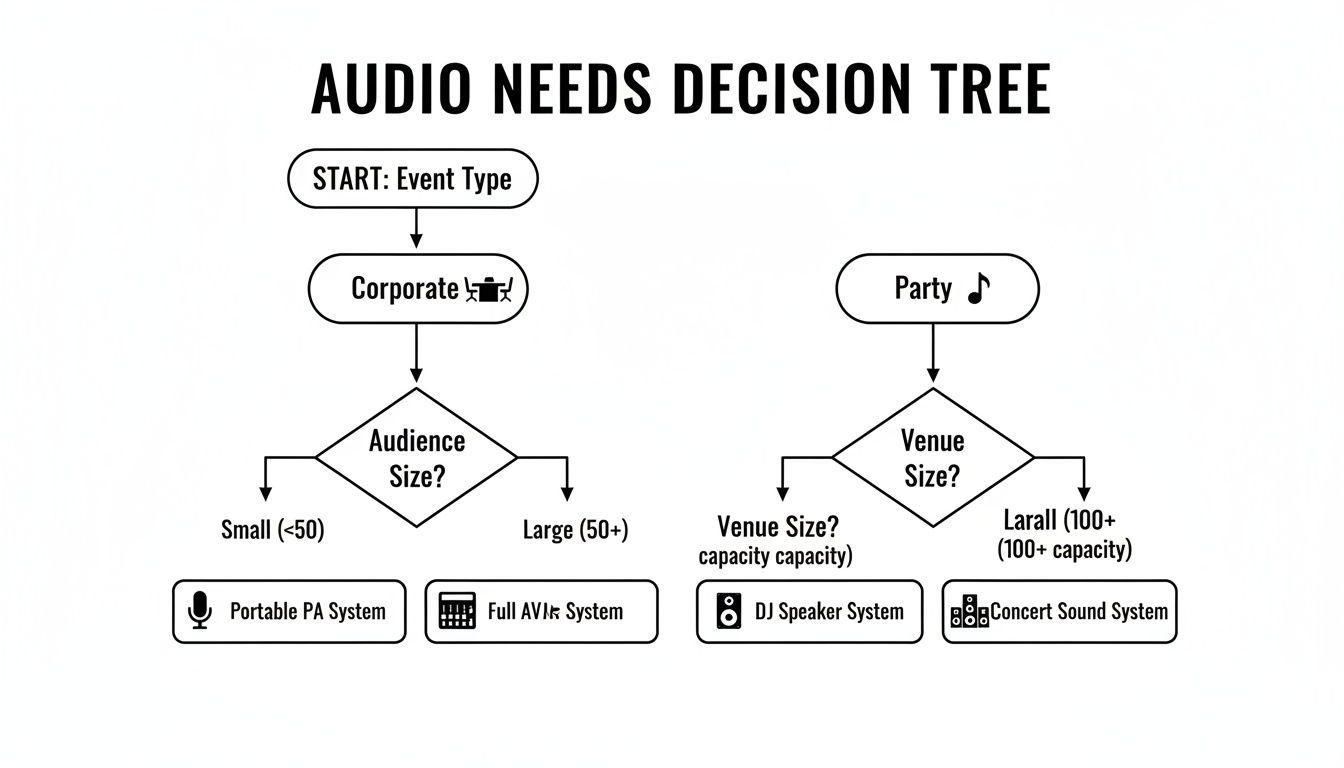
As you can see, for corporate events, it is mostly about the number of people in the room. For private parties and functions, the size and shape of the venue itself often play a bigger role in deciding what kit you will need.
Matching Loudspeakers to the Space
Speakers are usually the most obvious piece of audio equipment you will see, and your choice here is dictated almost entirely by the venue and your audience size. There is really no 'one-size-fits-all' option.
-
Point-Source Speakers: Think of these as your classic 'box' speakers. They are brilliant for smaller to medium-sized rooms, breakout sessions, or for filling in any awkward corners in a larger setup. For a conference of up to 150 people in a typical London hotel ballroom, a good pair of point-source speakers will usually do the job perfectly.
-
Line Array Systems: If you are dealing with a large crowd (anything over 250-300 people) or a venue with tricky acoustics like an exhibition hall, a line array is the professional standard. You have seen them—the curved stacks of speakers hanging at concerts. They deliver incredibly controlled sound over long distances, which means the people at the back hear just as clearly as those at the front.
-
Column Speakers: These are your secret weapon when aesthetics really matter. For a stylish gala dinner or a brand launch in a high-end venue, these slim, discreet speakers blend in beautifully. They push sound out widely across a room, giving you even coverage without big, bulky boxes getting in the way.
Imagine a multi-room trade show at the ExCeL Centre. The main stage will almost certainly need a line array for the big presentations, but the smaller seminar rooms can get by with simple point-source pairs. This kind of bespoke approach gives you the best sound quality where it counts, without overspending on the budget.
Selecting the Right Microphones
The microphone is where your audio journey begins, and the one you pick really depends on who is speaking and how they are presenting.
A classic mistake is thinking any microphone will do. A lapel microphone is fantastic for a hands-free panel discussion, but it can be a nightmare if the presenter is wearing a necklace that clinks or a rustly jacket.
Here is a quick rundown of your main options:
-
Handheld Wireless Microphones: These are the workhorses of the corporate event world. The sound quality is excellent, and they are ideal for passing around during a Q&A or for presenters who like to move about the stage.
-
Lapel (Lavalier) Microphones: Tiny, discreet, and clipped onto clothing. They are perfect for panellists or anyone who needs their hands free for a product demo. They just need to be placed carefully to avoid picking up the sound of clothes rustling.
-
Lectern (Gooseneck) Microphones: These are fixed to the lectern and provide consistent, high-quality sound for more formal speeches. They are a solid, reliable choice for awards ceremonies or keynotes where the speaker is not going to be moving around.
Here is a professional tip: it is not just about the type of microphone, but managing its wireless frequency. Any competent technician from a company like London Audio Visual Hire will run a frequency scan on-site. This stops your event's audio from being interrupted by interference from other wireless systems in the venue.
The Role of the Mixing Desk and Technician
The mixing desk is the brain of the entire operation. Every sound source—microphones, laptops for video playback, background music—is plugged into it. This is where the audio technician works their magic, balancing levels and adjusting the sound to suit the room.
For a simple talk with just one microphone, a small analogue mixer might be all you need. But for a conference with a panel of six, video clips, and music cues, you will need a digital mixing desk. This lets the technician save different audio 'scenes', switch between sources smoothly, and resolve any problems in an instant.
This is precisely why a skilled audio technician is not a luxury—they are an essential part of your sound system rental. They make all the small, real-time adjustments that your audience never notices but which are vital for a polished, professional event. You can get a fuller picture of all the components involved by reading our guide that explains what audio visual equipment is.
The UK's bustling events scene, especially in London, fuels a massive demand for professional AV services. The global audio-visual equipment rental market is forecast to hit around USD 38.2 billion in 2025 and is expected to grow to USD 76.3 billion by 2034. The UK is a huge player in this, thanks to our packed calendar of corporate events and early adoption of new technology. You can explore more projections about the AV equipment rental market on Oganalysis.com.
Budgeting and Logistics for Your Sound System Hire
Let us talk about the two things that can make or break any event: money and logistics. Getting the sound right is a crucial investment, but you need to know exactly where your money is going and have a solid plan for getting the equipment into the venue and working perfectly.
Getting this right is not just about avoiding a last-minute budget panic; it is about ensuring a smooth, stress-free setup on the day. From understanding what a quote truly means to figuring out venue access, every detail counts.
Breaking Down Your Sound System Quote
When a quote from an AV company like London Audio Visual Hire lands in your inbox, it is tempting to just scan for the total at the bottom. Resist that urge. A proper quote is a transparent breakdown of everything you are paying for, and understanding it is key to spotting value and avoiding hidden costs.
A professional quote should always detail these core components:
- Equipment Hire: This is the line-by-line cost for every piece of equipment. It covers the big items like the PA speakers and mixing desk, right down to the individual wireless microphones and stands.
- Technician Labour: You are not just hiring equipment; you are hiring expertise. This covers the skilled professionals who deliver, set up, operate, and pack down the system, usually billed in day or half-day rates.
- Transport & Delivery: This is the real-world cost of getting bulky, sensitive equipment across London. It factors in fuel, van hire, and often, the Congestion Charge.
- Insurance: A non-negotiable. This must include Public Liability Insurance, which any professional venue will demand before a supplier sets foot on site.
When you can see how it all adds up, you can ask smarter questions and make sure the solution is a perfect fit for your brief.
A Real-World Budget: London Conference Example
So, what does this look like in practice? Let us imagine a classic scenario: a one-day corporate conference for 200 delegates in a central London hotel. You need a main PA system, a microphone on the lectern, four lapel microphones for a panel discussion, and a couple of handheld microphones for the audience Q&A.
For an event of this size and specification, you should realistically budget between £900 and £1,500 + VAT.
This kind of figure is not just for the equipment. It should cover delivery and collection within London, and crucially, an experienced sound engineer on-site for the whole event to make sure everything runs without a hitch.
Think of this as a solid starting point for your budget. The final price can shift depending on the specific venue, how complex the schedule is, or if you need extras like audio recording or systems for breakout rooms.
The Make-or-Break Logistical Plan
A budget is one thing, but the on-the-ground practicalities are where a good plan becomes a great one. These are the details you must sort out with both your AV partner and the venue well in advance.
Get these points locked down early:
- Venue Access: When can the crew actually get in? Setting up and sound-checking a conference system properly is not a five-minute job. It usually takes at least two to three hours before your guests start arriving.
- Power: Where are the sockets? Professional audio equipment typically runs on standard 13A mains, but it is vital to ensure they are dedicated sockets, not sharing a circuit with power-hungry coffee machines or lighting rigs.
- Loading & Parking: Is there a proper loading bay? What about parking for the van? Are there any height restrictions they need to know about? These are the questions that prevent chaos on the event morning.
- Health & Safety: Your AV supplier must provide risk assessments and method statements (RAMS) if the venue asks for them. They will also be responsible for ensuring every cable is neatly taped down to prevent any trip hazards.
For event organisers here in the UK, the rent-versus-buy debate is pretty much settled. Audio technology moves so fast, with trends like networked audio and integrated systems constantly evolving, that owning equipment is a risky investment. Renting gives you access to the latest, perfectly maintained equipment for every event without the hefty capital expense. It is a view backed by industry analysis, which you can explore further by reading into the UK audio equipment market on ibisworld.com. This smart approach ensures you always have the best possible sound, tailored for that specific room and that specific day.
Making it Happen on the Day
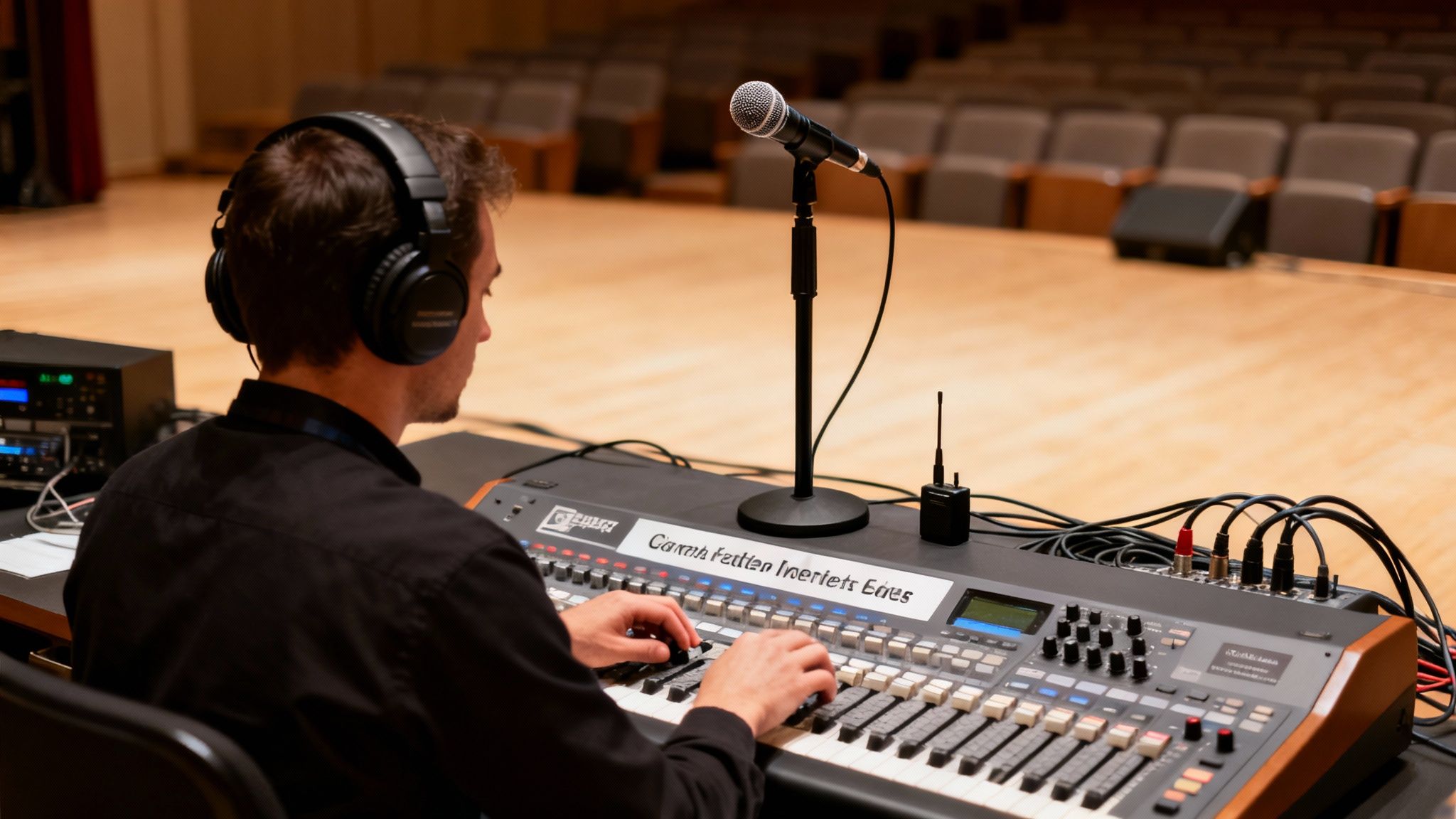
All the careful planning boils down to this: the day of the event. This is where a professional AV team really shows their value, taking a pile of black boxes and cables and turning it into a seamless audio experience. A cool, methodical approach during the setup and the live show is what separates a great event from a good one.
Your job is not to be a sound engineer, but to be the bridge. You are the key link between your client, your presenters, and the technical crew. If you understand what is happening behind the scenes, you can stay ahead of any potential issues and get them sorted long before they become a problem for the audience.
The All-Important Setup and Soundcheck
That quiet period before the doors open is invaluable for the audio team. It is when the technicians get to work, meticulously rigging, testing, and tuning the entire system to suit the unique acoustics of your venue. The best thing you can do for them is give them the time and space they need to do their job properly.
A proper soundcheck is far more than just tapping a microphone and asking, "Is this thing on?". It is a detailed process.
- Tuning the Room: The engineer will play test tones (and probably a bit of their favourite music) through the speakers. They are listening for any strange echoes or frequencies the room creates, then using an equaliser to flatten them out. This is what makes speech sound crisp and clear, not muddy.
- Assigning Microphones: Every single wireless microphone is assigned to a specific presenter and thoroughly tested. This is your chance to double-check who gets which microphone, make sure lapels are fitted neatly, and confirm handhelds have fresh batteries.
- Checking Playback: Any laptops for video clips, music players for walk-in tracks, or other audio sources are plugged in and their volume levels are set. This simple step prevents those awkward, jarring jumps in volume when a video suddenly starts playing.
A classic rookie mistake is scheduling presenter rehearsals during the initial technical setup. Always let the sound crew finish their checks first. That way, when your speakers get on stage, they are hearing the final, polished sound, which makes for a much more confident and useful rehearsal.
Dealing with Common On-Site Issues
Even with the best plan, live events can throw up challenges. The good news is that experienced audio technicians have seen it all before and know exactly how to handle the usual problems. Knowing what these are helps you communicate what is wrong if something does happen.
The two most common culprits are audio feedback and radio frequency (RF) interference.
Audio Feedback is that painful, high-pitched squeal you sometimes hear. It is a loop created when a microphone picks up the sound from the speaker it is amplifying. A professional technician stops this by:
- Cleverly placing speakers so they are not pointing directly at microphone hotspots.
- Using an equaliser to surgically cut the specific frequency that is causing the squeal.
- Briefing presenters on "no-go zones", such as walking directly in front of a PA speaker with their microphone switched on.
RF Interference is the reason a wireless microphone might crackle, hiss, or drop out completely. It is usually caused by other wireless equipment nearby. Before the show, a technician will perform a frequency scan of the room to find a clean, open channel for each of your microphones, locking it in to avoid any nasty surprises.
Of course, technical setup is only one part of the picture. The overall safety of the space is crucial. Following some best practices for securing your venue during events is always a smart move to protect your guests and all that expensive equipment.
Your Simple On-the-Day Troubleshooting Guide
While the technician is there to fix any major issues, you can be a massive help by spotting small problems and describing them clearly. If you hear something off, discreetly get the technician's attention and give them simple, factual information.
- Instead of "the sound is weird," try "The lectern microphone sounds a bit muffled." This tells them exactly which channel to check.
- Instead of "a microphone is broken," try "I can hear a crackle from the panellist on the far right." This pinpoints the specific wireless pack that might be the issue.
- "The audio on that video clip is much louder than the presenters." This is a very quick level adjustment they can fix in a second.
This kind of clear, calm communication helps the technical team work their magic without causing a fuss. It is this partnership on the day that guarantees your audio runs without a hitch, whether your audience is entirely in the room or joining from all over the world.
Your Sound System Hire Questions Answered
When you are juggling all the moving parts of a corporate event in London, audio hire can seem like a minefield of technical jargon. Over the years, we have found that the same questions tend to pop up. Here are some straightforward answers, based on our real-world experience, to help you feel confident in your decisions.
How Far in Advance Should I Book?
This is a very common question. For a standard corporate event, such as a conference or an awards dinner, you will want to get your AV provider confirmed at least four to six weeks out. That gives everyone enough time for a proper discussion about your needs, maybe a site visit, and crucially, it ensures the right equipment is actually available for your date.
However, London has its busy seasons. If you are planning an event during the summer rush or the Christmas party period, you need to think further ahead. For larger, more complex events, like a multi-day conference or a flagship product launch, I would strongly recommend booking three to six months in advance. It is the only way to guarantee you get the best specialist equipment and the most experienced technicians.
Do I Really Need a Technician on Site?
For anything more than a single microphone and a bit of background music, the answer is a resounding yes. Think of a technician as your audio insurance policy. They are not just there to press play; they are actively managing the sound throughout your event to make sure it is perfect.
Here is what they are actually doing:
- Live Mixing: They are constantly adjusting the levels for every microphone, video, and music cue. This is what makes the sound smooth, clear, and professional, rather than jarring or uneven.
- Troubleshooting: That sudden buzz from a speaker? A microphone that cuts out? They fix it, often before anyone in the audience even knows something was wrong.
- Speaker Management: They will get your presenters properly fitted with their microphones, do a quick soundcheck, and make sure they are comfortable before they step on stage.
A dedicated technician is what separates a dry hire of equipment from a fully managed, professional service. It frees you up to focus on your guests and your schedule, knowing the audio is in safe hands.
What Is the Situation with Insurance?
Any reputable AV company will have its own insurance sorted. The absolute must-have is Public Liability Insurance. Pretty much every venue in London will demand to see a certificate for it. This is what covers injury to people or damage to the venue that could be caused by the AV equipment or the crew.
You should always check that your supplier has a decent level of cover, with £5 million being a standard minimum. We carry full Public Liability and Employers' Liability insurance here at London Audio Visual Hire, and we are used to sending the certificates straight over to venues. It is a simple step that protects everyone and keeps you compliant.
Can You Handle Tricky or Unfamiliar Venues?
Of course. That is a huge part of the job. London is full of incredible, but often challenging, spaces. We have set up systems in everything from historic, listed buildings with echoey halls to modern, glass-walled skyscrapers. If it is a venue we have not worked in before, we will almost always arrange a site visit.
During that visit, our project manager is looking at a few key things:
- The room’s natural acoustics.
- Where we can get power and how we will run cables.
- Loading bay access and the best route for bringing in heavy equipment.
- Any potential radio interference that could affect wireless microphones.
This preparation means that on the day of the event, we turn up with a plan that is tailored to the space. It is all about finding solutions and delivering great sound, no matter where we are. That is what a professional sound system rental service is all about.
At London Audio Visual Hire, we live and breathe this work. Our whole approach is built on meticulous planning and providing calm, expert support when it matters most. If you are organising an event in London, our team is here to help you get the audio just right. Find out more about our services at https://londonaudiovisualhire.co.uk.


