
Great audio is the secret ingredient to an unforgettable event, but it is often overlooked. When running a professional event in London, you cannot afford to have your message garbled by poor acoustics or a crackling microphone. A quality sound system rental ensures every word, from the keynote's main idea to the final thank you, is delivered perfectly.
Why Professional Sound System Rental Is Essential
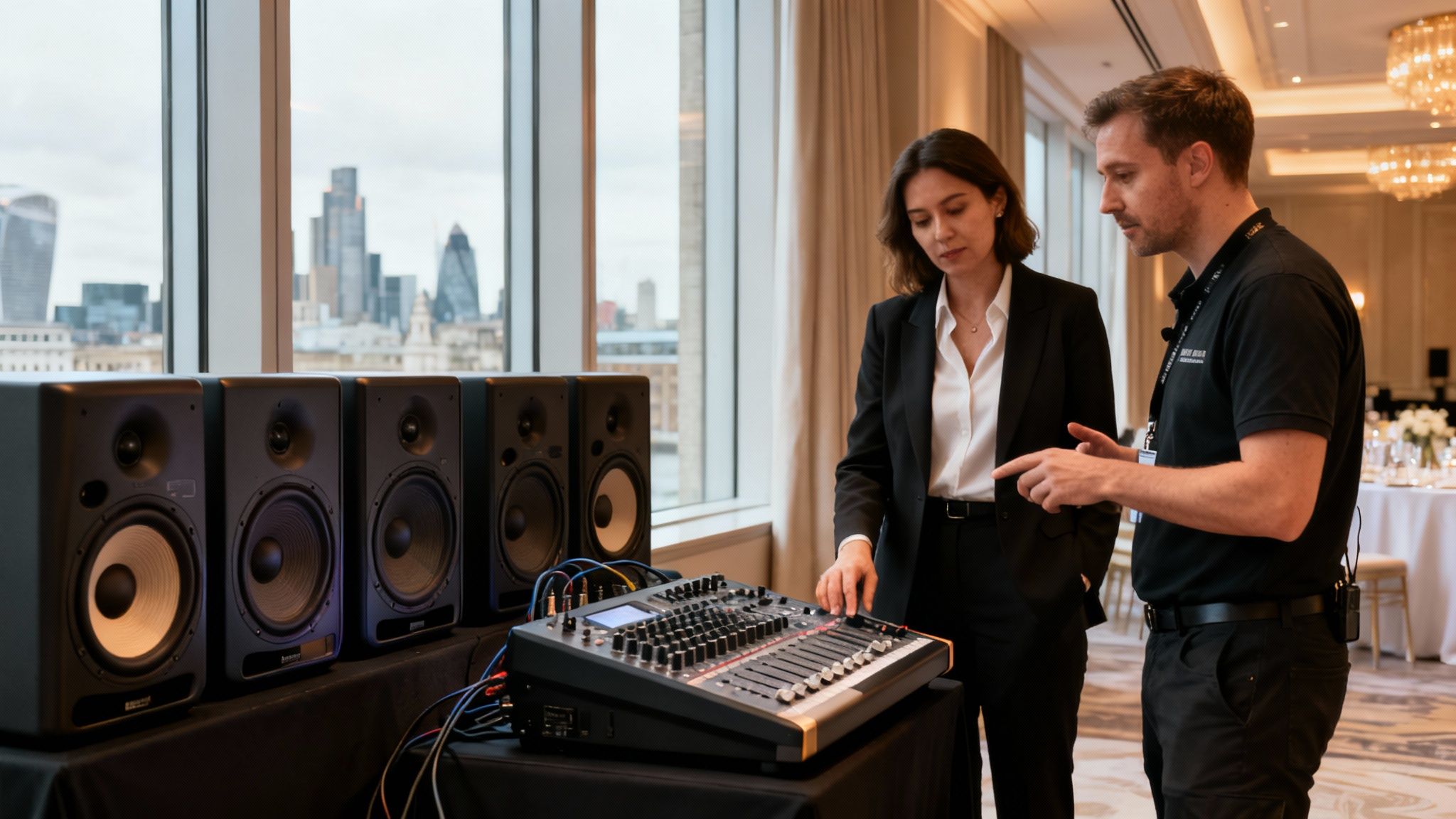
Whether you are staging a high-stakes brand launch or an elegant awards gala, the outcome depends on crystal-clear sound. While buying equipment may seem like a smart long-term investment, for most event planners, hiring a professional system is more practical. It offers better value, flexibility and, most importantly, peace of mind.
Renting gives you access to high-calibre, bespoke audio setups that are perfectly matched to your event. It sidesteps the significant cost of purchasing, not to mention the ongoing challenges of storage and maintenance. The primary benefit, however, is gaining an expert partner who ensures every speaker, cable and mixer is selected for a specific purpose.
Tailored Solutions for Every Scenario
When it comes to event audio, there is no "one size fits all" solution. A professional hire company will not just deliver equipment; they will assess the details of your event to design a system that works for the space. This approach helps avoid common problems like audio dead spots, screeching feedback or an underpowered system.
They will build your setup based on key factors:
- Audience Size: The expected number of attendees directly impacts the power and quantity of speakers required to ensure everyone hears clearly, from the front row to the back.
- Venue Acoustics: A historic hall with high ceilings and stone walls presents different challenges from a modern, acoustically treated conference centre. The audio strategy must be adapted accordingly.
- Content Type: The equipment needed for a single speaker at a lectern is very different from that required for a lively panel discussion or a musical performance.
When you partner with a specialist like London Audio Visual Hire, you get more than just equipment. You receive a meticulously planned audio solution that guarantees your message is delivered with clarity and impact.
Breaking Down a Modern PA System
You do not need to be a sound engineer to hire the right PA system, but understanding the basics makes discussions with a supplier more productive. A sound system is best thought of as a team of components, where each part has a crucial role.
At its core, any professional PA system has four main components working together: microphones, a mixing desk, amplifiers and speakers. Each element guides the sound on a step-by-step journey from the moment it is created to the moment your audience hears it. The right combination is the secret to great event audio.
High-quality audio is in demand. The UK's audio equipment rental market was recently valued at £739.51 million and is expected to climb to £1,369.99 million by 2033. This growth highlights the reliance of event planners on professional equipment for a flawless production.
What Each Component Does
A quote for sound system hire will list various pieces of equipment. Understanding their function helps clarify their importance. Let's walk through the signal chain.
-
Microphones: The Ears. This is where sound capture begins. A microphone's job is to convert sound waves, whether from a voice or an instrument, into a small electrical signal. Different microphones are used for different tasks, from handheld models for singers to discreet lapel mics for conference speakers.
-
Mixing Desk: The Brain. All signals from the microphones are sent to the mixing desk. This is the command centre where a sound engineer blends the audio. They use the mixer to adjust volumes, modify tone with EQ (equalisation) and ensure every element is balanced and clear.
-
Amplifiers: The Muscle. The signal leaving the mixing desk is clean but weak; it lacks the power to drive a large speaker. The amplifier's function is to boost this signal, providing the raw power needed to drive the speakers and fill the venue with sound.
-
Speakers: The Voice. This is the final step. Speakers convert the powerful, amplified signal back into the sound waves your audience hears. The type and placement of speakers are critical for ensuring consistent and clear audio coverage throughout the venue.
You can learn more about how these components fit into the broader event technology landscape in our guide on what is audio-visual equipment.
Front of House vs. Foldback Monitors
When you discuss your requirements with a supplier like London Audio Visual Hire, two common terms are "Front of House" and "foldback". While technical, the concepts are simple and vital for any event with on-stage presenters or performers.
A common mistake is assuming that performers on stage hear the same audio as the audience. They do not. They are listening to two separate sound systems, both managed from the same mixing desk but designed for different purposes.
Front of House (FOH) is the main sound system, comprising the large speakers aimed at the audience. Their sole purpose is to deliver clear, powerful audio to every person in the crowd. These are the speakers typically seen on either side of the stage.
Foldback monitors, on the other hand, are smaller speakers placed on the stage floor, all pointing back at the performers. They provide a custom audio mix exclusively for those on stage, allowing musicians to hear themselves or presenters to monitor their own voice. This is essential; without effective foldback, a speaker may not gauge their volume correctly, and a band can easily fall out of time.
Matching the Right Sound System to Your Event
Choosing the right sound system is about clarity and precision, not just volume. The goal is to ensure every guest can hear perfectly, whether they are in a small gallery or a large exhibition hall. This requires a careful assessment of your venue and audience numbers to achieve the right balance.
An incorrect choice can result in an underpowered system where the sound is thin and fails to reach the back of the room, or a system so overpowering it becomes uncomfortable. The key is finding the point where the audio is impactful without being intrusive.
Scaling Your Sound System by Venue and Audience
The two most significant factors that shape your audio setup are the room's physical size and the number of people in it.
For a small seminar of 50 people in a hotel meeting room, a simple two-speaker PA system on stands will be sufficient. This standard 'speakers on sticks' setup provides clear vocal reinforcement for a single presenter.
However, that same system would be inadequate for a conference of 300 delegates in a large ballroom. A crowd of this size requires a more sophisticated approach, often involving a 'distributed audio' system. This means placing multiple speakers around the room to ensure consistent, even sound coverage for everyone, avoiding loud and quiet spots.
The core principle is coverage, not just volume. A professional AV team's job is to ensure the person in the last row has the exact same crystal-clear audio experience as the person at the front. This is achieved by carefully selecting and positioning speakers for the specific venue's layout and acoustics.
Considering Line Arrays for Large-Scale Productions
When dealing with audiences in the high hundreds or thousands, such as at a major awards ceremony or a product launch in one of London's large venues, a line array system is essential. These are the long, curved stacks of speakers often seen hanging on either side of a large stage.
A line array works by focusing sound into a tight, controlled beam. This allows audio to travel much further with incredible clarity and far less volume drop-off over distance compared to a standard speaker. For any event where the message must reach a large crowd with power and precision, a line array is the industry standard.
This decision tree offers a quick visual guide to help you consider what your event might require.
As you can see, the event type has a huge influence on the complexity of the sound system, from a simple lectern mic up to a full conference PA.
Matching Microphones to Your Event Format
Speakers are only half the story. The microphones you choose are just as important and depend entirely on the on-stage activity. A solo keynote speaker has very different needs from a five-person panel discussion.
Here are a few common scenarios and the typical microphone solutions:
- Keynote Speech: A lectern microphone is a solid, fixed option. If your presenter prefers to move around the stage, a wireless handheld or a discreet headset microphone is a better choice, giving them freedom of movement.
- Panel Discussion: Each panellist needs their own microphone. Gooseneck table microphones offer a clean, professional look for a seated panel. If the format is more interactive, wireless handhelds provide greater flexibility.
- Q&A Session: You will want at least two wireless handheld microphones for staff to pass around the audience. This is crucial for ensuring everyone can hear the questions, not just the people on stage.
To get a feel for the specific professional-grade speakers, mixers and microphones available, you can browse the full range of audio equipment from a specialist supplier. Reviewing the options will help you visualise how different components can create the perfect setup for your event.
What Does it Cost to Hire a Sound System in London?
Budgeting for a professional sound system in London is not about finding a single price on a list. The quote you receive will be a detailed breakdown of all the equipment and services needed to make your event sound exceptional. Understanding these components is the best way to make an informed decision and avoid any surprises.
Your first major decision involves two different approaches: 'dry hire' or a 'full-service' package. They are designed for completely different needs and levels of expertise.
Dry Hire vs. Full-Service Packages
Dry hire is exactly as it sounds: you are hiring the equipment only. You typically collect the gear from the supplier's warehouse and return it afterwards. This is only a sensible option if you are an experienced technician who knows precisely how to set up, operate and troubleshoot the system yourself.
A full-service package, on the other hand, is the all-in-one solution designed for complete peace of mind. This is the standard choice for most corporate events, conferences and any situation where seamless execution is critical. It includes not just the speakers and microphones, but also:
- Delivery and Collection: The equipment is brought directly to your London venue and collected afterwards.
- Setup and De-rig: A team of professionals will install and test everything before the event, then safely pack it away at the end.
- On-site Technical Support: A dedicated sound engineer remains for the entire event to manage the audio and handle any issues.
Think of a full-service package as an insurance policy. Having an expert on hand to tweak audio levels, eliminate feedback and react to last-minute changes is what transforms a good event into a truly professional production.
What Shapes Your Quote?
Several factors will ultimately determine the final cost of your sound system hire. When a supplier like London Audio Visual Hire prepares a quote, they are carefully calculating everything required for a flawless experience.
The biggest cost drivers are usually:
- The Equipment: A simple two-speaker PA for a presentation will cost a fraction of a complex line array system needed for a large conference. The more powerful and sophisticated the equipment, the higher the price.
- Hire Duration: Most hire costs are based on a daily rate. For a multi-day exhibition, the total will be higher, but you can often secure a better daily rate for longer hires.
- The Technical Crew: The size of the crew is a significant factor. A small meeting might only need a single sound engineer, whereas a large-scale production could require a project manager and a full team of technicians. Our guide on conference AV hire in West London dives deeper into what is needed for bigger events.
Why a Sound Engineer is Worth the Investment
It can be tempting to view an on-site technician as an optional extra to save money, but their value is immense. A professional sound engineer does much more than just connect cables.
During the event, they are constantly at the mixing desk, ensuring a presenter’s microphone is clear and audible without being harsh, and expertly balancing background music with speech. They are your best defence against technical problems. If a microphone suddenly starts feeding back or cuts out, they can fix it in seconds, often before your audience even realises there was an issue. That is the difference between a seamless event and one remembered for the wrong reasons.
London’s event scene relies on professional sound system hire, reflecting a healthy UK audio-visual market where retailers are projected to see £496.7 million in revenue this coming year. This climate supports specialist hire companies like London Audio Visual Hire, whose project managers and technicians are the trusted experts behind events ranging from charity galas to large-scale trade shows. You can read more about the UK's audio and video retail market on ibisworld.com.
What to Ask Your Sound System Supplier Before You Hire
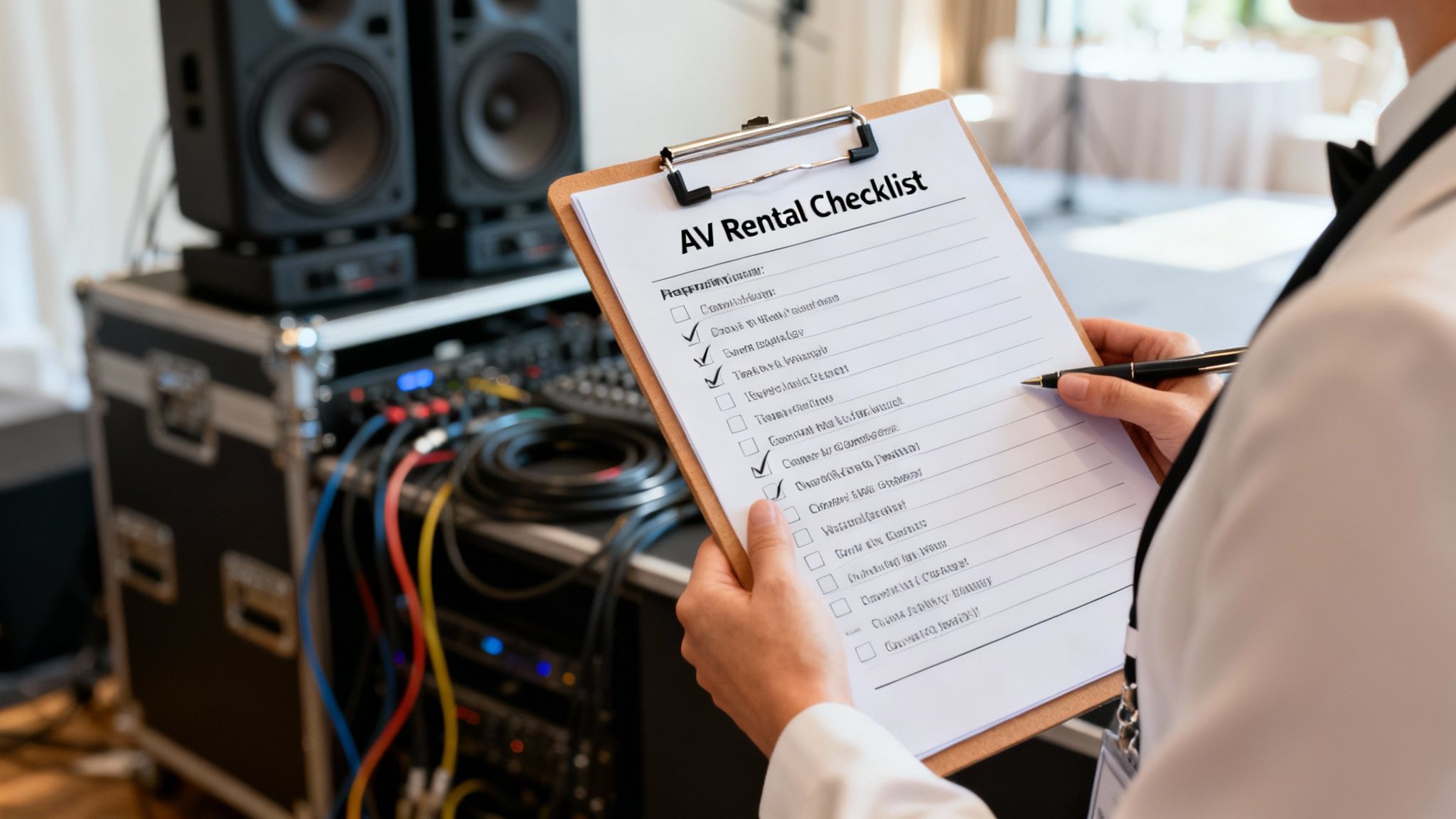
Choosing the right AV supplier is as important as selecting the right speakers. A good partner makes the entire process smooth and stress-free. A poor choice, however, could lead to technical issues and unnecessary complications.
A few well-chosen questions can tell you everything you need to know about a company's professionalism and capability. This vetting process helps you find a team that understands what is required to execute a successful event in London. You are not just ticking boxes; you are confirming that your event is in safe, experienced hands.
First Things First: Safety and Compliance
Safety is a critical consideration. Any reputable AV hire company will have immediate, clear answers to these questions. Hesitation or vague replies should be considered a major red flag.
-
Do you hold Public Liability Insurance? This is essential. It protects you, the venue and all attendees in the event of an accident involving their equipment or crew. A professional company will have no issue providing their certificate of insurance.
-
Is all your equipment PAT tested? Portable Appliance Testing (PAT) is a standard UK safety check for all electrical equipment. It confirms that everything, from the mixing desk to the microphones, is safe and meets legal requirements. Do not hesitate to ask for their PAT records.
-
Can you provide a Risk Assessment and Method Statement (RAMS)? For larger events, most London venues will require this documentation. An experienced supplier like London Audio Visual Hire will be accustomed to this, providing documents that outline potential hazards and how their team will work safely on-site.
Gauging Their Experience and Technical Know-How
Once safety is covered, you need to determine if they have the real-world expertise to deliver excellent sound. Their answers here will separate the professionals from the amateurs.
A great way to judge a supplier's experience is to ask about their backup plans. A team that confidently explains their process for handling unforeseen issues has likely encountered and resolved similar challenges before.
-
What is your experience with our specific venue? This is an excellent question. A team that has worked at your venue before will already be familiar with its acoustic challenges, power locations and loading procedures. This inside knowledge is invaluable and can prevent many last-minute problems.
-
What is your contingency plan if equipment fails? Professionals always have a Plan B. They should be able to tell you exactly what happens if a piece of equipment malfunctions. This usually means having critical spares on-site, such as extra microphones, cables or even a mixer, ready for immediate deployment.
-
Who will be my point of contact on the day? You need to know who to approach if an issue arises. Having a dedicated project manager or lead engineer on-site provides a single, accountable person for all audio-related matters.
The UK's sound equipment rental market is growing rapidly, which is great news for event planners. It means there is a fantastic selection of high-quality speakers, mixers and microphones available for everything from corporate events to festivals. You can learn more about the UK sound rental market forecast on datainsightsmarket.com.
Common Questions About Sound System Hire
Even the most organised event planner will have questions about the details of sound system hire. Here are answers to some of the most common queries to help you finalise your audio arrangements with confidence.
How Far in Advance Should I Book?
As a general rule for events in London, try to book your sound system at least four to six weeks in advance. This is particularly true during the busy summer and Christmas periods when high-quality equipment is in high demand.
If you are planning a larger, more complex production that might require a site visit or a bespoke audio design, providing more notice is always better. Booking early not only secures the equipment but also allows sufficient time for your technical team to conduct proper planning.
Booking well in advance means you are reserving more than just equipment. You are reserving the expertise of a project manager who can resolve every detail, from power requirements to loading bay access, long before the event day.
Do We Really Need a Site Visit?
Not always. If you are hosting a small event in a standard hotel conference room we have worked in before, we can often design the perfect system from a floor plan and a detailed discussion.
However, we would always recommend a site visit for:
- Large-scale conferences with multiple breakout rooms.
- Outdoor events where power and weatherproofing need to be assessed.
- Venues with challenging acoustics, such as historic buildings, art galleries or marquees.
A brief visit allows our technicians to identify potential sound challenges, map out power sources and plan the entire installation precisely. It is about ensuring the setup on the day is completely seamless.
What Happens If Something Breaks During the Event?
We understand that reliability is paramount. When you book a full-service sound system with London Audio Visual Hire, a dedicated sound engineer remains on-site for the entire event. Their role is to mix the sound, but they are also your first line of defence against any technical issues.
We always bring backup for critical items like microphones and cables. This combination of an on-site expert and spare equipment means that if anything does fail, the impact on your event is minimal.
Can the Sound System Work with Our Other AV Equipment?
Absolutely. Modern events rely on seamless integration, and our systems are designed for it. We can easily connect everything from presentation laptops and projectors to video walls and lighting desks.
This means we can ensure the audio from a video plays perfectly through the main speakers or that lighting cues coincide with a dramatic musical sting. To make the rental process smoother, you might find that using specialized equipment rental forms helps keep all the details organised. Just be sure to inform us about all your integration needs during the planning phase so we can guarantee everything works together perfectly.
A successful event hinges on clear communication, which starts with flawless audio. For a sound solution that is meticulously planned and perfectly suited to your London venue, trust the experts at London Audio Visual Hire.
See what we offer and let's discuss how we can make your next event sound incredible at https://londonaudiovisualhire.co.uk.