
When you hire a professional sound system, you are getting far more than speakers and wires. You are bringing in a complete, engineered audio solution for your event. It is an end-to-end service that covers everything from the initial technical design and equipment selection right through to on-site delivery, setup, operation by a skilled engineer, and breakdown afterwards.
This approach is about guaranteeing crystal-clear, reliable audio, which frees you to focus on your guests and the event itself.
What a Professional Sound System Rental Includes
Bringing a professional audio-visual supplier on board is a smart move. It effectively transfers the responsibility for your event's sound from your shoulders to a dedicated technical partner. Think of it as the difference between just renting kit and securing a successful audio outcome. The entire conversation shifts from a list of equipment to a fully managed service designed to deliver flawless sound for your specific needs.
More event planners appear to agree. In the UK, the sound system rental market is growing. A recent analysis valued it at around USD 739.5 million, with forecasts suggesting it could increase to USD 1.37 billion by 2033. This highlights a major industry trend: people are moving away from owning equipment and embracing the flexibility and high production values that professional rental offers.
Core Components of a Sound Rental Package
A proper sound system package from a provider like London Audio Visual Hire will always have several key elements working together. The exact specification will change depending on your event, but these are the non-negotiables.
- Loudspeakers and Amplifiers: The most obvious part of the kit. We will choose the right speakers and position them strategically to give you smooth, even sound coverage across the entire venue. This avoids quiet spots at the back or deafening patches near the front.
- Mixing Desk: This is the nerve centre of the whole operation. An engineer uses it to balance the audio levels from every source, making sure presenters can be heard clearly and the music sits at the right volume.
- Microphones: You will get a range of options depending on what you need. That could mean handheld wireless mics for a Q&A, discreet lapel mics for presenters who need to move around, or classic lectern mics for formal speeches.
- Cabling and Stands: All the essential but less glamorous items are included. That means every signal cable, all power distribution, and the correct, secure stands for speakers and mics to ensure a safe and tidy setup.
Beyond the Hardware: The Service Element
The real value in a professional sound system rental is the service that comes with the equipment. You are not just hiring boxes; you are hiring expertise. It is one thing to have the right equipment, but a truly professional service also understands and adapts to the latest hospitality technology trends to ensure your event feels modern and meets guest expectations.
This service starts with designing a system that is tailored specifically to your venue's acoustics. Then comes professional delivery and a meticulous setup by experienced technicians. Most importantly, it often includes a dedicated sound engineer who stays on-site for the entire event. They will manage the audio from start to finish, ready to troubleshoot instantly and adapt if your schedule changes on the fly.
Once the last guest has left, the team handles the full de-rig and removal, getting everything out efficiently. This complete, end-to-end management is what makes the whole experience seamless and stress-free for you. You can see the breadth of options available by exploring a full inventory of professional audio equipment.
How to Choose the Right Sound System for Your Event
Picking the right sound system is a make-or-break decision for any event. There is no such thing as a one-size-fits-all solution here. The kit you would need for an intimate seminar is worlds away from what a large product launch demands. The goal is simple: match the technology to the room and the audience, so every word and note lands perfectly.
It all boils down to three key things: the type of event you are running, the size of your audience, and the venue itself. Get one of these wrong and you risk classic, and completely avoidable, problems like muddy sound, the screech of feedback, or speeches that no one can understand. A good supplier will build a system around these three pillars from the start.
To begin, this simple flowchart can help point you in the right direction.
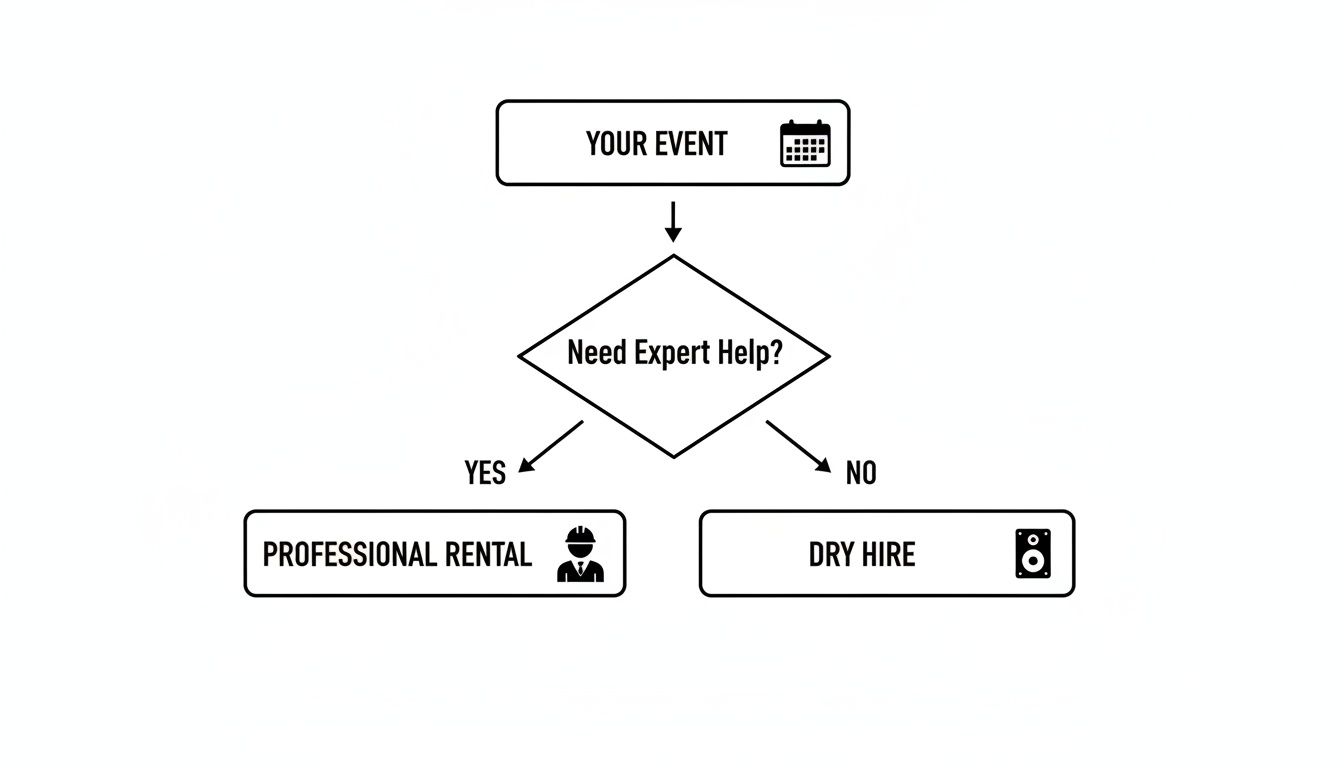
It is a quick way to decide between a full-service professional rental where everything is handled for you, and a 'dry hire' where you collect the equipment and run it yourself.
Matching the System to Your Event Type
The kind of event you are hosting is the biggest indicator of the sound system complexity you will need. Background music and a few announcements? A simple setup will suffice. But for something more dynamic, you need to think bigger.
-
Conferences and Seminars: It is all about vocal clarity. Your top priority is making sure everyone can hear the speakers on stage, the panel discussion, and any questions from the audience. This usually means a mix of microphones (lectern mics, lapels for freedom of movement, and handhelds for Q&As) and speakers placed strategically for even coverage.
-
Awards Dinners and Gala Events: These are often a mix of activities. You will have speeches, video clips, and maybe even a live band. The sound system needs to be flexible enough to handle the quiet moments of an acceptance speech and the high energy of a band without constant level adjustments.
-
Product Launches and Brand Activations: These are high-impact events. Audio is a huge part of creating the right atmosphere. You are likely looking at a powerful system, often a line array, that can deliver concert-quality sound for music and presentations. Subwoofers are almost always a must to give video stings and music tracks real punch.
Sizing the System for Your Audience
The number of people in the room directly impacts how much power and how many speakers you will need. If the system is too small, the sound will be thin and strained, barely reaching the back rows. If it is too big, you are wasting money on an oversized system that is difficult to manage.
A small breakout session for 30 people might just need a couple of compact speakers on stands. But for a conference plenary with 500 attendees, you need a more sophisticated setup. This could involve main speakers at the front and smaller 'delay' speakers part-way down the room to reinforce the sound, ensuring people at the back hear everything at the same time and volume as those at the front.
For larger events, it is not just about being loud – it is about coverage. The aim is to give every guest a comfortable listening experience, no matter where they are sitting. A well-designed system gets this right without blasting people in the front row.
Example Sound System Specifications by Event Type
To give you a clearer picture, here is a look at some typical sound system packages we would put together for common corporate events in London. This should help you visualise what your own event might require.
| Event Type and Audience Size | Core Speaker Setup | Microphone Requirements | Mixing Desk and Engineer |
|---|---|---|---|
| Small Seminar (50 guests) | 2 x Active Speakers (e.g. QSC K12.2) on stands | 1 x Lectern Gooseneck Mic, 2 x Handheld Wireless Mics for Q&A | Small 6-channel mixer (often manageable without a dedicated engineer) |
| Conference (200 guests) | 4 x Main Speakers (e.g. d&b Y-Series) plus front-fill speakers | 2 x Lectern Mics, 4 x Wireless Lapel Mics for panel, 2 x Handheld for Q&A | 16-channel digital mixing desk, dedicated sound engineer required |
| Awards Dinner (400 guests) | 6-8 x Main Speakers (e.g. L-Acoustics X12) plus subwoofers | 2 x Lectern Mics, 6 x Wireless Handheld Mics for awards and hosts | 32-channel digital desk with stage box, dedicated sound engineer crucial |
| Product Launch (500+ guests) | Small Line Array System (e.g. d&b T-Series) with multiple subwoofers | Wireless headset mics for presenters, multiple handhelds for brand ambassadors | Large-format digital desk, dedicated sound engineer and crew essential |
As you can see, the kit scales up significantly with the audience size and event complexity, and the need for a professional engineer becomes non-negotiable.
Getting to Grips with the Terminology
When you are talking to a rental company, you might hear a few technical terms. You do not need to be an expert, but knowing what they mean can be helpful.
-
Power (Watts): This is a rough measure of how much output an amplifier or speaker has. More watts can mean more volume, but it is not the whole story. The efficiency of the speaker is just as important in determining how loud it actually gets.
-
Dispersion: This is the angle, horizontally and vertically, that a speaker projects sound. A speaker with wide dispersion is great for covering a wide but shallow audience up close. A narrower dispersion can project sound much further, which is perfect for long, deep rooms.
Understanding the basics of what audio visual equipment is involved can make your conversation with a supplier much more productive. The technicians at London Audio Visual Hire are experts at turning your event goals into a clear technical plan, so you get exactly the right equipment without needing an engineering degree.
Budgeting for Sound System Hire in London
Before you do anything else, you need to establish your budget. It is the first, and arguably most important, step in sorting out the audio for any event. The cost of hiring a professional sound system in London is not a single figure; it is a spectrum. The final price depends on the scale of the kit you need, the level of technical support you want, and the logistical realities of your event. Understanding these variables is the key to spending your money wisely.
It is also worth noting a significant shift in the industry. More event professionals in London are choosing to hire sound systems rather than buy them. This is part of a broader move towards outsourcing specialist needs on a project-by-project basis, avoiding the cost of owning, storing, and maintaining expensive equipment. While retail sales of audio equipment have dipped, the rental market is growing. This shows that having the flexibility to pick the right specification for each unique event is what really matters.
What Drives the Rental Cost?
When you get a quote from a reputable supplier like London Audio Visual Hire, it should clearly break down where the money is going. A few core factors will always determine the final price.
-
The Size and Specification of the System: This is the biggest factor. A simple PA system with a couple of speakers for a small seminar is at one end of the scale. A complex line array with multiple speakers for a huge conference or a product launch is at the other, and the price will reflect that.
-
Hire Duration: Most quotes are for a standard single-day hire. If your event stretches over several days, or you need extra time for rehearsals and setup, expect to pay more. The good news is that these extra days are usually charged at a lower rate.
-
The People Involved: Never underestimate the cost of expertise. Your quote will include the crew needed to make it all happen – from the drivers who deliver the equipment to the technicians who set it up. Crucially, it also includes the on-site sound engineer, whose skills are what will make your event sound professional.
-
The Logistics of the Job: London has its own set of challenges. Is your venue difficult to access? Are there tight loading bay restrictions? Is it inside the Congestion Charge zone? Does everything need to be packed down and removed in the middle of the night? All these logistical hurdles will be factored into the quote.
Understanding Price Brackets
Every event is different, but it helps to have a rough idea of what to expect. Think of it less as a fixed menu and more as a guide to what you get for your money, from a basic kit-only hire to a full-service audio production.
A word of warning: it is tempting to go for the cheapest quote. But an unusually low price is often a red flag. It could mean corners are being cut on the quality of the equipment, the experience of the engineer, or the level of support you will receive. That is a risk that could put your entire event in jeopardy. Real value is about reliability and a stress-free experience, not just the lowest number on a page.
What to Expect at Different Price Points
Here is a rough breakdown of what your budget will likely get you in London:
-
Dry Hire (£150 – £300+): This is the DIY option. You are simply renting the equipment and are responsible for collecting it, setting it up, operating it, and returning it. This is only a good idea if you know exactly what you are doing and your event is very simple.
-
Small Event Package with Engineer (£500 – £900+): Perfect for events with up to 150 guests. This typically gets you a pair of high-quality speakers, the right microphones, a small mixing desk, and a sound engineer to run everything for you. Delivery and setup are all part of the service.
-
Full Conference or Awards Solution (£1,500 – £5,000+): This is a fully managed, professional service for larger corporate events. This means a sophisticated multi-speaker system, a wide range of microphones (for panels, presenters, Q&A), a high-specification digital mixing desk, and a dedicated team of engineers and technicians to see the project through from start to finish.
Overcoming London Venue and Acoustic Challenges
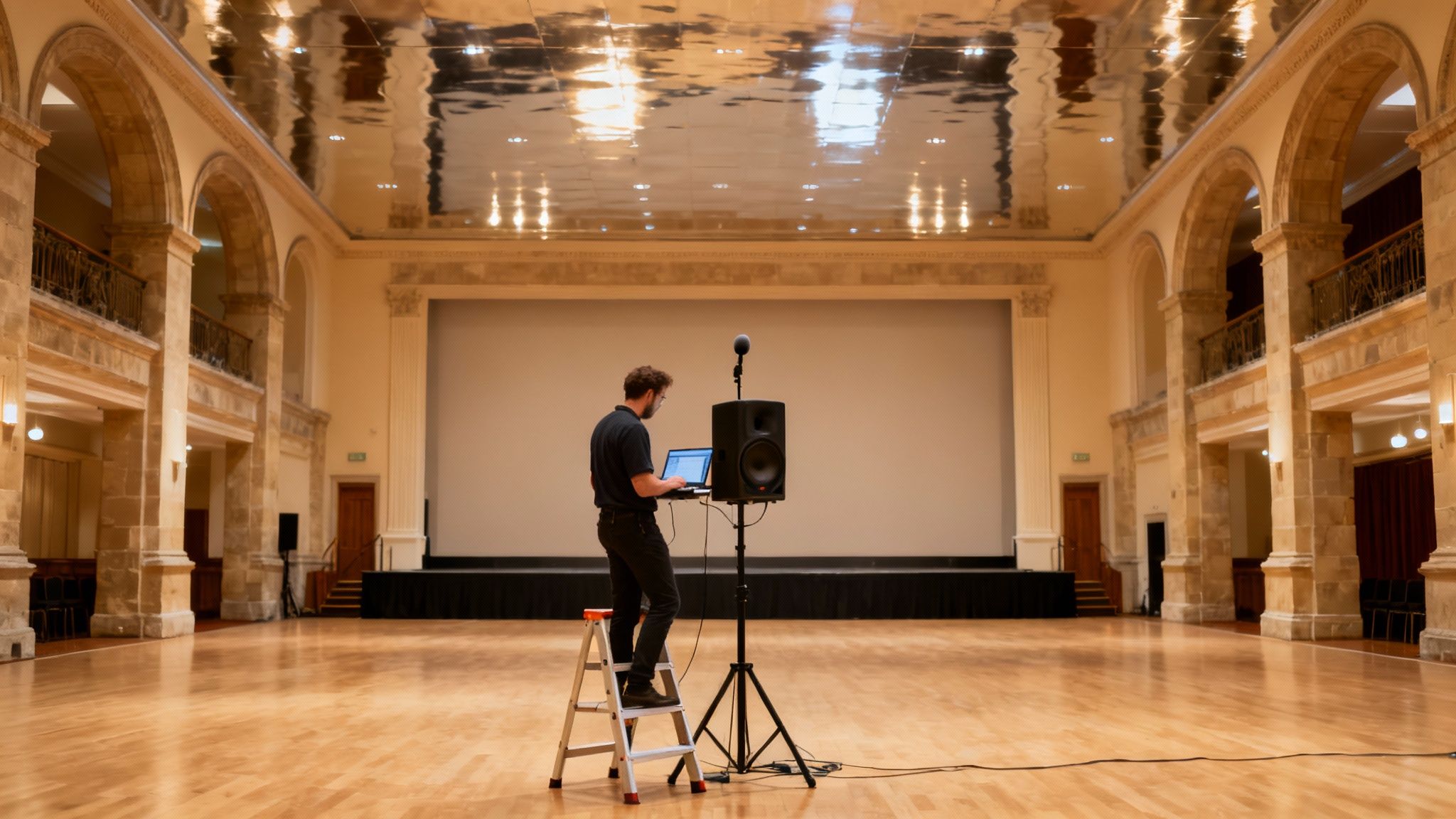
Hiring a sound system in London is not just about picking the right kit; it is about understanding the city's varied collection of event spaces. You could be in a Grade II listed hall one day and a sleek, modern conference centre the next. Each one is entirely different, presenting unique acoustic and logistical puzzles. Getting this right is often the deciding factor between a flawless event and an audio problem.
The sheer architectural variety is both an advantage and a challenge. A beautiful, centuries-old hall with ornate plasterwork and stone floors will make sound bounce around, turning speech into an unintelligible mess if you are not careful. Conversely, a contemporary space packed with glass might look incredible, but it creates harsh reflections that need taming with clever speaker placement and technical skill.
The Importance of a Site Visit
There is no substitute for seeing the venue in person. A proper site visit lets a sound engineer experience the room, spot potential problems, and design a system that works with the space, not against it. It is absolutely fundamental.
Here is what a good technician is looking for:
- Room Dimensions and Materials: How high are the ceilings? Are there large areas of glass, stone, or wood? Are there irregular shapes? All these things drastically change how sound behaves.
- Ambient Noise: What is the background noise level like? Is the air conditioning loud? Can you hear traffic from the street or noise from an adjacent room?
- Power Availability: Are there enough sockets in the right places? Is the supply stable, or do we need to bring in our own power distribution?
- Rigging and Placement Options: Where can we actually put the speakers? Historic venues can be famously strict about what you can attach to their walls and ceilings.
This early assessment informs every decision that follows, from the type of speakers chosen to their exact angle and position. It is all about making sure every guest gets crystal-clear sound.
Navigating London's Logistical Hurdles
It is not just about the acoustics inside the room. Simply getting the equipment to a central London venue can be half the battle. These are the details event planners sometimes overlook, but they are crucial for a smooth setup.
Working with a supplier who knows London's venues inside and out is a massive advantage. An experienced crew has seen it all before. They anticipate the bottlenecks and have plans in place to deal with them, saving you stress on the day.
You quickly learn to plan for common challenges:
- Loading and Access: Many London venues have small loading bays, strict time slots, or service lifts that cannot fit a flight case. Sometimes it is a long, awkward journey from the van to the event space.
- Parking and Transport: Juggling the Congestion Charge, ULEZ, and the simple lack of parking requires careful planning and can add to the budget.
- Noise Restrictions: If you are in a residential area or a multi-purpose building, you will likely have strict noise limits and a non-negotiable curfew.
- Heritage Building Regulations: Listed buildings have a different rulebook. It can affect everything from where you can run a cable to whether you are allowed to use a haze machine.
Partnering with Venue-Savvy Experts
A good AV supplier with a long history in the capital will know all about these quirks. At London Audio Visual Hire, our team has worked in hundreds of the city's most popular event spaces. We know the challenges before we even walk through the door. This hands-on experience means we can design and deliver sound solutions that work, without any guesswork.
You can take a look at some of the London venues we work with regularly to get a sense of our experience. Even with the best equipment, some rooms have stubborn noise issues, which is where things like specialised audio noise removal plugins can be useful. By knowing a venue’s personality ahead of time, we make sure that on event day, the only thing you have to worry about is the show itself.
The Booking Process: From First Call to Final Pack-Down
So, you know you need a professional sound system. What happens next? Finalising the booking and understanding the on-site logistics is what separates a smooth, stress-free event from a last-minute scramble. Think of it less as a simple transaction and more as a collaborative project with your audio supplier.
It all starts with the first phone call or email. To get a realistic quote that will not change dramatically later, come prepared with the details. The more information you can share from the start, the faster a good technical team can begin to build a picture of what you need.
The Journey from Quote to Confirmation
Once you have sent over the key information about your event, the booking process generally unfolds in three stages. Each step is designed to refine the details, ensuring there are no surprises for you or the AV team on the day.
-
The Initial Quote: A project manager will review your brief and send back a detailed proposal. This is not just a number; it should break down the suggested equipment, the number of crew members needed, transport costs, and the total price. This document is your starting point for discussion.
-
System Design and Refinements: This is where the real collaboration happens. You will likely have a more in-depth discussion about the event's running order, review floor plans, or even meet the technical team at the venue for a site visit. The first quote is then fine-tuned based on this deeper understanding, making sure the final setup is a perfect fit for the space and schedule.
-
Confirmation and Sign-Off: With all the details finalised, you will get a final specification sheet and quote. Approving this is what locks in the equipment and crew for your event date. It is always best to get this completed well ahead of time, particularly if your event is large or falls during a peak season.
What Happens on the Day of the Event?
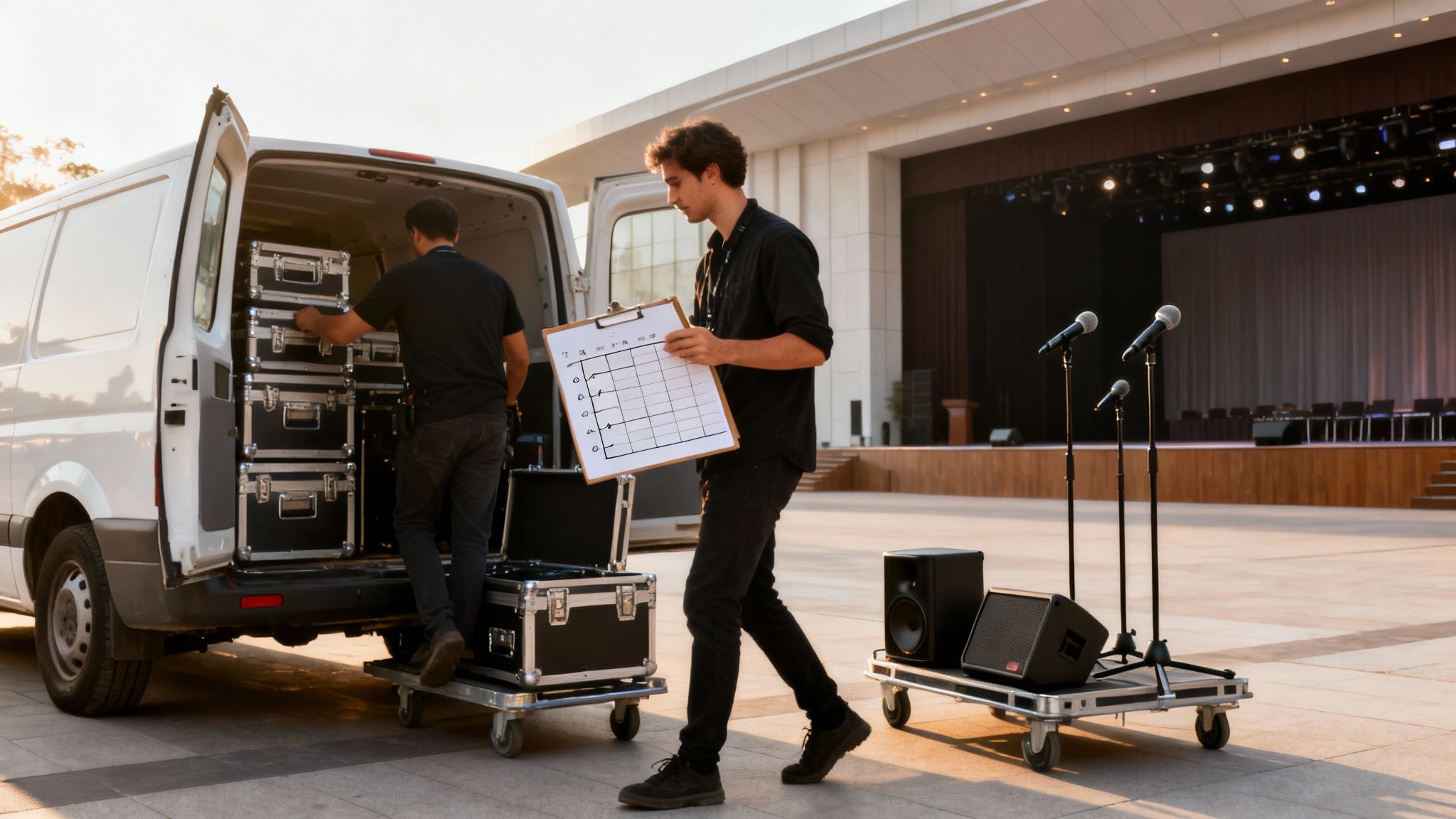
With all the planning complete, you can finally switch your focus to your guests, speakers, and the event itself. A professional crew from a supplier like London Audio Visual Hire will arrive ready to execute the plan meticulously.
The crew's arrival time, or 'load-in', is always agreed upon in advance, accounting for the complexity of the setup and when the venue allows access. The first thing they will do is check in with the venue manager, then begin bringing in the equipment and positioning the main items like the speakers and the mixing desk exactly as planned.
Do not underestimate the sound engineer's role. They are not just there to plug things in. For the duration of your event, they are your dedicated audio expert, responsible for delivering pristine sound and ready to solve any problem that arises instantly.
Once everything is physically in place, the engineer gets to work on a thorough sound check. This means testing every single microphone, running any video clips to check audio levels, and meticulously "tuning" the speaker system to compensate for the room's unique acoustic quirks. Anyone speaking or performing will be invited up for their own sound check to get their levels right and make sure they are comfortable.
Throughout the live event, the engineer is actively mixing, ensuring that the transition from a keynote speaker to a video clip to background music is completely seamless. When the last guest has departed, the team will de-rig and load out all the equipment efficiently, leaving the space exactly as they found it. That end-to-end management is the hallmark of a truly professional service.
Essential Questions to Ask Your Audio Visual Supplier
Choosing the right AV partner is one of the most critical decisions you will make for your event. The quality of the sound directly shapes your audience's experience, so it is vital to look beyond the price and assess a supplier's real-world competence and professionalism.
Asking the right questions upfront does more than just tick boxes. It helps you sort simple equipment hire companies from genuine technical partners who will support you. Getting this clarity from the start builds a relationship based on trust and protects your event from day one.
Assessing Their Experience and Expertise
First, you need to get a feel for their track record and whether they are the right fit for your specific event. Any good supplier will be happy to talk you through their history and capabilities.
A huge indicator of their expertise is whether they have worked in your venue before. A team that already knows the room's acoustic quirks, power limitations, and loading bay logistics has a massive head start.
- Have you worked at our venue before? If they have, ask them what challenges they faced and how they handled them. If it is a new space for them, find out how they plan to familiarise themselves – a site visit should be their first suggestion.
- Can you provide case studies or references for similar events? This is not about being difficult; it is about checking they have handled events of your scale and complexity before.
- What are the qualifications of your on-site sound engineers? You are paying for a seasoned professional who can solve problems under pressure, not a junior technician who is just there to press play.
Understanding Their Contingency and Safety Planning
Professional event production is 90% planning for what could go wrong. Any credible supplier will have solid backup plans and take health and safety seriously. If you get vague answers here, consider it a major red flag.
Even the best-maintained equipment can fail. Knowing what their plan B is will save you a world of stress. Remember, you are not just renting speakers; you are securing a flawless outcome.
A professional AV company’s value is most apparent when something unexpected happens. Their ability to solve a problem quickly and calmly, without your guests ever knowing, is what you are paying for.
It is also crucial to confirm they have all the necessary paperwork to protect you, your guests, and the venue.
- What is your contingency plan for equipment failure? They need a clear process. This should include having backup equipment either on-site or on standby for rapid deployment.
- Can you provide a copy of your public liability insurance? The industry standard is £10 million of cover. Most professional venues will not let a supplier through the door without it.
- Will you provide risk assessments and method statements (RAMS)? This is standard procedure and shows they are committed to keeping their crew and your attendees safe.
By asking these pointed questions, you can confidently choose a supplier like London Audio Visual Hire, and rest easy knowing your event's audio is in safe, experienced hands.
Sound System Rental FAQs: Your Questions Answered
To wrap things up, let's tackle some of the detailed questions we hear all the time from event planners. Getting these details right is often what separates a good event from a great one.
What Kind of Power Does a Professional Sound System Need?
This is a critical logistical hurdle. The power demand depends entirely on the kit you are using. A simple PA system for speeches might just need a single, standard 13-amp socket, the kind you find anywhere.
But once you scale up for a large conference, awards show, or live band, you are looking at much bigger requirements. This could mean multiple 32-amp or even 63-amp three-phase power supplies.
Any reputable supplier will not leave you guessing. They will calculate the precise power draw for your specific setup and give you a technical specification sheet. You can then take this straight to your venue's technical manager to make sure they have the right power, in the right place, well ahead of the event day.
What Happens When My Agenda Changes at the Last Minute?
Last-minute changes are part of the job. It is live events, and things happen. This is precisely where having an experienced sound engineer on-site becomes invaluable.
Suddenly have an extra speaker on the panel? A last-minute awards video just arrived in the running order? No problem. The key is to simply let your on-site technical lead know as soon as you do. They will calmly re-patch a microphone, adjust the levels on the mixing desk, and get the new video audio cued up. The audience will be none the wiser.
How Does the Sound Work with Video and Lighting?
In modern event production, nothing works in isolation. Sound, video, and lighting are all part of the same ecosystem, and a professional crew knows how to make them work together seamlessly. Your sound rental company should be collaborating with the other technical teams from day one.
Think about when a video plays on the big screen. The audio from that video file is fed directly into the sound engineer's mixing desk. They treat it just like another microphone, controlling its volume and equalisation to make sure it is crisp, clear, and perfectly balanced for the room. It is all about creating one unified, slick experience.
For anything more complex, like a hybrid event or a live stream, the integration goes a step further. The sound engineer will create a completely separate audio mix just for the online audience. This is often called a 'mix-minus' feed, and it is specially designed to give remote viewers a perfect broadcast-quality experience, free from any of the room's natural echo or potential feedback. It is this kind of detailed coordination that defines a professional production.
Planning an event in London means you need a technical partner who understands the city and its unique venues. At London Audio Visual Hire, we do not just rent out equipment; we provide meticulously planned sound solutions and experienced engineers dedicated to making your event sound incredible. Find out how we can support your next event.