
If there is one thing that can make or break an event, it is the sound. Whether you are running a corporate conference, launching a new brand, or hosting an awards night, your message is everything. If people cannot hear it properly, you have lost them.
This is precisely why hiring a professional sound system is the only way to go. It completely removes the gamble of relying on a venue's tired in-house speakers or an amateur setup.
Why Professional Sound Hire Is Not Just a 'Nice-to-Have'
Think about the last time you were at an event with poor audio quality. Muffled speakers, ear-splitting feedback, or silence during a crucial moment. It immediately seems unprofessional and is distracting for the audience. It undermines the speaker's credibility and cheapens every other investment you have made, from the catering to the venue itself.
Many people fall into the trap of thinking a venue's built-in system will be adequate. These are often designed for little more than background music or basic announcements. They are simply not built to handle the dynamic needs of a professional presentation, a lively panel debate, or the nuance of a keynote speech.
It Is About More Than Just Speakers
When you work with a specialist supplier, like London Audio Visual Hire, you are getting far more than just equipment. You are gaining the expertise to make it all work perfectly. It is a partnership that ensures every component is right for the job, installed correctly, and managed flawlessly from start to finish.
Here is what that means for your event:
- Flawless Clarity: Professional-grade microphones, speakers, and mixers mean your audience hears every word exactly as intended. No straining or confusion, just clear, intelligible sound.
- A System Built for You: The equipment is chosen specifically for your venue's acoustics, the number of guests, and the type of event you are running. A simple speech setup is very different from mixing multiple audio sources for a hybrid event.
- On-Site Peace of Mind: Having an experienced sound engineer on hand is invaluable. They will spot and solve problems before you even know they exist, letting you focus on hosting your guests.
It is no surprise that more event planners are choosing this route. The UK's audio equipment rental market was valued at USD 739.51 million in 2024 and is expected to exceed USD 1.3 billion by 2033. You can read more about the UK audio equipment rental market trends on deepmarketresearch.com.
This statistic shows a significant shift in the industry. Renting a sound system has become a fundamental part of creating events that not only happen, but make a real impact.
How to Size Your Sound System for Any Event
Getting the sound system right for your event is more of an art than a science, and it certainly is not about guesswork. The goal is to create a sound that feels natural and present for everyone in the room, not just blasting volume from the front. You want every word to be crystal clear and every piece of music to have impact, without ever feeling overpowering.
It is a delicate balance. A system that is too small means your message gets lost in a muffled mess at the back of the room, leaving guests frustrated and disengaged. A system that is too large is not just a waste of money; it creates an uncomfortable, echoey environment that can ruin the atmosphere.
Key Factors That Determine System Size
So, how do you find that sweet spot? It all comes down to three core elements. Any reputable hire company, like London Audio Visual Hire, will walk you through these before providing a quote.
-
Audience Size: This is the most important factor. A system for a small workshop of 50 people is a world away from what you need for a gala dinner with 500 guests. People absorb sound, so the more bodies in the room, the more power and speakers you need to ensure audio reaches every corner evenly.
-
Venue Acoustics: Every room has its own unique character. A modern, carpeted conference centre is a completely different challenge to a historic hall with stone floors, high ceilings, and glass walls. A beautiful older venue might look stunning, but it can be an acoustic nightmare, turning sound into a chaotic echo. This requires careful management with specific types of speakers and expert placement.
-
Content Type: What will people be listening to? If it is just one person giving a presentation, the needs are quite simple. However, a panel discussion with four people, video clips with their own audio, and background music requires a much more sophisticated setup, almost certainly with a digital mixing desk to manage it all.
Thinking through these factors is what separates a polished, professional event from one that feels amateurish. The audio choices you make have a direct impact on how your event is perceived.
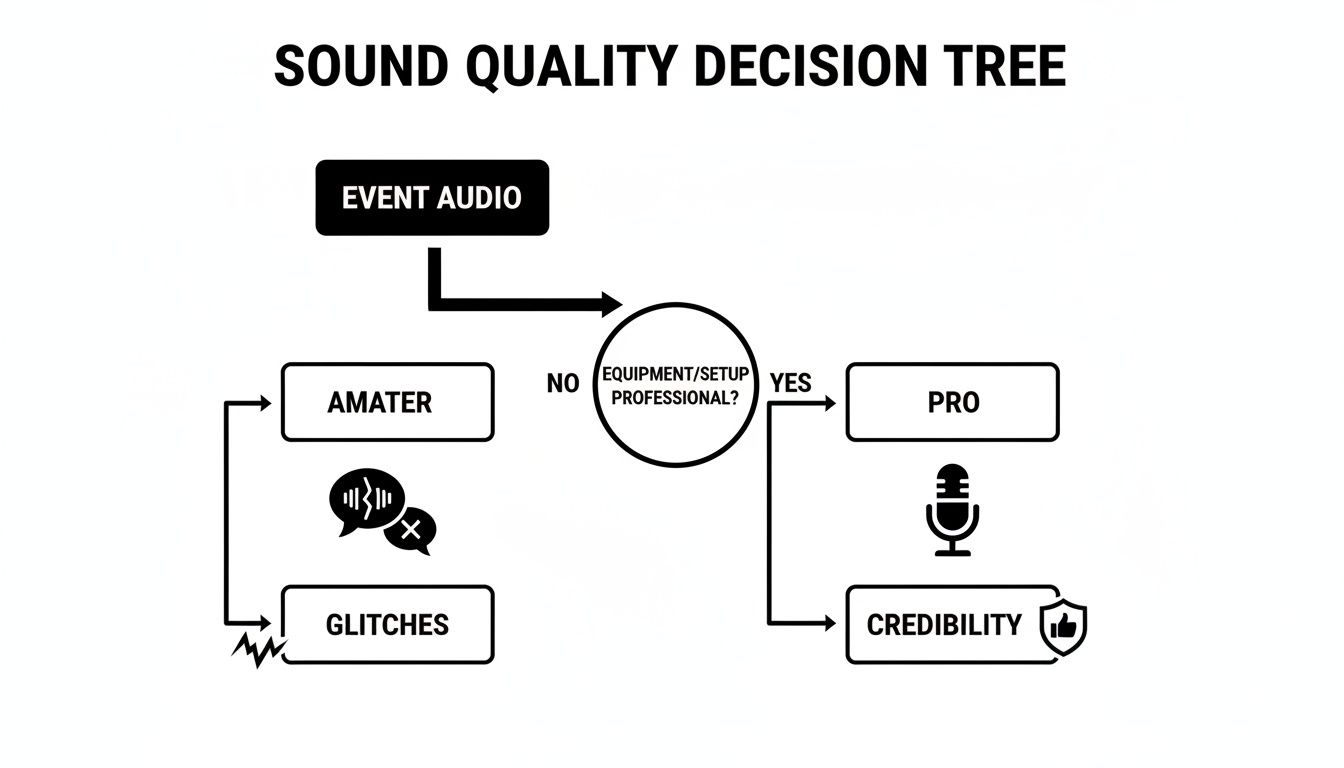
As you can see, investing in professional audio is a direct path to building credibility. Trying to cut corners often leads to technical headaches that undermine your audience's confidence.
A Quick Sizing Guide for Common Events
To put this into perspective, here is a quick reference table. It is designed to give you a solid starting point for what kind of equipment is typically needed for some of the most common event types in the UK.
Sound System Sizing Guide by Event Type
| Event Type & Audience Size | Primary Audio Need | Typical Speaker Setup | Essential Microphone Kit |
|---|---|---|---|
| Small Meeting or Workshop (Up to 50 guests) |
Crystal-clear speech for a single presenter. | A pair of compact "point-source" speakers on stands at the front. | 1x Lectern Mic 1x Handheld Wireless Mic for Q&A |
| Medium Conference (50 – 250 guests) |
Even coverage across a wider room; handling multiple speakers. | Main speakers at the front, plus smaller 'delay' or 'in-fill' speakers partway down the room. | 2-4x Lapel Mics (for a panel) 1x Lectern Mic 1x Handheld Wireless Mic |
| Awards Night / Gala Dinner (250 – 500+ guests) |
High-impact audio for music & video, plus speech clarity in a challenging acoustic space. | A 'line array' system for controlled, long-distance coverage. Subwoofers for music and multiple delay speakers. | 1x Host Mic 2x Handheld Wireless Mics 1x Lectern Mic |
| Exhibition Stand (Variable) |
Localised, attention-grabbing sound without disturbing neighbouring stands. | Small, directional speakers or a discreet screen with a built-in soundbar. | 1x Headset Mic for a presenter (if needed). |
This table is a great starting point, but remember, every event is unique. A good supplier will always tailor the final specification to your specific venue and programme.
Real-World Sizing Scenarios
Let us break down a few of those examples to see how the thinking works in practice.
The Sizing Principle: The true goal is not just loudness; it is intelligibility. This is the secret to professional sound. It means every single person, from the front row to the back corner, can understand every word spoken. That is the real test of a great sound system.
Scenario 1: The Small Breakout Session (50 Guests)
Imagine a standard hotel meeting room. The focus here is simplicity and vocal clarity. The room probably has carpets and low ceilings, which is excellent for acoustics.
- The Setup: All you really need is a pair of compact, active speakers on stands. Placed at the front and angled slightly inwards, they will cover this space perfectly.
- The Mics: A single microphone on a lectern for the speaker, plus a wireless handheld mic to pass around for audience questions. It is all managed through a small, simple mixer that a technician can set up in minutes.
Scenario 2: The Medium Conference (200 Guests)
Now we are in a larger, purpose-built conference hall. The main challenge is getting clear sound all the way to the back without deafening the people at the front.
- The Setup: You will need a more powerful main speaker system. Crucially, your supplier will likely recommend smaller 'delay' speakers placed about halfway down the room. These ensure the people at the back hear the audio at the same time and volume as everyone else.
- The Mics: This is where it gets more complex. You might have a panel of four people, each needing their own lapel mic, plus the lectern mic, and audio from a video presentation. A professional digital mixing desk with a sound engineer to operate it becomes absolutely essential.
Scenario 3: The Large Gala Dinner (500+ Guests)
Think of a grand ballroom in an old hotel: huge ceilings, marble floors, and lots of reflective surfaces. This is the big league of audio challenges.
- The Setup: This is a job for a line array system. Those curved stacks of speakers you see at concerts are not just for show; they allow engineers to precisely control the sound and aim it directly at the audience, minimising unpleasant echoes from the ceiling and walls. You will also need subwoofers for the music and a network of delay speakers.
- The Mics: The audio sources are non-stop: a host's microphone, winners coming to the stage, video packages, a live band, and background music. It is a dynamic, fast-moving show that requires an experienced sound engineer at the controls to make it all seamless.
Understanding a Professional PA System
Let us demystify the technical side of sound systems. It is not as complicated as it seems. At its heart, a professional PA (Public Address) system has just a few core parts, and each one has a specific job. Once you understand what each component does, you will be able to read a quote and know exactly why certain items are essential for your event.
Think of it like a band. You have the singer, the guitarist, and the drummer, each making their own sound. It is the sound engineer at the mixing desk who blends them all into a cohesive track. The audio equipment is the band, and the engineer is the producer.
Microphones: The Ears of Your System
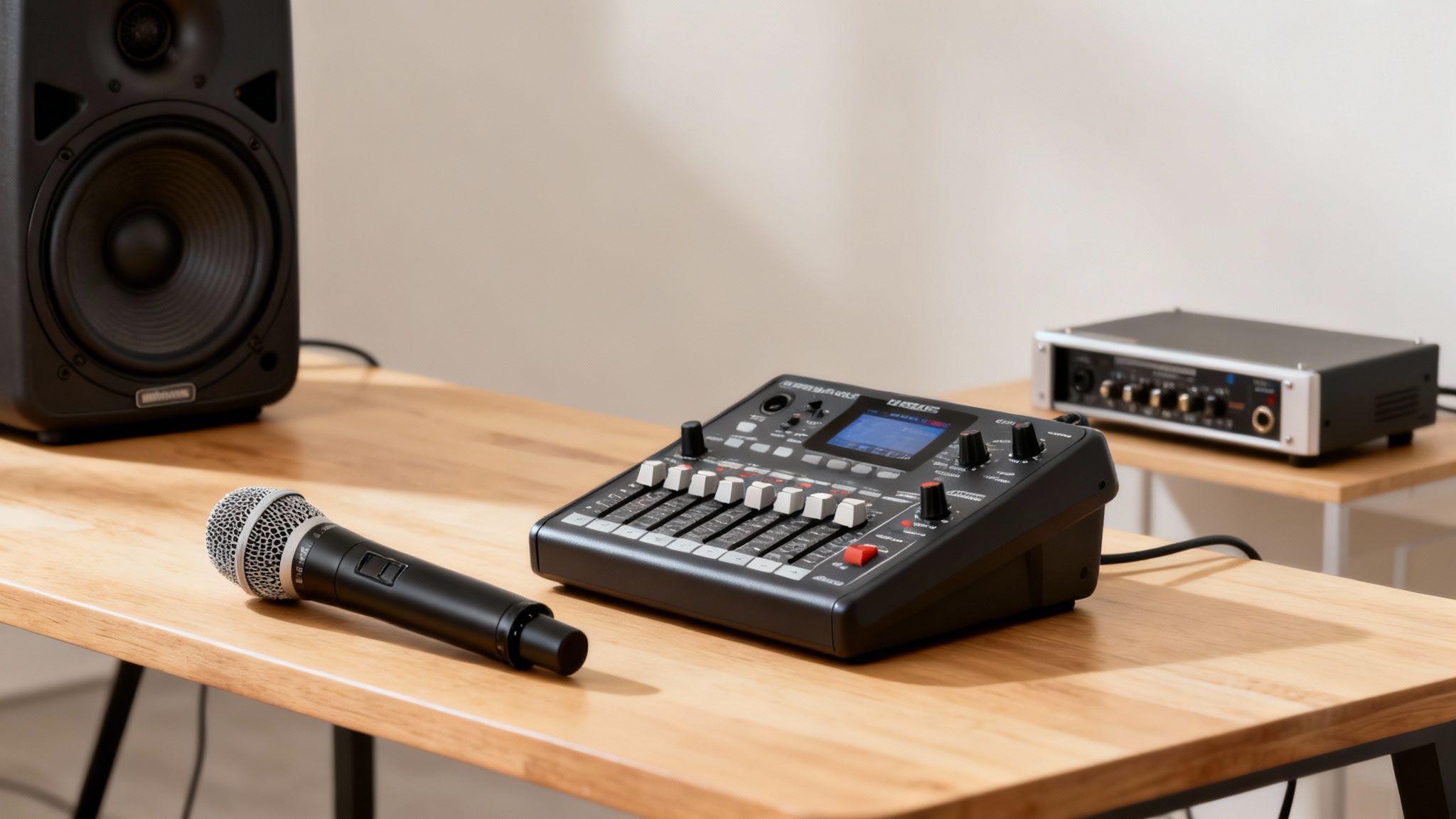
Everything starts with the microphones. Their one job is to capture sound waves, whether that is a speaker's voice, a musical instrument, or the general ambience of the room, and turn them into a tiny electrical signal. This signal is the raw ingredient for everything that follows.
You need the right tool for the right job, and microphones are no different:
- Lectern Microphones: Fixed to a podium, these are perfect for a presenter who is staying in one spot. They provide a very clean, consistent sound.
- Handheld Wireless Microphones: The go-to choice for Q&A sessions or a host who moves around the stage. They offer complete freedom of movement.
- Lapel (or Lavalier) Microphones: These are the small, discreet mics that clip onto a jacket or shirt. They are the industry standard for panel discussions, keeping the speakers' hands free.
The world of rental equipment is vast, with microphones, mixers, and professional speakers all playing their part. Even within microphones, the choice between wired and wireless options is a key decision. For anyone planning a major event, this variety shows just how sophisticated professional audio has become.
The Mixing Desk: The Brain
If the microphones are the ears, the mixing desk is the brain of the whole operation. Every single sound, from every microphone, every laptop playing a video, and every piece of background music, is routed here first. It is where a sound engineer works their magic, adjusting the volume, tone, and balance of each individual sound before blending them into the final mix that goes out to the speakers.
For any event with more than a couple of audio sources, a digital mixing desk is an absolute must. It gives the engineer complete control: they can save settings for different presenters, manage complicated audio feeds for a live stream, and surgically remove problem frequencies to prevent feedback. A good engineer with a digital desk can stop that horrible screeching sound before it even starts. It is a level of control you simply cannot get from a basic analogue mixer.
Amplifiers and Speakers: The Voice
So, we have a perfectly balanced mix coming out of the desk. Now we need to make it loud enough for everyone to hear. This is a two-step job for the amplifiers and speakers.
-
Amplifiers (The Muscle): The signal from the mixer is clean, but it is very weak. An amplifier's job is to give it the raw electrical power it needs to physically move a speaker cone and create sound. Many modern speakers have amplifiers built right into the cabinet, which is why you will often hear them called active or powered speakers.
-
Speakers (The Mouthpiece): This is the final, critical step. Speakers take that powerful electrical signal from the amplifier and convert it back into the sound waves that travel to your audience's ears. As we covered earlier, the type of speakers you use and where you place them is crucial for getting clear, even sound throughout the venue.
The crucial thing to remember is that every piece in this chain matters. A world-class microphone is pointless if the mixing desk is poor, and the best speakers in the world cannot rescue a badly mixed signal. This is why you hire a complete, professional system; it is about how all the parts work together.
Understanding this flow from microphone to speaker helps make sense of the technical jargon you might see on a quote. It also explains why every item on that list is there. For a deeper dive into the equipment, you can learn more about what audio visual equipment consists of in our dedicated guide.
Budgeting for Professional Sound Hire
Budgeting for sound system hire can feel like a dark art, but understanding the costs early on is one of the smartest things you can do when planning an event. It is not just about avoiding surprises; it is about making sure you get the right equipment and, crucially, the right support for the job.
The price you are quoted is not just a number plucked from thin air. It is a direct reflection of the quality of the equipment, the work involved in setting it all up, and the skill needed to ensure your event sounds fantastic from start to finish.
To understand any quote, you first need to understand the two main ways audio hire is priced.
Dry Hire vs Wet Hire Explained
The biggest split in how sound systems are rented comes down to two terms you will see everywhere: 'dry hire' and 'wet hire'.
-
Dry Hire: Think of this as the "DIY" option. You are simply renting the equipment: the speakers, the mixer, the microphones. You collect it, transport it, set it up, run it, and bring it back yourself. It looks cheaper at first glance, but it is really only for people who genuinely know their way around professional audio equipment. If something goes wrong, you are on your own.
-
Wet Hire: This is the full-service package and what most events actually need. A professional company like London Audio Visual Hire does not just drop off the equipment. We bring the technicians and sound engineers to deliver, install, operate, and take it all away again. It is the stress-free, "it just works" solution.
For any serious corporate event, wet hire is the only sensible option. That price includes the one thing you cannot pack in a flight case: the expertise of a sound engineer who will be on-site, making sure everything sounds perfect and dealing with any issues before your audience even notices.
Key Factors That Influence Your Quote
Once you have decided on a wet hire, a few other things will shape the final price. Any good quote should break these down for you so you know exactly what you are paying for.
-
Event Duration: Most quotes work on a 'day rate'. If your event runs over several days, you will naturally pay more, but you can usually expect a lower rate for the second and third days.
-
Setup Complexity: There is a world of difference between setting up a single microphone on a lectern and wiring up a conference panel with eight speakers, plus audio feeds for video playback and a live stream. The more complex the setup, the more time and skill it takes, and the cost will reflect that.
-
Technician and Crew Numbers: A simple presentation might only need one technician to set up and pack down. But a large awards dinner with a live band? You will likely need a dedicated sound engineer to mix the show, a stage technician, and maybe extra crew. Each person adds to the labour cost.
This demand for quality equipment and skilled people is driving huge growth in the audio-visual rental market. It is projected to jump from USD 5.2 billion in 2023 to USD 8.4 billion by 2032, which shows how much businesses value getting this right. You can read more about the AV equipment rental market dynamics if you are interested in industry trends.
Budgeting Takeaway: When you get a quote for a wet hire, remember you are not just renting equipment. You are investing in peace of mind, knowing an experienced professional is there to ensure your event’s sound is flawless from the moment the doors open until the last person leaves.
Getting the Logistics Right for a Flawless Event
Great equipment is one thing, but it is the execution that makes or breaks an event. When you hire a professional sound system, what you are really paying for is the expertise to get all the practical details right. This is the invisible work that guarantees a seamless audio experience, and it is a lot more than just dropping off a few speakers and plugging them in.
The whole process kicks off long before your event date. It all starts with meticulous planning and clear communication, making sure every technical detail is covered and every potential issue is considered. It is this groundwork that separates a smooth, stress-free event from one full of last-minute panic.
The Project Timeline From Start to Finish
From that first phone call to the final pack-down, there is a well-trodden path that every professional hire follows. A seasoned company like London Audio Visual Hire will walk you through each step, leaving nothing to chance.
-
Initial Consultation and Site Visit: The first step is always a conversation about what you need. A site visit is often essential; it lets us check the room's acoustics, find power sources, and map out where everything will go.
-
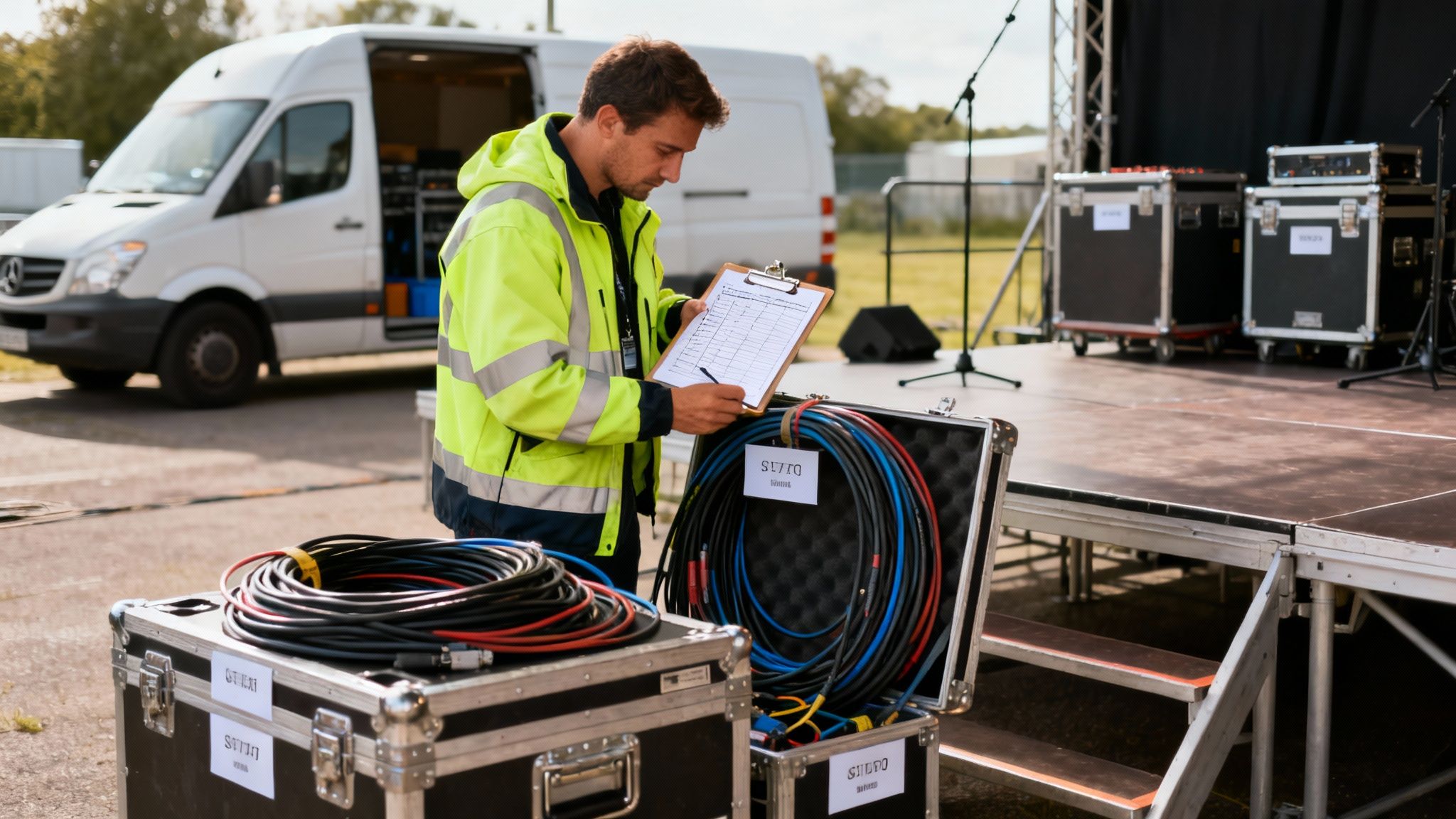
Preparing the Equipment: Back at the warehouse, our technicians get to work. They will prepare and test every single piece of equipment for your event. This means programming digital mixers, checking every microphone, and ensuring every cable is in perfect working order.
-
Liaising with the Venue: Your supplier should handle all communication with the venue's management. We will arrange access times for loading in, confirm the power situation, and provide all necessary health and safety documents, like risk assessments.
-
Delivery and Setup (The 'Rig'): On the day, the crew arrives to build the system. This is a carefully timed operation to get everything installed safely and efficiently. Cables are taped down neatly to prevent trip hazards.
-
The All-Important Soundcheck: Once everything is in place, we run a full soundcheck. Every microphone, every laptop, and every audio source is tested to get the levels just right, ensuring the sound is perfectly clear and balanced everywhere in the room.
Power, Safety, and Peace of Mind
Let us talk about one of the most overlooked but critical details: power. Professional sound systems need a lot of electricity, and you cannot just assume a standard wall socket will be sufficient. A good supplier will determine exactly what the system needs and check that the venue can handle the load without blowing a fuse.
A huge part of a professional AV supplier's job is adhering to strict health and safety rules. All our equipment is PAT tested (Portable Appliance Testing) for electrical safety. Our technicians are trained to work safely, especially when rigging heavy speakers or running cables through public spaces.
This is not just about ticking boxes. It protects your guests, the venue staff, and our crew, giving you one less thing to worry about.
Why Your Sound Engineer Is Your Best Asset on the Day
It is easy to think the sound engineer’s job is done once the music starts. Not even close. Their most important work happens during the event. They are not just a technician hiding in the corner; they are an active, vital part of making your event a success.
An engineer’s role is to:
- Actively Mix the Show: They are constantly adjusting the volume levels for different speakers, keeping everything consistent and easy to hear.
- Fix Problems Before Anyone Notices: That sudden screech of feedback or a faulty cable? A good engineer will fix it in seconds, often before the audience even knows something was wrong.
- Hit Every Cue: They will seamlessly fade in background music, play video soundtracks, and trigger any other audio cues right on schedule.
- Look After the Online Audience: If you are running a hybrid event, the engineer is also managing a completely separate audio mix for the live stream. This is absolutely crucial for successful hybrid event streaming.
When it comes down to it, the logistics managed by your hire company are the foundation of your event. It is what ensures the right equipment shows up, is set up correctly, and is run by a skilled professional who is totally focused on delivering incredible sound for you and your audience.
9 Questions to Ask Before You Hire Any Sound System
Choosing the right audio-visual partner is one of the most critical decisions you will make for your event. The best companies do not just supply equipment; they provide expertise and a safety net, anticipating problems before they have a chance to derail your day.
To help you find that perfect fit, we have put together a list of essential questions. Think of this as your vetting process. Asking these questions will help you separate the true professionals from the rest and give you complete confidence in your choice.
Getting the Basics Right: Insurance, Safety, and Planning
Before you even think about signing a contract, you need to cover the essentials. These first few questions are about compliance and professionalism. They will quickly reveal whether a potential supplier is a credible, reliable partner or a risk you cannot afford to take.
-
Can you show me your public liability insurance? This is non-negotiable. Proper insurance protects you, the venue, and every single guest if something goes wrong. Any professional company will have this on hand and be happy to share it.
-
Is all your equipment PAT tested? In the UK, Portable Appliance Testing (PAT) is a legal requirement. It is a standard safety check for all electrical equipment. If a company cannot provide up-to-date PAT certificates, walk away.
-
What is your plan for equipment failure? Even top-of-the-line equipment can fail. A professional will have a solid contingency plan. Ask them what backup equipment they bring as standard and how they would handle a worst-case scenario, like a mixing desk failing mid-presentation.
-
Do you need to do a site visit? For anything more complicated than a simple two-speaker setup, the answer should be a resounding "yes." A site visit shows they are committed to understanding your venue’s unique quirks, from its acoustics to its loading bay access.
Who Is on the Ground?: Roles and Responsibilities
Knowing exactly who will be on-site on the day, and what they will be doing, is key to a smooth-running event. Getting this wrong can lead to serious stress when you can least afford it.
One of the clearest signs of a professional hire company is how they talk about their team. You should know precisely who is in charge of your event's sound and feel completely confident in their ability to run the show from start to finish.
Make sure you are both on the same page by asking:
-
What exactly will the on-site technician be doing? Is their job just to drop off the equipment and pick it up later? Or will they be there to operate everything? For most corporate events, you absolutely need a dedicated operator to manage the sound levels and troubleshoot on the fly.
-
What kind of experience does the sound engineer have? The skills needed for a corporate conference are very different from those for a rock concert. You want to make sure your engineer's experience is a perfect match for your event's specific demands.
Nailing the Logistics: Timings and Coordination
Finally, let us talk about the practical side of things. A clear, agreed-upon schedule is the secret to a stress-free setup and breakdown.
-
Can you walk me through the schedule for setup and soundcheck? A well-organised supplier will give you a detailed timeline, including their arrival, how long setup will take, and, crucially, a dedicated slot for sound-checking.
-
Who will coordinate with the venue manager? This should not be your job. Your AV supplier should take the lead on all technical conversations with the venue, confirming everything from power requirements to access times.
Essential Questions for Your Audio-Visual Supplier
To make sure you have covered all the bases, use this table as a final check before you commit. It summarises the critical points to discuss with any potential audio-visual hire company.
| Category | Question to Ask | Why It Is Important |
|---|---|---|
| Compliance & Safety | Can you provide a copy of your public liability insurance? | This is non-negotiable protection for you, your guests, and the venue against accidents. |
| Compliance & Safety | Is all your equipment PAT tested? | Ensures all electrical equipment is legally compliant and safe to use, a fundamental UK requirement. |
| Contingency | What are your plans for equipment failure? | Reveals their professionalism and preparedness for dealing with unexpected technical issues. |
| Planning | Will you conduct a site visit for our event? | Demonstrates their commitment to tailoring the setup to your specific venue's acoustics and logistics. |
| On-Site Support | What is the specific role of your on-site technician? | Clarifies whether you are getting a setup crew or a dedicated operator for the entire event. |
| On-Site Support | What experience do your engineers have with our type of event? | Ensures their technical skills are perfectly aligned with your event's unique audio needs. |
| Logistics | What is your proposed schedule for setup and soundcheck? | A detailed schedule is the hallmark of a well-organised company and prevents day-of delays. |
| Logistics | Who is responsible for liaising with the venue? | A professional supplier should manage all technical coordination with the venue directly, saving you time. |
Getting clear, confident answers to these questions is the best way to ensure you are hiring a true partner for your event.
This checklist gives you a solid framework for vetting potential suppliers. To get an idea of the equipment involved, you can browse a wide range of professional audio solutions by viewing the London Audio Visual Hire equipment list.
Common Questions About Sound System Hire
When you are organising an event, a few questions about the sound system always seem to come up. To help clarify, here are some straight answers to the queries we hear most often from event planners. This advice comes from years of hands-on experience delivering audio for corporate events all over the UK.
How Far in Advance Should I Book?
For a large corporate event, especially if it is during a busy time like summer or the run-up to Christmas, you will want to book your sound system three to six months ahead. This gives everyone enough time for proper planning, site visits, and making sure the right equipment is reserved for you.
If it is a smaller meeting or a simpler setup, four to six weeks' notice can be sufficient. That said, booking early is never a bad idea. It guarantees you get what you need and makes the whole process far less frantic for everyone.
What Is the Difference Between a PA System and a Sound System?
In our industry, the terms are practically interchangeable. A 'Public Address' or PA system is technically one type of sound system, specifically for amplifying sound (usually speech) for an audience. 'Sound system' is simply the broader, catch-all term.
When you contact a supplier to hire a sound system for your conference, you are really asking for a professional PA system, designed and scaled for your specific event.
Do I Really Need a Professional Sound Engineer?
For anything more complicated than one person speaking into one microphone, the answer is a resounding yes. A professional sound engineer is absolutely essential. Their job is not just about plugging things in; they are actively managing the audio throughout your event. They will be balancing all the different microphones and music, ensuring levels are perfect, and fixing any issues before you or your guests even notice them.
An experienced engineer on site is the single biggest factor that separates an amateur-sounding event from a polished, professional production. It is the core of what we call a 'wet hire' and the best insurance you can have for a flawless event.
What Information Do You Need to Give Me an Accurate Quote?
To provide a quote that is as accurate as possible, we need a few key pieces of information from you. The more you can tell us upfront, the better our proposal will be.
- The date, start time, and finish time for the event.
- The full venue address, including the specific room or hall.
- A good estimate of how many guests you are expecting.
- The type of event you are planning (e.g., conference, awards dinner, panel discussion).
- A list of everything you need sound for (e.g., how many presenters need microphones, if you are playing videos, background music, etc.).
Pulling off a great event is all in the details, and getting the sound right is non-negotiable. At London Audio Visual Hire, our team is dedicated to smooth delivery and providing calm, expert support on the day.
Get in touch today to discuss your event's sound system requirements