
Renting sound equipment is the most effective way to deliver professional, high-impact audio at any event, without the significant capital investment and maintenance of ownership. Whether for a keynote speech, product launch, or gala dinner, hiring is the practical method for accessing top-tier systems and the technical expertise required to operate them.
This guide will walk you through the entire process, from the initial conversation to the final pack-down.
The Foundations of Flawless Event Audio
If your audience cannot hear the content, the event has failed. Professional sound is non-negotiable. From ensuring a crucial presentation is crystal clear to creating an immersive atmosphere at an awards night, professional audio is the bedrock of the guest experience. The primary challenge for most event planners is navigating the technical jargon to achieve a consistent, high-quality result.
This guide provides a complete roadmap for the rental of sound equipment. We will cover everything from building a comprehensive brief to the final de-rig, demonstrating how meticulous planning and expert execution can elevate any event.
Why Hiring is the Smart Choice
For anyone managing various events throughout the year, renting audio equipment is the logical choice. Here’s why it consistently wins out over purchasing.
- Access to Top-Tier Equipment: You can use the latest professional equipment, from digital mixing desks to advanced speaker arrays, without the significant cost of ownership.
- Expert Technical Support: You are not just renting equipment. You are gaining the experience of seasoned sound engineers who manage the setup, operation, and troubleshooting, ensuring a stress-free event for you.
- Perfectly Scaled Solutions: It is straightforward to match the audio setup to your exact requirements. An intimate workshop for 50 people requires a very different system to a conference for 500. Renting allows you to specify the correct solution every time.
The data supports this approach. The UK's audio equipment rental market was valued at USD 739.51 million in 2024 and is projected to continue growing, driven largely by corporate events and conferences that demand high-quality, reliable sound.
A professional hire partner does more than supply equipment. They provide peace of mind. By managing the detailed planning and on-site technical execution, they free you to focus on running a successful event.
You can explore different UK-based suppliers and see what’s on offer by checking out the Speakerstacks platform. To get a better idea of the specific professional-grade equipment we're talking about, have a browse through our own inventory right here: https://londonaudiovisualhire.co.uk/equipment/
Defining Your Audio Needs with a Clear Brief
Before considering speakers and microphones, it is essential to prepare a detailed brief. This is the single most important element of renting sound equipment. A well-defined brief saves considerable time and prevents complications later.
A solid brief acts as a roadmap. It informs your AV supplier of your objectives, which prevents miscommunication, costly last-minute changes, and ensures the quote accurately reflects your needs. A vague brief may result in a system that is either underpowered for the job or over-specified and therefore over-budget.
From Your Vision to a Tech Spec
The purpose of the brief is to translate your vision into a technical checklist. Start with the overall objective. What is the desired atmosphere? What is the primary function of the sound system? Is the goal crystal-clear speech for a keynote speaker, or a powerful, bass-heavy system for a DJ?
Consider these two practical scenarios.
Scenario A: The Multi-Presenter Conference: Imagine an all-day conference for 300 delegates at a large venue like The Barbican. The schedule includes multiple keynote speakers, panel discussions with up to six participants requiring lapel microphones, and several video presentations with audio. The absolute priorities here are clarity and reliability. Every word must be heard clearly throughout the space.
Scenario B: The Gala Dinner: Now picture an awards dinner for 150 guests at a classic venue such as The Savoy. The audio requirements are more varied. You need subtle background music for guest arrival, a wireless handheld microphone for the host, and a system capable of handling a four-piece live band for the after-party. The focus here is on quality, atmosphere, and seamless transitions.
The requirements are distinctly different. The conference needs a system designed for speech intelligibility in a potentially challenging acoustic environment. The gala dinner, by contrast, demands a versatile setup that can transition from background music to high-energy live performance.
Building Your Essential Briefing Checklist
Vague requests lead to vague quotes. To secure a system that is genuinely right for your event, you must provide your supplier with comprehensive details. When a client provides a thorough brief, a company like London Audio Visual Hire can design a perfectly tailored solution.
A great brief is not just a list of equipment. It is a clear explanation of your event goals. The more information you provide upfront, the smoother the process and the better the result on the day.
Your brief must include the following information.
Core Event Information
- Event Date and Times: Be specific. We require the full schedule, from crew access time for setup, to the event start and finish times, and, crucially, the time the venue must be cleared.
- Venue Details: The full address, the specific room name(s), and a contact for the venue's event manager or in-house technician are essential.
- Audience Size: How many people are you expecting? A system for 50 guests is vastly different from one designed for 500.
Technical and Content Requirements
- Floor Plans: A floor plan showing the stage, seating layout, and other key features is invaluable. It helps us determine speaker placement and safe cable routing.
- Content Types: List everything that requires amplification. Is it only live speakers? A panel discussion? A Q&A session with microphones for the audience? Videos? A DJ? A live band?
- Presenter and Performer Details: How many people will be speaking at once? Will they be at a lectern, or do they require wireless microphones to move around? If there is a band, we will need to see their technical rider.
Compiling this information makes your audio supplier a partner, not just a vendor. We can identify potential issues in advance, suggest the best solutions, and deliver a flawless audio experience that brings your vision to life.
Choosing the Right Sound Gear for Your Venue
Once your event brief is finalised, the next step is to translate that vision into an equipment list. Reviewing technical specifications can be daunting, but success is not about knowing the jargon; it is about understanding the basic components and how they function within your chosen space.
A common mistake is assuming bigger is always better. The rental of a suitable sound system is about precision, not power. A setup that is perfect for a 50-person seminar will be inadequate in a 500-person exhibition hall. Conversely, using a large conference system in a small meeting room is equally problematic, creating a muddy, uncomfortable listening experience.
What's Actually in a PA System?
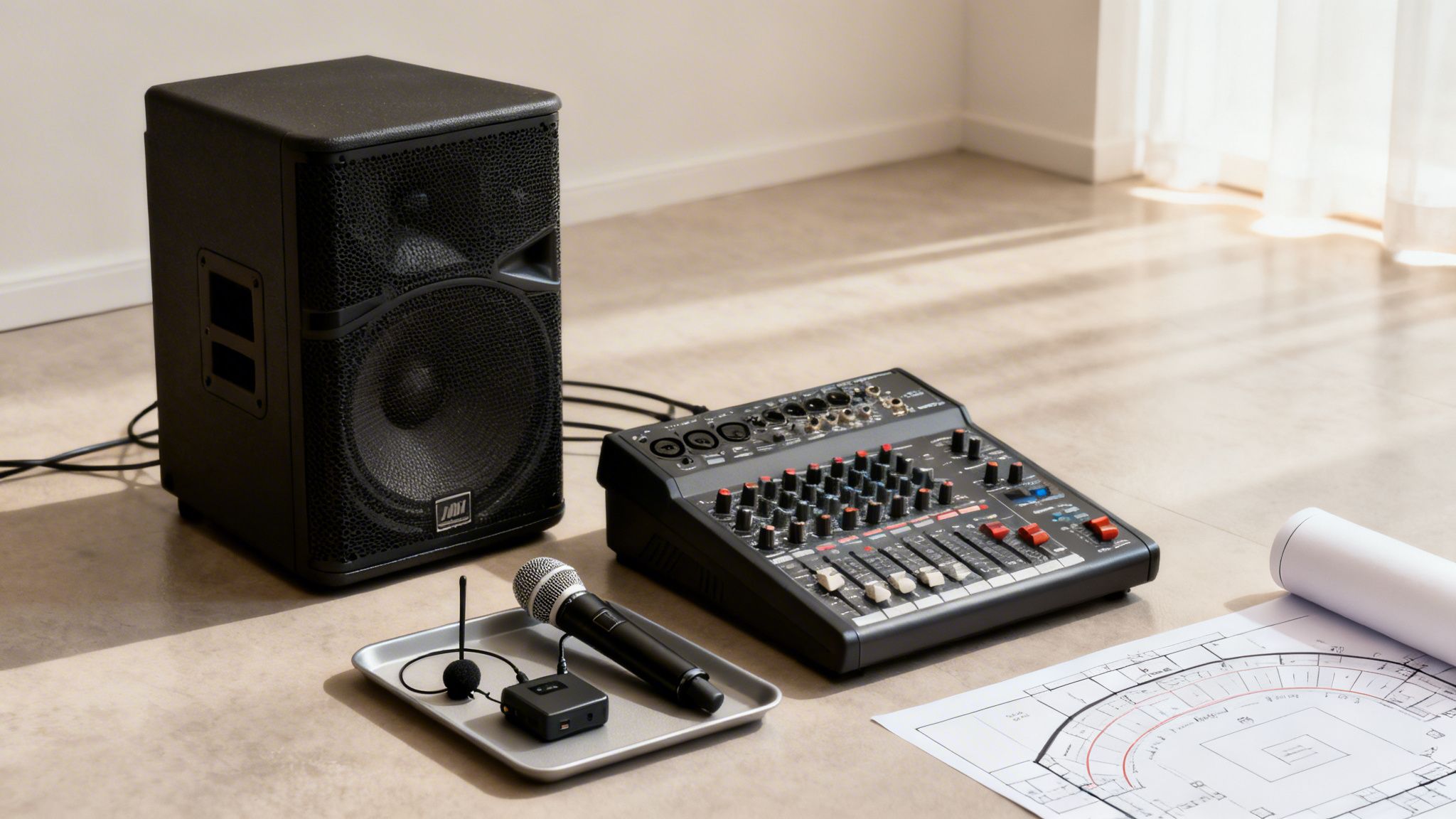
When we talk about a sound system, we are usually referring to a Public Address (PA) system. This is the collection of equipment that projects sound from the stage to the audience. While specifics vary, almost every professional setup comprises three core components. Understanding these will make your discussions with AV suppliers much clearer.
Microphones: This is the starting point. Microphones convert sound waves, such as a presenter's voice or an instrument, into an electrical signal. The first key decision is typically between wired and wireless options.
Mixing Desk: This is the control centre of the audio operation. A sound engineer uses it to take all the audio inputs (microphones, laptops, music sources) and balance them. They adjust the volume and tone of each source before sending a single, blended signal to the loudspeakers.
Loudspeakers: The final step. Loudspeakers convert the electrical signal from the mixer back into the sound the audience hears. The number, type, and placement of speakers are crucial for ensuring everyone in the room has the same high-quality audio experience.
If you want to explore the technical details further, our guide on what audio visual equipment entails is an excellent resource. A little knowledge helps ensure a provider like London Audio Visual Hire delivers a system that is genuinely fit for purpose.
Getting the Right System for the Room
The venue itself has a significant impact on sound. A space with high ceilings, glass walls, and hard floors is an acoustic challenge compared to a carpeted hotel ballroom with soft furnishings. Sound reflects off hard surfaces and is absorbed by soft ones. This is precisely why a "one-size-fits-all" approach to sound hire is ineffective.
To illustrate, let’s compare two very different events.
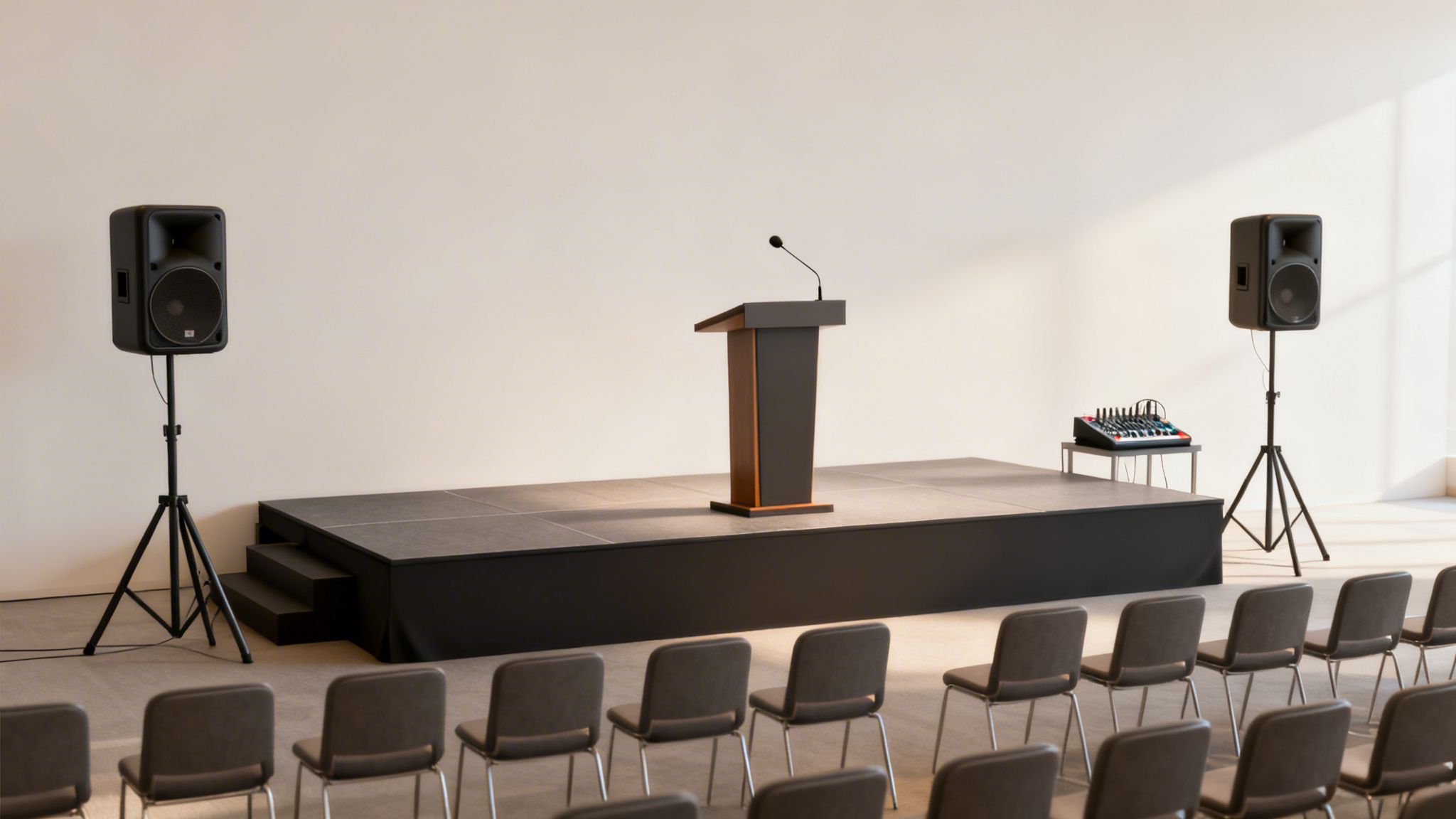
The Small Seminar: For a group of 50 people in a standard hotel meeting room, the audio needs are simple. The setup would likely consist of two compact speakers on stands, a small mixing desk, and a microphone on the lectern. The goal is crisp, clear speech that everyone can hear without straining.
The Major Conference: Now consider 500 delegates in a large exhibition hall. This requires a much more powerful system to fill the space without creating excessive volume levels or echoes. This typically involves a more complex setup with multiple speakers placed strategically, sometimes with smaller 'in-fill' speakers to cover any audio dead spots, all controlled from a more capable digital mixing desk.
The objective is always the same: every person in the audience must hear every word perfectly, whether they are in the front row or at the back of the room. A good AV partner will analyse your venue's unique acoustics and design a system to achieve this.
Thinking Beyond the Basics
Once the core PA system is specified, a few other details can significantly enhance the professionalism of your event. Considering these early will prevent issues on the day.
PA System Sizing Guide for Common Event Types
This quick-reference table provides a starting point. It is not a substitute for a professional consultation but can help you understand what might be required for your event.
| Audience Size | Event Type | Typical PA System Components | Key Considerations |
|---|---|---|---|
| Up to 50 | Seminar, Workshop, Board Meeting | 2 x compact speakers on stands, small analogue mixer, 1-2 mics | Simple vocal clarity is key. A portable "all-in-one" PA system is often sufficient. |
| 50 – 150 | Small Conference, Awards Dinner | 2-4 x larger speakers, small digital mixer, 4-6 mics | Will you have Q&A? You'll need handheld wireless mics. Is there background music or video playback? |
| 150 – 500 | Large Conference, Product Launch | Multiple speakers (line array or distributed), digital mixer | Requires professional system design to ensure even coverage. An experienced sound engineer is essential. |
| 500+ | Exhibition Hall, Outdoor Event | Large-format line array, multiple delay speakers, large mixer | Complex acoustic challenges. Requires detailed planning, a site visit, and a full technical team. |
Remember, this table is a guide. Factors like room shape, ceiling height, and live music will all influence the final specification.
Key Decisions Beyond the Basics
Wired vs. Wireless Microphones
This choice often depends on practicality and presenter preference.
- Wired microphones, such as those on a lectern, are highly reliable and deliver excellent sound quality. They are ideal for speakers who remain in one position.
- Wireless microphones (handheld for Q&A or a small lapel mic) give presenters the freedom to move around the stage. This allows for a more dynamic style but requires careful management by an engineer to avoid radio interference.
The Importance of Foldback Monitors
A small, wedge-shaped speaker on the stage floor pointing towards a presenter is a foldback monitor. It is a simple but vital piece of equipment.
It allows speakers to hear their own voice clearly, which helps them maintain a natural pace and tone, especially in a large room where sound can feel distant. Forgetting to specify monitors is a common oversight that can negatively affect a presenter's performance.
Managing Logistics, Power, and People
Even the best audio equipment is useless without a solid logistical plan. Renting sound equipment involves more than just speakers and a mixing desk; it includes the intricate coordination of power, venue access, and having the right personnel on site. Managing these details separates a seamless event from a stressful one.
The process begins with clear, early communication with the venue to resolve practical details. Any reputable supplier will handle this, but understanding the process helps you appreciate what is happening behind the scenes.
Getting Friendly with the Venue
For anything more complex than a simple speech setup, a technical site visit is essential. This allows a project manager or engineer to assess the space in person, identifying potential issues long before the event day.
Here’s what they are looking for:
- Power Availability: Where are the power sockets? Are they standard 13-amp sockets, or does the PA system require more substantial 32-amp or 63-amp three-phase power? A professional will ensure the system does not overload the venue’s circuits, a common and avoidable problem.
- The Load-in Route: What is the access route from the delivery vehicle to the stage? Are there lifts, tight corners, or stairs? Understanding this determines the time and personnel required for a smooth setup.
- Speaker and Rigging Points: For larger events, flying speakers from the ceiling provides the best coverage. A site visit confirms if the venue has suitable rigging points and if they can support the weight. It also helps plan the optimal placement for ground-stacked speakers, ensuring good coverage and safe cable management.
The Human Element: Your Technical Team
High-quality equipment is only as good as the person operating it. The scale and complexity of your event will determine the technical team you need.
A common mistake is to invest heavily in equipment but economise on the crew. An experienced sound engineer is not a luxury; they are your insurance for excellent audio.
The event crew typically includes several key roles:
- AV Technicians: These individuals handle the physical setup, running cables, positioning speakers, and preparing microphones according to the plan. For a straightforward event, a technician may also operate the system.
- Sound Engineer: For events with live music, multiple speakers, or complex audio cues, a dedicated engineer is essential. Their job is to mix the sound live, constantly adjusting levels to ensure every word and note is heard perfectly.
- Project Manager: On larger productions, a project manager acts as the central coordinator. They are your single point of contact, liaising between you, the venue, and the technical crew to ensure everything runs smoothly.
To understand the full spectrum of support available, it is worth exploring the professional event production services that partners like London Audio Visual Hire can provide.
Playing it Safe: Compliance and Insurance
Any professional audio hire company prioritises safety and legal compliance. This is not just a formality; it protects you, your guests, and the venue from liability. Before signing any agreement, ensure your supplier has the correct documentation. Working with established firms, like those you might find among the Top event production companies london: 2025 picks, often streamlines this process.
There are several non-negotiable documents you should expect:
- Public Liability Insurance: This is essential. It covers any accidental injury or property damage. A reputable company will hold a policy for at least £5 million.
- PAT Testing Certificates: Every piece of electrical equipment must be regularly safety tested. Portable Appliance Testing (PAT) certificates prove that the equipment is maintained and safe to use.
- Risk Assessment and Method Statement (RAMS): This document identifies potential hazards, from tripping over cables to manual handling, and details how the crew will work safely to mitigate them. Many venues require this document before allowing a supplier on-site.
On-Site Execution and Contingency Planning
With the planning complete, event day is when the plan is put into action. Translating a technical specification into a live sound system requires calm coordination and extensive experience. When a professional crew arrives on site, they begin a structured process designed to deliver flawless audio.
The load-in and setup is a carefully coordinated process. An experienced team from a company like London Audio Visual Hire will work to a pre-agreed schedule, coordinating with the venue manager and other suppliers. This ensures that flight cases are moved safely, cables are run discreetly, and audio components are positioned without obstructing other teams.
This initial phase is about building the system's foundation. Speakers are positioned for optimal coverage, the mixing desk is set up at its control point, and every microphone is prepared for testing. It is methodical work that follows the technical plan precisely.
From System Test to Soundcheck
Once the equipment is physically in place, the technical work begins. This is more than just tapping a microphone and saying, "one, two." A sound engineer will systematically test every link in the audio chain to ensure the system is fully operational before any presenters arrive.
This process involves several critical steps:
- Line Checking: A point-to-point test of every cable. Does the signal from the lectern microphone reach the correct channel on the mixing desk? Is it free from interference? Every connection is checked.
- Speaker Tuning: You may hear a "shushing" sound, known as pink noise, playing through the PA. The engineer uses this to analyse how the room's acoustics are affecting the sound. They then use equalisation ('EQing the room') to correct any problematic frequencies, ensuring the audio sounds natural and clear.
- Frequency Management: When using multiple wireless microphones, interference is a risk. The engineer scans for available radio frequencies and assigns a clean channel to each wireless device. This prevents pops, crackles, or signal dropouts.
The logistics involved on the day are a critical part of making sure everything runs smoothly.
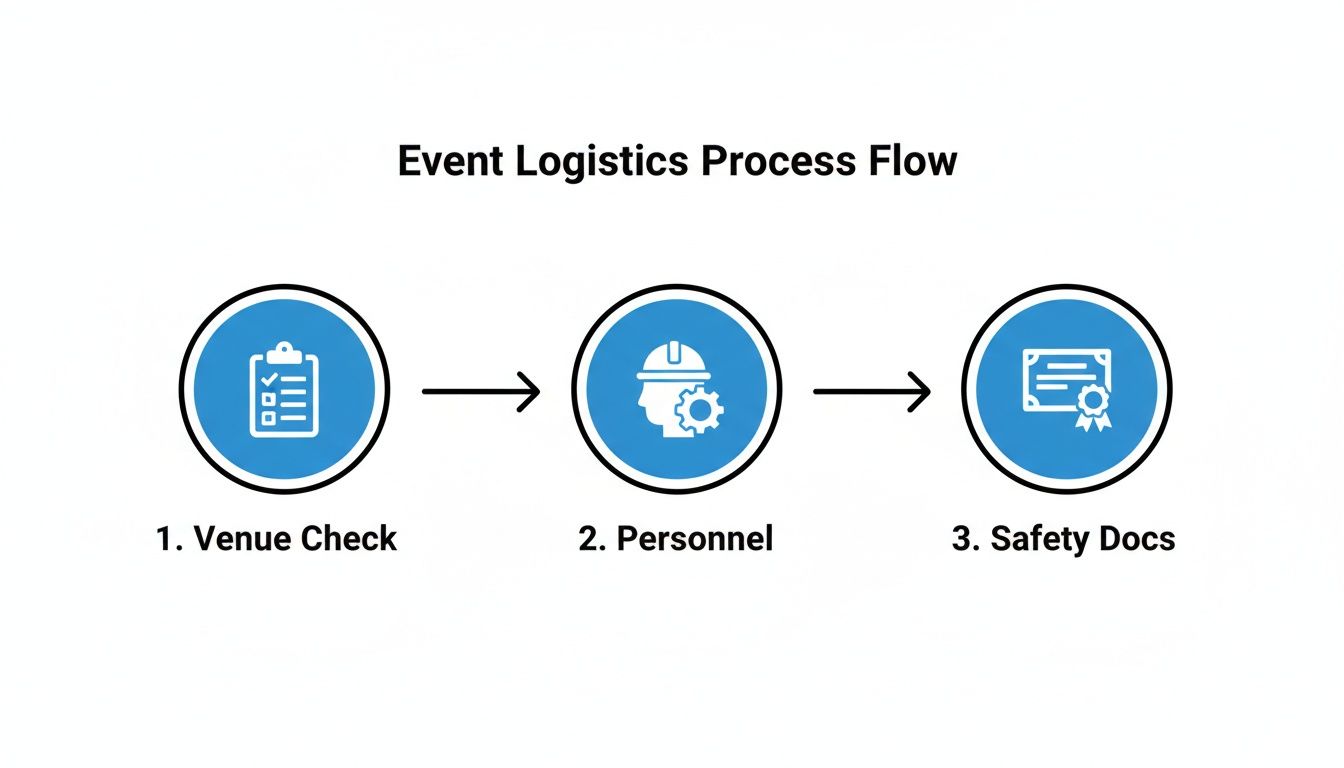
This workflow shows how a thorough venue check, having the right people on the job, and getting the safety paperwork sorted forms the bedrock of a professionally managed event day, dramatically cutting down on-site risks.
The final, and arguably most important, pre-event step is the soundcheck with the presenters. This is a dedicated time slot, ideally before guests arrive, for anyone using a microphone to become comfortable. The engineer uses this time to set the specific volume and tonal settings for each person's voice, ensuring they sound their best. A good soundcheck gives a presenter confidence and ensures their message is heard clearly.
Proactive Troubleshooting and Thinking Ahead
Even with the best plan, live events can be unpredictable. This is where an experienced on-site engineer proves their value. They are not just operating the equipment; they are anticipating and solving problems before the audience is aware of them.
An experienced engineer’s primary role during an event isn't mixing—it's listening. By constantly monitoring the audio, they can make tiny adjustments to maintain quality and react instantly to any unexpected issue, ensuring the experience feels completely seamless for everyone in the room.
Common on-site issues are handled with a calm, methodical approach.
- Microphone Feedback: That piercing squeal is preventable. An engineer prevents this by carefully positioning speakers away from microphones and by using the mixing desk to remove the specific frequencies causing the feedback loop. This is known as "ringing out" the system.
- Unexpected Interference: If a wireless microphone picks up static from a nearby radio source, an engineer can swiftly switch it to a pre-planned backup frequency, often without the speaker needing to pause.
- Volume Level Management: The acoustics of a room change when it fills with people. A space that sounds perfect when empty will sound different once it contains 300 people absorbing the sound. A good engineer makes subtle adjustments to the overall volume to compensate, ensuring consistent clarity.
Ultimately, a successful event day depends on control and foresight. It's the combination of a rigorous setup, a thorough soundcheck, and the proactive problem-solving that only a professional engineer can provide. This meticulous attention to detail is what ensures the rental of sound equipment translates into a truly flawless audio experience.
Wrapping Up: De-Rig and Reviewing the Partnership
The event's conclusion does not mean the job is finished. The post-event de-rig is a crucial final stage that reflects your AV partner's professionalism and respect for the venue.
A top-tier crew, like the ones from London Audio Visual Hire, will approach the de-rig with the same care as the setup. This is a systematic process of safely dismantling equipment, coiling cables, and securing everything in flight cases.
The operation should be quiet, efficient, and discreet. The goal is to leave the space exactly as it was found, working around the venue's staff and schedule. This smooth exit maintains a good relationship with the venue, which benefits your future events there.
From Supplier to Partner: The Post-Event Debrief
With the equipment packed away, there is one final, vital step: the post-event review. This is where a supplier relationship can become a long-term partnership. A brief debrief is an opportunity to discuss what worked well and what could be refined for the next occasion.
Honest, constructive feedback is valuable. Was the sound for the panel discussion clear from every seat? Did the live band's audio mix have the desired impact? This dialogue helps your AV team fine-tune their approach for your future events, guaranteeing an even smoother experience.
A proactive debrief elevates a one-time transaction into a strategic partnership. It shows a mutual commitment to excellence and continuous improvement, the hallmark of any great event team.
This final stage brings the process full circle. It reinforces that excellent event audio is not just about renting the right equipment. It is the result of a collaborative process, from the initial brief to the final de-rig, underpinned by expert knowledge and a strong relationship with your technical team.
Got Questions? We’ve Got Answers on Sound Hire
Planning event audio can be complex. We have compiled answers to the questions we hear most often from event planners.
How Far Ahead Should I Book the Sound System?
The answer depends on your event's scale.
For larger, more complex events such as conferences, awards shows, or live music performances, you should book your sound equipment and crew three to six months in advance. High-end equipment and experienced engineers are in high demand, especially for popular dates.
For smaller events, like a simple presentation or a drinks reception, booking four to six weeks out is often sufficient. However, be mindful of peak seasons like summer and the pre-Christmas period, when availability is limited. It is always advisable to book as early as possible.
Do I Really Need a Sound Engineer?
If your event involves more than a couple of microphones, live music, or complex audio cues, then yes, a professional sound engineer is essential. They do not just set up the equipment; they actively mix the show, balance levels in real-time, and resolve any issues before they affect the audience.
For a very basic setup, such as a single lectern microphone for a speech, a competent AV technician can manage the setup and soundcheck. However, as soon as complexity increases, the engineer becomes your safety net.
Think of a sound engineer as an investment in quality control. They are the person who turns a collection of speakers and microphones into a crystal-clear, professional audio experience that enhances your event.
What Info Do You Need to Give Me an Accurate Quote?
The more detail you provide upfront, the more accurately we can tailor a system to your event and budget. A vague brief leads to a vague quote, so please try to have this information ready:
- The Basics: We need the event date, the full venue address, and an estimated audience size.
- The Timings: When can our crew access the venue to set up? What time does the event start and finish? When must the venue be cleared?
- The Content: What needs to be amplified? Tell us about the number of speakers, if you have a band or DJ, and if you require background music or video sound.
- The Space: A floor plan is extremely helpful. It allows us to determine the best placement for speakers, how to run cables safely, and where to position the mixing desk.
A detailed brief helps a technical partner like London Audio Visual Hire design a system that is right on the money, avoiding guesswork and ensuring your event runs without a hitch.
If you’re ready to start planning, drop us a line through our website at https://londonaudiovisualhire.co.uk.