

When you need to rent speakers in London, the success of your event hinges on achieving the right audio. It is not just about volume; it is about delivering your message with clarity and creating an atmosphere that engages every guest.
Matching Your Audio Needs to Your London Event
Choosing the correct sound system is one of the most critical decisions for an event organiser. London offers a wide variety of venues, from historic buildings with challenging acoustics to modern conference centres. This variety means a one-size-fits-all approach to sound is ineffective.
The goal is to move beyond technical jargon and focus on what matters: delivering impactful sound that keeps your audience engaged. Whether it is a keynote speech, a high-energy product launch, or a formal gala dinner, the audio quality directly shapes the guest experience.
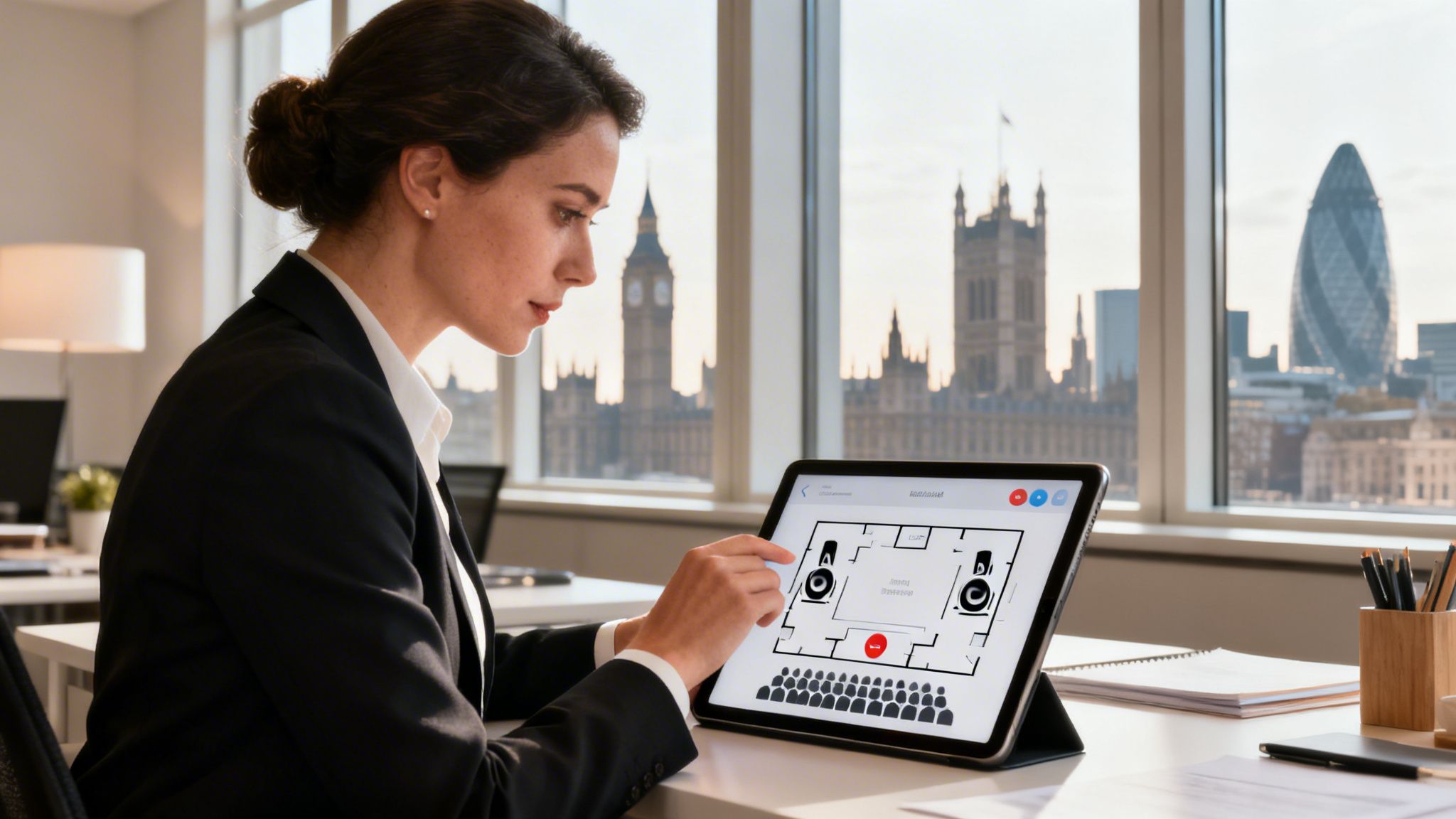
Defining Your Event's Audio Profile
Before contacting a supplier, it is helpful to outline your basic requirements. This preparation leads to a more productive discussion and ensures the subsequent quote accurately reflects your needs.
Start by considering these core elements:
- Audience Size: Are you hosting an intimate meeting for 50 people or a large conference for 500? The equipment required for each is significantly different.
- Event Type: Is the primary focus spoken word, background music, or a live band? Each scenario demands a different speaker setup and ancillary equipment.
- Venue Layout: Will guests be seated or standing? Are there pillars or separate rooms that also require sound coverage?
- Content Sources: What devices will connect to the system? You may need microphones for presenters, a laptop for video playback, or inputs for a DJ mixer.
Clarifying these details is the first step in briefing your audio-visual partner. With this information, they can recommend a setup that is genuinely suitable for your event. To understand the components involved, you can learn more about what audio visual equipment entails in our detailed guide.
A common challenge is underestimating the complexity of sound in London's unique venues. In a Grade II listed building, for example, there may be restrictions on rigging equipment and significant acoustic issues like echo and reverberation. Managing such a space requires specialist equipment and a technician with relevant experience.
The Value of Professional Speaker Hire
A professional hire company acts as a strategic partner, not just a supplier. An experienced team, such as London Audio Visual Hire, does more than deliver equipment. We provide the technical knowledge to assess your needs, select the right hardware, and ensure it is installed and operated correctly on the day.
This expertise is invaluable. It helps prevent common event problems such as feedback during a CEO’s speech, audio dead spots, or a technical failure mid-presentation.
Investing in professional audio support provides peace of mind. It ensures your message is heard as intended, protecting your brand's reputation and contributing to a successful event.
Choosing the Right Speaker Type for Your Purpose
Navigating technical specifications for speakers can be complex. A more effective approach is to focus on the experience you want to create rather than the equipment itself. Is it a conference where every word must be clear, or a product launch where music needs to make an impact?
Making the right choice at the outset is crucial. A suitable sound system will either integrate seamlessly or become a powerful tool for audience engagement. An unsuitable one can detract from an otherwise well-planned event.
Match the Speakers to the Event
The event format provides the clearest indication of the speakers you require. Different occasions have distinct audio demands. Here are some common scenarios in London and the typical solutions.
Conferences and Seminars: For events focused on the spoken word, a Public Address (PA) system is the standard choice. These systems are designed for vocal clarity. The objective is to ensure the person in the back row can hear a keynote speaker as clearly as the person in the front. A typical setup includes a pair of speakers on stands, a lectern microphone, and wireless handheld microphones for audience questions.
Gala Dinners and Awards Ceremonies: These events combine speeches, background music, and audio stings for awards. While the clarity of a PA system is still necessary, aesthetics often play a larger role. In London’s historic venues, large black speaker boxes can be visually intrusive. Column array speakers are an effective solution. They are tall, slim, and blend into the background, delivering excellent sound without being an eyesore.
Product Launches and Brand Activations: To generate excitement, you need sound with significant impact. For a large launch event, consider line array speakers. These are the curved stacks of speakers commonly seen at concerts. They are designed to project sound over long distances, ensuring the audio is powerful and consistent throughout the venue.
Pop-Ups and Outdoor Events: For locations without easy access to mains power, or for temporary events in parks, portable, battery-powered speakers are the ideal choice. Modern versions are surprisingly powerful and offer high-quality sound, providing freedom from power constraints and cables. They are well-suited for smaller gatherings or street marketing campaigns.
Do You Need a Subwoofer?
Sometimes, the main speakers are not sufficient. To create a truly immersive sound, you may need specialised equipment. This is where a discussion with your AV supplier is highly beneficial.
The most common addition is a subwoofer. These speakers are designed exclusively to produce deep, low-frequency bass that you can feel as well as hear.
For a standard conference, subwoofers are generally unnecessary. However, if you are planning a DJ set, a live band performance, or showing a dramatic video with a cinematic soundtrack, they are essential. They add the depth and energy that standard speakers cannot produce alone.
Investing in professional audio hire is about more than just equipment; it is about assurance. In London, where over 40% of all UK corporate events take place, event planners have found that professional AV support can reduce setup failures by as much as 70%. This is a significant advantage for any in-house team or agency. You can find more data on this in the UK audio equipment rental market report.
To help you begin, here is a quick-glance table comparing common speaker hire options.
Speaker Hire Options for London Events
This table provides a simple overview of the main speaker types, their best applications, and the typical audience size they can accommodate. Use it as a starting point for your conversation with a supplier like London Audio Visual Hire.
| Speaker Type | Best For | Typical Audience Size | Key Feature |
|---|---|---|---|
| PA System | Conferences, seminars, meetings | 50 – 500 | Optimised for speech clarity and even vocal distribution. |
| Column Array | Gala dinners, awards shows, high-end receptions | 100 – 400 | Discreet, slim profile for visually sensitive venues. |
| Line Array | Large launches, concerts, festivals | 500 – 5000+ | Provides powerful, consistent coverage over wide areas. |
| Battery-Powered | Outdoor events, pop-ups, small activations | 20 – 150 | Offers maximum portability and no need for mains power. |
Having a basic understanding of what might work for you makes the initial call with your AV partner much more productive. You will be able to explain your objectives, and they can help you address the technical details.
Sizing Your System for Your Venue and Audience
You have decided on the right type of speaker for your event. The next question is: how many do you need? This is about more than just volume; it is about ensuring every guest has a consistent and intelligible listening experience.
This is where sound dispersion and coverage become important. This technical-sounding term simply means matching the speaker’s power and angle to the physical space and the people within it.
Consider these factors:
- Audience Size: How many people are you expecting? This determines the overall sound pressure level (SPL) required.
- Dispersion Angle: Every speaker projects sound in a specific pattern, similar to the beam from a torch. This angle dictates the area a single speaker can cover effectively.
- Venue Layout: Is the room long and narrow? Are there pillars, balconies, or other architectural features? Anything that can block or reflect sound needs to be considered.
- Environment: For outdoor events, you must contend with background noise, wind, and the absence of walls to contain the sound.
Even indoors, every room has unique acoustic properties. Many historic London halls have ornate ceilings and hard surfaces that create a challenging environment of echoes and sound traps requiring careful management.
For a practical example, a standing reception for 200 people in a gallery space is very different from a seated conference for the same number. For the reception, you would want several smaller speakers distributed around the room, so the sound is clear but not overpowering, allowing for conversation.
For the seated conference, you would likely use fewer, more powerful speakers aimed directly at the audience to ensure every word from the stage is clear.
Practical Examples for Different Formats
For a drinks reception in a converted warehouse, a typical specification might be four 12-inch speakers on stands, placed strategically for 360° coverage. This setup ensures guests can chat comfortably without encountering audio 'dead zones'.
Now consider a seated conference for 200 delegates. In a typical theatre-style layout, the priority is speech intelligibility. Here, a pair of speakers mounted on either side of the stage, perhaps with small 'front fill' speakers along the stage lip, would be effective. A subwoofer is rarely needed unless you are playing video content with a significant soundtrack.
Outdoor events add another layer of complexity. Wind and crowd noise can absorb sound, reducing a speaker’s effective range. In these situations, portable, battery-powered units with built-in wind protection or more powerful horn-loaded designs are valuable for cutting through the ambient noise to deliver clear audio.
This diagram illustrates how your event's purpose directly influences the ideal speaker setup.
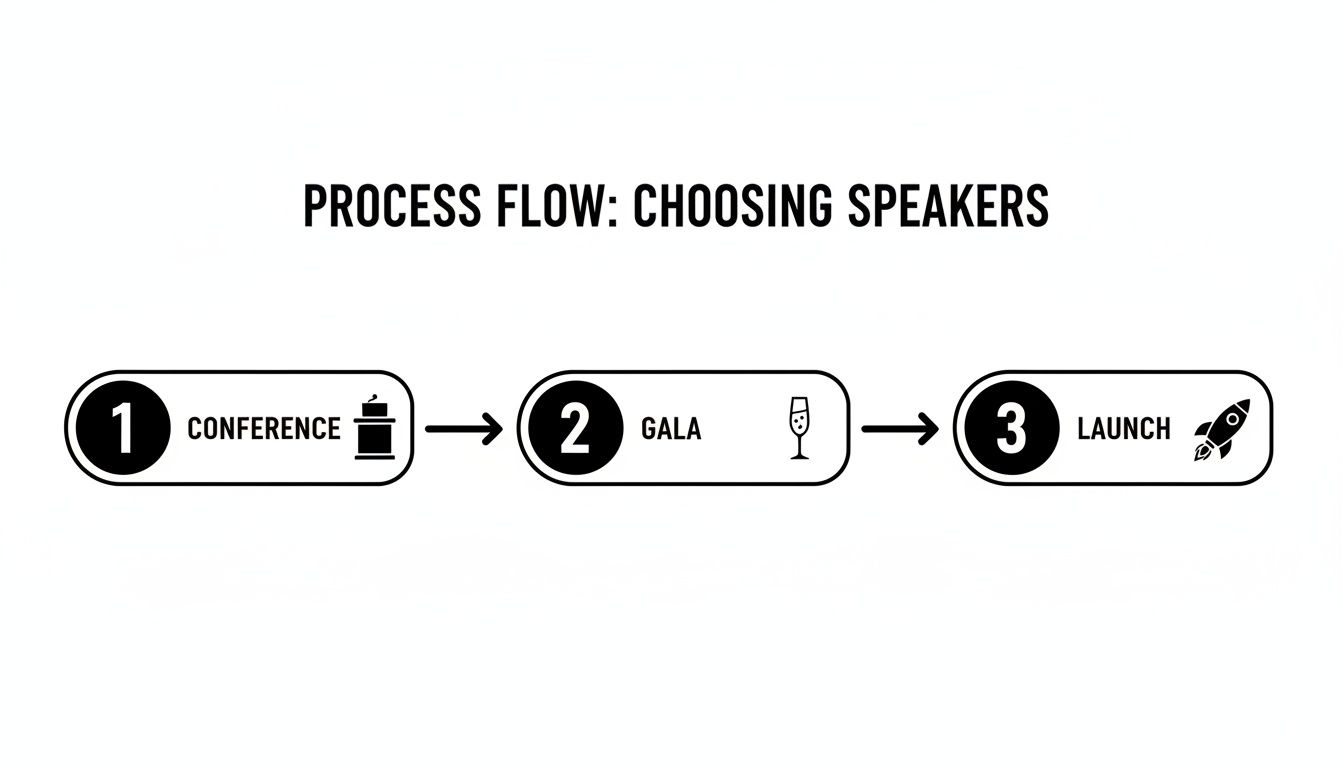
As shown, the audio strategy for a conference differs significantly from that for a gala dinner or a product launch. Conferences prioritise clear speech, galas often benefit from discreet column arrays, and launches may demand a powerful line array to create a high-impact experience.
The diversity of London's event scene is a key driver for the UK's audio-visual hardware market, which was valued at £11.37 billion in 2023 and is projected to reach £16.55 billion by 2030.
There is no substitute for a professional site visit or, at a minimum, a detailed venue floor plan. This is the only way to accurately assess sightlines, locate power sources, and identify potential acoustic problems before the event.
Ensuring Even Coverage
The aim is to eliminate 'hotspots' (where sound is too loud) and 'dead zones' (where it is barely audible). This is achieved by understanding speaker dispersion and managing the overlap between them.
Most professional speakers have a horizontal coverage angle between 60° and 120°. A wider angle means fewer speakers are needed, but it can also lead to more sound reflecting off side walls, which can compromise clarity.
Experience shows that moving a speaker just a few feet can make a significant difference. It is a precise process where expertise is crucial.
This is where your hire partner's knowledge is invaluable. Using their experience and sometimes simulation software, they can design a system that performs effectively in the real world. Proper planning from the start saves considerable time and stress on event day.
Our detailed venue selection guide can be a great resource for mapping out your potential sound layout.
Fine-Tuning SPL Levels
Different events require different volumes. For speeches, a comfortable level is typically around 75–85 dB. For background music, the range might be similar, but for a DJ or live band, you will likely need 95–105 dB or higher.
A useful tip is to plan for a 3 dB increase in power to compensate for the audience. A room full of people and their clothing absorbs a surprising amount of sound.
Before finalising any hire, use this quick checklist:
- Confirm your maximum audience number and their arrangement (seated or standing).
- Assess the room's acoustics, noting any hard, reflective surfaces.
- Double-check the location and capacity of available power sockets.
- Map out your ideal speaker positions on a floor plan.
Correctly sizing your speaker system is not just a technical exercise. It ensures your message is heard, your atmosphere is appropriate, and every guest has a positive experience.
Planning Your Power and Connections
You have chosen your speakers, but achieving excellent sound involves more than the speakers alone. The technical infrastructure, such as power and connections, is where many events encounter problems. Addressing this from the beginning can prevent significant stress on the day.
First, address power. Before anything else, you must understand the venue's power availability. Find out how many standard 13-amp sockets are available and, crucially, where they are located. This is the first question any professional AV team will ask, as it dictates their entire power plan.
For anything larger than a simple speech setup, you will likely need more power than a few wall sockets can provide. This is where professional-grade power distribution units are used. These units take a high-capacity feed from the venue, often a 32-amp or 64-amp supply, and safely divide it into multiple, protected outputs for all your audio, lighting, and video equipment.
Understanding the Key Connections
You do not need to be a sound engineer, but knowing the basic terminology for cables and connectors helps when briefing your AV supplier. It ensures clear communication.
XLR: This is the standard connector in professional audio. You will see these robust, three-pin connectors used for microphones and for linking mixers to active speakers. They feature a locking mechanism to prevent accidental disconnection.
Speakon: These are specifically designed for connecting passive speakers to amplifiers. They handle high currents safely and also lock into place, providing a secure connection that is essential when delivering significant power.
Jack (TRS/TS): You will recognise these from guitars and keyboards. If you have a musician performing, your technician will use a DI (Direct Injection) box. This device converts the signal from a jack cable into a balanced XLR signal, which is vital for preventing buzzes, hums, and signal loss over long cable runs.
A crucial tip: Laptops are used at almost every corporate event. When you rent speakers in London, always mention you will be connecting one. Your supplier will then bring a DI box and the correct adaptors to get a clean, hum-free signal from the laptop into the main sound system. This simple point is often overlooked.
The Other Essentials: Ancillary Kit
Beyond the main components, a range of supporting equipment is what makes a setup professional, safe, and tidy. To get a feel for the full range of gear involved, it is worth browsing the audio visual equipment hire options offered by specialists like London Audio Visual Hire.
Here is a look at what should be on the list:
- Speaker Stands: Heavy-duty stands are non-negotiable. They position the speakers at the correct height for even sound coverage and keep them stable and secure.
- Cable Ramps: If any cables must cross a walkway, these are a health and safety requirement. They protect the cables from damage and, more importantly, prevent a trip hazard.
- Gaffer Tape: A technician's essential tool, used to neatly secure cables to the floor, keeping the event space tidy and eliminating trip risks.
- Audio Mixer: This is the control centre of the audio system. The mixer is where the sound engineer blends all audio sources, such as microphones, laptop audio, and background music, into a controlled output.
By having a clear conversation about power, connections, and these ancillary items with your AV partner, you enable them to succeed. They will arrive on-site with everything they need for a flawless event, allowing you to focus on the bigger picture.
Getting Delivery, Setup, and the Soundcheck Right
This is where planning meets execution. On event day, a well-prepared brief is your most valuable asset for a smooth and stress-free process. When you rent speakers in London, success depends on clear communication and a solid partnership with your AV supplier.
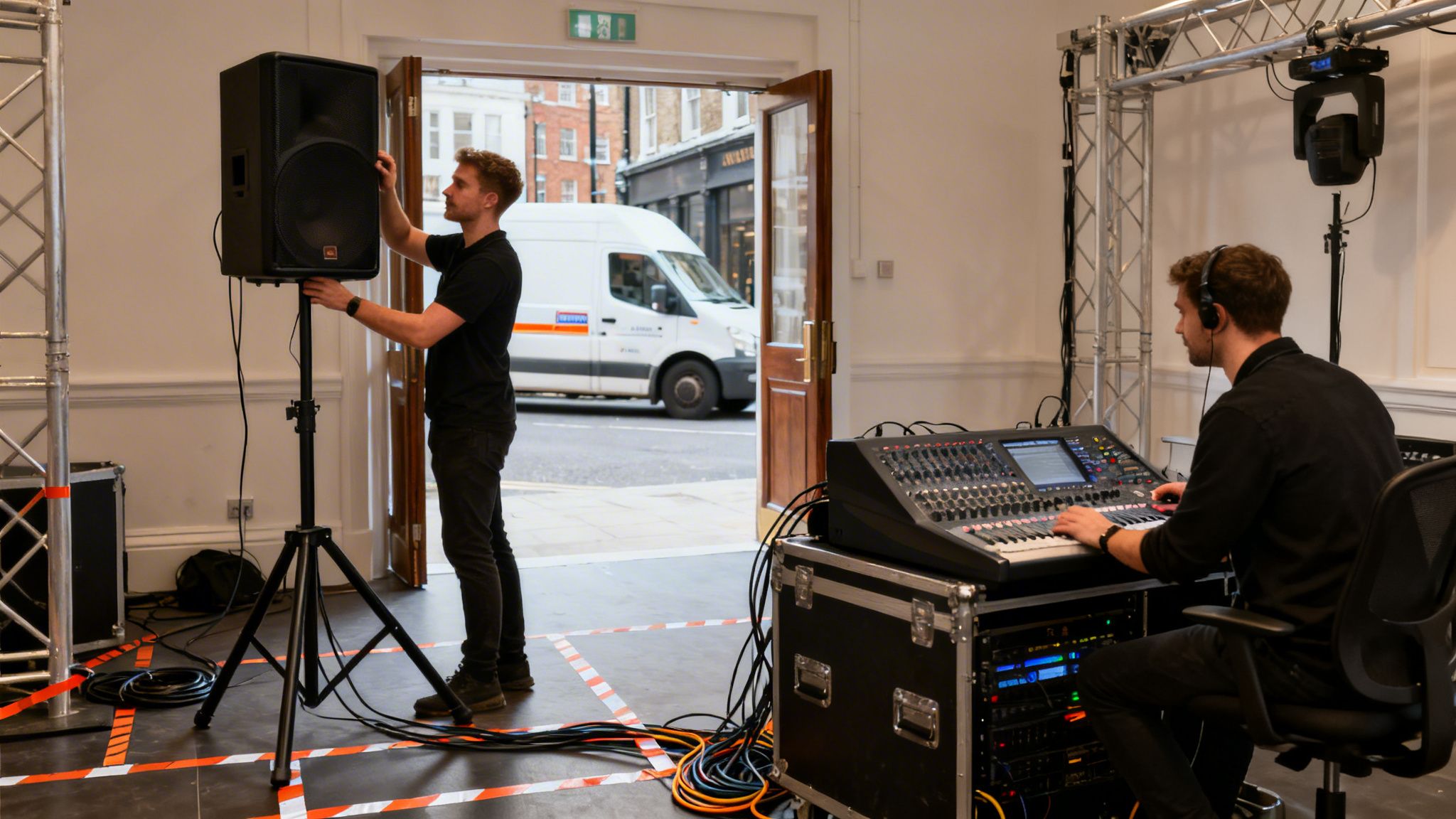
Any reputable hire company, like London Audio Visual Hire, will manage the logistics, but they need your input. Providing precise timings, loading bay details, and a contact for the on-site venue manager allows them to begin work without delay.
Coordinating the Get-In and Rigging
London venues can be logistically challenging, with congestion charges, ULEZ, and tightly scheduled loading bays. An experienced supplier will know this and build buffer time into their schedule. Your role is to ensure their access is clear upon arrival.
Once the crew is on-site, their priorities are safety and efficiency. This typically involves:
- Safe Rigging: Technicians will securely mount speakers on stands or trussing, ensuring they are completely stable.
- Tidy Cable Management: They will run cables neatly along walls and secure them with gaffer tape to eliminate trip hazards. In high-traffic areas, they should use cable ramps to protect both the equipment and your guests.
- Clean Power: The engineer will implement a power strategy, using dedicated lines for audio equipment to avoid interference and audible buzz from other electrical systems.
An event can be easily derailed if the AV team is not informed about a last-minute rehearsal or other logistical changes. A shared, detailed running order is the single best tool for ensuring everyone on-site works together effectively.
Providing the technical team with a clear workspace can significantly reduce setup time. It is a small courtesy that allows them to focus on delivering perfect audio.
Why You Cannot Skip the Soundcheck
The soundcheck is not a formality; it is the most critical part of the audio setup and is non-negotiable. This is where the sound engineer meticulously tests and adjusts every component of the system.
During the soundcheck, the engineer will:
- Balance Levels: Adjust every input, from a lapel microphone to background music and video playback, to ensure they blend correctly. This prevents one source from overpowering another.
- Eliminate Feedback: The engineer will "ring out" the system by pushing frequencies to the verge of feedback. This allows them to identify and cut the specific frequencies that cause piercing screeches before the event begins.
- Check Coverage: The engineer will walk the room, from the front row to the back corners, to ensure the sound is clear, even, and intelligible for every guest.
Your role is to ensure your presenters are available for the soundcheck. A brief five-minute test with each person at the lectern allows the engineer to equalise their microphone for their voice. By facilitating this, you provide the final element needed for a flawless audio experience.
Putting It All Together: Your Hire Brief and Budget
You have completed the groundwork and know what you need. The final step is to compile this information into a clear, detailed brief for your AV partner. Approaching a supplier with a comprehensive brief facilitates a productive conversation and helps them provide their best advice from the outset.
A good brief ensures the quotes you receive are accurate and easy to compare. It saves time for all parties by eliminating the need for back-and-forth emails to clarify basic requirements. When a client sends us a detailed brief, we at London Audio Visual Hire can immediately understand the project and confirm our availability.
Working Out Your Budget
Budgeting for a speaker system is not as simple as selecting an item from a price list. The final cost is a combination of the equipment itself, the complexity of the setup, the duration of the hire, and the level of on-site technical support required.
A conference PA system, for example, will include costs for microphones and a mixer. A high-energy launch party will likely require subwoofers and a larger crew, resulting in a different price.
When compiling your budget, be sure to account for:
- The Kit: The specific speakers, mixers, and microphones needed.
- The Crew: The number of technicians required for setup, operation, and de-rig.
- Logistics: Delivery and collection costs, particularly within central London.
- The Timeline: The duration of the hire, from a half-day meeting to a multi-day conference.
Considering these elements separately helps you build a realistic budget and compare quotes effectively.
The Ultimate Speaker Hire Checklist
A well-structured brief is a powerful tool. It demonstrates professionalism and gives your AV company the information they need to design the perfect system without guesswork. Before you contact a supplier, ensure you have these details ready.
From a supplier's perspective, receiving a detailed brief is extremely helpful. It allows us to focus on providing a solution that will work for you, rather than trying to fill in the blanks.
Here is what to include in your brief:
Event Basics:
- Event Name & Date(s)
- Timings (access for setup, event start and finish, and clear-out deadline)
Venue Details:
- Venue Name & Full Address (including postcode)
- Room Name or specific area (e.g., 'The Ballroom')
- A mobile number for your on-site contact person.
Audience & Audio Needs:
- Expected number of guests.
- Room layout (e.g., theatre style, cabaret, standing reception).
- Purpose of the sound (e.g., speeches, background music, DJ, or live band).
Technical Specifications:
- Number and type of microphones required (lectern, handheld for Q&A, lapel).
- Devices to be connected (e.g., presentation laptop, DJ decks, phone).
Once you have this information prepared, you are in an excellent position to contact suppliers confidently. You will be speaking their language and will be well on your way to securing the perfect sound for a memorable London event.
Got Questions? We've Got Answers
Planning an event involves managing numerous details, and it is normal to have questions about audio. To help you make confident decisions, we have answered some of the most common queries we receive from event organisers in London.
How Far in Advance Should I Book Speakers?
For most corporate events, we recommend booking your speakers and AV equipment at least four to six weeks in advance. This is particularly important if your event falls during London's peak seasons, such as summer or the Christmas period.
If you are organising a large conference or an event with a complex technical setup, a two to three-month window is advisable. This extra time allows for in-depth planning, site visits, and ensures the availability of high-demand equipment.
Is Insurance Included with the Speaker Hire?
Yes, any reputable supplier, including London Audio Visual Hire, will have full public liability insurance. This policy covers our equipment and our technical team while they are on-site at your venue. It is always wise to ask for details of this cover before confirming your booking.
A key point to remember: for 'dry hire' (where you only take the equipment without a crew), you are often responsible for insuring it yourself. We almost always provide a full-service hire with our own technicians to ensure everything is set up and operated safely, which is fully covered by our insurance.
Can I Connect My Own Laptop or Phone?
Yes, this is one of our most frequent requests. Our technicians come prepared with all the necessary cables and professional DI (Direct Injection) boxes to ensure a crisp, reliable audio signal from any standard device.
To ensure a smooth setup on the day, please inform us which devices you will be using when you first make contact. This allows us to bring the correct adaptors, especially for Apple products with Lightning or USB-C ports, and avoid any last-minute issues.
Arranging the audio for your next London event does not need to be a complicated process. A degree of planning combined with the right expert support will ensure your message is delivered perfectly. For friendly, tailored advice and a stress-free production, feel free to contact London Audio Visual Hire.
You can see everything we offer by exploring our audio visual hire services.


