
Getting the right public address hire is the difference between a message that connects and one that is lost in the noise. It is more than just arranging a few speakers; it is a calculated decision based on your venue, your audience, and what you need them to hear. Get it right, and your event feels professional and slick. Get it wrong, and it can undermine the entire day.
Matching the PA System to Your Event
Choosing a PA system can seem daunting. A system that is too small results in muffled sound and frustrated attendees. One that is too large is a waste of budget. The key is to start with a clear brief, built around three simple questions: Who are you talking to? Where are they? And what are they listening to?
This simple decision tree can help you visualise the process and start to define your requirements.
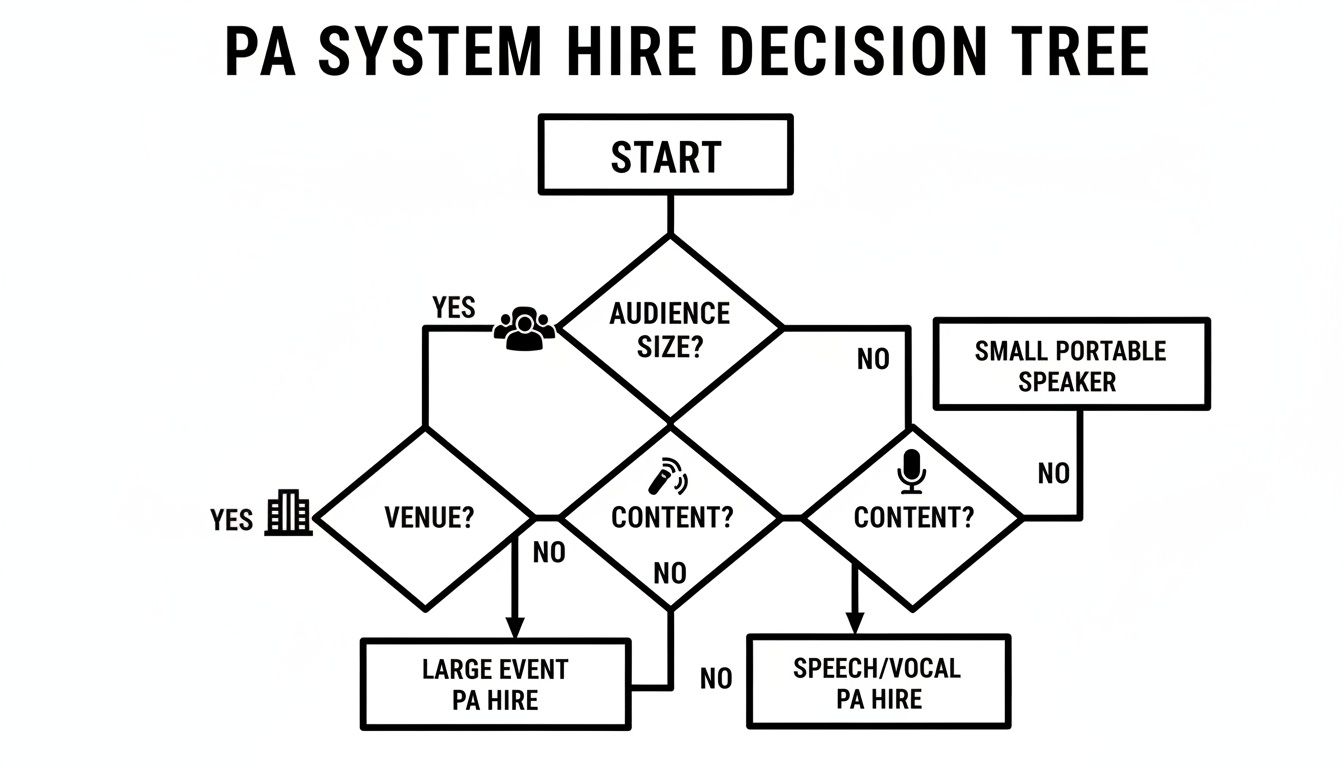
As you can see, one factor flows directly into the next. Finalise these details, and you are well on your way to finding the ideal audio setup.
Assessing Venue and Audience Size
First, you need to understand the space you are working with. A small, carpeted boardroom in a Canary Wharf office behaves very differently from a cavernous hall in a historic London venue with high ceilings and marble floors. Think about the room's acoustics. Are there potential echo traps? Are there awkward layouts that could create sound 'dead spots'?
It is just as important to get a realistic handle on your audience numbers. For an intimate workshop with 30 people, a compact PA system with a couple of speakers will likely be sufficient. But if you are expecting 300 guests for a product launch, you will need a far more robust system. This means more power and, crucially, speakers placed strategically to give everyone the same experience.
For larger events, it is not just about volume; it is about clarity and coverage. The goal is for someone at the back of the room to hear just as clearly as someone in the front row, without the sound being uncomfortably loud for those nearest the speakers.
Defining Your Audio Content
What, exactly, needs to be amplified? The answer to this question dictates the specific equipment you will need. A single presenter at a lectern has completely different requirements to a panel discussion or a live band.
- Speech-Based Events: For conferences, AGMs, or training seminars, your number one priority is vocal clarity. This usually means hiring high-quality lectern or discreet lapel microphones paired with speakers designed for crisp voice reproduction.
- Mixed Media Events: If your event includes a mix of video playback, background music, and live speakers, you will need a more flexible setup run through a mixer. This allows a technician to balance all the different audio sources smoothly without any jarring shifts in volume.
- Live Performances: This is where things get more complex. A band needs specific microphones for different instruments and vocals, on-stage monitors so they can hear themselves, and a multi-channel mixing desk operated by an experienced sound engineer.
Thinking through these audio needs is a fundamental part of any solid corporate event planning checklist. This is especially true in the UK, where a thriving business community creates constant demand for professional events. With small and medium-sized enterprises (SMEs) employing around 16.7 million people, countless businesses depend on clear communication at their events.
To help you get started, here is a quick-reference table matching common London event types with typical PA system recommendations.
PA System Recommendations by Event Type
| Event Type | Audience Size | Venue Example | Recommended PA Package |
|---|---|---|---|
| Small Meeting/Workshop | 10 – 50 | Hotel meeting room, office boardroom | Compact PA with 2 speakers, 1-2 microphones, simple mixer. |
| Medium Conference | 50 – 200 | Conference centre breakout room | 4-speaker system, lectern & lapel microphones, small mixing desk. |
| Large Conference/AGM | 200 – 500+ | Large hotel ballroom, auditorium | Multi-speaker line array, multiple microphones, digital mixer, on-site technician. |
| Exhibition Stand | Variable | Olympia, ExCeL London | Small, focused speakers (e.g., column speakers) and a wireless headset microphone. |
| Gala Dinner / Awards | 100 – 400 | Livery hall, large event space | Distributed speaker system, wireless handheld microphones for awards, lectern microphone. |
This table provides a solid starting point for discussions with a hire company.
By clearly defining your venue, audience, and content, you give a supplier like London Audio Visual Hire exactly what they need to build the right quote. This detailed brief is vital whether you're planning a small seminar or need a comprehensive setup, like those discussed in our guide to conference AV hire in West London. It ensures you get flawless audio without paying for equipment you do not need.
Understanding the Key PA System Components
To get the right public address system for your event, it helps to know what you are actually hiring. You do not need to be a sound engineer, but understanding the core building blocks will make your conversation with a supplier much more productive. It ensures the final package is a perfect fit for your objectives.
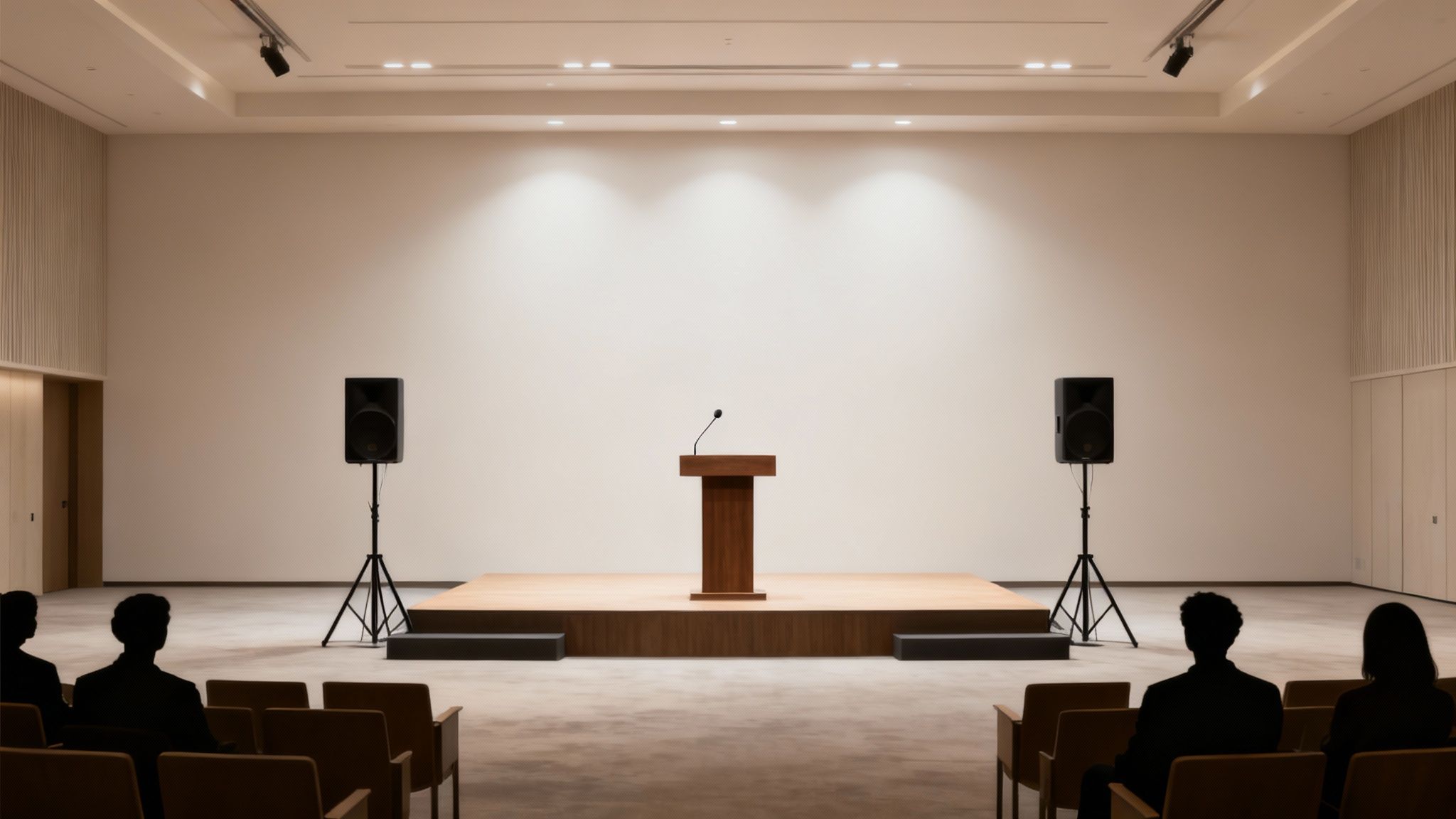
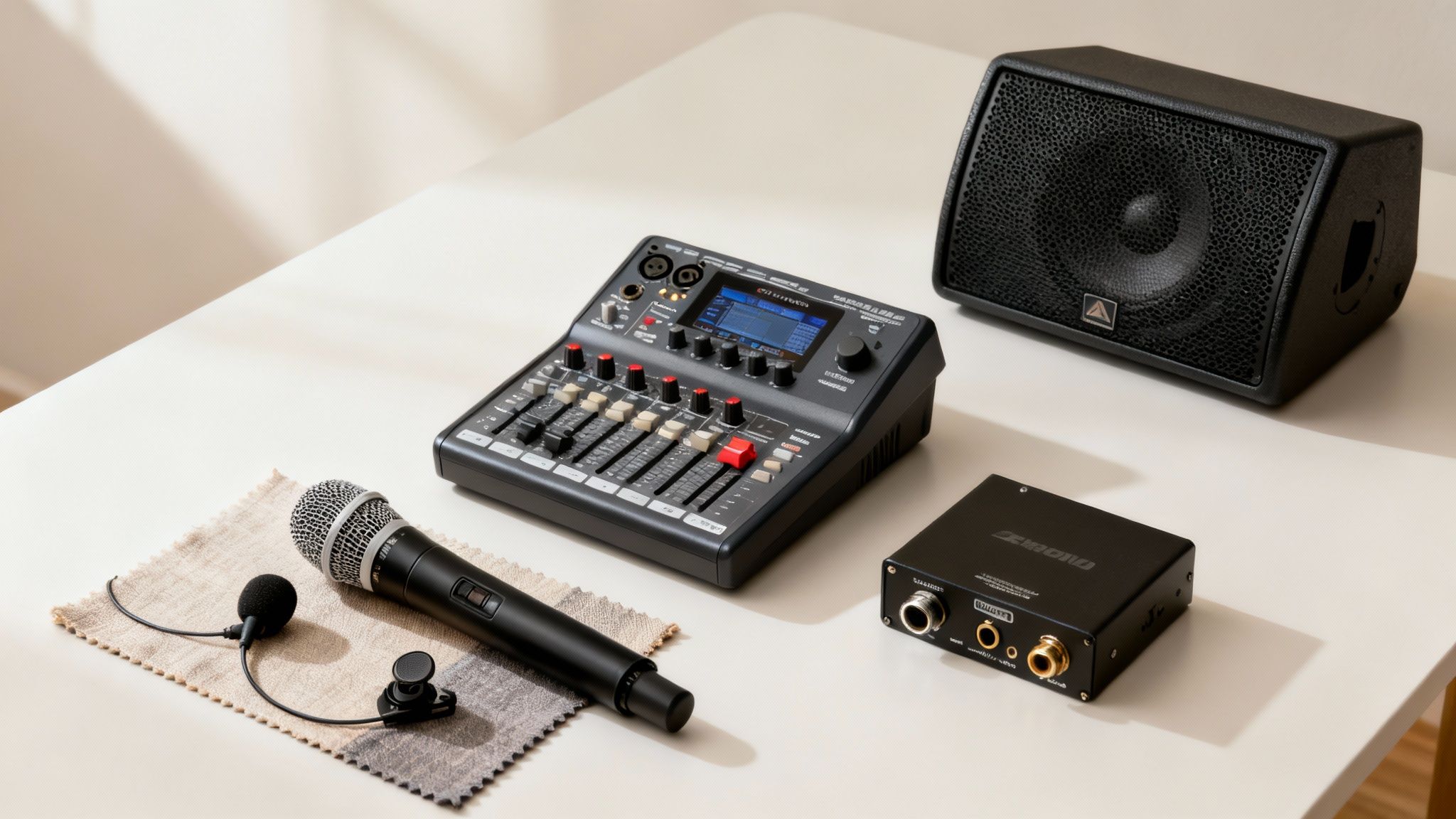
At its most basic, a PA system does three things: captures sound, controls it, and then projects it to your audience. Each of those stages relies on specific pieces of equipment, from the microphones to the speakers.
Microphones: The Starting Point for All Audio
Everything starts here. The microphone is the first link in the chain, turning a voice or music into an electrical signal. The type of microphone you choose can make a huge difference to both sound quality and how smoothly your event runs.
- Handheld Microphones: These are the versatile workhorses of the event world. They are ideal for audience Q&A, passing between presenters, or for awards hosts. They are tough, easy to use, and wireless versions give speakers total freedom to move around the stage.
- Lapel (Lavalier) Microphones: These are small, discreet microphones that clip onto a presenter's clothing. They are perfect for keynote speakers or panel discussions where people need their hands free. You get great, consistent sound even if the speaker moves around, but they are not practical for sharing.
- Lectern (Gooseneck) Microphones: These are the classic microphones you see fixed to a podium. They are the standard for formal speeches, providing a reliable, static audio source so long as the speaker remains in position.
The right choice comes down to your event's format. A panel of four speakers is best served with four lapel microphones. A lively Q&A, on the other hand, is far easier to manage with a couple of handhelds ready to be passed around.
Mixers: The Control Centre
The audio mixer, or mixing desk, is the brain of the operation. It takes in all the signals from microphones, laptops, and video playback and lets a technician balance the levels, adjust the tone, and blend everything into one clean, professional-sounding output for the speakers.
You will generally come across two types:
- Analogue Mixers: These are traditional desks with physical knobs and faders for every function. They are very hands-on and intuitive for many engineers, but they can be bulky.
- Digital Mixers: These are much more compact and powerful. The desks let you save settings for different parts of an event (e.g., a "walk-in music" scene and a "panel discussion" scene) and are the standard for professional corporate events.
If you have more than two microphones or need to mix speech with music, a mixer is essential. It is what separates a messy collection of sounds from a polished production.
Speakers: Projecting the Final Sound
Speakers are the final piece of the puzzle. They take the electrical signal from the mixer and turn it back into audible sound for your audience to hear. The kind of speakers you need is dictated entirely by the size of your venue and where your audience is sitting.
The primary goal of any speaker setup is not just volume but even coverage. Every attendee, whether in the front row or the back corner, should hear the presentation with the same level of clarity.
For a small meeting, a simple pair of active speakers (those with amplifiers built-in) on stands will likely suffice. For larger conferences or in acoustically tricky rooms, you might need a line array system. These are the vertical columns of speakers you see at big events, designed to project sound clearly and evenly over a much greater distance.
Of course, these are just the main components. Behind the scenes, you have amplifiers to power certain types of speakers and DI (Direct Injection) boxes to get a clean audio signal from a laptop into the mixer. To get a feel for the bigger picture, you can check out our guide on what is audio visual equipment.
Knowing a little about these elements demystifies the process and shows why the right technical skill is so crucial. The demand for this expertise is growing; in the UK's tech sectors, employment has expanded by an average of 11.7% per year between 2020 and 2024. As the UK government's analysis of the digital technology sector highlights, this is not just about equipment, it is about the skilled people who make it all work together seamlessly.
Getting Power and Cabling Right
You can have the best PA system in the world, but without a solid power source and a safe cabling plan, it is just a pile of expensive metal. These are the details people often forget, but they are the bedrock of a successful event. Getting them right prevents technical glitches, keeps your guests safe, and makes the entire setup look professional.
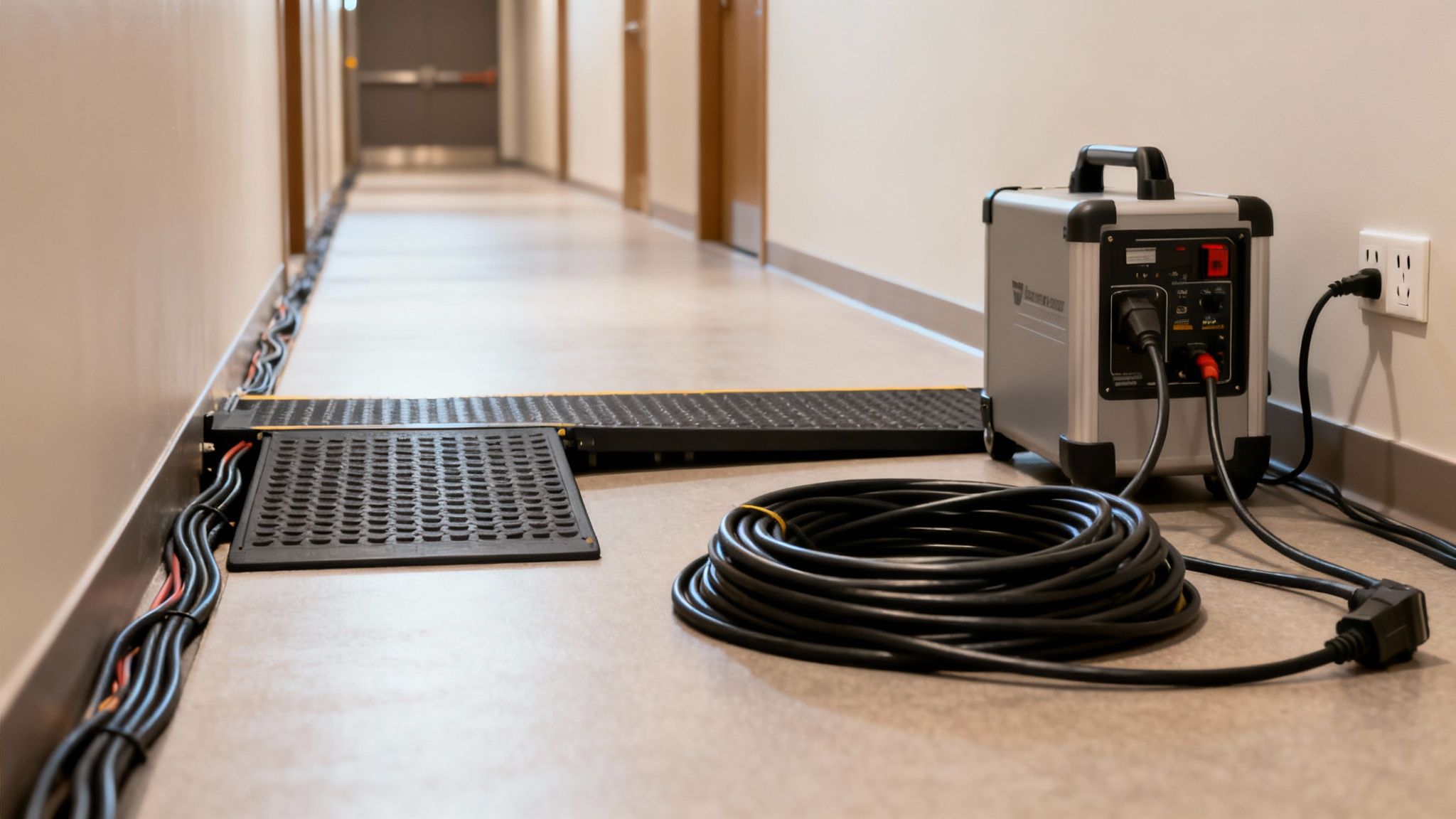
First, you need to do a power check. Before booking a public address hire package, your supplier needs to speak with the venue manager. It is not just about knowing where the sockets are; it is about understanding what they can handle. A standard UK 13-amp socket will be sufficient for a simple PA, but start adding lights and video, and you will likely need dedicated 32-amp or even 63-amp supplies.
Having this conversation early on prevents nightmare scenarios, such as realising the only power outlet is on the opposite side of the room from your stage. That is a recipe for long, unsightly cable runs and last-minute stress.
What to Ask the Venue About Power
When you talk to the venue, you need to get specific information to feed back to your AV provider. A quick checklist will make sure you do not miss anything vital.
- Socket Locations: Get a floor plan that marks out every usable power outlet in the room.
- Circuit Load: Find out if the sockets are on their own dedicated circuit. The last thing you want is for the PA to cut out because it is sharing power with the kitchen's industrial dishwasher.
- Socket Types: Are they standard 13-amp sockets, or does the venue have more substantial industrial connections like Ceeform?
- In-House Distribution: Some larger venues have their own power distribution boxes. If they do, it can make life much simpler.
Getting these answers upfront means a good hire company can plan their power distribution and cabling down to the last detail. It is the foundation of a safe, reliable setup.
Cable Management Is Not Just About Tidiness
Once the power source is sorted, it is all about how you run the cables. Neat, safe cabling is a hallmark of a professional crew. It is also a legal requirement. Under health and safety rules, you have a duty of care to make sure everyone at your event is safe.
Trailing cables are one of the most common trip hazards. Any cable crossing a path where people will walk needs to be properly secured.
Here is the golden rule: if people can walk on it, it has to be covered. Gaffer tape might work for a quiet corner, but for any main walkway or doorway, you need professional rubber cable ramps. There are no exceptions.
These ramps do more than just stop people from tripping; they also protect the cables from being crushed by foot traffic or heavy flight cases. It is that kind of attention to detail that separates the professionals from the amateurs. You also need to protect the equipment itself from power surges, so a basic understanding surge protection is crucial for safeguarding sensitive audio equipment.
Always Have a Plan B for Power
If your event is a major one, a major conference, an awards night, or a flagship product launch, you have to ask yourself: "what happens if the power goes out?" It is rare, but venue-wide power cuts do happen. For complete peace of mind, a backup power solution is a smart move.
This could be as simple as a small Uninterruptible Power Supply (UPS) for the sound desk, or as comprehensive as a dedicated generator for the entire production. Raising these 'what-ifs' with your supplier shows you are thinking ahead and are serious about a flawless event.
By exploring the full range of equipment available at https://londonaudiovisualhire.co.uk, you can specify exactly what you need for a robust power and cabling plan. Being proactive about these logistics is what makes an event truly seamless.
The Real Value of On-Site Technical Support
When you are looking at PA hire, one of the first big questions is whether to opt for a ‘dry hire’ (just the equipment) or a fully supported package. The dry hire option always looks tempting on paper because it is cheaper. But for any event that truly matters, the real value comes from having an experienced sound engineer on-site. Their presence turns a simple equipment rental into a complete audio solution.
Think of an on-site technician from a professional outfit like London Audio Visual Hire as more than just a delivery person. They become a crucial part of your event team, owning the entire audio setup from the moment they arrive to the moment they pack up. They ensure every single component is installed correctly, configured properly, and tuned specifically for the acoustics of your London venue.
This level of professional service is why the UK’s event communication market is so robust, now valued at £4.5 billion. That figure shows just how seriously UK businesses take their events. The fierce competition within the UK's communication activities market means suppliers have to deliver exceptional quality to stand out.
From Soundcheck to Live Mixing
A technician's job starts hours before your first guest walks through the door. They will run a meticulous soundcheck, testing every microphone and audio source. You will see them walking the room, listening carefully to find any acoustic dead spots and making sure the sound is clear and balanced in every single seat.
Once the event begins, their role switches to active, hands-on management. They are focused on the mixing desk, making constant, subtle tweaks to keep the audio pristine. This is not a "set it and forget it" job.
Here is what they are actually doing:
- Balancing Speaker Levels: A softly spoken panellist needs a very different microphone setting from a booming keynote speaker. The technician adjusts these levels on the fly, so your audience never has to strain to hear or be overwhelmed by volume.
- Juggling Multiple Sources: They will seamlessly blend background music, audio from a video presentation, and multiple live microphones, ensuring every transition is smooth.
- Eliminating Feedback Before It Starts: That high-pitched squeal from feedback can ruin a crucial moment. A good engineer uses equaliser (EQ) controls to find and eliminate the problem frequencies before they become audible.
This is not just about avoiding problems; it is about creating a polished, professional sound that reflects well on your brand and keeps your audience completely absorbed.
An on-site technician provides more than technical skill; they offer peace of mind. Knowing an expert is dedicated to managing your audio allows you and your team to focus entirely on your guests and content.
Troubleshooting in Real-Time
Even the best-laid plans can go wrong. A wireless microphone battery can die mid-sentence, a presenter might accidentally press the mute button on their belt pack, or a faulty laptop cable can introduce a buzz. Without an expert on hand, these minor issues can quickly derail a session, creating stress and making the event look amateurish.
A skilled technician can spot and solve these problems in seconds, often before the audience even realises anything was amiss. Picture a lively Q&A with a handheld microphone being passed around. If feedback suddenly erupts, the engineer will instantly pinpoint the cause and adjust the volume or frequency to stop it. That immediate, calm response is priceless.
Ultimately, deciding whether to include on-site support comes down to a simple risk assessment. When you weigh the potential for technical issues against the guarantee of flawless audio, the investment in a sound engineer often becomes the most sensible decision you can make for your event. It is about making sure your message is heard, loud and clear.
Getting to Grips with Quotes, Contracts, and Insurance
Let's discuss the paperwork. While it may not be the most exciting part of event planning, understanding the commercial side of hiring a PA system is essential. It is how you manage your budget, protect your event, and ensure there are no surprises down the line. A professional supplier will make this easy with clear, detailed documents. Knowing what to look for makes the whole process feel much less daunting.
It all starts with the quote. A detailed, itemised quote is not just a price list; it is a sign that you are dealing with a professional and transparent company. If you receive a vague, one-line price, be wary. Those are often the ones that come with hidden costs later on.
What a Proper Quote Looks Like
A good quote breaks everything down, so you can see exactly where your money is going. This level of detail is your best tool for comparing different suppliers fairly and making sure you are not paying for things you do not need.
Your quote should clearly spell out:
- Equipment Costs: Every key piece of equipment, such as speakers, microphones, and mixing desks, should be listed with its individual hire fee.
- Labour Charges: This covers the people on the ground. Look for day rates or hourly charges for technicians, sound engineers, or any other crew.
- Transport and Logistics: There is always a cost to get the equipment to your London venue, set it up, and take it away again. This should be a separate line item.
- Consumables: Small but necessary items like batteries for wireless microphones or gaffer tape for securing cables might be listed here.
- VAT: A simple but crucial point: the quote must clearly state if the prices include or exclude VAT.
When a quote is laid out like this, you are in control. You can scrutinise every detail and ask smart questions about anything that is not clear.
The Hire Contract: What to Watch Out For
Once you have agreed on a quote, the hire agreement or contract will follow. It is a legally binding document, and you must read it before signing. It might feel like a formality, but this document defines everyone's responsibilities and is your protection if anything goes wrong.
Pay special attention to the terms and conditions. Many event issues arise from details in the cancellation terms and payment schedules, so make sure you know exactly what you are agreeing to.
Focus on these key sections:
- Cancellation Policy: What happens if you have to cancel? Most companies have a tiered structure. For example, you might lose 25% of your deposit for a cancellation 30 days out, but 100% if you cancel within 7 days of the event. This is standard, but you need to know the specifics.
- Liability for Damage: The contract will state who pays if equipment gets lost, stolen, or broken. For a 'dry hire' where you just take the equipment, that responsibility is usually yours. If you have hired a full crew, the liability often stays with the supplier's on-site team.
- Payment Terms: Check the deposit amount required to confirm the booking and when the final balance is due. Reputable firms will typically ask for a deposit upfront and the rest just before or immediately after the event.
Insurance and Safety: The Non-Negotiables
Finally, any legitimate public address hire company in the UK must have the right insurance and safety certifications. Do not feel awkward about asking for proof. It is a routine part of due diligence, and any credible supplier will have these documents ready to send over.
Before you make any final decisions, it is a good idea to run through a quick checklist to vet potential suppliers. This helps ensure you are partnering with a reliable and professional company.
Supplier Vetting Checklist
| Category | Question/Verification Point | Why It Matters |
|---|---|---|
| Insurance | Can you provide a copy of your Public Liability Insurance (PLI) certificate? | This protects you, your guests, and the venue from accidents. A minimum of £5 million is standard, but many London venues now require £10 million. |
| Safety | Can I see your latest PAT Testing records for the equipment? | This is a legal requirement. It confirms all electrical equipment is safe to use, preventing electrical faults or hazards. |
| Experience | Do you have case studies or references from similar events or venues in London? | This demonstrates their track record and proves they have the experience to handle an event of your scale and type. |
| Support | What are your emergency contact procedures during an event? | You need to know you can get immediate help if something goes wrong with the audio mid-event. |
| Clarity | Is the quote fully itemised with no hidden costs? | A transparent quote shows professionalism and helps you manage your budget effectively, avoiding unexpected bills later. |
Taking a few minutes to confirm these points can save you a world of headaches. It is the difference between a smooth-running event and a potential disaster.
Verifying this paperwork is not just about ticking boxes. It is about ensuring the safety of your attendees, protecting the venue from damage, and covering your own organisation from potential liability. By asking for these documents, you empower yourself to hire with total confidence, knowing you have chosen a safe, professional partner like London Audio Visual Hire.
A Few Common PA Hire Questions Answered
When you are arranging the sound for an event, a few questions always seem to come up. Drawing from our experience across hundreds of London venues, here are some straightforward answers to help you finalise your plans.
How Far in Advance Should I Book a PA System for My London Event?
For a standard corporate meeting or a small workshop, booking your PA system two to four weeks in advance is usually sufficient. That gives everyone enough time to sort out the details without any last-minute panic.
However, if you are planning something larger, a large conference, a high-profile brand launch, or anything during busy periods like summer or Christmas, you should aim to book at least two to three months ahead. This is not just about securing the equipment; it is about getting the best technicians and allowing for proper, detailed planning. Of course, last-minute requests happen, and we can often help, but booking early prevents a lot of stress.
What's the Difference Between Active and Passive Speakers?
It all comes down to the amplifier. Active speakers have the amplifier built directly into the cabinet. This makes them a neat, all-in-one package that is quick to set up, which is perfect for smaller events, breakout sessions, or exhibition stands where you just need good, clear sound without complexity.
Passive speakers, on the other hand, need a separate, external amplifier to drive them. This approach gives you far more control and flexibility, which is why it is the standard for bigger events where sound quality and coverage are critical. An experienced hire company will know exactly which type is right for your event and venue.
The simple way to think about it: Active speakers offer convenience for smaller events. Passive speakers deliver the power and precision needed for larger, more complex productions.
Do I Need a Site Visit Before My Event?
For any event in a venue that is new to you or known to be acoustically challenging, a site visit is a very good idea. While an experienced supplier like London Audio Visual Hire will know many of London's popular venues inside out, you cannot beat seeing the space for yourself.
A pre-event visit lets a project manager check the power situation, listen for acoustic problems like echoes or dead spots, and figure out the logistics, things like where the van can park and the best route for loading in. For a simple setup in a standard hotel meeting room, you can probably skip it. But for a conference, awards night, or gala dinner, it is an essential part of making sure everything runs like clockwork.
What Happens If Equipment Fails During My Event?
Any professional hire company worth its salt has multiple backup plans. First, all their equipment should be rigorously maintained, serviced, and PAT tested for electrical safety. That prevents most problems from ever happening.
Second, for any important event, a good supplier will build in some redundancy. This might be as simple as including a spare microphone of each type or having a backup laptop ready to go for presentations.
If you have hired an on-site technician, they are your immediate safety net. They can fix most glitches in moments, often before anyone in the audience even notices. If you have opted for a 'dry hire' (equipment only), make sure you have a support number you can call for instant help. It is always worth asking about the support plan before you sign the contract.
Arranging the audio for your event does not have to be stressful. When you work with the right people, you can be confident that your message will be heard loud and clear. The team at London Audio Visual Hire has the expertise and the equipment to make any event in the capital sound great.
To have a proper chat about what you need for your public address hire, visit us at https://londonaudiovisualhire.co.uk.