
When planning an event in London, selecting the right projector and screen is fundamental to making an impact. Your audio-visual setup ensures your message is delivered with clarity. It is the difference between an engaged audience and one that is distracted or unable to see your presentation clearly.
Working with a professional hire company removes the guesswork and guarantees the polished, seamless delivery every event planner aims for.
Why High-Quality Visuals Are Essential for London Events
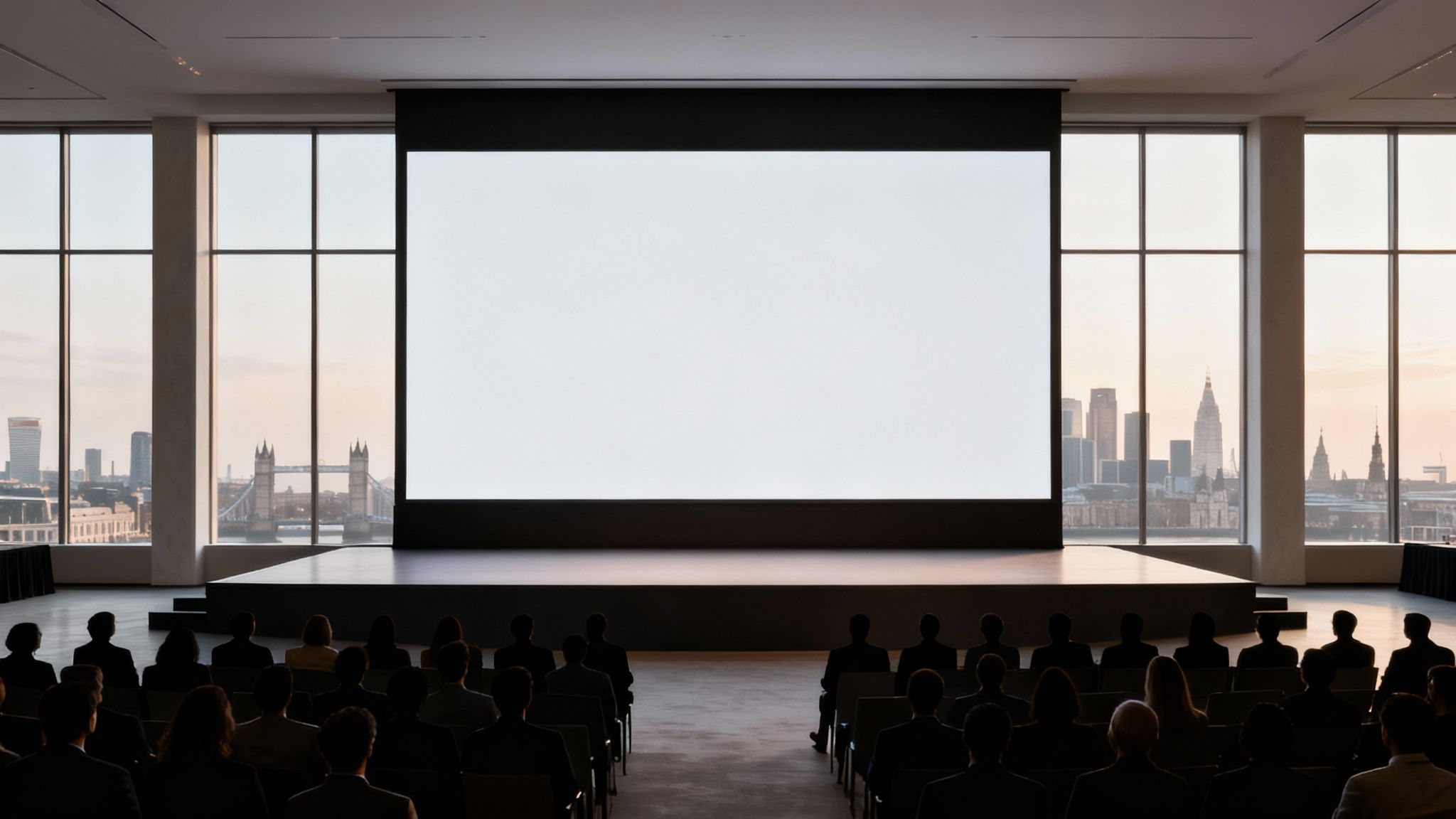
In a city as competitive as London, the quality of your visuals is a direct reflection of your brand. Whether you are hosting a product launch in Shoreditch or a financial conference in the City, your audience has high expectations. A subpar visual experience does not just look amateurish; it can undermine your credibility and dilute your message.
A dim, fuzzy projection or a screen that is too small for the room can derail an otherwise meticulously planned event. These are not minor issues. They create a barrier between you and your audience, reducing engagement and making it harder for them to absorb your content.
The Pitfalls of a DIY Approach
Organisations sometimes attempt to manage AV equipment internally to reduce costs, but this often leads to predictable and stressful problems. Instead of focusing on guests and content, the event team can find themselves troubleshooting technical issues moments before the event begins.
Here are the most common risks:
- Poor Image Quality: A standard office projector cannot compete with the ambient light in most large venues. The result is washed-out colours, fuzzy images and illegible text.
- Incorrect Screen Size: If the screen is too small, people at the back of the room cannot see the detail. If it is too large for the space, it can feel overpowering and unprofessional. The right size depends entirely on the room's dimensions.
- Technical Glitches: Ensuring compatibility between laptops, clickers, sound systems and video sources is often more complicated than it appears. Compatibility issues are a common cause of event-day disruption.
- Safety Hazards: Improperly secured screens and trailing cables are not just untidy; they pose a genuine health and safety risk to everyone in the room.
When you engage a specialist for your projector and screen hire in London, you are not just renting equipment. You are investing in peace of mind and ensuring your content is seen exactly as intended, with maximum impact and professionalism.
A professional service like London Audio Visual Hire manages all of this for you. We ensure you have the right equipment for your venue, install it safely and test everything thoroughly long before your first guest arrives. This guide will walk you through everything you need to consider.
Defining Your Event's Visual Needs
Before considering specific models, the first step in hiring a projector and screen is to establish a clear picture of your event's requirements. This involves more than just a headcount; it means understanding the specifics of your venue, the content you will be showing and the overall experience you want to create. A solid brief is the foundation of any successful technical setup.
The visual needs for an intimate workshop for 50 people in a hotel meeting room are vastly different from a presentation for 500 in a large convention hall. Each scenario requires a different approach to achieve a professional, engaging result.
Audience Size and Viewing Distance
The number of attendees is the starting point for determining screen size. A common mistake is to select a screen that is too small, leaving people at the back unable to see the details on your slides. When this happens, their engagement is lost and the purpose of your presentation is undermined.
Conversely, an oversized screen in a small room can feel overpowering. The goal is to find a balance where the person in the last row can comfortably read the text and see all visuals clearly, without the screen dominating the space.
As a general rule, the back row of seats should be no more than eight times the height of the screen. For a 2-metre high screen, your furthest guest should not be more than 16 metres away.
Venue Characteristics
The physical characteristics of your London venue play a significant part in equipment choice. You must assess these environmental factors before making any decisions:
- Ambient Lighting: How much natural light is in the room? A space with large windows or bright, non-dimmable house lights will require a projector with a much higher lumen count to prevent the image from looking washed out.
- Ceiling Height: Low ceilings can limit the maximum screen size and may make certain truss or stand options unfeasible. Always obtain an accurate floor-to-ceiling measurement.
- Room Dimensions: The room's size and shape dictate the throw distance: the space between the projector's lens and the screen. This measurement is critical for your AV team to determine which lens is needed to fill the screen perfectly.
In the UK, corporate events from training days to conferences rely heavily on projector and screen setups. This market is projected to account for a 55.1% share of the professional projector screen market by 2025. For event agencies in London, getting these details right is non-negotiable for everything from a product launch to an awards ceremony.
Content Format and Aspect Ratio
Finally, consider what you are displaying. The aspect ratio, the relationship between the screen's width and its height, must match your content. If it does not, you will end up with stretched, distorted images or black bars at the sides.
Most modern presentations and videos use a widescreen 16:9 aspect ratio. Some older formats might be 4:3. It is crucial to confirm this with the content creator well in advance so you can hire the correctly shaped screen.
Understanding the basics of what audio visual equipment entails provides a better grasp of how these components work together. Communicating these technical details to your AV provider is key to a flawless event.
Choosing the Right Projector and Screen for Your Venue
Reviewing a technical specification sheet for projectors can be confusing. You will see terms like lumens, contrast ratio and resolution. While they are all important, they are meaningless without the context of your specific London venue and objectives.
The goal is to fit the technology to the room, not force the room to fit the technology. A high-specification projector is only as good as its suitability for the space. Think of your AV partner as a technical translator; we turn those specifications into what really matters: a flawless visual experience for your guests.
Decoding the Technical Specifications
To choose your equipment with confidence, you only need to understand three key metrics. They work together to produce the crisp, bright image you require.
-
Lumens (Brightness): This is your primary consideration, especially in venues with significant natural light. Measured in ANSI lumens, it is a measure of the projector's light output. For a small, dark boardroom, 2,000-3,000 lumens is sufficient. In a bright exhibition hall or a marquee during the day, you will need 10,000 lumens or more to prevent the image from looking faded.
-
Resolution (Clarity): This refers to the level of detail in the image, determined by the number of pixels. For most corporate presentations and videos, Full HD (1920×1080 pixels) is the standard, providing excellent clarity. If you are displaying highly detailed content like architectural plans on a large screen, stepping up to 4K (3840×2160 pixels) will make a significant difference.
-
Contrast Ratio (Depth): This measures the difference between the whitest white and the blackest black an image can produce. A high contrast ratio, such as 2000:1, gives the image depth. Colours appear richer, blacks are deeper and your visuals will have a vibrant, professional quality.
This flowchart provides a simple starting point for thinking about how your event's scale impacts your AV needs.
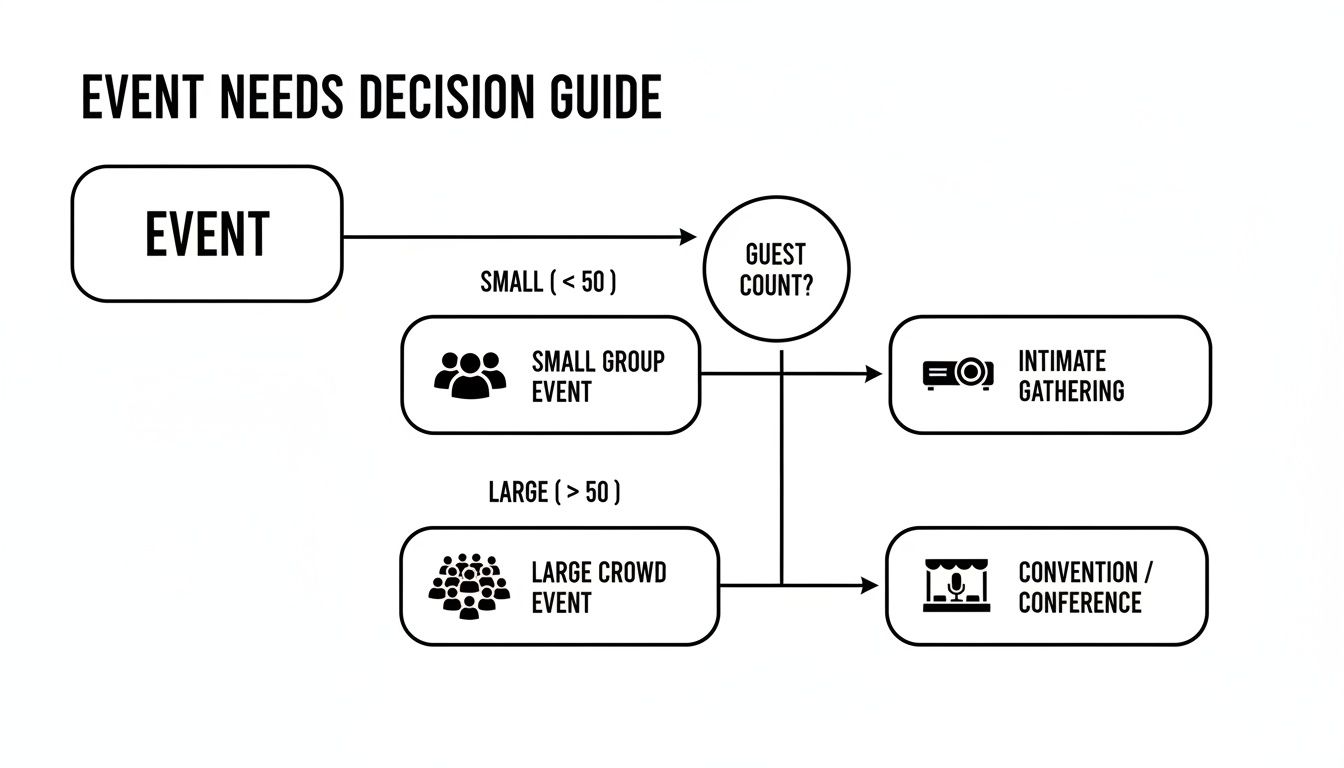
As you can see, your guest count is the first major factor, and it dictates the scale of the equipment you will need from the start.
The Screen: Your Projector's Partner
The screen is an equal partner in creating a high-quality image. Its surface, type and placement are as critical as the projector itself. Projecting onto a white wall will result in a dull, low-contrast image that looks unprofessional.
One of the first decisions is the projection method. Front projection, with the projector placed in front of the screen, is the most common setup. It is straightforward and works in most spaces.
However, for a more polished look on stage, consider rear projection. The projector is placed behind a special translucent screen, which hides all cabling and hardware. This means presenters will not cast distracting shadows by walking in front of the beam. It is a popular choice for high-end conferences and awards nights.
For event planners managing multiple London venues, flexibility is crucial. Hiring provides access to the ideal equipment for each specific event, without the significant capital outlay of ownership.
The UK projector screen hire market has grown by 35% in the past three years. Event professionals are choosing flexible daily hires, costing from £100 to £500, over the £2,000 to £20,000 it can cost to purchase the equipment. For London organisers, it is a practical way to achieve excellent visuals without a long-term financial commitment.
To help you visualise the options, here is a quick guide to matching equipment to common event types.
Matching Projector and Screen Types to Your London Event
This table breaks down typical scenarios we encounter, helping you connect your event with the right equipment.
| Event Scenario | Recommended Projector Type | Recommended Screen Type | Key Consideration |
|---|---|---|---|
| Small Boardroom Presentation | Short-Throw Projector (3,000+ Lumens) | 8ft Pull-Up Screen | Maximising image size in a confined space without shadows. |
| Medium-Sized Conference | Laser Projector (7,000+ Lumens) | 12ft Fast-Fold Screen | Overcoming ambient light and ensuring visibility for all attendees. |
| Large Awards Ceremony | High-Brightness Projector (12,000+ Lumens) | 16ft Rear-Projection Screen | Creating a clean, professional stage set without visible equipment. |
| Exhibition Stand Video Loop | Ultra-Short-Throw Projector | Projection Film on Glass | Attracting attention in a busy, bright hall with a creative display. |
Choosing the right combination is about understanding the interplay between the technology and the environment. It is what elevates a good event to a great one.
Real-World London Scenarios
Here are two classic London event setups and the thought process behind the equipment selection.
The Intimate Boardroom Pitch
- The Scene: A small meeting room in a Bloomsbury townhouse, for 15 executives.
- The Challenge: Limited space and the need for a fast, discreet setup.
- The Solution: A 3,000-lumen short-throw projector paired with an 8ft pull-up screen. The short-throw lens creates a large, bright image from just a few feet away, which is ideal for tight London spaces.
The Large Conference Keynote
- The Scene: A grand hotel ballroom near Marble Arch, with 300 delegates.
- The Challenge: Bright house lights, a large room and the need for clear visibility for everyone.
- The Solution: A powerful 12,000-lumen laser projector and a 16ft wide fast-fold screen. To keep the stage looking immaculate, we would configure it for rear projection. This combination delivers a sharp image that cuts through the ambient light.
By thinking through these factors, you will be better equipped to hire the right projector and screen for your London event. You can explore our full range of AV equipment to see the models we have available.
Managing Logistics, Installation and On-Site Safety
You have chosen the right equipment, but getting it to the venue and set up flawlessly is where the real work begins. The success of your projector and screen hire depends on execution on the day. This is about expert logistics, professional installation and a strict focus on health and safety.
This is where an experienced AV partner demonstrates their value. They will liaise with London venues about tight loading bay times, navigate the constraints of listed buildings or plan access to a fourth-floor conference room with no lift. A smooth, calm setup process sets the tone for the entire event.
Pre-Event Coordination and Site Visits
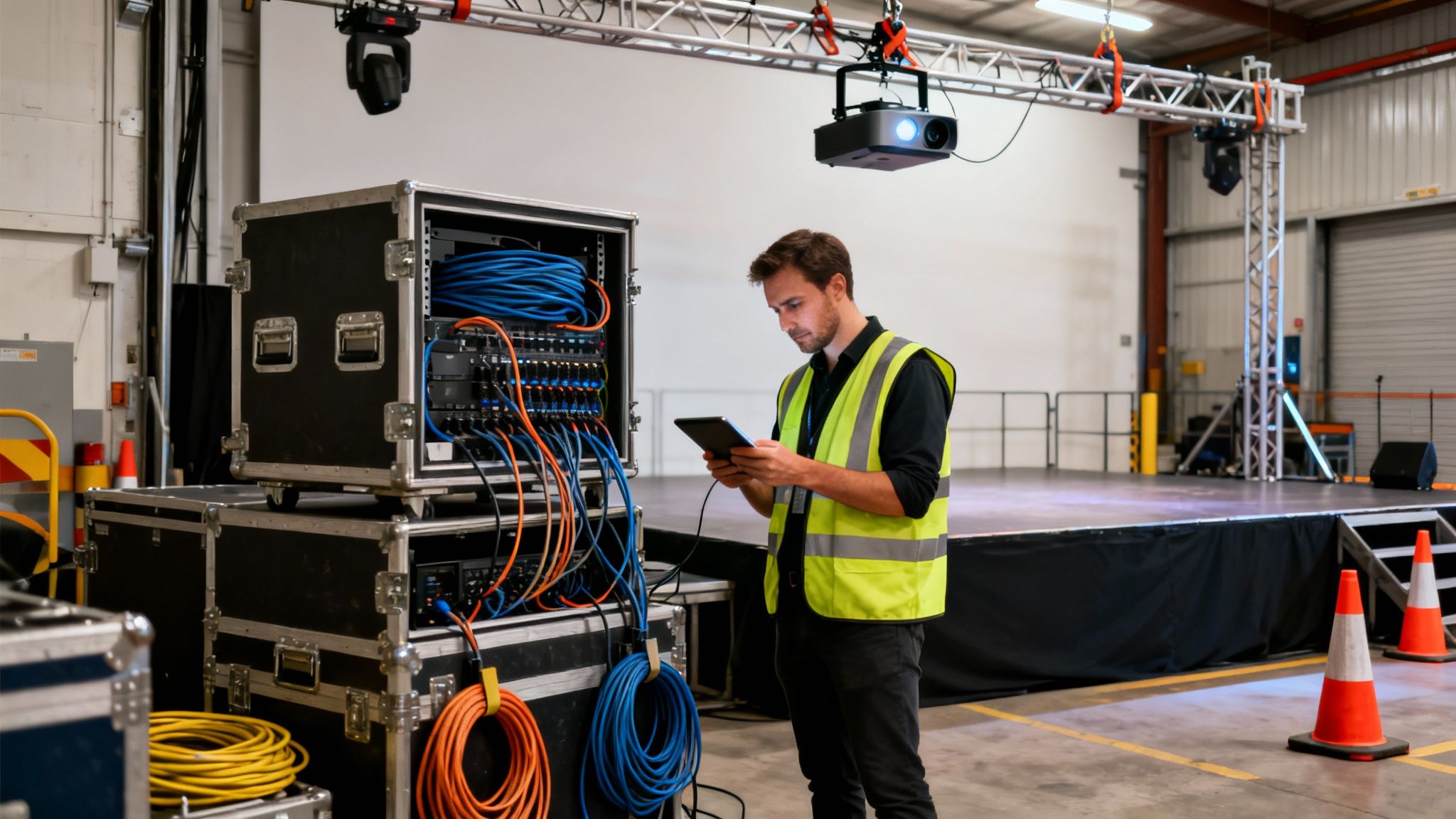
Proper coordination starts weeks, not hours, before your event. For any complex or large-scale hire, a pre-event site visit is essential. It allows our technicians to assess the space, measure exact throw distances, identify power sources and map out cable runs.
This step removes guesswork and prevents last-minute problems. During this visit, we will confirm critical details with the venue manager:
- Access Times: What is the earliest the crew can access the site to begin setup?
- Loading and Parking: Where is the loading bay and are there any vehicle restrictions?
- Venue Rules: Are there specific house rules on rigging equipment or taping cables to floors?
Answering these questions upfront means our team arrives fully prepared, with a clear plan that respects the venue's procedures.
The true value of a professional AV partner is their ability to identify and solve logistical hurdles before they become event-day emergencies. This proactive approach means the technical setup is one less thing for you to worry about.
Health and Safety On-Site
Health and safety during an installation are paramount. A professional event space is a safe one, and that responsibility covers every piece of equipment brought into the room.
Clean cable management is a key example. All power and signal cables must be run neatly and taped down securely with high-visibility gaffer tape to eliminate trip hazards. In high-traffic areas like doorways or aisles, we always use heavy-duty rubber cable ramps to protect both your guests and our equipment.
A large part of this is anticipating what could go wrong. To learn more about safety planning, it is useful to understand how to do a risk assessment. This is a standard part of our process, helping us to identify potential hazards and implement controls before they cause any issues.
The Value of an On-Site Technician
For any significant event, having a dedicated technician from London Audio Visual Hire on-site is invaluable. Their role goes beyond setup; they are your technical support for the entire event.
Here is what having a technician on-site means for you:
- Pre-Event Checks: They will power on all equipment, test every input and sit down with your speakers to run through their presentations, ensuring every laptop connects without issue.
- Live Event Monitoring: During the event, they are on standby to manage playback cues, adjust microphone levels and monitor all the equipment.
- Instant Troubleshooting: In the unlikely event of a problem, such as a presenter’s laptop freezing or a loose cable, they are there to fix it immediately, often before the audience is aware.
This level of on-site support gives you complete peace of mind. It frees you up to focus on your guests and speakers, confident that the AV is in expert hands.
Decoding AV Hire Costs and Packages in London
Understanding the costs is essential for any event planner. When you are hiring a projector and screen in London, the price reflects the quality of the equipment, the level of support you need and the complexity of your event.
A reputable hire company will provide a transparent quote with a full breakdown. This way, you know precisely what you are paying for, from the projector itself to the expert technician who ensures everything runs smoothly on the day.
What Is Included in a Standard Hire Package
For a typical corporate meeting or workshop, a standard hire package usually includes everything you need. It is a convenient, all-in-one solution.
While the exact contents can differ between suppliers, you can generally expect a few core items for one price:
- The Projector: A reliable model appropriate for your audience size and the venue's light levels.
- The Screen: A fast-fold or pull-up screen of a suitable size, including all necessary stands and a professional black drape kit.
- Essential Cabling: All power and signal cables (like HDMI) needed to connect a standard laptop.
- Delivery and Collection: The cost to transport the equipment to and from your central London venue is usually included.
This bundled approach simplifies the process. You get a complete, compatible system without needing to manage the smaller details.
Understanding Add-On Services and Costs
Not every event is straightforward. Sometimes you require more equipment or an extra pair of hands. Add-on services allow you to tailor the setup to your event's specific needs.
These are usually itemised separately on your quote. Common extras include:
- On-Site Technician: For complete peace of mind, a dedicated technician is invaluable. They handle the setup, run the presentation and are there to resolve any issues instantly.
- Complex Rigging: Flying a screen from the ceiling or building it into a custom stage set requires specialist rigging and a certified crew, which is a specific add-on.
- Additional AV Equipment: You might also need a PA system for sound, microphones for speakers, a dedicated presentation laptop or a seamless switcher to move between different inputs.
- Extended Hire Periods: A standard hire is typically for one day. If your event runs for several days, the price will be adjusted accordingly.
The real value in a professional hire quote lies in its clarity. A detailed breakdown empowers you to make informed decisions, ensuring there are no hidden costs or surprises.
The Financial Case for Hiring Versus Buying
For most businesses, hiring makes good financial sense. London's event scene is constantly active, and the demand for high-quality visual equipment has increased. UK projector rentals have grown by 35% in the last three years as planners look for more cost-effective options.
When you consider that a professional-grade projector can cost from £2,000 to £20,000, the argument for hiring for a one-off conference or an annual meeting becomes clear.
This is where smart financial planning is important. Managing your costs is a huge part of successful event management, and AV hire is often a significant line item. For anyone looking to improve in this area, learning about budgeting an event effectively is a great place to start.
Hiring means you avoid a large capital outlay on equipment that will quickly age. You also sidestep the ongoing costs of storage, maintenance and insurance. It is simply a more pragmatic choice.
The Advantage of a Professional AV Hire Partner
Hiring the right projector and screen in London is about more than just the equipment. The final, and arguably most important, element is the expertise behind it. When you partner with a dedicated audio-visual specialist, you are not just renting equipment; you are collaborating to ensure your event is a success.
We have walked through the key stages, from defining your needs to managing on-the-day logistics. A professional partner like London Audio Visual Hire brings all those threads together. We provide deep technical knowledge, meticulous planning and hands-on operational support. We become an extension of your team, focused on delivering a flawless visual experience for your audience.
Beyond Equipment Supply
Choosing an AV partner is an investment in reliability and peace of mind. Our job is to foresee potential problems, guide you towards the best technical setup for your goals and then execute that plan perfectly on the day. This is especially true for high-stakes events where there is no margin for error.
A true AV hire partner does not just take your order. They work with you to understand what you are trying to achieve. Their success is measured not by the equipment they provide, but by the impact your event has on your audience.
This integrated support is at the heart of what we do. For larger events, our experience in full conference production ensures that every technical detail, from the visuals to the sound and lighting, works together in complete harmony.
Ultimately, working with a specialist removes the technical burden from your shoulders. It frees you to concentrate on what you do best: your content and your guests, knowing with total confidence that the visual aspect of your event is in expert hands. If you would like to discuss your next event, please get in touch with our team today.
Your Questions Answered
When you are deep in event planning, the technical details can feel daunting. Here are some of the questions we are asked most frequently by event planners. We will provide straightforward answers to help you plan with confidence.
How Far In Advance Should I Book?
This depends on your event.
If you are organising a large-scale conference, an awards night or anything during the busy summer and Christmas seasons, you should aim to secure your AV equipment four to six weeks ahead of time. High-demand equipment, like our large screens and high-brightness laser projectors, gets booked up quickly for these peak dates.
If you only need a simple setup for a meeting in a hotel boardroom, giving us one or two weeks' notice is usually sufficient. We are adept at handling last-minute requests, but booking early always gives you the best choice and peace of mind.
Our best advice is to book it, then you can focus on other priorities. Securing your AV hire early is one less major task to worry about, letting you concentrate on your content and your guests.
What Happens If There Is A Technical Problem On The Day?
This is a common concern for every event planner. It is precisely why having one of our technicians on-site is such a popular option.
Long before your first guest arrives, our technician will have run through a full checklist, ensuring every piece of equipment is working perfectly. They will meet your presenters, test their laptops and check their slides to resolve any compatibility issues.
During the event, they are always present, monitoring everything. If a problem does occur, they are able to respond instantly, often fixing it before anyone in the audience even notices. For high-stakes events where you cannot afford a single glitch, that level of support is invaluable.
Can You Handle Venues With Lots of Natural Light?
Yes, absolutely. This is a classic London challenge. From glass-walled boardrooms overlooking the Thames to daytime receptions in marquees, ambient light can wash out a projected image, making it look weak and unprofessional.
We have the right tools for the job. It is all about overpowering the daylight.
- High-Lumen Projectors: We use powerful laser projectors that produce 10,000 lumens or more. They are specifically designed to cut through bright, ambient light.
- Ambient Light Rejecting (ALR) Screens: These are not standard screens. Their special surface is engineered to reflect the projector’s light directly towards your audience while absorbing light from other sources like windows or overhead fixtures.
With this combination, your visuals remain sharp, vibrant and full of contrast, no matter how bright it is outside.
Planning your next event in London? The team at London Audio Visual Hire has the expertise and the equipment to help you make a real impact. Take a look at our services and get in touch for a no-obligation discussion.