
When planning a corporate event, choosing the right projection screen to hire is a critical decision. It directly affects the quality of your visuals and, ultimately, how your audience connects with your message. While it is easy to focus on the projector, the screen is just as vital – it is the canvas for your content.
Why the Right Screen is Crucial for Your Event
A common mistake is to allocate budget to a high-powered projector but treat the screen as an afterthought. However, the screen surface is where your message comes to life. A poor-quality or mismatched screen can undermine even the best projector, resulting in washed-out colours, distracting glare, or poor viewing angles for parts of the room.
This oversight can instantly diminish the professional feel of your event and reduce the impact of your presentation.
For any professional event in London, hiring a high-quality screen is non-negotiable. It ensures your visuals are displayed exactly as intended. The correct material, proper tension and appropriate size work in harmony with your projector and the venue's lighting to create an image that is sharp, vibrant and evenly lit. This level of detail transforms a standard presentation into a powerful visual experience that holds an audience's attention.
The Unsung Hero of Visuals
Consider the relationship between a projector and screen as that of an artist and their canvas. An artist may have the finest paints, but if they are working on a canvas that is wrinkled, dirty or has the wrong texture, the final painting will be compromised. The same principle applies here; a top-of-the-line projector is wasted on a flimsy, low-grade surface.
A professional projection screen is the silent partner to your projector. It is responsible for colour accuracy, optimal brightness and clear detail. It provides the foundation for everything your audience sees, making it a critical component of event production.
What a Professional Screen Delivers
Working with an experienced supplier to hire the correct screen brings tangible benefits that are evident on the day.
- Exceptional Image Quality: Professional screens feature specialised surface coatings designed to reflect light evenly, preserving the colour richness and contrast of your visuals.
- An Improved Audience Experience: A bright, clear image means every person in the room has a good view, regardless of their seating position. This keeps them focused on your content, not straining to see the screen. You can learn more about the different types of audio visual equipment and their roles in our detailed guide.
- A Polished, Professional Appearance: A correctly sized, perfectly tensioned screen contributes to a clean, professional stage design and reflects the high standards of your organisation.
Choosing the Right Type of Projection Screen
Selecting the right projection screen is a technical decision that impacts your entire event. A correct choice ensures your visuals are sharp and impactful. An incorrect one can lead to issues ranging from a compromised stage design to a frustrated audience viewing a washed-out image.
A screen is a key piece of technical equipment. The type you choose will influence setup times, labour costs and the overall professional feel of your event. Let's examine the main options.
Fixed-Frame Screens: The Gold Standard for Quality
When picture quality is the highest priority, a fixed-frame screen is the solution. These are ideal for high-end product launches, cinematic screenings or major corporate announcements where every detail matters.
These screens are built around a solid aluminium frame that pulls the screen material perfectly taut. This tensioning is key as it creates a completely flat, smooth surface, eliminating any possibility of waves or ripples. The result is flawless image clarity and sharp focus from edge to edge. The trade-off is that they are rigid and take longer to assemble, making them better suited to single-location events rather than those requiring rapid setup.
Fast-Fold Screens: The Versatile Workhorse
For the majority of conferences, awards nights and exhibitions in London, the fast-fold screen is the preferred choice. As the name suggests, its frame is designed to collapse and be assembled in minutes, which is invaluable when working with tight venue turnaround times.
The screen surface clips onto the frame with press studs, providing excellent tension for a flat viewing surface. Their practicality, portability and rapid setup make them the standard for most events, striking an effective balance between high quality and operational efficiency.
When considering projection screen hire, the decision often involves balancing visual perfection with logistical reality. A fixed-frame screen offers the ultimate canvas, while a fast-fold screen provides practicality without significant compromise.
Front vs. Rear Projection: A Critical Logistical Choice
Once you have settled on the frame type, the next major decision is projector placement. Your choice between front and rear projection has a significant impact on your stage layout, equipment placement and the overall aesthetic.
-
Front Projection: This is the conventional setup. The projector sits in front of the screen, typically located within the audience area. It is simple and does not require much space behind the stage. The main drawback is that the projector and its cables are visible, and anyone walking in the beam’s path will cast a distracting shadow.
-
Rear Projection: In this configuration, the projector is placed behind a special, semi-translucent screen. This facilitates an exceptionally clean and professional-looking stage. All technical equipment is hidden from view, which is ideal for awards ceremonies or keynotes where presenters need to move freely without creating shadows. The primary consideration is space: you need a deep, clear area behind the screen, which can be a challenge in many compact London venues.
To help you map out your decision, this flowchart walks you through the key considerations for achieving the right visual setup.
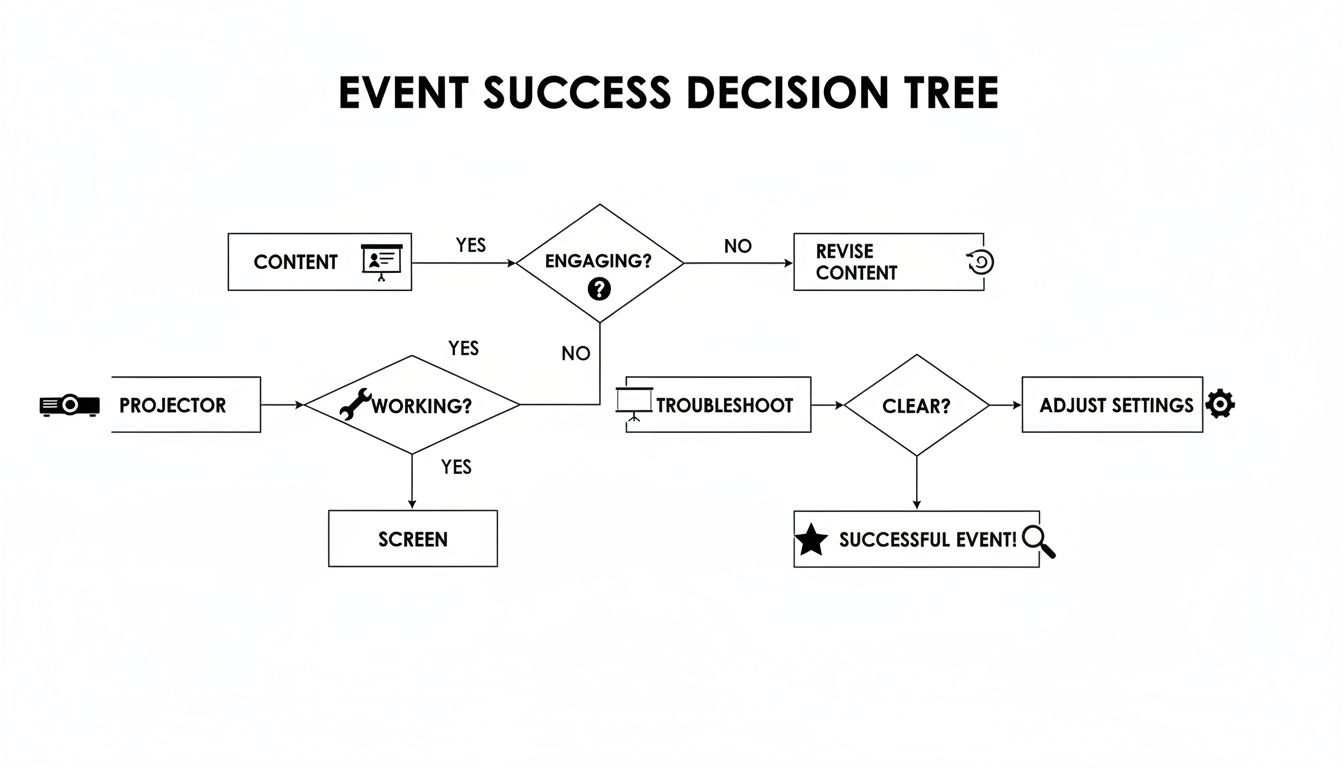
As the chart shows, even the best content requires the right projector and, crucially, the right screen for the venue to be effective.
To help you decide at a glance, we have put together a quick comparison of the most common screen types you will encounter when hiring for a London event.
Screen Type Suitability Matrix for London Events
| Screen Type | Key Benefit | Ideal Event Type | Considerations |
|---|---|---|---|
| Fixed-Frame | Unbeatable image quality, perfectly flat surface. | High-end brand launches, film screenings, art exhibitions. | Longer setup time; not easily portable. Requires a dedicated build team. |
| Fast-Fold | Speed and portability. Excellent balance of quality and convenience. | Conferences, awards ceremonies, roadshows, general corporate events. | Good, but not quite the flawless surface of a fixed-frame. Best all-rounder. |
| Inflatable (Airscreen) | Massive scale, suitable for outdoor use. | Outdoor cinema, large festivals, public viewing events. | Requires power for the blower; can be affected by high winds. |
| Tripod Screen | Ultra-portable and simple to set up by one person. | Small meetings, breakout rooms, temporary displays for <50 people. | Limited size options; not suitable for professional, large-scale events. |
This matrix should give you a solid starting point for shortlisting the right screen for your specific needs, matching the technology to the ambition of your event.
Corporate events are a primary driver of the UK projection screen hire market. Professional applications are expected to command 55.1% of the market share in 2025, a clear indication of the growing demand for high-calibre visual solutions. With market growth forecast to peak at 5.52% in 2027, the need for experienced AV partners is set to increase.
Here at London Audio Visual Hire, we can guide you through the best screen choice for your specific event, venue and budget. Our inventory is stocked with options to suit any scenario. To see what is available, feel free to browse our full range of AV equipment for hire. By thinking through these options carefully, you can ensure your visual presentation is seamless, professional and leaves a lasting impression.
Understanding Technical Specifications
Engaging with projection screen hire can feel like learning a new language. AV technicians use terms like 'aspect ratio', 'gain' and 'viewing angle', but what do they mean for your event? Understanding these concepts is key to making an informed hire and ensuring your presentation looks crisp and professional.
Let's clarify the essential terminology. Once you understand these fundamentals, you will be able to communicate effectively with any supplier and choose the perfect screen for your content and venue.
What is an Aspect Ratio?
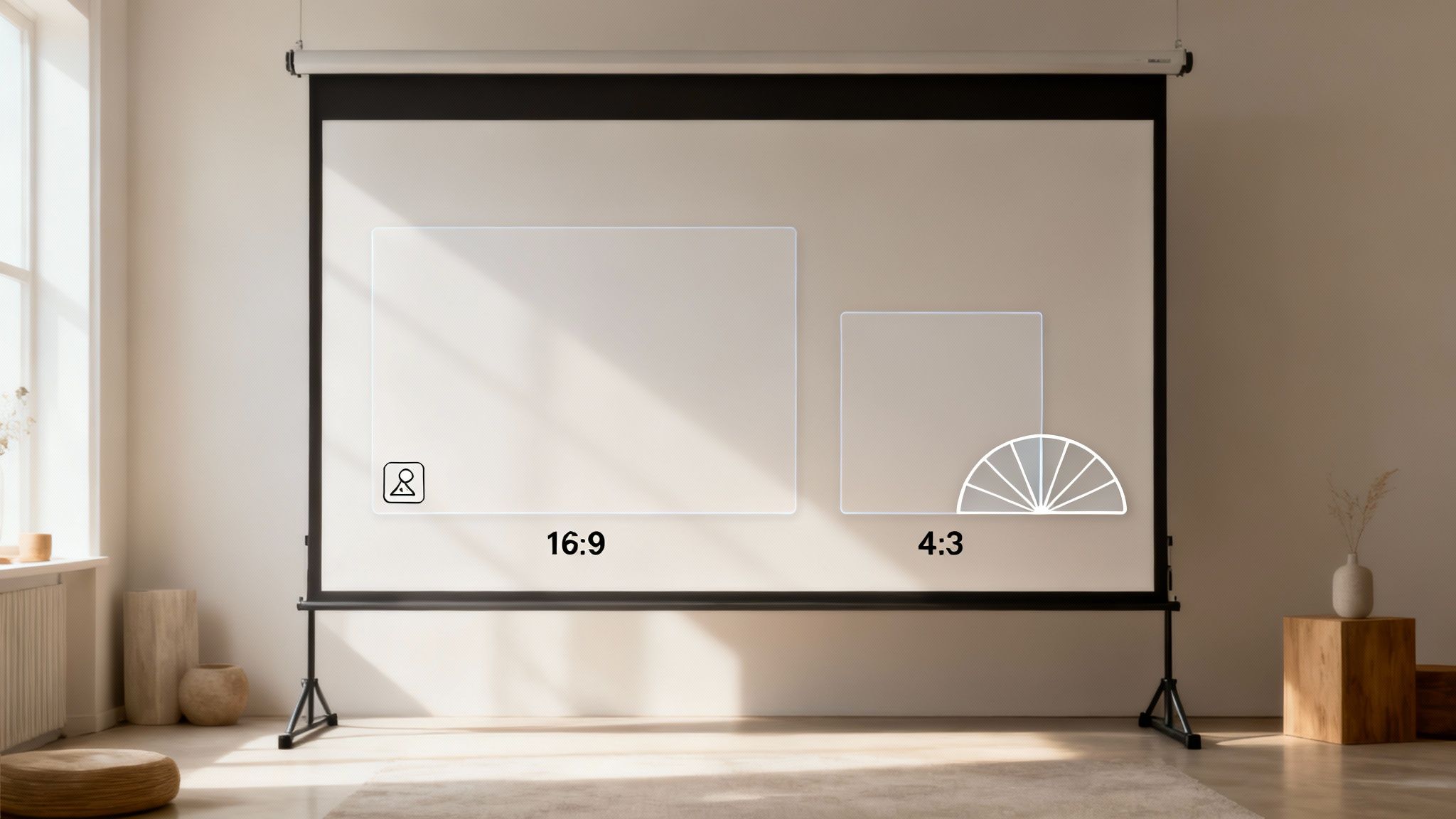
Simply put, the aspect ratio is the shape of your screen, defined as the ratio of its width to its height. If your presentation is created in widescreen format, you need a widescreen canvas to match. A mismatch will result in black bars bordering the image or, worse, a stretched and distorted picture.
You will almost exclusively encounter two main options:
- 16:9 (Widescreen): This is the modern standard. It is the shape of laptop screens, HD videos and nearly all PowerPoint or Keynote presentations. For any conference, awards night or event using modern video content, 16:9 is the required format.
- 4:3 (Standard): This is the squarer, traditional format reminiscent of older televisions. It is now considered a legacy format. You would only require a 4:3 screen if you have a specific, older piece of content created in that shape. For anything else, it simply creates large black bars on either side of the image.
A key rule is to always create your presentation slides in the same aspect ratio as the screen you are hiring. This simple check makes a significant difference.
Why Screen Gain Matters
Screen gain is a measure of the screen surface's reflectivity. It indicates how much of the projector’s light is reflected back towards the audience. The baseline is 1.0 gain, which is typical of a standard matt white surface that scatters light evenly.
A screen with a gain higher than 1.0 (for example, 1.2 or 1.5) is more reflective. It focuses more light towards the centre of the audience, making the image appear brighter and more vibrant. This can be particularly useful in rooms with significant ambient light, such as a hotel ballroom with large windows or an exhibition hall with bright overhead lighting.
However, there is a trade-off. High-gain screens often have a narrower viewing angle. This means the image appears excellent for those seated centrally, but individuals at the far sides may see a noticeably dimmer picture. An experienced AV supplier like London Audio Visual Hire can assess your venue's lighting and help you select the appropriate gain.
For most corporate events in London venues where you have reasonable control over the lighting, a screen with a gain between 1.0 and 1.2 is optimal. It delivers excellent brightness without sacrificing the view for people seated at the periphery.
Calculating the Perfect Screen Size
Selecting the right screen size is a balancing act. Too small, and the audience in the back rows will struggle to see. Too large, and it can overwhelm the space and cause discomfort for those in the front row.
The ideal size depends on the room's layout and audience seating. There are straightforward industry guidelines to provide a starting point.
- The Furthest Viewer Rule: The screen’s height should be approximately one-sixth of the distance to the furthest seated person. For instance, if your back row is 18 metres from the stage, you should look for a screen that is at least 3 metres high.
- The Closest Viewer Rule: To avoid neck strain, no one should be seated closer to the screen than twice its height. Using the same example, for a 3-metre-high screen, your front row should be at least 6 metres back.
These are not abstract figures; they are practical guidelines for ensuring everyone has a clear and comfortable view. A good technician will use these rules as a starting point, also factoring in elements like ceiling height and any pillars that might obstruct sightlines.
Matching Your Screen to Your Venue
Choosing the right screen involves more than just selecting a size. It requires making it work within the specific constraints of your London venue. Every space has its own challenges, from the natural light in a glass-walled conference room to the low ceilings of a historic building. Addressing these challenges is key to a flawless visual experience.
A successful setup always begins with a thorough assessment of the environment. Consider window locations, ceiling height, and the availability of rigging points. Even the distance from the stage to the front row is important. Managing these details ensures your image is bright, sharp and easily visible to every attendee.
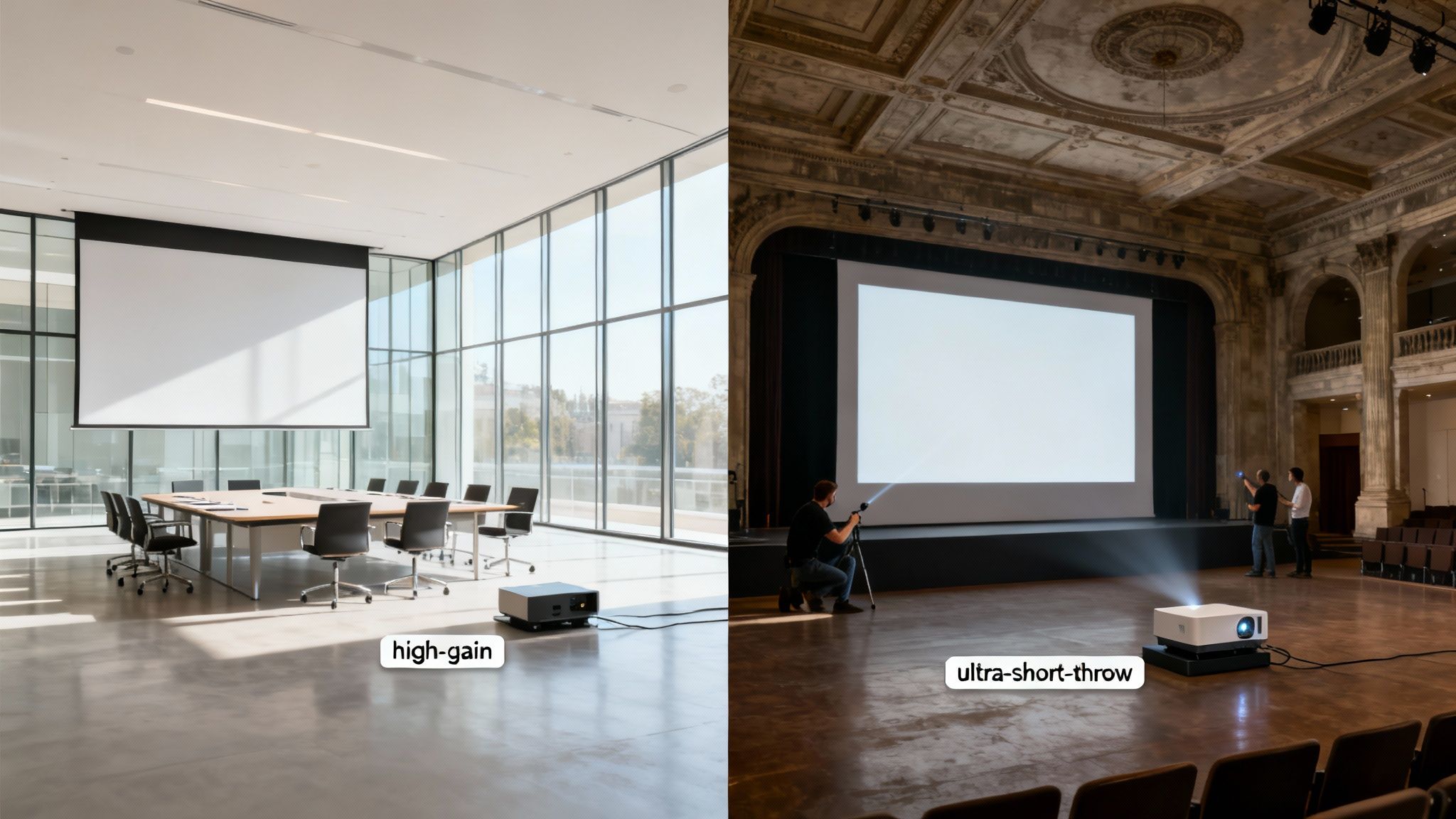
Tackling Ambient Light
The primary challenge for good projection is ambient light. This is any stray light from windows, house lighting or nearby exhibition stands that can wash out your image, making it appear faded. Simply increasing the projector's brightness is not always the most effective solution.
A better approach is to use a screen with a higher gain. A high-gain screen is engineered to counteract ambient light by focusing more of the projector's light directly towards the audience. The result is an image that appears significantly brighter and more impactful, even in a room that cannot be completely darkened. This makes it an ideal solution for daytime conferences or venues with abundant natural light.
Solving Space and Throw Distance Problems
Many London venues are characterful but compact. A standard projector requires a certain distance between its lens and the screen to create a large image – this is known as the throw distance. In a tight space, it can be impossible to achieve a large enough picture without placing the projector in the middle of the audience.
This is where ultra-short-throw (UST) projectors are invaluable. A UST projector can cast a large, perfectly formed image from just a few centimetres away. This technology is a game-changer for venues with limited depth, such as exhibition stands or small meeting rooms, as it frees up valuable floor space.
The right combination of screen and projector can solve almost any venue-specific problem. An experienced AV team will analyse the space and recommend a technical pairing that works with the room's limitations, not against them.
The demand for these clever solutions is growing. The UK projector screen market outlook predicts that growth will accelerate to 5.52% by 2027, largely driven by corporate and educational events that require flexible setups for diverse urban spaces.
The Value of a Professional Site Visit
While floor plans are useful, nothing replaces an expert assessment on-site. A site visit from an experienced AV technician is one of the most important steps in the planning phase.
An expert can identify potential issues that are not apparent on paper, such as:
- Rigging and Safety: Locating secure points to hang a screen or truss safely.
- Power Distribution: Ensuring there are sufficient power outlets in the correct locations.
- Sightline Obstructions: Checking for pillars or low-hanging fixtures that could block views.
- Logistical Access: Determining the most efficient route for moving equipment in and out of the building.
This pre-event check helps ensure a stress-free setup. It means the technical team arrives with the correct equipment and a clear plan, making your projection screen hire a smooth and seamless part of your event. Our team has worked in nearly all of London's most popular event venues and knows exactly what to look for.
Breaking Down Projection Screen Hire Costs
When budgeting for an event in London, the cost of a projection screen hire encompasses more than a single daily rate. You are paying for a complete service: the right equipment, technical expertise and the logistical support required to make your presentation look professional.
A simple 8-foot tripod screen for a small workshop will naturally have a different price than a professionally dressed 20-foot fast-fold screen for a major conference. While screen size and type are the biggest variables, the complexity of the job also significantly influences the final quote.
What Drives the Price?
The quote you receive for screen hire is a sum of its parts. Understanding these components helps you compare proposals and ensure you are not paying for unnecessary items.
- Screen Size and Type: Larger screens cost more, as do specialised options like fixed-frame screens or surfaces designed for rear projection.
- Installation Complexity: A standard screen on legs is straightforward. Rigging the same screen from a ceiling truss or building it into a bespoke stage set requires more crew, time and expertise.
- Crew and Technicians: The number of people needed to set up and remove the equipment is a key cost. If you also require a technician on-site during the event to manage visuals, this will be factored in.
- Delivery and Logistics: Transporting equipment across London can be complex. The final cost will reflect the venue's location, access (stairs versus service lifts) and whether the work needs to occur outside standard business hours.
What is Typically Included in a Hire Package?
A professional quote should be clear and all-inclusive. It should cover the entire setup, not just the screen surface. A standard package from a reputable supplier will almost always include:
- The projection screen surface and its complete frame.
- All necessary stands, legs and safety weights for secure ground support.
- A full professional dress kit: the black drapes for the top, bottom and sides that provide a clean, finished appearance.
Any additional services, such as a technician on standby, complex rigging or a specific late-night collection, should be listed as a separate line item. This transparency is crucial. Much like understanding sound system rental prices, knowing the details helps you build a realistic event budget.
A detailed quote is a sign of a professional AV partner. It demonstrates a thorough understanding of your event's requirements and provides complete clarity on all costs involved, preventing unexpected charges later on.
The UK hire market is flexible. Basic projector and screen packages can start from around £65 to £100 per day. For larger, more demanding events requiring high-end 8K projectors and premium screens, daily costs could range from £450 to £550.
Portable screens are very popular for their versatility and are expected to constitute over 40% of the UK market share by 2025. This highlights the importance of matching the equipment to the specific job to achieve the best value and impact.
Nailing the Logistics for a Flawless Setup
Securing the right screen is only half the task. Events often encounter problems with logistics: the practicalities of getting equipment into the venue, setting it up and removing it afterwards. Although easily overlooked, forward planning with your AV provider is what distinguishes a smooth, professional setup from a stressful, last-minute rush.
A clear, agreed-upon plan is your roadmap for the day. It covers everything from the moment the vehicle arrives to the final checks after de-rig. This is where the experience of a seasoned supplier is invaluable.
Key Logistical Questions to Ask Your AV Provider
Before confirming a booking, discuss the practicalities in detail. Asking the right questions now resolves potential issues and ensures everyone understands their responsibilities and timings. It is the most effective way to avoid surprises on the day.
Here are the essentials to confirm with your AV partner, like London Audio Visual Hire:
- Delivery and Collection Times: Establish specific arrival and departure windows for the crew and equipment. You need to ensure these align with the venue's access policies and do not clash with other suppliers.
- Setup and De-rig Duration: How much time will the technicians need? Obtain a realistic estimate for assembling the screen and for dismantling it safely. This must be factored into your event timeline.
- Power Requirements: What are their power needs? Be specific, especially if you have motorised screens or other powered equipment. Then, double-check the venue can provide the necessary power in the correct location.
- Loading and Access: How will they get the equipment in? Inform them about the loading bay, any stairs, service lifts or tight corners. This information can save significant time and effort.
A good AV company will ask you these questions proactively. They need to understand the logistics upfront to ensure everything runs efficiently. Their job is to manage the technical and logistical challenges for you.
Health and Safety: The Non-Negotiables
Beyond timings and access, you must verify your supplier’s health and safety credentials. This is not merely a formality; it is part of your responsibility as the event organiser and a clear indicator that you are working with a professional company.
Ensure your provider can supply documentation for these three items:
- Public Liability Insurance: This is essential. It protects you, the venue and your guests in the event of an accident involving their equipment or crew.
- PAT Testing Certificates: Every piece of electrical equipment brought into the venue must be PAT tested to certify it is safe to use. No certificate means no entry.
- Risk Assessments and Method Statements (RAMS): For any installation more complex than a simple screen on a stand, such as hanging a screen from a ceiling, you should request a RAMS document. This details exactly how they plan to complete the job safely.
Working with a fully insured and safety-compliant company like London Audio Visual Hire provides complete peace of mind. It allows you to focus on what matters most: your guests and your event.
Your Projection Screen Questions, Answered
To conclude, let's address some of the most common questions our team receives from event planners. This section serves as a quick-reference guide to help you finalise your arrangements.
Should I Choose Front or Rear Projection?
This decision depends on your venue's space and the desired aesthetic.
Front projection is the standard for most events. It is simple: the projector sits with the audience, pointing at the screen. The main disadvantage is that the equipment is visible, and there is a risk of someone walking through the light beam and casting a shadow during a presentation.
For a sleek, professional finish, rear projection is the superior option. All equipment is concealed behind a special screen, creating a clean, seamless effect. The consideration is that you need a significant amount of clear space behind the screen for the projector's throw, which can be a challenge in compact London venues.
What is the Right Aspect Ratio for My Presentation?
For almost any contemporary corporate event, the answer is 16:9 widescreen.
This is the native format of modern laptops, HD video and presentation software like PowerPoint and Keynote. Choosing 16:9 ensures your content fills the screen perfectly, without black bars at the top or sides. The older, squarer 4:3 ratio is now largely obsolete; you would only need it for displaying very old content. Always check your presentation's format, but in most cases, it will be 16:9.
Can I Use a Projection Screen Outdoors?
Yes, but it is a different scenario that requires specialist equipment. For outdoor events, you will likely need a robust, often inflatable screen that has been properly weighted and secured to withstand wind.
The most important factor to remember is that projection only works outdoors after sunset or in deep, reliable shade. Even an overcast day is too bright for a projector, as the daylight will wash out the image completely. If you need a large screen for a daytime outdoor event, an LED video wall is the correct solution, not a projection screen.
Feeling clearer? If you would like to discuss the specifics for your next event, please contact the team at London Audio Visual Hire. Our project managers can help you select the perfect screen to ensure your visuals look incredible.
See what we offer at https://londonaudiovisualhire.co.uk.