
When hiring a PA system in London, you are not just renting speakers and a microphone; you are investing in clarity. The goal is to ensure every person in the room, from the front row to the back corner, hears your message perfectly. There is no one-size-fits-all solution for professional events; the right sound system is always tailored to the unique demands of the day.
Matching Your Event to the Right PA System
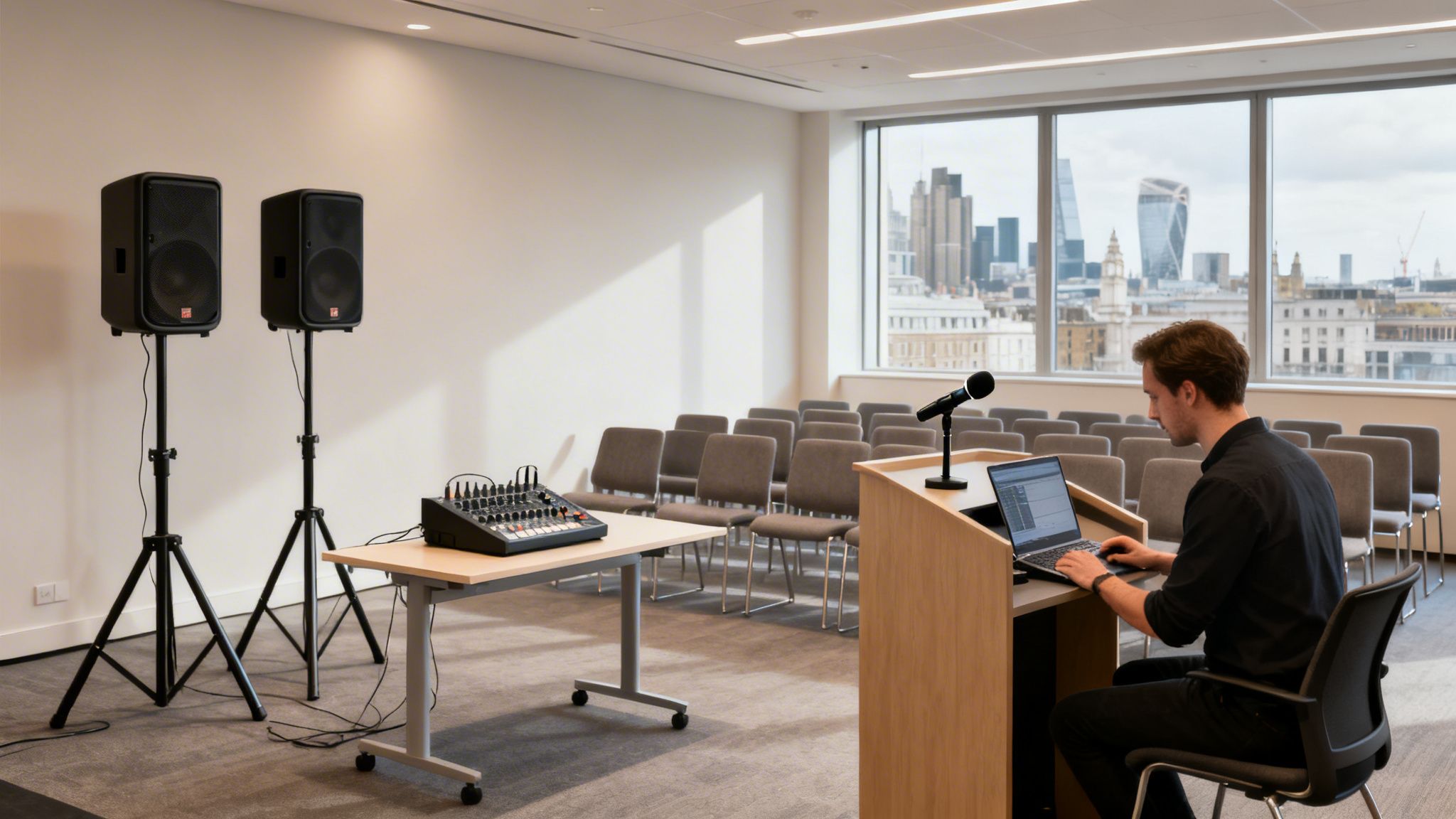
Before considering specific equipment, you must clarify your event's needs. The audio setup for a 500-person conference is entirely different from what you would need for an intimate product launch or an awards dinner. Everything from audience size and venue acoustics to presentation style will shape your technical plan.
Getting this right is crucial. The UK’s professional AV market is expanding for a reason: it grew by 7.6% in 2023, reaching a value of US$7.7 billion. This reflects a growing understanding that expert audio support is non-negotiable for high-stakes corporate events across the capital.
To provide a clearer picture, let's break down the likely requirements for a few common event types.
| Event Type | Audience Size | Recommended Speaker Setup | Essential Microphone Types | Key Consideration |
|---|---|---|---|---|
| Conference/Panel | 50 – 500+ | Distributed system (multiple smaller speakers) for even coverage. | Lectern, tabletop for panel, handheld wireless for Q&A. | Speech intelligibility is the number one priority. |
| Product Launch | 50 – 250 | Two main speakers with subwoofers for full-range sound. | Wireless handheld for presenter, potentially headset mic. | Creating energy and impact with music and presentations. |
| Awards Dinner | 100 – 400 | Combination of main speakers for stage and smaller 'in-fill' speakers. | Lectern for host, wireless handheld for award winners. | Balancing announcements, music, and ambient chatter. |
| Small Meeting | < 50 | A simple 'speaker on a stick' pair is often sufficient. | Wired or wireless handheld. | Simplicity and ease of use for presenters. |
This table is a starting point. A professional PA hire company will work with you to refine the specifics based on your exact venue and agenda.
Corporate Conferences and Panel Discussions
For any event focused on the spoken word, such as a conference or a panel discussion, your entire focus should be on clarity. The goal is simple: ensure every syllable is crisp and clear for everyone, regardless of where they are sitting.
To achieve this, you will need a specific combination of equipment:
- Lectern Microphones: A high-quality gooseneck microphone at the podium is standard practice. It ensures the main speaker is always heard clearly.
- Panel Microphones: Do not make panellists share. Provide each person with their own microphone, either a tabletop model or a discreet lapel mic, to capture their input without issue.
- Audience Q&A Microphones: A pair of wireless handheld microphones is essential for engaging the audience. This allows their questions to be heard by the entire room, not just those sitting nearby.
- Smart Speaker Placement: Instead of just two large speakers at the front, a 'distributed system' with several smaller speakers placed strategically around the room often works better. It delivers far more even and comfortable sound coverage.
Product Launches and Brand Activations
For events where the goal is to create buzz and energy, the audio requirements shift. At a product launch or brand activation, you need a PA system that can handle dynamic music, video soundtracks, and powerful presentations with high fidelity.
I have seen this mistake made time and time again: clients underestimate the power needed for background music. The aim is to build an atmosphere, not drown out conversations. A professional sound engineer knows how to find that sweet spot and can adjust levels on the fly as the event's energy changes.
For these high-impact events, you will almost certainly require subwoofers. They provide the deep, low-end frequency that gives music a full, rich sound and creates a truly immersive experience. A skilled technician ensures the sound is powerful but never uncomfortable. If you are curious about the different components of a professional setup, our guide on what is audio visual equipment is a great place to start.
How to Choose the Right AV Hire Partner in London
Choosing a company for your PA system hire in London is not just about finding the cheapest quote. You are not simply renting speakers; you are bringing on a technical partner whose skill and reliability can make or break your event.
Get it right, and they become an extension of your own team, handling every audio detail seamlessly. Get it wrong, and you could face technical glitches, poor sound, and unnecessary stress. You are looking for proven experience, not just a warehouse full of equipment.
Questions to Ask Potential Suppliers
When you start contacting suppliers, a few direct questions will quickly separate the professionals from the rest. A good company will have clear, confident answers ready.
Here is what you need to investigate:
- Experience: "Can you provide examples of events you have handled that are similar to mine in size and style?" You need to see a track record that matches your needs.
- Venue Knowledge: "Are you familiar with my London venue? Have you worked there before?" A team like London Audio Visual Hire, who know the city's venues well, can foresee and sidestep logistical challenges before they become a problem.
- The Technical Team: "Who will be on-site as our technician? What is their background?" You are paying for a skilled engineer, not just a delivery driver.
If you receive vague or hesitant answers to any of these questions, consider it a significant red flag.
Dry Hire vs. a Full-Service Partnership
It is also crucial to understand the type of service you are buying. The difference between a simple equipment drop-off and a fully managed service is substantial.
I have seen it countless times: a corporate event tries to save money by opting for 'dry hire'. This means you just get the equipment. You are then responsible for the entire setup, operation, and any troubleshooting. Unless you have a competent technician on your own staff, this is a massive gamble for any important event.
A full-service partner, on the other hand, handles everything from start to finish. This typically includes:
- A Dedicated Project Manager: A single point of contact who understands your event's goals.
- Professional On-site Support: An experienced sound engineer who stays to manage the system throughout the day.
- Guaranteed Peace of Mind: The confidence of knowing all technical aspects are in expert hands.
Finally, there are some non-negotiables. Always ask for proof of public liability insurance and confirm they adhere to strict health and safety regulations, including providing PAT-tested equipment. A professional AV partner will also offer transparent pricing with no hidden fees, demonstrating their investment in your event’s success, not just their invoice.
Getting to Grips with London Venue Logistics
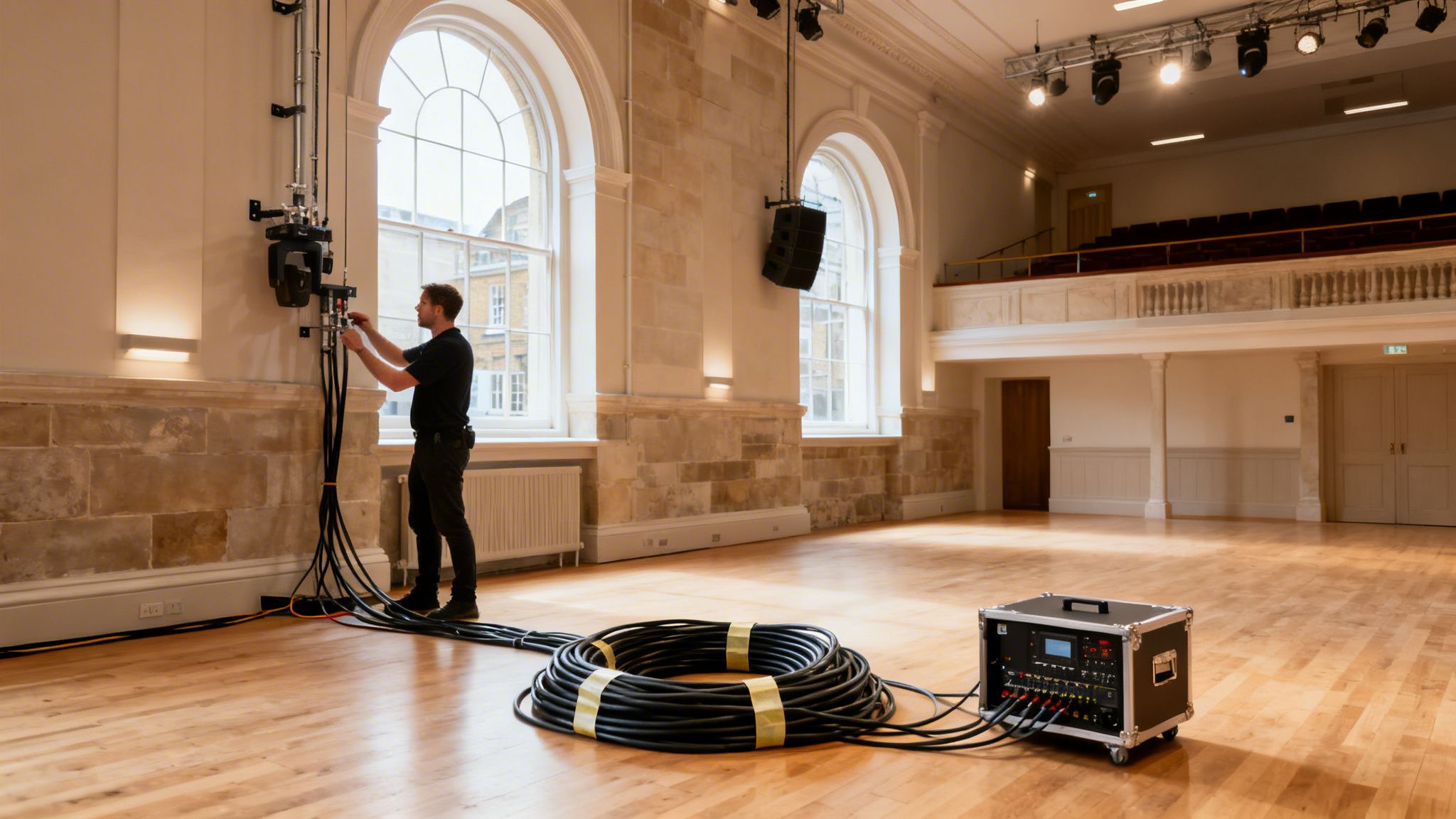
Hiring the right PA system is only half the battle. The real challenge, and where things can go wrong, is making it work within the venue. Every London space has its own character and rules, whether it is a Grade II listed building in Mayfair or a modern conference centre in Canary Wharf.
If you do not plan for these details, you risk a stressful event day. The only way to guarantee a smooth setup is to get your technical team on-site well before the event.
Why You Cannot Skip the Site Visit
A site visit is not optional; it is a necessity. This is where your AV partner moves from theory to reality, assessing the room and identifying practical hurdles that a floor plan will never show.
It is also your first and best chance to connect with the venue's on-site manager. A good relationship here is invaluable. You can get clear, direct answers on the things that truly matter:
- Access: When, precisely, can the crew load in? Are there service lifts, a specific loading bay, or a long walk through the main lobby?
- Noise Levels: Does the venue have a sound limiter? What are the strict curfews? This is critical, especially in residential areas or hotels with other guests.
- Power Sources: Where are the sockets? It is essential to know exactly how many are available, their type (13A, 16A, 32A), and their power limits.
- Rigging and Placement: Can speakers be flown from the ceiling, or do they need to be ground-stacked? Are there any 'no-go' zones for equipment placement?
Overlooking these points can bring your event to a halt, from last-minute setup delays to being asked to reduce the volume. If you are scouting locations, checking a supplier's past experience at different London venues can give you an idea of what to expect.
I will never forget a job where the only 32-amp supply was on the opposite side of a massive ballroom from the stage. We had to run nearly 50 metres of armoured cable, carefully routing and covering every inch to avoid creating a trip hazard. That is the kind of problem you solve at a site visit, not on the morning of the event.
Your Blueprint for a Safe and Seamless Setup
After the walkthrough, your AV provider should draw up a detailed technical plan. Think of it as the master blueprint for the on-site crew. This document maps out exactly where every speaker, microphone, and mixing desk will go and, crucially, how it will be powered.
A huge part of this plan revolves around cable management. In any public event, messy cables are more than an eyesore: they are a major safety liability. A professional crew will arrive with gaffer tape, cable ramps, and trunking to ensure every wire is completely secured and out of harm's way.
Finally, there is no room for compromise on safety compliance. All professional equipment used in a public venue must be PAT tested (Portable Appliance Testing) to confirm it is electrically safe. Any reputable hire company will ensure their entire inventory is certified, which is something both you and the venue manager will need to see for your records.
Understanding PA Hire Pricing and Packages
Budgeting for sound can feel complex, but it does not have to be. Once you understand what goes into a quote for PA system hire in London, you will find the process is quite straightforward. The final cost boils down to a few key variables.
The most significant decision, and the one with the most impact on your budget, is whether you opt for a ‘dry hire’ or a full-service package. These are two different ways of working, and they have a huge effect on both the price and your responsibilities on the day.
Dry Hire Versus Full Service
A dry hire is exactly what it sounds like: you are just renting the equipment. You collect it, set it up, operate it, and return it. This can be a cheaper option, but only if you genuinely have an experienced technician on your team who is familiar with professional audio equipment.
On the other hand, a full-service package is the option most businesses choose for corporate events, and for good reason. It is a complete, hands-off solution that typically includes:
- Delivery & Collection: All equipment is transported directly to your London venue and collected afterwards.
- Professional Setup: A qualified technician rigs the entire system and ensures it is all working perfectly.
- On-site Sound Engineer: An expert stays for the entire event, managing microphones, music, and presentations so you do not have to.
- De-rig: The crew safely dismantles and removes everything once your event is over.
For most organisers, the peace of mind that comes with a full-service package is invaluable. It lets you focus on your guests, not on troubleshooting a feedback issue.
What Shapes the Final Quote?
Beyond the basic package type, a few other factors will influence the final invoice. Knowing what they are beforehand helps you budget more accurately and understand exactly what you are paying for.
The single biggest mistake in event budgeting is underestimating technician time. An engineer's day does not start when guests arrive; it begins hours earlier for setup and soundchecks and finishes long after everyone else has gone home.
Here are the main factors that affect the cost:
- Event Duration: A half-day meeting will naturally cost less than a full-day conference that continues into an evening awards ceremony.
- Technician Numbers: How many crew members do you need? A simple speech might only require one engineer, but a panel discussion followed by a live band will likely need a larger team.
- Logistical Complexity: Getting equipment into some London venues can be challenging. Navigating tight access roads, long loading routes through a hotel, or central London transport logistics can all add to the labour and time required.
The UK’s audio equipment rental market is a significant business, valued at over USD 739 million in 2024. This shows how many professionals rely on hiring high-quality, scalable sound systems instead of facing the huge cost of buying them outright. You can read more about the growth of the UK's audio equipment rental market on Deep Market Insights.
When you receive a quote, ensure it is itemised so you can see a breakdown of the costs. A transparent quote means no surprises. To get a better idea of what might be on that list, you can browse a full list of available AV equipment.
Getting It Right on the Day: Your On-Site Checklist
All the planning in the world leads to this moment: the event itself. When it comes to live audio, success is not about hoping for the best. It is about having a methodical, professional process on the ground in the hours before your doors open.
Any reputable supplier, like London Audio Visual Hire, understands this. Their real work starts long before the first guest arrives, laying the groundwork for a seamless audio experience.
The Soundcheck: Your First and Most Important Step
A soundcheck is non-negotiable. This is the dedicated time when the technician systematically works through every component of the system, identifying potential problems so they can be resolved before anyone notices.
A proper soundcheck is far more than a quick "testing, one, two." It is a comprehensive test of the entire setup:
- Every Microphone, Every Time: Each microphone, from the lectern mic for the keynote speaker to handhelds for audience Q&A, is tested to ensure the signal is clean and strong. No crackles, no dropouts.
- A Walk of the Room: The engineer will walk the entire event space, from the front row to the back corners, checking that the audio is clear and at a comfortable volume everywhere. This eliminates annoying "hot spots" where it is too loud and "dead zones" where you cannot hear.
- Testing All Media: This is a crucial step. The technician will need to play every video clip, audio sting, and piece of background music you plan to use. This confirms everything is routed correctly and plays at the right level, avoiding awkward silences or sudden blasts of sound.
Any sound engineer worth their salt will "ring out the room" before an event starts. Using a graphic equaliser, they find and eliminate the specific frequencies that are prone to causing high-pitched feedback. It is a proactive measure that stops the problem before it happens.
On-Site Coordination and Planning for the Unexpected
Great audio is a team effort. Your sound engineer must be perfectly in sync with the event manager, the show caller, and the presenters. Before going live, they should all gather to confirm communication methods and walk through the running order.
This ensures microphones are handed over smoothly between speakers and that music cues land with perfect timing. It is about proactively managing the audio flow of the event, not just reacting to problems.
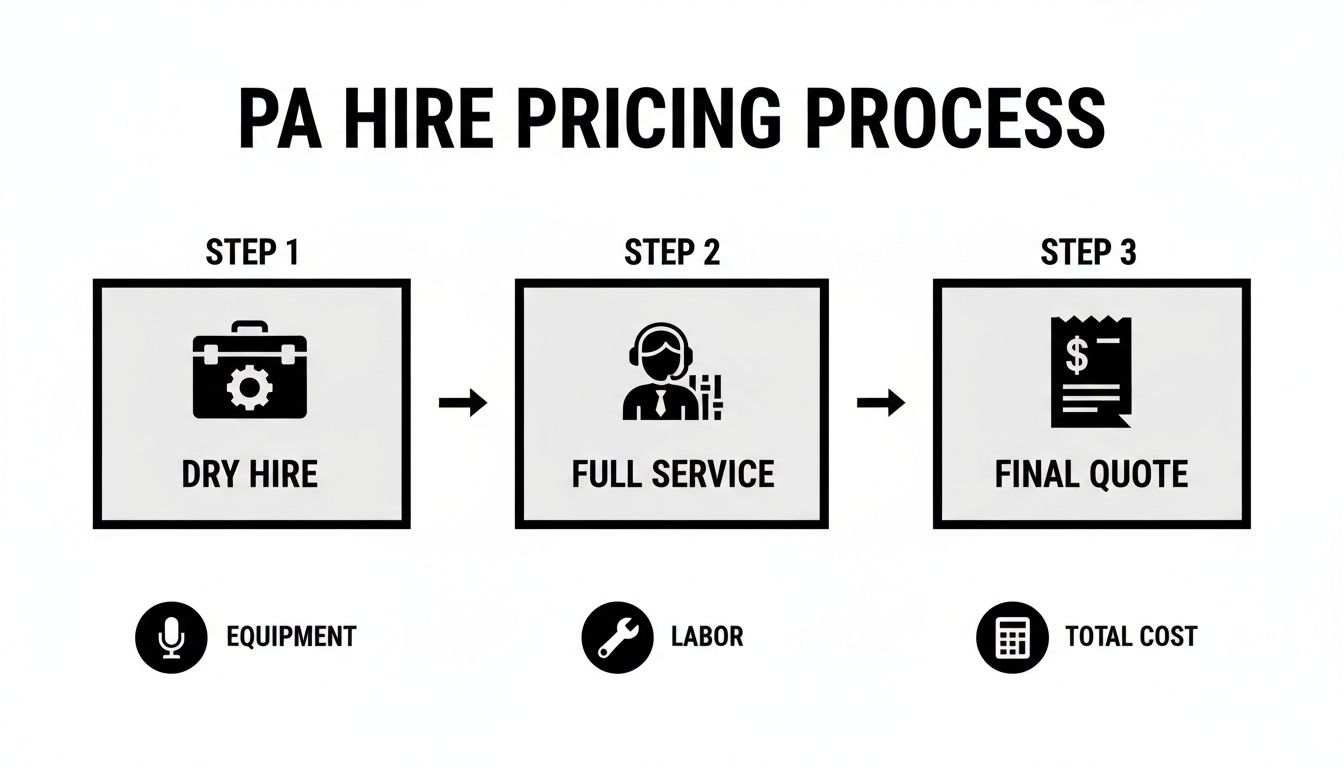
The level of on-site support you have will depend on the service you have chosen, which naturally affects the cost. A basic "dry hire" leaves the on-site management to you, while a full-service package means having an expert technician there to handle everything.
Even with the best plan, you must be ready for surprises. A professional hire company will always have a Plan B. This means having backup equipment on-site, such as spare microphones, extra cables, and for critical events, even a backup mixing desk. A good technician is also a troubleshooter, ready to instantly tackle common issues like wireless interference or a buzz from a presenter's laptop.
The De-Rig: Leaving a Good Last Impression
The event is not over when the last guest leaves. It is over when the last piece of equipment is packed up. A professional de-rig is just as important as the setup, and an experienced crew will work quickly and carefully to dismantle the system.
They will ensure every item is accounted for and, just as importantly, leave the venue in the exact condition they found it. This means removing all gaffer tape, tidying cables, and working with venue staff for a smooth exit. It is a final touch that protects your professional reputation and keeps you in the venue's good books for next time.
Your PA Hire Questions, Answered
When you are organising an event, sound is one of those things you just need to work, but it is easy to feel out of your depth. To help clarify things, we have gathered the questions we hear most often from event organisers in London.
Getting the audio right is a cornerstone of any successful event. It is a huge industry for a reason: the UK's audio-visual sector, which is the largest in Europe, contributes a staggering £15 billion to our economy every year. You can get the full picture by reading the UK AV sector's economic contribution report on mpa-emea.org.
How Far in Advance Should I Book?
For any large or complex corporate event, especially during busy periods like summer or the Christmas season, you should aim to book your PA system at least 3-6 months in advance. If you are planning a smaller meeting or your event falls in a quieter part of the year, 4-6 weeks is usually a safe timeframe.
Booking early is not just about ensuring equipment availability. It gives your AV partner the time they need to do their job properly, from carrying out a site visit to coordinating logistics with your venue.
Can't I Just Play Music from My Laptop?
You technically can, but for any event with a professional reputation to uphold, it is a very bad idea. Simply plugging a laptop or phone into a speaker gives you almost no control, and the audio quality is not sufficient for a corporate environment.
A proper PA hire package always includes a mixing desk, which is vital for several reasons:
- Volume Management: You need to prevent background music from drowning out conversation and ensure speeches are perfectly clear.
- Tone Control (EQ): A mixer allows a technician to adjust the audio to suit the room’s acoustics, preventing harsh or muffled sound.
- Managing Inputs: It allows for smooth switching between microphones, a presentation laptop, and a music playlist without any awkward pauses or glitches.
The most common 'quick fix' that fails on the day is assuming a simple speaker and a laptop will suffice for an audience of 50+. Without a proper mixer and a technician to manage levels, what seems like a cost-saving measure quickly turns into an audio headache for presenters and guests alike.
Do I Really Need a Sound Engineer On-Site?
If your event involves anything more than playing a simple background music playlist, the answer is almost certainly yes. For conferences, product launches, awards ceremonies, or anything with live speakers, an on-site engineer is not a luxury, it is a necessity.
Think of them as your audio safety net. They manage every sound element as it happens, from swapping microphones between speakers to fixing unexpected issues instantly. They fine-tune levels throughout the event, so you can focus on your guests and the event itself without worrying about technical problems. The peace of mind they provide is invaluable.
Frequently Asked Questions About PA Hire in London
To give you a quick reference, here are some of the most common queries we receive from event organisers about sound systems for their London events.
| Question | Answer |
|---|---|
| What is included in a basic PA hire package? | Typically, it includes speakers, speaker stands, a small mixing desk, and all necessary cables. For speeches, it would also include a microphone. |
| Can I 'dry hire' equipment and set it up myself? | Yes, many companies offer 'dry hire' (equipment only). However, unless you have experience, it is risky. Professional installation ensures everything is set up safely and sounds its best. |
| How much power does a PA system need? | This varies hugely. A small system for a speech might only need a single 13-amp socket. A large concert system could require a dedicated 3-phase power supply. Always confirm this with your supplier. |
| My venue has a built-in sound system. Should I use it? | It depends. Some in-house systems are excellent, but others are old or poorly maintained. It is wise to have your AV supplier assess it or simply bring in their own trusted equipment for guaranteed quality. |
| What happens if a piece of equipment fails? | If you have a technician on-site, they will have backups and can troubleshoot immediately. With a reputable hire company, all equipment is regularly tested (PAT tested) to minimise the risk of failure. |
We hope these answers help you feel more confident about planning the audio for your next event. Having a clear idea of what you need is the first step toward a flawless production.
For clear, reliable, and expertly managed London Audio Visual Hire, our team of project managers and technicians is here to support your event from start to finish. Get in touch to discuss your requirements.