
When organising an event in London, getting the sound right is not just a detail; it can be the single factor that makes or breaks the entire experience for your guests. This guide provides practical advice on navigating the pa system hire London market, helping you turn your vision into a clear technical brief and guarantee a flawless event.
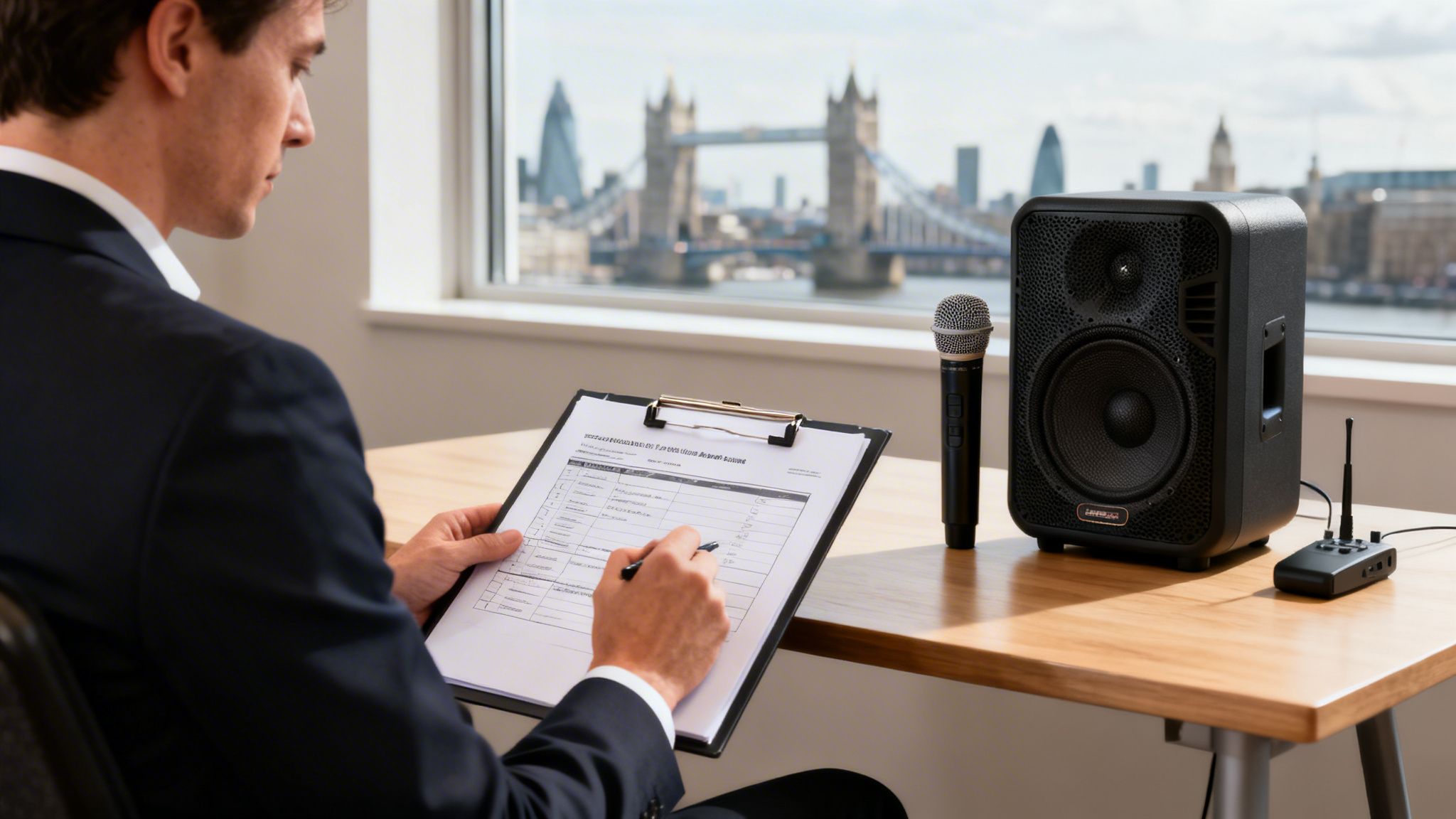
How to Plan Your Event Sound Like a Professional
Specifying professional sound for an event often seems more complicated than it is. It all comes down to knowing what information a PA hire company needs to provide an accurate quote and the right equipment. This is not just about ticking boxes on a checklist; it is about the practical details that lead to a smooth audio experience from the moment your first guest arrives.
This article aims to demystify the technical side of event sound and give you the confidence to manage it effectively. Whether it is a corporate conference at a City hotel, a high-energy product launch in Shoreditch, or an elegant wedding, a solid brief is your foundation for success.
First Things First: Building Your Technical Brief
A good brief is more than a shopping list of equipment. It tells the story of your event, its goals, and the atmosphere you want to create. To get there, you need to think about the core purpose of your audio.
- Is it for speech? The main priority might be ensuring every word from a keynote speaker is crystal clear, even for people at the back of the room.
- Is it for music? Perhaps you have a live band or a DJ, and you need a system with enough power and bass to create a party atmosphere.
- Is it for atmosphere? You may simply need subtle background music or audio from video presentations to set a specific tone as guests mingle.
Answering these questions gives a supplier the context they need. It is the first step in translating your creative ideas into a technical solution. Before you go further, it is worth gaining a basic grasp of what is audio-visual equipment and how the different parts work together.
To make this easier, the table below outlines the key questions you need to answer. Think of this as your checklist for gathering all the essential details your audio supplier will need.
Core Factors for Your PA System Hire Brief
| Factor | Key Questions to Ask |
|---|---|
| Event Type & Purpose | What kind of event is it? Is the focus on speech, music, or both? |
| Audience Size | How many people are you expecting? This directly impacts speaker power and quantity. |
| Venue Details | What are the room dimensions? Are there any acoustic challenges like high ceilings or reflective surfaces? |
| Content & Inputs | What needs to be amplified? List all microphones (lectern, handheld, lapel), laptops, instruments, etc. |
| On-site Contact | Who is the main point of contact for the audio team on the day of the event? |
Once you have these answers, you are not just asking for "a PA system"; you are providing a blueprint for a successful event.
A professional PA hire company acts as the translator between your event vision and the technical reality. A clear, detailed brief allows them to choose the right speakers, microphones, and mixing desk for the job, preventing common problems like feedback or dead spots in the room.
A Growing Market for a Reason
It is no surprise that reliance on professional hire services is growing. The UK's audio equipment rental market was valued at USD 739.51 million in 2024 and is projected to reach USD 1,369.99 million by 2033.
This significant growth shows how much event organisers now depend on expert suppliers for critical services. When the stakes are high, bringing in specialists is no longer a luxury; it is a necessity.
How to Define Your Event's Audio Needs
Before contacting a PA hire company in London, you need to be clear on what you actually require. This is not just about a rough guest count; it is about examining your event's content, schedule, and the overall atmosphere you are aiming for.
Nailing this first step is crucial. It is the only way to get a realistic quote and ensure the system that arrives on the day is up to the job.
It is a common mistake to underestimate audio needs and end up with the wrong equipment. A panel discussion for 100 people and a live band playing to the same crowd are two completely different scenarios. The panel needs crystal-clear vocal reproduction from multiple microphones, while the band needs a system that can handle deep bass, electric guitars, and individual monitor mixes for each musician.
Audit Your Audio Sources
First, make a simple list of everything that needs to make a sound. Run through the entire event schedule, from the first guest's arrival to the last one's departure.
What might be on your list?
- Presenter Microphones: How many people are speaking at once? Will they be at a lectern, or will they need a wireless handheld or a discreet lapel microphone to move around the stage?
- Audience Participation: If you are planning a Q&A session, you will need a couple of roving microphones for the audience. Without them, only the people in the first few rows will hear the questions, which can disrupt the flow.
- Music and Entertainment: Is a DJ playing? Is a live band performing? Or will you just have background music playing from a phone or laptop? Each one connects to the system differently.
- Video Playback: Do not forget the audio from any videos you plan to show. That sound needs to come through the main speakers, not the small speakers on a projector or laptop.
Think of your list of audio inputs as a cast list for a play. A professional audio company needs to know every "character" that will have a speaking or musical part. This way, they can have the right microphone and input channel ready for their cue.
Consider the Performance Type
The kind of performance is just as important as the number of inputs. When music is involved, the details really matter. A solo acoustic guitarist has far simpler needs than a five-piece rock band or a roaming brass ensemble.
For instance, "roaming" or "wandering" bands are popular at London events, weaving through the crowd as they play. While many are purely acoustic, some use wireless systems to amplify their instruments. This allows them to cover a large space or be heard over a noisy crowd, but it requires a specialist PA setup and often a dedicated engineer to manage it.
If you have booked a band, you must get their technical rider and pass it on to the PA hire company. This is the band's own document, and it specifies exactly what they need, from particular microphone models to the number of monitor speakers on stage.
The demand for this level of detail is growing. In 2023, the UK's professional audiovisual market grew by 7.6%, reaching a value of US$7.7 billion. It shows that in a world-class city like London, high-quality production and clear audio are no longer optional extras. You can read more on the UK's AV market outlook to see how the industry is developing.
Think About Coverage and Atmosphere
Finally, put yourself in your guests' shoes. You want everyone to hear clearly, whether they are sitting at the front or standing at the back of the room. This is what professionals call good sound coverage.
You also need to tell your supplier about the atmosphere you're trying to create. Is this a serious corporate conference where every syllable must be perfectly clear? Or is it a party where the bass needs to be felt, not just heard?
This context helps an audio supplier like London Audio Visual Hire choose the right equipment. They will consider not just speaker size, but speaker type. Some are designed to spread speech evenly across a wide area, while others are built to deliver the punch and low-end frequencies needed for music. By giving them the full picture, you are helping them design a system that brings your vision to life.
Picking Out the Right PA System Equipment
Once you have a handle on what your event needs to sound like, it is time to look at the actual equipment. This is where things can become technical, but it is simpler when you think of it as picking the right tools for the job. You are looking for equipment that delivers crisp speech, has enough power for music, and integrates everything seamlessly.
A classic mistake is to focus only on the speakers. They are obviously important, but they are just one piece of the puzzle. The mixing desk, microphones, and any on-stage monitors are just as crucial for a professional sound. A good PA system hire London company will walk you through the options, but having some background knowledge yourself makes for a much more productive conversation.
Understanding Speakers: Power and Spread
When discussing speakers, you will often hear two terms: power (in watts) and dispersion (in degrees). Power is not just about being loud; it is about having enough clean power, or ‘headroom’, to handle the loudest moments without the sound becoming distorted. An underpowered system will sound thin and harsh when you push it.
Dispersion is about how the sound spreads out from the speaker cabinet. A wide dispersion angle is perfect for covering a crowd that is spread out and close to the stage. A narrower angle, on the other hand, is better for projecting sound to the back of a long, thin room without it bouncing off the side walls and becoming muddy.
Here is a quick rundown of the common types you will encounter:
Point Source Speakers: These are the standard speakers that most people picture. They work well for small to medium-sized events but can struggle to cover larger or awkwardly shaped spaces evenly. You might end up with spots that are too loud and others where you can barely hear.
Line Array Systems: For large conferences, festivals, or concerts, line arrays are the industry standard. These are the curved stacks of speakers you see hanging at major events. They are designed to work together to provide incredibly smooth and controlled sound coverage over a huge area, ensuring people in the back row also get a great experience.
Column Speakers: A fantastic, stylish option when aesthetics matter. Their slim, elegant profile makes them a popular choice for high-end corporate events, art galleries, or weddings. They offer superb clarity for voices and spread the sound widely, filling a room without being visually intrusive.
To help you visualise what your event might require, here is a practical comparison of some typical PA system configurations.
Example PA System Setups for London Events
| Event Type & Audience Size | Typical Speaker Setup | Essential Microphones | Mixing Desk Requirement |
|---|---|---|---|
| Small Corporate Meeting (Up to 50 people) | 2 x small active speakers on stands | 1-2 x Lectern or wireless handheld mics | Small 4-6 channel analogue mixer |
| Panel Discussion / Q&A (50-150 people) | 2 x column speakers or 4 x point source speakers | 4-6 x Lapel or tabletop condenser mics | 8-12 channel digital mixer for control |
| Wedding Reception / Party (100-200 people) | 2 x main speakers + 2 x subwoofers | 2 x Wireless handhelds for speeches/toasts | 12-16 channel mixer for band/DJ |
| Large Conference / Awards Show (200-500+ people) | Small line array system or multiple point source speakers on delay | 8-10 x Wireless handheld/lapel mics | 24+ channel digital mixer with scene recall |
This table is not exhaustive, but it gives you a solid idea of how the scale and content of your event directly influence the equipment list.
The Mixing Desk: Your Audio HQ
Think of the mixing desk, or sound console, as the central nervous system of your audio setup. This is where a sound engineer brings everything together. Every microphone, laptop, and instrument is plugged into the mixer. From there, the engineer can balance the volume of each source, adjust the tone with EQ, and build the final, polished sound that your audience hears.
For a simple meeting with one speaker and a video playing from a laptop, a small 4-channel mixer will suffice. However, for an event like a corporate awards show with several presenters, video clips, and background music, you will quickly need a 16 or 24-channel digital mixer. A compact digital mixer like the Allen & Heath CQ-18T is a popular choice for many London events because it packs a lot of features into a small footprint.
The number of inputs you need is the single biggest factor in determining the size of the mixing desk. It is always wise to plan for a few spare channels. Last-minute additions are very common, and having an extra input ready to go can be a lifesaver.
Microphones and Monitors: Giving Performers What They Need
The right microphone makes a world of difference. A wireless handheld mic gives a presenter the freedom to walk the stage, while a tiny, clip-on lapel mic is much more discreet for a panel of speakers. For a band, you will need a whole collection of specific mics designed to capture the unique sound of everything from a kick drum to an acoustic guitar.
Do not forget stage monitors. Often called "foldback" or "wedges," these are the speakers on stage pointing back at the performers. They are absolutely essential. Whether it is a musician or a keynote speaker, being able to hear themselves clearly is crucial for a confident, polished delivery. A performer who cannot hear themselves will struggle, and that directly affects the quality of the show for everyone.
This flowchart can help you see how the details of your event guide the equipment choices.
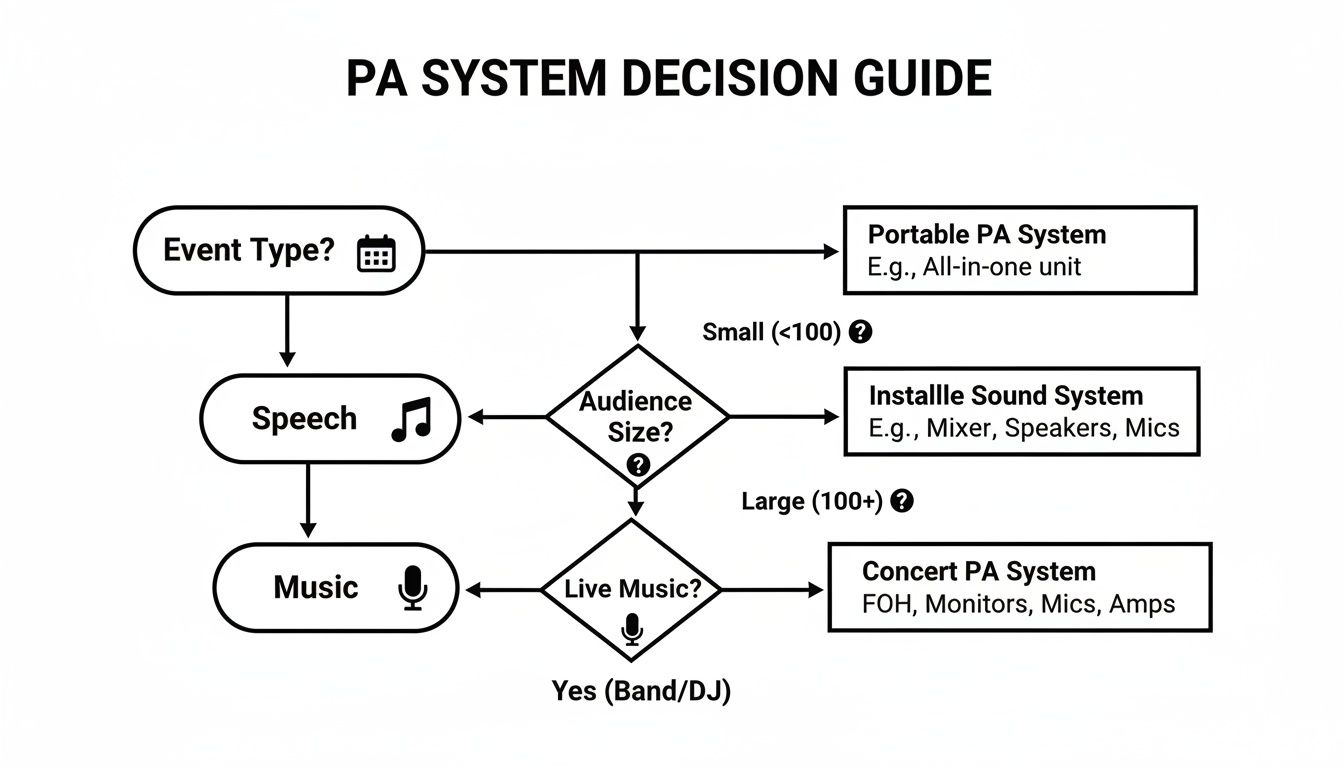
As you can see, it is a logical path. The decision branches out depending on whether your event is focused on speech or music, and how many people you need to reach.
Finally, a word on subwoofers. For any speech-only event, you do not need them. But if you have a DJ or a live band, they are non-negotiable. Subwoofers produce the low-end bass frequencies that give music its depth and energy. A party without subwoofers will sound thin and weak.
Understanding these components means you can read a quote from a company like London Audio Visual Hire and know exactly why certain items are on the list, ensuring you get the perfect system for your event.
Managing London Logistics and Venue Coordination
Hiring a PA system in London involves much more than just the equipment. In a city like this, logistics can make or break your event. Understanding the venue’s rules and the city’s unique challenges from the start is the difference between a smooth setup and last-minute panic.
Once you have chosen your audio supplier, your next call should be to the venue manager. This is not just a courtesy; it is a critical planning session. You need to discuss the practicalities of getting bulky, heavy equipment into and out of their space.
Navigating Venue Access and Restrictions
Every London venue is different. A modern conference centre is built for this, but a listed Georgian townhouse or a trendy warehouse conversion is not. You cannot assume anything.
It is time to get specific with your questions:
- Loading and Unloading: Is there a proper loading bay, or will the van be blocking a side street? Are there time restrictions? It is common for venues in central London to have strict rules, such as no deliveries during rush hour.
- Parking: Where can the AV team park their van? On-site parking is a major advantage. If it is not available, you need to budget for the high cost of commercial parking in areas like Westminster or the City of London.
- Physical Access: Map out the journey from the loading bay to the event space. Are there stairs, tight corridors, or a small service lift? Get the lift dimensions. A flight case for a mixing desk will not fit in a small passenger lift, and discovering that on the day is a disaster.
- Power Supply: Where are the power sockets, and what type are they? For most small setups, standard 13-amp sockets are fine. However, a larger system might require a 32-amp supply. Your audio team needs to know this well in advance.
A quick chat with the venue manager can uncover potential problems weeks ahead of time. Imagine discovering a historic venue has a strict 95dB sound limit, or that the main service lift is out of action. This gives your audio supplier time to find a solution, like specifying smaller speakers or bringing in extra crew for a manual load-in.
Dealing with London-Specific Challenges
On top of the venue itself, you are also dealing with London. This brings another layer of complexity, often with hidden costs that need to be factored into your quote from the beginning.
Consider these points:
- Congestion Charge & ULEZ: Is the venue inside the charging zones? Any professional quote for PA hire in London will have already factored in these transport costs.
- Tight Turnaround Times: London venues are busy. It is not unusual for a space to host a daytime conference followed by an evening awards dinner. This can leave an incredibly narrow window for your AV team to dismantle one system and set up another.
- Historic and Unusual Venues: One of the joys of London is its unique spaces, such as museums, galleries, and converted railway arches. These places come with a long list of rules to protect their character, dictating where equipment can go and how it must be handled.
The Non-Negotiable Paperwork
No professional London venue will let an outside supplier plug in a single cable without seeing the right paperwork. Your PA hire company should have this ready to go, as venues often ask for it weeks before the event.
Two documents are absolutely essential:
- Public Liability Insurance (PLI): This is the venue's protection if an accident causes injury or damages their property. Most venues require a minimum of £5 million in cover, and many large ones insist on £10 million.
- PAT Testing Certificates: Every single piece of electrical equipment, from the main speakers down to the last extension lead, must be certified as safe through Portable Appliance Testing (PAT). Venues will rightly demand proof.
This paperwork is not optional. If a potential supplier seems vague or hesitant about providing these documents, it is a significant red flag. For larger events with significant technical requirements, you are always better off working with a specialist team that handles these logistics daily. Exploring a dedicated conference AV hire in London service can save a lot of trouble.
Why a Professional Sound Engineer Is Essential
You can choose the perfect speakers and microphones for your pa system hire in London, but that is only half the battle. Excellent equipment can sound terrible if no one knows how to operate it. This is where a professional sound engineer comes in. They are the ones who turn a collection of gear into a smooth, flawless audio experience.
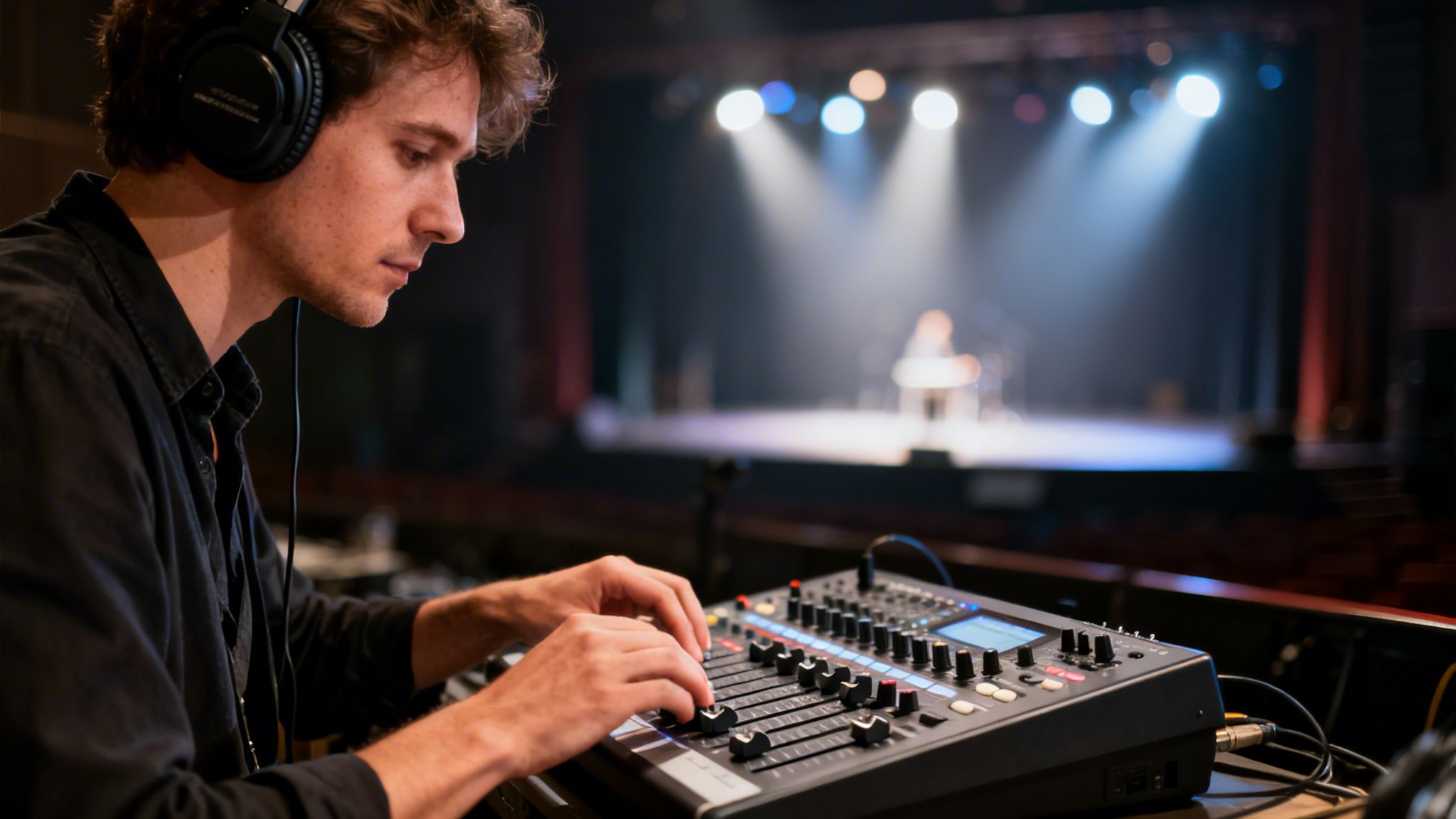
It is easy to see an engineer as just another budget item, but think of them as your quality control. They are the single point of contact for everything your audience hears. That kind of peace of mind is priceless, letting you focus on your guests and the event itself.
More Than Just Pressing ‘Play’
What does a sound engineer actually do? Their work starts long before your first guest arrives and does not end until the last cable is packed away. Their entire focus is on delivering clean, consistent sound from start to finish.
This breaks down into a few key areas:
- System Setup and Tuning: First, they will get everything connected safely and correctly. Then comes the crucial part: "tuning the room." They use equalisation (EQ) to address the venue's acoustic quirks, eliminating feedback before it can start and ensuring the sound is clear, whether the room is full of soft furnishings or hard, reflective surfaces.
- Sound Checks: Before the doors open, the engineer runs a thorough sound check on every audio source. That means testing every presenter's microphone, checking playback from laptops, and setting the levels for any background music or video clips.
- Live Mixing: During the event, they are actively mixing, constantly adjusting faders to make sure every speaker is heard, music does not drown out conversation, and the transitions between presentations and videos are completely seamless.
- Troubleshooting: If a microphone battery suddenly dies or a rogue buzz appears, the engineer is your first responder. They are trained to find and fix problems fast, often so discreetly that the audience never notices.
This level of skill comes from a deep talent pool. The UK's audio-visual sector is the largest in Europe, contributing £15 billion in Gross Value Added (GVA) annually. It is a robust industry that has grown by an average of 3.1% each year since 2010 and employs over 170,000 skilled professionals. When you hire an engineer from a reputable company, you are tapping into that expertise. You can read more about the UK's AV sector economic contribution to see just how significant this industry is.
A Real-World Example: The Corporate Awards Night
Picture a high-stakes awards ceremony at a prestigious London hotel. The schedule is packed, the cues are complex, and the pressure is on. This is where an engineer truly proves their value.
As an award winner's name is called, the engineer brings in their walk-on music perfectly. As the winner gets to the podium, the music fades out just as their microphone goes live, with no awkward pauses or jarring feedback.
A skilled engineer thinks ahead. They will have the next presenter's lapel microphone live and ready before they even take the stage, so you never miss their first few words. Small fumbles like this can shatter a speaker's confidence.
Throughout the night, the engineer is juggling audio from video clips, multiple presenters, and the host's commentary. If there is a last-minute decision to add a surprise musical guest, they do not panic. They simply get it done, quickly setting up what is needed and creating a great mix on the fly.
This is the difference between an event that feels amateur and one that feels truly professional. Bringing an engineer on board from a trusted provider like London Audio Visual Hire is not an expense; it is an investment in a stress-free event that runs like clockwork.
Your PA Hire Questions, Answered
Even the most organised event planner has questions when arranging sound. After years of working on events across London, we have heard them all. Here are the answers to the most common queries we receive, with the straightforward advice we would give over the phone.
How Far Ahead Should I Book My PA System?
This is an excellent question, and the answer really depends on your event.
For anything large or complex, such as conferences, awards dinners, or weddings, you should aim to book your PA system and crew three to six months in advance. London’s event scene is busy, and the best suppliers get booked quickly, especially during the summer and the Christmas party season.
If you're planning something smaller, like a simple presentation or an internal meeting, providing four to six weeks' notice is usually sufficient. Booking early not only secures the right equipment and people; it gives everyone time for proper planning, which might include a site visit and arranging logistics with your venue.
What Should a Professional PA Hire Quote Look Like?
A professional quote should be clear and fully itemised. If it is vague, that is a red flag. You need to see exactly what you are paying for so you can compare your options fairly.
A solid quote for PA system hire in London will always break down:
- The Equipment List: A detailed list of all equipment, from specific speaker models and mixing desks down to the exact number and type of microphones.
- The Ancillaries: A line for all the essential extras, such as cables, stands, and any rigging needed to make the system work safely.
- Logistics Costs: Clear charges for delivery and collection. This should also include any London-specific fees like the Congestion Charge or venue parking.
- Labour Fees: This should be separated, showing the cost for setup (the rig) and dismantling (the de-rig) separately from the live event operation.
- Technician Fees: If a sound engineer is staying for your event, their fee should be a separate line item, usually as a day or half-day rate.
The most important thing is that your quote must confirm the company has up-to-date Public Liability Insurance and that all equipment is PAT tested. Venues will not allow suppliers on-site without this paperwork. It is non-negotiable.
Can I Just Hire the Equipment and Set It Up Myself?
You can, but we would not recommend it. While a "dry hire" (equipment only) might seem fine for something very small, like a single speaker for background music, it is a significant risk for any professional event.
The DIY approach often leads to common audio problems that can disrupt your event and make your organisation look unprepared. These include high-pitched microphone feedback, dead spots where no one can hear, or simply connecting things the wrong way and getting total silence.
Bringing in an experienced technician is a small investment for complete peace of mind. They will ensure the system is properly configured and tuned to the room, guaranteeing a smooth, professional result.
What Happens if Something Goes Wrong During My Event?
This is exactly why having a professional technician on-site is so critical. A dedicated sound engineer is your first line of defence against any technical issue.
An experienced professional can fix most common problems, such as a dead microphone battery or a mysterious buzz from a cable, quickly and discreetly, often before anyone in the audience even knows something was amiss. Any reputable hire company plans for the unexpected. At London Audio Visual Hire, our engineers always carry a kit of essential spares like extra cables and batteries. For critical events, we will even build backup equipment into the original plan for total redundancy. The show will always go on.
Getting the sound right is a crucial part of a successful London event. The team at London Audio Visual Hire has the experience and the equipment to ensure your audio is crisp, clear, and perfectly suited to your venue. Find out more about how we can help with your next event by visiting londonaudiovisualhire.co.uk.