

When organising an event, getting the sound right is non-negotiable. For PA hire in London, the first step is to define what your event truly needs. The system for a small seminar is vastly different from one for a large awards show, with requirements determined by audience size, the venue, and the type of audio being amplified.
Matching Your Event to the Right PA System
Selecting the correct PA system is the foundation of a successful event. Before requesting quotes, you must develop a detailed brief. This initial step prevents miscommunication, ensures quotes are comparable, and guarantees the equipment provided is fit for purpose. A product launch in a modern conference centre has very different demands to a gala dinner in a historic Livery Hall.
A thorough assessment involves more than a simple headcount. It requires a methodical analysis of three key areas: the number of attendees, the venue's physical characteristics, and the specific audio content.
Defining Your Audio Requirements
First, consider the numbers. A system for a 50-person workshop in a hotel meeting room is straightforward. For a 500-delegate conference at the ExCeL, the requirements are far more complex. Consider how your guests will be distributed. Are they all seated theatre-style, or are they mingling and networking? This directly affects the number of speakers required and their placement to ensure clear sound for everyone.
Next, you must understand the venue. London offers many unique spaces, each with its own acoustic challenges. A modern, carpeted conference room is acoustically forgiving as it absorbs sound. In contrast, a grand, historic hall with high ceilings, stone floors, and large windows is prone to echo and reverberation. Identifying these challenges early allows your AV team to plan accordingly, bringing the right equipment to manage the room’s acoustics. You can learn more about the fundamentals in our guide on what is audio visual equipment.
This flowchart outlines the core assessment process to help you map out your needs.
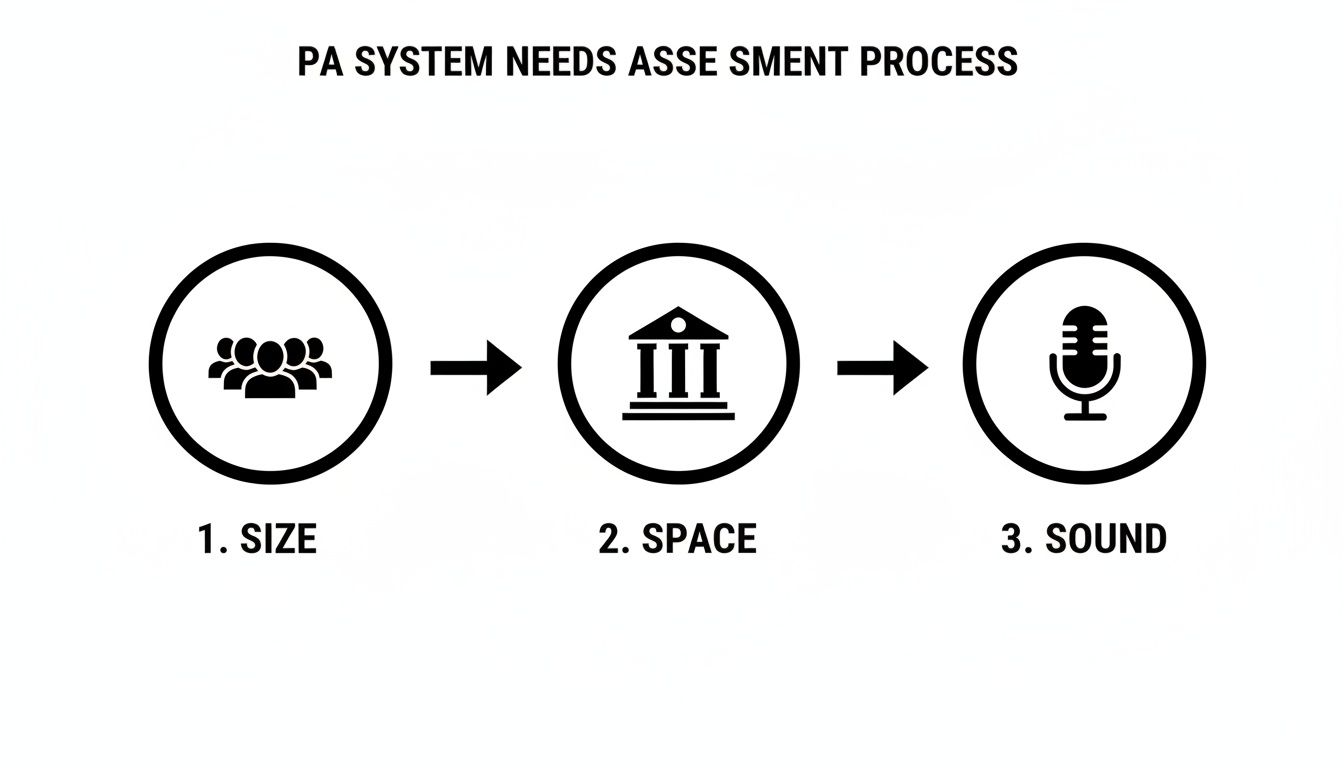
By systematically considering the audience size, the space, and the sound you are producing, you build a solid foundation for your technical brief.
Articulating Your Technical Brief
Once you have a clear understanding of the scale and setting, it is time to specify the audio requirements. The equipment needed for a single speaker at a lectern is far simpler than what is required for a panel discussion with six participants or a live band with a drum kit and multiple vocalists.
I always recommend creating a checklist of every audio source. It might look like this:
- Microphone Types: Do you need a lectern microphone for the main speaker? A pair of handheld wireless microphones for Q&A sessions? Or discreet lapel microphones for presenters who move around the stage? Be specific.
- Playback Sources: List everything that will be used to play sound. This could be a laptop for presentation videos, a tablet running a background music playlist, or a feed from a DJ’s mixer.
- Live Performers: If you have a band, they should provide a 'technical rider'. This document is invaluable. It details their exact requirements, from the number of vocal microphones and instrument inputs to their on-stage monitor needs.
Providing this level of detail to your supplier is essential. A precise brief allows a company like London Audio Visual Hire to specify the right mixing desk, speakers, and accessories from the outset.
Finally, do not forget the most important component: the human one. For any setup more complex than a single microphone and speaker, an on-site sound engineer is essential. Their ability to manage levels, eliminate feedback, and resolve problems instantly is invaluable. To create a more immersive atmosphere, consider how elements like Par Can lighting can work alongside your sound system to transform the space and elevate the entire experience.
Navigating London's Unique Venue Challenges
Hiring a PA system in a city like London presents unique challenges. The landscape ranges from ultra-modern conference centres to centuries-old listed buildings, each with its own rules and logistical complexities. These practical, on-the-ground issues can challenge even the most experienced event planners.
The key to avoiding last-minute technical problems is proactive planning. This means moving beyond the floor plan and facilitating early communication between your AV partner and the venue manager. For any event of scale, a detailed site visit is not just a useful step; it is essential.
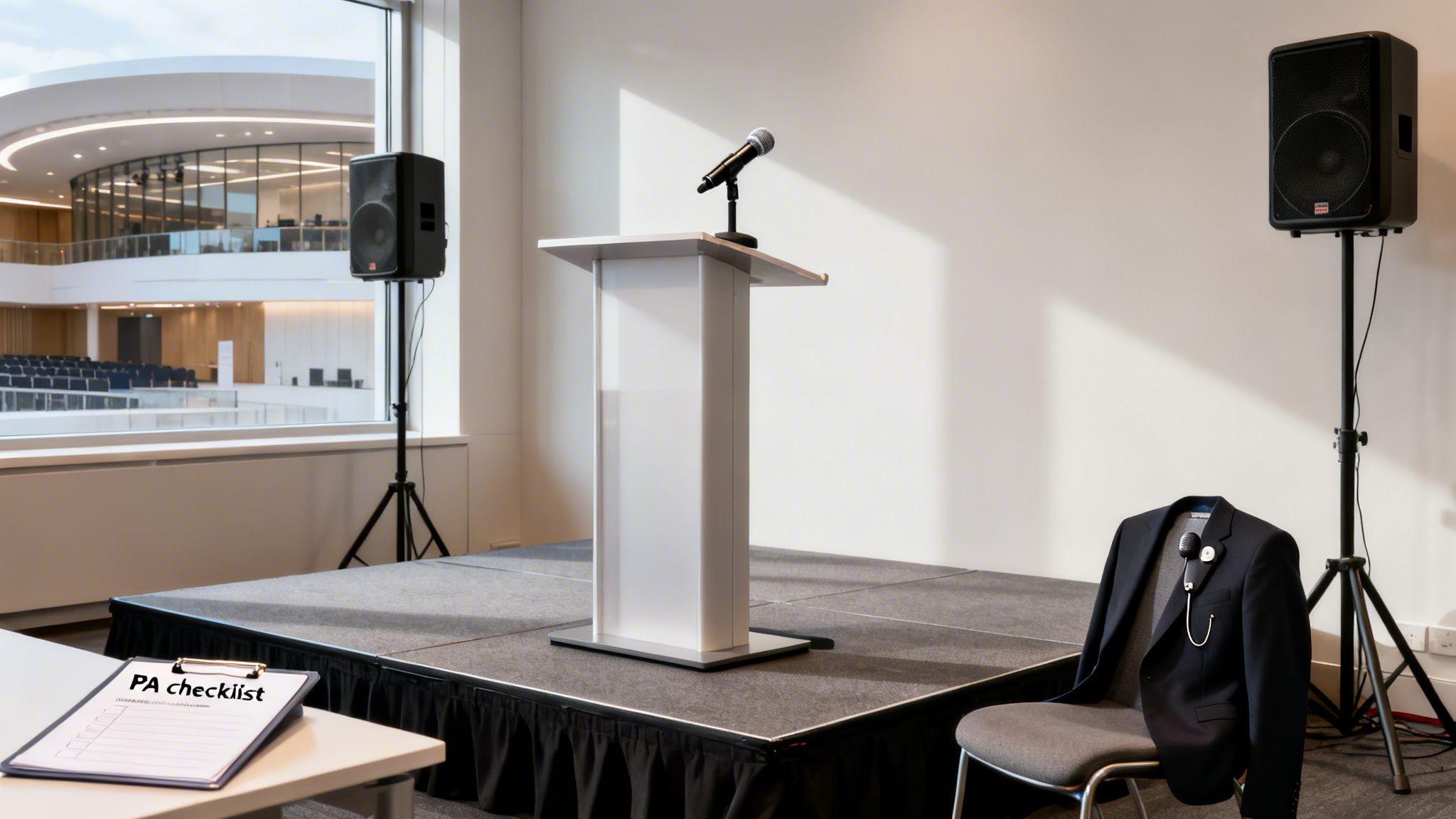
This is the only way for your technical team to truly assess the room's acoustics, identify logistical issues, and design a system that works within the venue's constraints. What appears straightforward on paper can be a completely different story in reality.
Site Visits and Venue Liaison
The most effective action you can take is to arrange a joint site visit with your AV project manager and a representative from the venue. This meeting aligns all parties, turning potential problems into resolved issues well before the first guest arrives.
During this walkthrough, your technical partner will assess several crucial factors:
- Logistical Access: How will they transport the equipment into the building? They will check loading bay dimensions, vehicle access, and the route from the van to the event space. Navigating a narrow Mayfair street or a venue without a loading bay requires a solid plan.
- Power Availability: They need to locate power outlets and assess their capacity. A historic townhouse might have limited, older power sources, meaning the crew may need to run long cable routes or even bring in their own generators.
- Rigging and Placement Points: The team will identify the best locations for speakers to achieve even sound coverage and look for any existing rigging points for lights or other equipment. This is particularly critical in architecturally sensitive buildings.
A site visit transforms abstract plans into a concrete, actionable strategy. It is your best insurance policy against unforeseen technical failures and is a standard part of the service offered by a professional company like London Audio Visual Hire.
Key Questions for the Venue Manager
Even with your AV expert present, you should have your own checklist of questions for the venue manager. Their answers can uncover hidden costs or limitations early in the process, preventing later complications.
Ensure you ask about:
- Noise Restrictions: "Do you have a sound limiter?" This is a critical question. Obtain the specific decibel (dB) limit and find out what time the restrictions apply. This is a common condition set by local councils, especially for venues near residential areas.
- In-House AV Systems: What equipment do they already have? Some venues have excellent built-in systems, but others may be poorly maintained or unsuitable for your event. You need to know if you are required to use their equipment or if you can bring in your own.
- Acoustic Challenges: Ask them if the room has any known sound issues. A space with floor-to-ceiling glass, like many modern venues overlooking the Thames, can create significant echo that a professional engineer must anticipate and manage.
This thorough approach is why London has such a strong, specialised AV industry. The city is the undisputed hub for the UK's audio-visual sector, home to an incredible 715 mapped recording studios, far more than any other region. This density means you have access to a deep pool of engineers who know the city's venues inside and out. You can read the full government market assessment on the UK’s studio landscape for more detail.
By tackling these practical venue challenges head-on, you ensure your PA hire in London is a complete, tailored solution designed for success. For a closer look at how different spaces can be handled, see our profiles on some of London's top event venues.
How to Choose and Vet Your AV Hire Partner
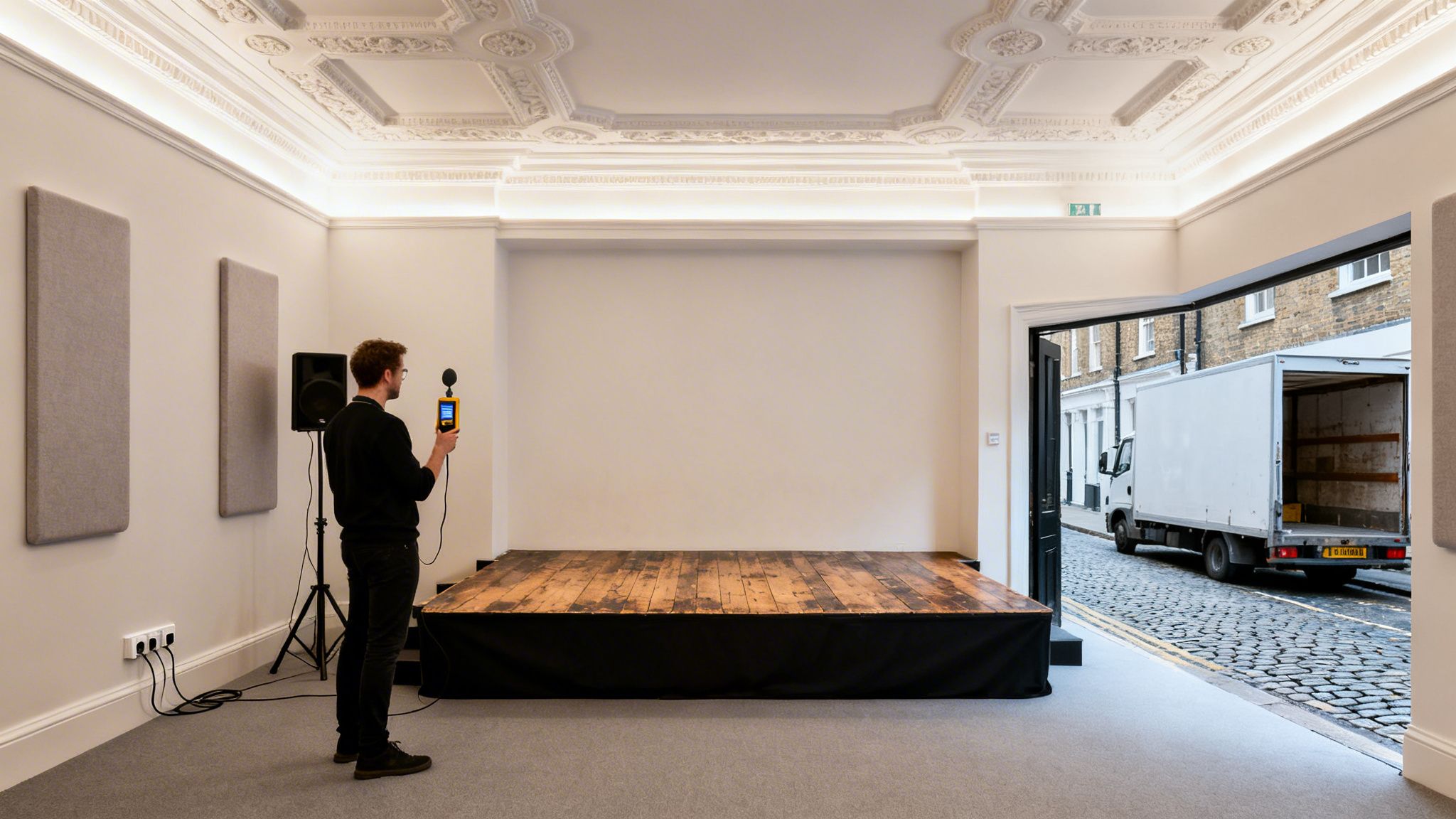
The success of your event's sound depends almost entirely on the supplier you choose. When searching for PA hire in London, it is easy to focus on price. However, experience shows that the real value lies in a partner's expertise, reliability, and technical capability. A cheap quote can quickly become expensive if equipment fails mid-speech or support is unavailable.
Choosing the right company is not about finding the lowest price; it is about finding a team that understands the immense pressure of live events in the capital. You need a partner with robust processes who can guarantee a smooth delivery. This diligence during the vetting stage is what separates a seamless event from a stressful one.
Beyond the Price Tag: Core Vetting Criteria
When you shortlist potential suppliers, your checklist needs to extend beyond the bottom line of a quote. Any professional AV hire company should be able to provide key documents without hesitation. This is not just paperwork; it is proof of their commitment to safety and quality.
Here are the non-negotiables to request:
- Public Liability Insurance: Always ask to see their certificate. A minimum of £5 million in cover is standard for most London venues, but many larger or more prestigious ones will insist on £10 million. If they cannot provide this, do not proceed.
- PAT Testing Records: Every piece of electrical equipment they bring into your venue must be regularly tested for safety. Get confirmation that their entire inventory is PAT (Portable Appliance Testing) certified.
- Relevant Case Studies: Look for evidence that they have handled events similar to yours in scale, style, and complexity. A company that excels at conferences might not be the best fit for a high-energy product launch with a live band, and vice versa.
Think of these documents as the bedrock of a supplier's credibility. They demonstrate a real commitment to keeping your guests, your staff, and the venue safe, which is an invaluable assurance.
Understanding Service Levels: Dry Hire vs. Full Production
Deciding on the right level of service is a crucial step. The choice is usually between 'dry hire' and a fully managed production service, and it will depend on your event's complexity and your team's own technical confidence.
Most London AV hire companies offer a spectrum of support. Here is a brief overview of what that typically means.
PA Hire Service Level Comparison
| Service Level | What's Included | Best For | Typical Cost Indicator |
|---|---|---|---|
| Dry Hire | Equipment rental only. Delivery and collection. | Simple meetings, small private parties, or when you have your own expert tech team. | £ |
| Delivery & Setup | All of the above, plus an engineer to set up and test the equipment before leaving. | Medium-sized events like workshops or panel talks where the setup is static. | ££ |
| Full Production | A dedicated project manager, on-site sound engineer(s) for the full event duration, and all logistics handled. | Corporate conferences, award ceremonies, live performances, anything complex or high-stakes. | £££ |
While dry hire can seem like a budget-friendly option, it leaves all the responsibility for setup and operation with you.
For any significant corporate event, a full production service is the only path I would recommend. You are not just hiring equipment; you are hiring a dedicated team of experts. This includes a project manager for planning and, crucially, an experienced on-site technician to run the system flawlessly.
Partnering with a company like London Audio Visual Hire for a full-service solution means you have an expert sound engineer on hand to manage levels, solve problems instantly, and adapt to any changes. You can learn more about our dedicated team and approach.
This level of professional support is what the city’s events industry is built on. With total per-production spend for major film projects in London hitting a record £15.1 million, the city is home to battle-tested technicians who thrive in high-stakes environments.
Remember, building the perfect event team goes beyond your AV supplier. Collaborating with other top-tier partners, like a trusted Hospitality Recruitment Agency London, ensures every aspect of your event is handled by professionals. A dream team of suppliers is the true foundation of a perfectly executed event.
Understanding Costs and Deciphering AV Quotes
An audio-visual quote can be confusing at first glance, often filled with technical jargon and a long list of line items. Gaining a clear picture of what you are actually paying for is the key to managing your event budget and making an informed choice between PA hire companies in London.
A detailed, transparent quote is a sign you are dealing with a professional organisation that values clear communication over hiding costs in confusing package deals.
The cheapest quote is almost never the best value. A low-cost offer might be appealing, but it often omits essentials like experienced technicians or a contingency plan. Real value comes from a complete service that covers every detail, ensuring the sound on the day is perfect. This is more important than ever as the UK's professional AV market grows, with the audio equipment rental sector alone expected to reach USD 1,369.99 million by 2033. This massive investment in event technology highlights the importance of working with qualified local experts. You can read more about the growth of the AV equipment market.
Breaking Down a Typical PA Hire Quote
A good quote should be itemised so you can see exactly where your budget is allocated. The equipment will vary depending on your event's needs, but most quotes from a company like London Audio Visual Hire will be broken down into these core components.
Here is what you should look for:
- Equipment Rental: This is the basic cost for the hardware itself. It should clearly list major items like speakers, mixing desks, microphones, and monitors. A good quote will not just say "speakers"; it will specify the models or at least the standard of equipment you are getting.
- Labour and Crew: This covers the time and expertise of the technical team. It is often split into setup (the 'rig'), operation during the event, and takedown (the 'de-rig'). Do not cut costs here. Skilled technicians are your best insurance policy against problems.
- Transport and Logistics: This fee covers the complex task of getting all the equipment and crew to your London venue and back. For any central London location, this will almost certainly factor in costs for the Congestion Charge or ULEZ.
Spotting Potential Additional Costs
Beyond the basics, a thorough quote will also highlight potential extra charges. Knowing about these from the start means no surprises on the final invoice and shows the supplier is being transparent.
Understanding the 'extras' is not about trying to avoid them; it is about planning for them. These costs are usually tied to the specific demands of your event or venue and are necessary to complete the job properly.
Common extras to look out for include:
- Out-of-Hours Fees: If your event involves a late-night setup or a de-rig in the early hours, expect to pay more for labour. This is standard practice and fairly compensates the crew for working unsociable hours.
- Parking and Access: If the venue does not have a dedicated loading bay or if vans need to be parked in a paid car park, this cost is usually passed on. It is a simple logistical reality.
- Insurance Waivers: Some companies offer an optional damage waiver. For a small fee, it protects you from a large bill if a piece of hired equipment is accidentally damaged during your event.
What to Expect: Real-World Examples
To give you a better idea, here are some approximate figures for PA hire in London. These are only estimates; the final price will depend on your exact needs, the venue, and the level of technical support you require.
- Small Seminar (Up to 100 Guests): For a simple setup with a lectern microphone, a couple of speakers, and a small mixer for playing presentation audio, you are likely looking at a cost between £350 – £600. This would typically include delivery and setup.
- Awards Dinner (Up to 500 Guests): This is a much larger undertaking. A large event with multiple wireless microphones for hosts and winners, background music, video playback sound, and especially a live band, needs a far more sophisticated system and a dedicated sound engineer. Costs here could easily be in the £2,500 – £7,000+ range, particularly if the band has a complex technical rider or you are adding stage lighting into the mix.
When you understand how these costs are constructed, you can compare quotes with much more confidence, knowing exactly what to look for beyond the bottom-line figure.
On the Day: Ensuring a Smooth Operation
After extensive planning and liaison with your supplier, the event day arrives. The difference between a frantic, stressful event and one that feels calm and professional often comes down to a solid production schedule and clear communication between your team and your AV partner.
Your event day plan is your guide. It must be shared with everyone involved, from the venue manager to the AV project lead at London Audio Visual Hire. This ensures everyone is working from the same information.
Your Production Schedule as a Roadmap
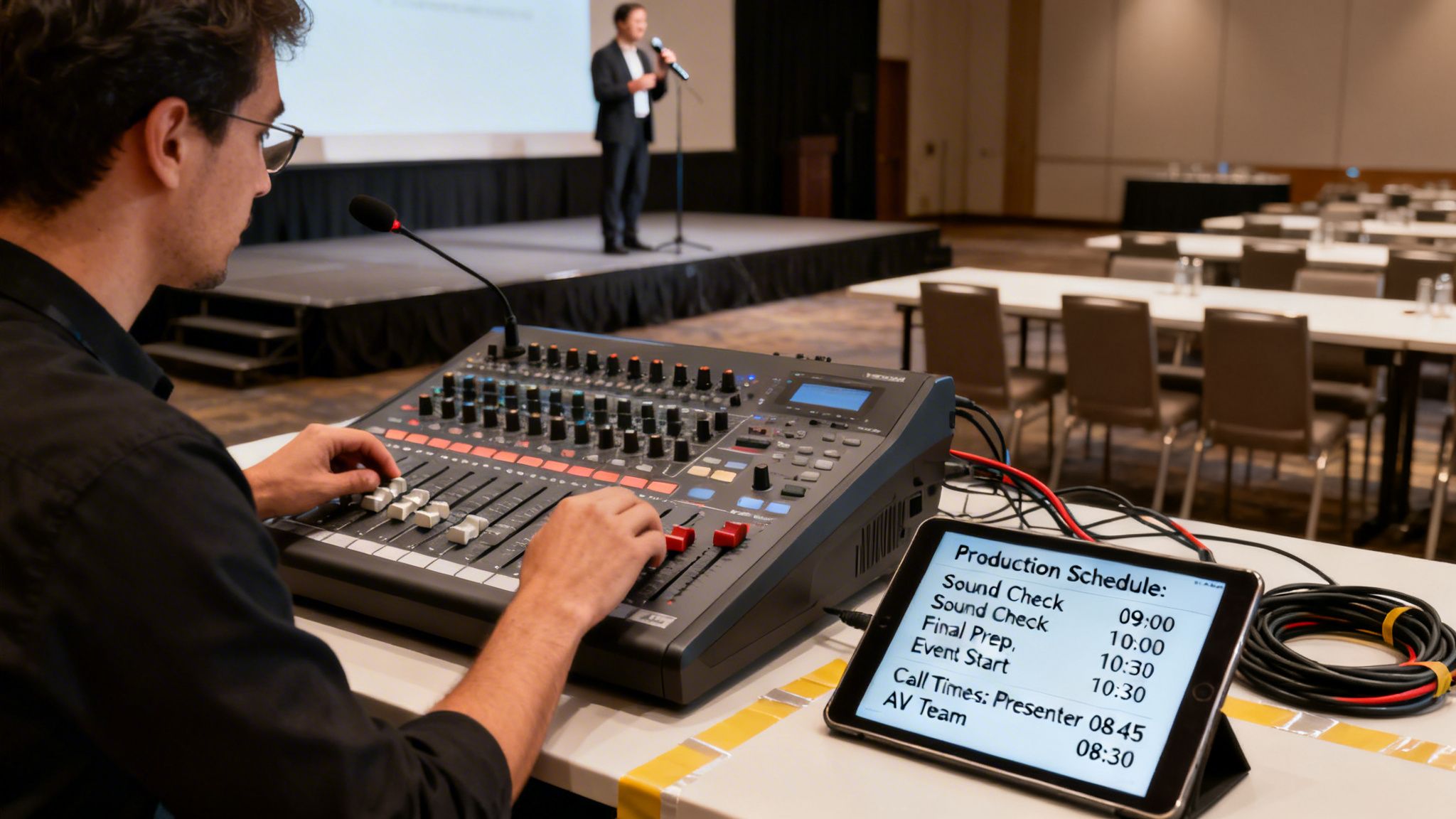
A production schedule is more than a simple running order; it is a minute-by-minute logistical map of your event. It should detail every technical touchpoint, starting long before your first guest arrives.
This vital document needs specific timings for:
- AV Load-in and Setup: The exact time the technical team can access the venue. This must be agreed with the venue manager, and you must factor in any access issues like service lifts or loading bay restrictions.
- System Checks: A dedicated window for the engineers to power up and test every piece of equipment, from the main speakers to the last microphone, before any presenters are on stage.
- Sound Checks: Individual, scheduled slots for every presenter, panellist, or performer. Rushing this stage is a common mistake and the fastest way to get poor audio quality.
- Event Start and Key Cues: The official start time, plus timings for crucial audio moments like walk-up music, video playback, or changes in background atmosphere.
- De-rig and Load-out: When the event concludes and the team can start packing down, plus the venue’s firm deadline for clearing the room.
The Pre-Event Briefing Checklist
Before the day begins, a final meeting with your AV project manager is non-negotiable. It is your last chance to run through the entire plan, clarify any final details, and ask any remaining questions. Using a checklist ensures nothing is missed.
A thorough pre-event briefing sets a calm, coordinated tone for the day. It confirms that you and the technical team share the same vision for how the event will unfold, leaving no room for guesswork.
Here is a quick rundown of what your briefing should cover:
- Key Contacts: A master list with names and mobile numbers for the main event planner, the on-site AV lead, the venue manager, and any key speakers or the stage manager.
- Final Running Order: The most recent version of the schedule. Be sure to highlight any recent changes for the technical team.
- Contingency Plans: A brief 'what if' discussion. For instance, what is the backup plan if a presenter's laptop fails or a wireless microphone experiences interference?
A good briefing checklist ensures everyone knows their role and what to expect. The table below is a simple template you can adapt to create a brief for your own AV team. It is an effective way to ensure you have covered all the essential information they will need before they arrive.
Sample AV Briefing Checklist for Event Planners
| Category | Information to Provide | Example |
|---|---|---|
| Event Overview | Name of the event, date, venue address, and primary on-site contact. | "Innovate 2024 Conference, 15 October, The QEII Centre, Sarah Jones (07700 900123)" |
| Schedule | Key timings: AV load-in, setup complete by, sound checks, event start/end, de-rig complete by. | "Load-in: 07:00, Setup complete: 08:30, Sound checks: 08:30-09:15, Event: 09:30-17:00, De-rig complete by 18:30." |
| Audio Requirements | Number and type of mics needed (lectern, handheld, lapel), music playback cues, video audio sources. | "1x lectern mic, 4x handheld mics for Q&A, 2x lapel mics for keynote speakers. Walk-on music for each speaker." |
| Visual Requirements | Presentation formats (16:9), laptop connections needed (HDMI, USB-C), any videos to be played. | "All presentations are 16:9 PowerPoint. We need HDMI and USB-C at the lectern. One 5-minute video file (MP4 format)." |
| Venue Specifics | Loading bay location, power availability, sound limiter details, venue contact person. | "Loading via Bay C. Power is 1x 32A socket stage left. No sound limiter. Venue contact is Mark Smith." |
| Contingencies | Backup plan for presenter laptop failure, spare microphone availability. | "Please have a spare HDMI laptop ready as backup. Ensure one spare handheld mic is on standby." |
Having this information ready makes the entire process smoother and shows your AV supplier that you are a professional who understands what they need to succeed.
Why You Cannot Skip a Proper Sound Check
A proper sound check for every person using a microphone is not just a useful step, it is essential for achieving professional-quality audio. This is the only time an engineer can correctly set the levels for each voice, which is crucial for clarity and preventing feedback.
During the check, the engineer is listening for several key things. They are setting the volume for that specific person, ensuring their voice carries clearly across the room. They are also adjusting the EQ (equalisation) to match the person's voice and eliminate any problem frequencies that might cause feedback.
The Professional Pack-Down: De-Rig and Venue Handover
The job is not finished when the last guest leaves. A clean, professional de-rig is the final signature of a quality PA hire in London. Your AV team should work quickly but safely to dismantle all equipment.
Good communication with the venue manager is vital here. The AV crew chief should check in with the duty manager to ensure the load-out follows the venue’s rules, especially around noise if other events are still taking place. The goal is to leave the space exactly as you found it, with all gaffer tape removed cleanly and any furniture returned to its original position.
Your PA Hire Questions, Answered
Let's conclude with a few frequently asked questions from event planners regarding PA hire in London. These concise, expert answers should provide the confidence you need to make the right technical decisions.
How Far in Advance Should I Book?
If you are planning a significant corporate event in London, you should be speaking to your AV partner at least 4 to 6 weeks in advance.
For larger or more complex events, such as a multi-day conference or an awards ceremony during the busy summer or Christmas seasons, you should aim to confirm bookings 8 to 12 weeks in advance.
This lead time is not just about equipment availability. It is crucial for the detailed planning that ensures an event runs smoothly. It allows for a proper site visit, considered system design, and coordinating logistics with the venue. While last-minute bookings are sometimes possible, you will almost certainly have to compromise on equipment and preparation time.
Do I Really Need a Sound Engineer On-Site?
For anything beyond a single microphone and a couple of speakers, the answer is a firm yes. I know a 'dry hire' (equipment only) can appear to save money, but the value an experienced sound engineer brings to a live event is immeasurable.
Your on-site engineer is there to:
- Manage Levels: Ensure every presenter is heard clearly and that background music does not overpower conversations.
- Prevent Feedback: Actively identify and eliminate microphone squeals before they become a problem.
- Troubleshoot: Instantly resolve any technical issues that arise, whether it is a faulty cable or a laptop that will not connect to the system.
Having a professional technician on site provides peace of mind. It frees you and your team to focus on your guests and the event, knowing the audio is in safe hands.
What is a Sound Limiter and How Does It Affect My Event?
A sound limiter is a device many London venues have installed to control volume, usually as a condition of their operating licence from the local council. It is designed to prevent the event from disturbing neighbours.
It consists of a microphone in the room that monitors the sound pressure level (SPL). If the noise exceeds a set decibel (dB) limit for more than a few seconds, it cuts the power to the sound system. This can be disastrous during a live band's performance or a crucial speech.
You must ask your venue about a sound limiter on your first visit. If they have one, your AV supplier needs to know the exact dB threshold. They can then design a system that works within that limit, and the engineer will be prepared to manage it.
Can I Play My Own Music from a Phone or Laptop?
Yes, playing a Spotify playlist or background tracks from a phone or laptop is a standard request. The key is to inform your AV provider in advance.
Simply handing your phone to the engineer on the day is not ideal. They need to have the correct cables ready to connect your device to the mixing desk. It is also much safer to have the music physically downloaded onto the device rather than relying on the venue's Wi-Fi or a patchy mobile signal. For the best sound quality, use high-quality audio files like WAV or high-bitrate MP3s.
What Happens if Equipment Fails During the Event?
This is precisely why you vet your suppliers thoroughly. Any professional company, like our team at London Audio Visual Hire, will have robust contingency plans built into their process.
First, all our equipment is meticulously maintained and tested before it leaves the warehouse, which significantly reduces the risk of failure. Secondly, for critical items like the main presentation microphone or the playback laptop, the on-site equipment list will always include spares.
If a piece of equipment does fail, the on-site engineer has the backup and the expertise to swap it out in seconds. In most cases, the audience will be completely unaware that anything went wrong.
Planning your next event in the capital? The team at London Audio Visual Hire provides expert advice and reliable production for corporate events of all sizes. Find out how we can support you at https://londonaudiovisualhire.co.uk.


