
You can plan the most spectacular event, with incredible speakers and stunning visuals, but if your audience cannot hear properly, the entire experience falls flat. Getting the sound right is not just a box to tick; it is one of the most crucial investments you will make. For event planners across the UK, choosing the right PA hire company can be the difference between a resounding success and a frustrating failure.
Why Nailing Your Event Audio is Non-Negotiable
From a packed conference hall to an intimate product launch, crystal-clear audio is what connects your message to your audience. When people can hear every word without straining, they stay engaged. Get it wrong, and you risk losing their attention completely.
This guide serves as a roadmap to finding and managing the perfect audio partner. We will cover everything from the initial brief to on-site execution, ensuring you feel confident at every stage.
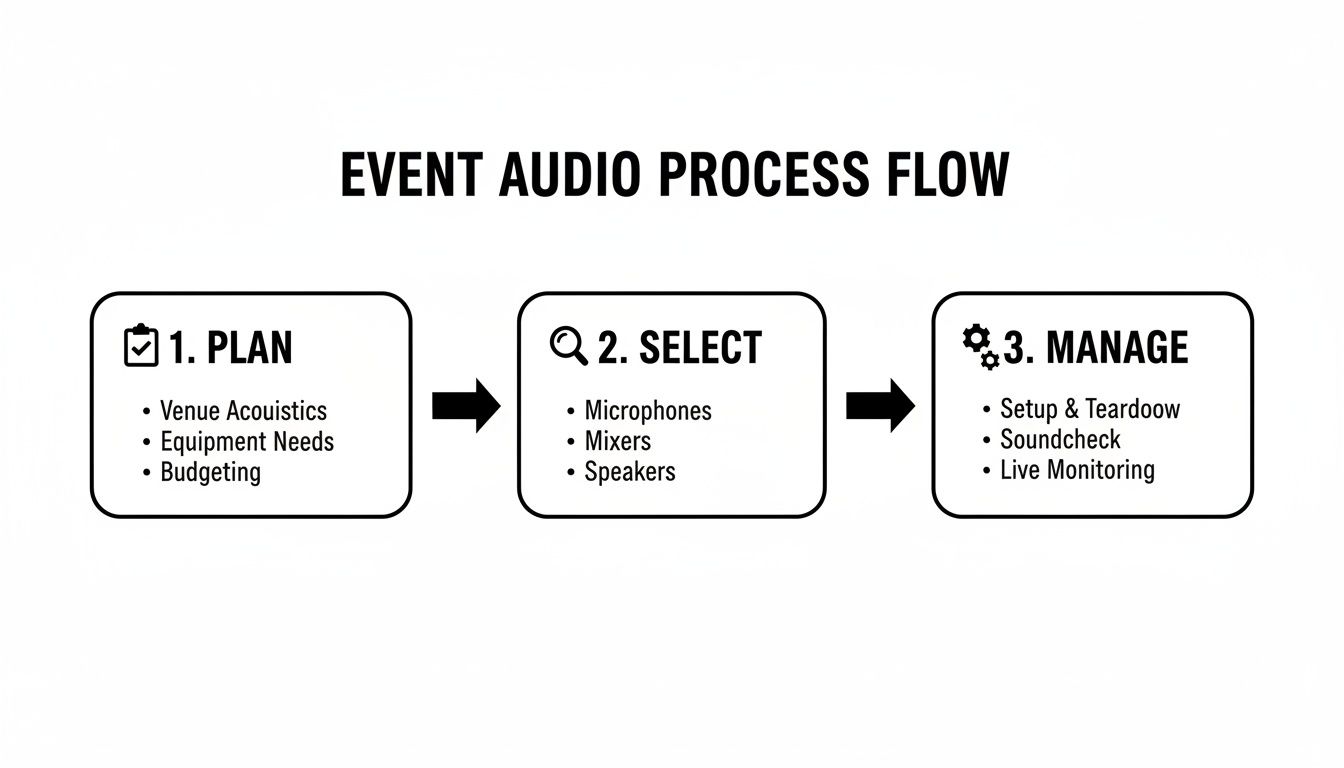
By following a clear process, you can sidestep common audio problems such as feedback shrieks, dead microphones, and speakers that are not powerful enough for the room. We will tackle real-world challenges, like decoding technical quotes and comparing disparate proposals, with practical, straightforward advice.
The Growing Demand for Better Sound
The importance of high-quality audio is becoming widely recognised. The UK audio equipment rental market was valued at USD 739.51 million in 2024 and is projected to grow. This surge is driven by an increasing demand for professional audio at corporate events, festivals, and conferences. You can explore the full analysis of the audio equipment rental market to see the trends for yourself.
Our goal is to help you cut through the noise and find a supplier who delivers flawless sound, every time. Throughout this guide, we will reference the high standards set by industry experts like London Audio Visual Hire to provide a clear benchmark of what excellent service looks like.
Setting a high standard from the outset is key. It helps you properly evaluate potential suppliers and find a true partner who acts as a seamless extension of your own team.
Ultimately, this changes the dynamic. You are not just hiring equipment; you are building a strategic partnership. This mindset empowers you to ask the right questions, make informed decisions, and ensure your event’s audio is as polished and professional as every other element.
Defining Your Audio Needs Before You Make Contact
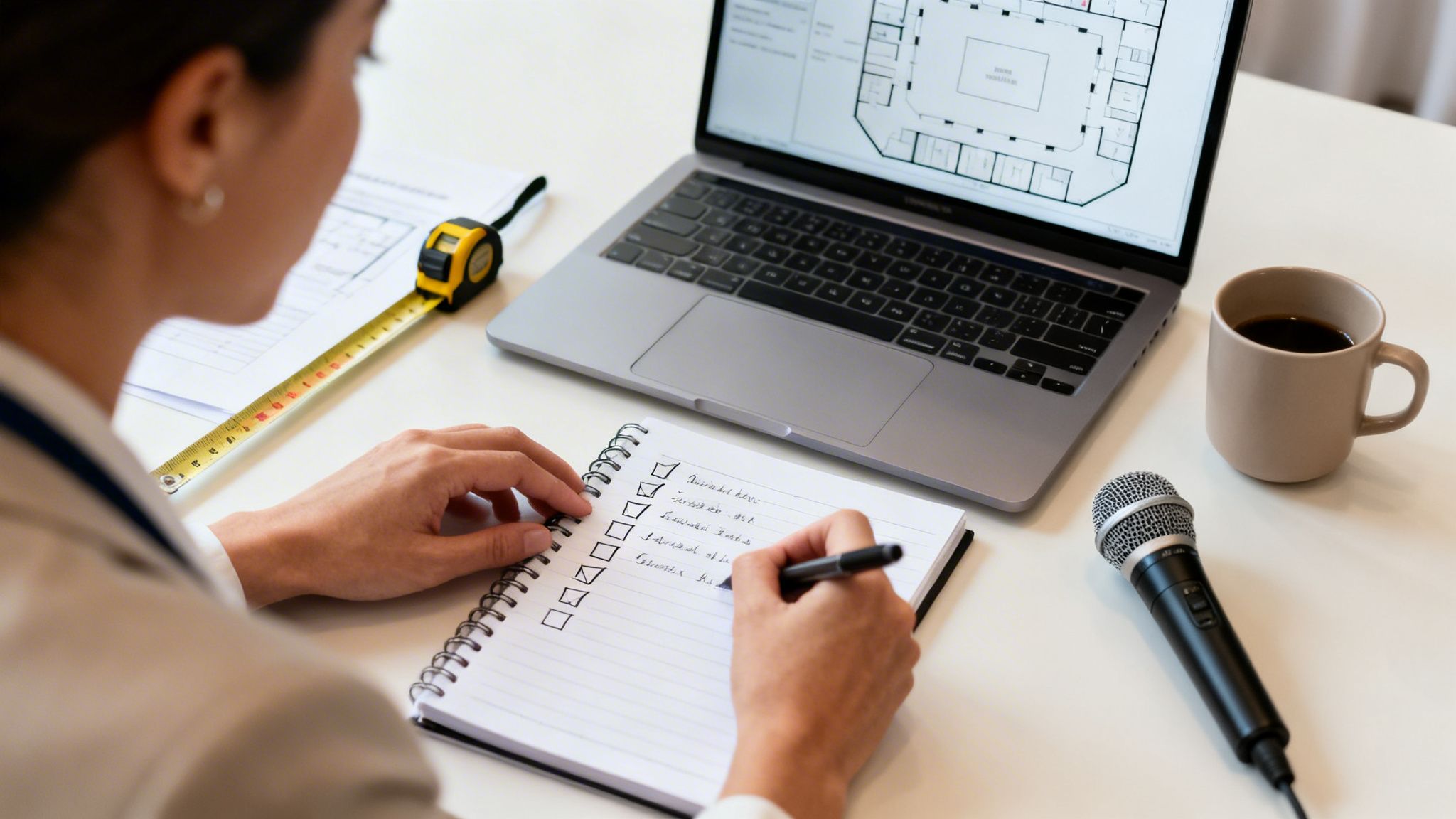
Before contacting PA hire companies, it is essential to prepare a detailed brief. This is the single most effective action you can take to ensure the quotes you receive are accurate and comparable. A comprehensive brief saves time and prevents miscommunications.
When you provide a supplier with a clear overview of your event, they can move from being an order-taker to a genuine partner. They can offer advice, suggest better solutions, and consult on what will work best. The aim is to move beyond a vague "I need a sound system" request and instead, paint a vivid picture of what you want to achieve.
Understand Your Venue and Audience
Your starting point is always the physical space. Every venue has its own acoustic personality, which dictates the type of speakers required and their placement.
Consider the environment:
- Acoustics & Materials: Are you in a grand ballroom with marble and glass, or a purpose-built conference centre with carpets and acoustic panelling? Hard, reflective surfaces are notorious for creating echo and feedback, which may require a more advanced system or specific speaker placement.
- Room Dimensions & Layout: A long, narrow room requires a different approach to a wide, open one. If you have a floor plan, provide it. Note the ceiling height and mark the locations of the stage, seating, and any obstacles like pillars or partition walls.
- Audience Size: This is straightforward but crucial. The sound system for an intimate gathering of 50 people is entirely different from what is required for a crowd of 500. Be realistic about your numbers, as this directly affects the power and coverage needed.
These details provide a potential supplier with the core information they need. If you are keen to understand the equipment behind the sound, you can learn more about what audio visual equipment involves.
Any competent PA hire company will immediately ask about the venue and audience. If a supplier provides a quote without asking these basic questions, it should be considered a red flag. It suggests a lack of interest in delivering a suitable solution.
Map Out Your Event’s Content and Format
Once you have established the 'where', consider the 'what'. The audio requirements for a conference with keynote speakers are completely different from a high-energy awards show with a live band or a product launch that relies on video content.
The simplest way to tackle this is to create a rough running order. It does not need to be elaborate; a simple schedule showing what kind of audio is happening and when will suffice. This helps the supplier understand the flow of the event and what inputs the sound desk will need to handle.
The Essential Details for Your Brief
To get an accurate proposal from PA hire companies, your brief needs to answer a few key questions. Use this as a checklist:
- What is the audio content? Will it be:
- Live speech (keynotes, panel discussions)?
- Pre-recorded music (background atmosphere, walk-up stings for awards)?
- Live music (a DJ, a cover band, a string quartet)?
- Audio from video clips?
- How many people need microphones simultaneously? A single presenter is simple. A six-person panel discussion requires a more complex mixing setup to manage multiple open microphones.
- What kind of microphones do you need? Consider the different styles:
- Lectern mics for a formal presentation setup.
- Handheld wireless mics for audience Q&A or presenters who move around the stage.
- Lapel (lavalier) mics for keynote speakers who need their hands free.
- Are there any special audio needs? Consider whether you need an audio feed for a live stream, a recording for a podcast, or a press feed for broadcast media. Mention specific inputs for a DJ's decks or a band's equipment.
Providing this level of detail transforms your enquiry from a general query into a concrete project plan. It allows a team like London Audio Visual Hire to engineer a system that is perfectly tuned to your event, ensuring a flawless experience for everyone in the room.
How to Evaluate PA Hire Companies Beyond Price
Choosing an audio supplier based on price alone is a common and risky mistake in event planning. A low quote can seem appealing but often conceals issues with equipment quality, technical skill, or reliability. A professional PA hire company is more than a supplier; they are a partner invested in your event’s success, and that value extends far beyond the cost.
To move past a price-first mentality, you need to know what to look for. It requires digging deeper for evidence of quality, expertise, and dependability. This is not just about avoiding problems; it is about building a network of trusted suppliers you can rely on.
Assessing Technical Inventory and Maintenance Standards
The equipment a company uses tells a story. Reputable companies invest in industry-standard brands known for performance, such as d&b audiotechnik, L-Acoustics, Meyer Sound, and Shure. When speaking to a potential supplier, do not hesitate to ask what brands they stock.
However, brand names are not the whole picture. How that equipment is maintained is what truly matters. Well-maintained equipment is reliable equipment.
You are entitled to ask for proof of their maintenance standards:
- Regular Servicing: What is their process? Do they have a system for checking and servicing equipment after every hire?
- PAT Testing: In the UK, all electrical equipment must be regularly PAT (Portable Appliance Testing) tested. This is a legal safety requirement. Ask to see their current PAT certificates. If they cannot produce them, it is a non-negotiable reason to walk away.
- Firmware Updates: Modern digital desks and processors require regular firmware updates to function correctly. A company that stays on top of this demonstrates a commitment to peak performance.
A supplier who is open and proud of their maintenance logs is a supplier you can trust. Vague answers or hesitation should be considered a major red flag.
Gauging Team Expertise and Professionalism
On the day of your event, the people behind the equipment are your most important asset. From the project manager coordinating logistics to the sound engineer at the mixing desk, their expertise turns a collection of speakers and cables into a flawless audio experience.
Your first interaction is usually with a project manager. Pay attention to their questions. Are they simply taking your order, or are they asking intelligent questions about the venue, audience, and your objectives? A great project manager, like those at London Audio Visual Hire, acts as a consultant, using their experience to identify potential problems before they arise.
Then there are the on-site technicians. A great sound engineer is not just technically proficient; they are calm, an excellent communicator, and a creative problem-solver. That human element is crucial, especially under pressure. The European audio-visual rental market is set to grow by 7.65% annually through 2034, with the UK taking a 25% share. With around 40% of all UK events happening in London, a team's calm expertise and intimate venue knowledge is essential for a flawless event. You can find more details in this AV market growth report.
Verifying Health, Safety, and Insurance Credentials
Compliance is not just paperwork. It is a critical indicator of a company's professionalism and their commitment to safety. Before signing any contract, you must verify they have the correct credentials to work legally and safely at your venue.
Here is your essential checklist:
- Public Liability Insurance: This is absolutely vital. It covers injury to people or damage to property. Most UK venues require a minimum of £5 million cover, and it is not uncommon for larger venues to demand £10 million.
- Employers' Liability Insurance: If the company has staff, this is a legal requirement in the UK.
- Risk Assessments and Method Statements (RAMS): For any complex job, the supplier must provide detailed RAMS. These documents show they have considered potential risks and have a solid plan to mitigate them.
Always ask to see the actual insurance certificates. A professional company will have them ready and will expect you to ask.
Creating a simple comparison chart when vetting suppliers can help you keep track. This allows you to see at a glance who meets the criteria and where potential red flags lie.
Key Supplier Evaluation Checklist
| Evaluation Criteria | Supplier A | Supplier B | Notes / Red Flags |
|---|---|---|---|
| Public Liability Insurance | £10m | £5m | Both meet standard requirements, but A is better for larger venues. |
| PAT Testing Certificates | Provided on request | Vague, "will send later" | Red Flag: Supplier B's hesitation is a concern. |
| Team Experience / CVs | Provided senior tech CVs | General company bio only | Supplier A offers more transparency on team expertise. |
| Relevant Case Studies | 2 corporate conferences | 1 festival, 1 wedding | Supplier A's experience is a closer match for our event. |
| Initial Consultation | Asked detailed questions | Took brief without probing | Supplier A's consultative approach is a strong positive. |
This simple process forces you to look beyond the quote and focus on the factors that truly determine a successful partnership.
Looking at Case Studies and Client Feedback
Finally, you need proof that they can deliver. Case studies and testimonials are your best insight into a company’s real-world experience. Do not just look for glowing reviews; look for evidence of events that are similar to yours in scale, style, and setting.
A case study for a large conference at ExCeL London demonstrates a different skillset than a testimonial from a small wedding. If you are planning a product launch in a unique, acoustically challenging London venue, find a PA hire company that can prove they have handled that kind of challenge before.
That proven track record, specific to your needs, is the ultimate assurance that your event's sound is in safe hands.
Making Sense of Technical Quotes and Your Budget
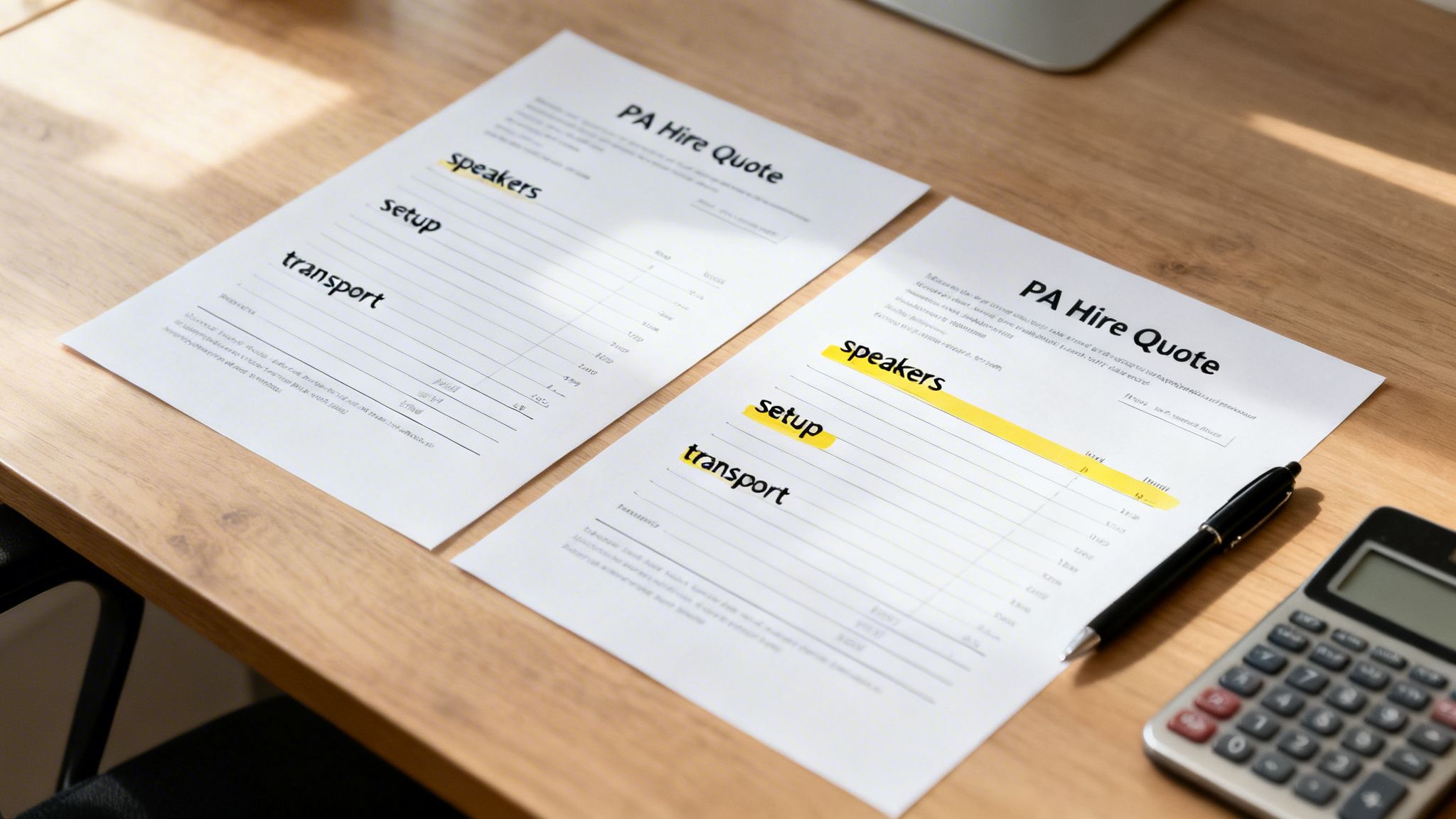
When a quote arrives in your inbox, it can look like a foreign language filled with technical jargon. Learning to read between the lines is the key to spending your budget wisely and making a confident choice.
A good PA hire company will aim for clarity, but some inside knowledge on your part is helpful. Think of the quote as the company’s proposed solution to your specific audio puzzle. Every line item should directly address a need outlined in your brief, from the venue’s characteristics to the type of content you are presenting. If you cannot see the connection, it is your cue to ask questions.
What Is This Equipment For?
You do not need to be a sound engineer, but knowing the basic components of a PA system will help you understand what you are paying for.
Here are the common items you will find on a professional quote:
- Point Source Speakers: These are classic, standalone speakers. They are suitable for smaller events, as monitors for performers, or to fill in sound in awkward areas of a larger room.
- Line Array Systems: These are the vertical columns of speakers often seen at large concerts and conferences. They are designed to project sound clearly over long distances, making them essential for large audiences.
- Subwoofers: These reproduce low-frequency sounds that provide bass. If you have a DJ, a band, or cinematic video content, they are necessary. For a simple speech-only conference, they are probably not required.
- Microphones: The quote should detail the type of microphone, not just the quantity. Handheld mics are ideal for audience Q&As, while lapel (lavalier) mics give presenters the freedom to move. Lectern mics are standard for formal speeches from a podium.
A professional company like London Audio Visual Hire will provide an itemised list with makes and models. You can explore a full range of event equipment to see what a modern inventory looks like.
If you receive a quote that just says "PA System" with one lump sum, consider it a major red flag. A detailed breakdown shows the company has thought about your event, not just sent a generic template.
Watching Out for Hidden Costs
A trustworthy quote is transparent and covers everything from the equipment to the personnel. Budgets can spiral due to extra costs that were not accounted for initially.
Ensure the proposal explicitly lists costs for:
- Transport: Getting the equipment to and from your venue.
- Labour: The crew's time for the setup (load-in) and breakdown (de-rig). This can be a significant portion of the cost.
- Technicians: The on-site sound engineer and any support crew needed during your event.
- Contingency: A small allowance for essentials like extra cabling, adapters, and gaffer tape. It shows they are prepared.
For most organisations, hiring is more cost-effective than buying. Marketing agencies and festival organisers can cut their audio costs by 50-70% through hiring. This is especially true in London, where an estimated 80% of venues have unique acoustic challenges that require expert handling. For a charity gala, the AV rental might be around £15,000, whereas owning the same equipment could cost upwards of £50,000. You can read more on the AV rental market findings to see how the numbers stack up.
Aligning the Quote with Your Budget
What if your preferred supplier's quote is slightly over budget? Do not dismiss it immediately. This is where the conversation starts.
Speak with their project manager. Explain your budget constraints and ask if there are ways to refine the proposal without sacrificing quality. Could a different but still high-quality brand of speakers be used? Is every microphone absolutely necessary? A true partner will work with you to find a solution that meets both your needs and your budget.
On-Site Logistics and Day-of-Event Management
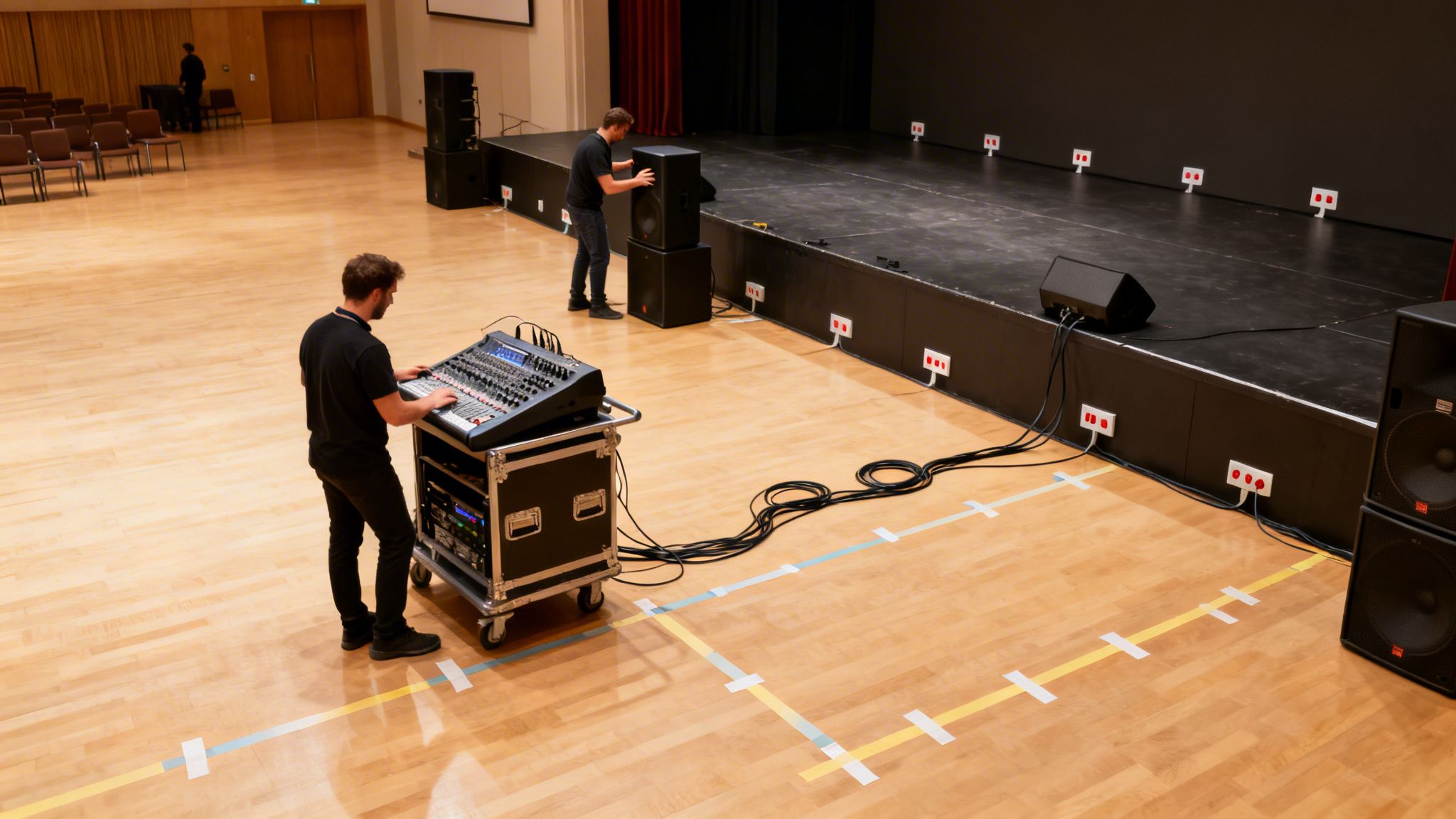
All your careful planning culminates on the event day. Months of work can be undermined by poor on-site coordination, and this is where a professional PA hire company demonstrates its value. Their job begins not when the first guest arrives, but with meticulous scheduling and communication to ensure everything runs smoothly.
The key to a stress-free event is working closely with the supplier’s project manager. Together, you will coordinate with the venue to map out a precise schedule. This is not a rough timeline, but a detailed, agreed-upon plan covering every logistical touchpoint.
Building the Event Day Schedule
A detailed schedule is your most valuable tool on event day. It is the single source of truth that prevents suppliers from conflicting with one another and guarantees your audio team the time and space they need. A seasoned project manager will insist on finalising this well in advance.
Your schedule needs to clearly define time slots for these critical phases:
- Load-in: When can the crew and their equipment access the venue? This requires careful coordination with the venue manager, considering loading bay access, service lifts, and other suppliers.
- Setup (Rigging): This is the time allocated for technicians to build the sound system, run cables, and position speakers. The time required depends on the complexity of the setup.
- Soundcheck: This is non-negotiable. It is when the engineer tests every microphone, checks all audio playback sources, and tunes the system to the room’s acoustics. This process eliminates feedback and ensures clear, balanced sound for every seat.
- Rehearsals: If you have presenters, a panel, or a live band, they need dedicated time to run through their segments with the audio team. This is crucial for setting microphone levels and sorting out specific cues.
- De-rig (Load-out): The schedule must include sufficient time for the crew to dismantle and remove all equipment safely after the event.
A top-tier PA hire company never operates in isolation. They know they are part of a larger team and will proactively work with your lighting, video, and staging suppliers to align schedules.
Communication and On-Site Professionalism
On the day, calm and clear communication is vital. Before the doors open, establish your primary point of contact within the audio crew, usually a lead technician or on-site project manager. You need to know exactly who to go to if an issue arises.
Remember, the crew are a direct reflection of the company you hired. You should expect more than technical skill. True professionals remain calm under pressure, are excellent problem-solvers, and communicate respectfully with you, your speakers, and the venue staff. A team like London Audio Visual Hire is known for having technicians who are not just equipment experts but also experienced event professionals. To see how a seasoned provider can make a difference, you can learn more about the various AV services available for all types of events.
Final Pre-Event Checks
In the final days before your event, a quick checklist can prevent avoidable headaches. This last-minute check confirms every detail is locked in.
Run through this final confirmation with your PA hire company:
- Crew Accreditation: Have all crew members been issued the correct security passes for venue access?
- Power Requirements: Has the venue confirmed the location and availability of the 32A or 63A power supply the audio team needs?
- Final Schedule Sign-Off: Has the final, most up-to-date schedule been sent to and approved by all key parties, including the venue and other suppliers?
- Emergency Contacts: Do you have mobile numbers for the lead audio technicians, and do they have yours?
This thorough approach to on-site management transforms your supplier from a vendor into an essential part of your delivery team, all working towards the shared goal of a flawless event.
Your Audio Partner: The Secret to Flawless Sound
Ultimately, choosing a PA hire company is more than an item on your event checklist. It is a decision that can make or break the experience for everyone in the room. Think of it less as a transaction and more as a partnership. You are not just renting equipment; you are securing expertise, reliability, and peace of mind.
Moving away from a purely price-driven decision is the first step towards a successful event. When you invest time in detailed briefing and careful vetting of potential audio suppliers, you lay the groundwork for a smooth production. The goal is to find audio professionals who understand what you are trying to achieve.
From Supplier to Teammate
This is the real difference between a good event and a great one. When you find an expert partner, like the team at London Audio Visual Hire, they become a seamless extension of your own crew. They are on-site, ready to solve problems, and as committed to delivering incredible sound as you are.
Do not think of it as hiring equipment. Think of it as investing in your event’s atmosphere, your speaker’s confidence, and your audience’s focus. The right audio partner is not a cost—it is your guarantee for peace of mind.
Building this kind of relationship allows you to create memorable, high-impact events time and again. It is the formula for ensuring your audio is not just adequate, but perfect. When your supplier is as invested in the outcome as you are, you have found the key to getting it right.
Your PA Hire Questions, Answered
Hiring a PA system can seem daunting, especially with so much riding on getting the sound right. Here are answers to some of the most common questions from event planners.
How Far in Advance Should I Book?
This depends on the scale of your event. For a large conference or a major launch in a city like London or Manchester, you should look to book your audio supplier 3-6 months in advance. This is especially true during the busy summer and Christmas periods when the best equipment and crew are in high demand.
For smaller events, such as a single-room corporate meeting, 4-6 weeks' notice is often sufficient. However, the more complex your requirements, the sooner you should start the conversation. It provides time for a proper site visit and detailed planning.
What Is the Difference Between a Dry Hire and a Wet Hire?
Understanding this terminology is key, as it has a significant impact on your budget and responsibilities.
- Dry Hire: This is simply renting the equipment. You collect it, set it up, operate it, and return it yourself. This is only advisable if you have a qualified technician on your team who is familiar with the equipment.
- Wet Hire: This is the standard for almost every professional event. A wet hire includes the equipment plus the experienced sound engineers and crew who deliver, install, and operate it for you.
For any event where the audio simply must work, a wet hire is the only sensible choice. It is your guarantee that the system is set up correctly and managed by a professional who can handle any issues that arise.
Should I Just Use the Venue's In-House AV System?
Using the in-house system can seem convenient, but it is often a false economy. Most built-in PA systems are designed for basic announcements, not the dynamic, high-quality sound required for a professional event. They may lack the power for a large crowd or the right inputs for your needs.
When you bring in a specialist audio company, you are getting more than just better equipment. You are getting a system designed specifically for your event's acoustics and audience size, all run by dedicated engineers. That level of control and reliability is something an in-house system rarely offers.
What Insurance Should My PA Hire Company Hold?
Any professional and reputable audio company will have its insurance in order, and you should always ask to see the certificates as part of your due diligence.
Before you sign a contract, make sure they have:
- Public Liability Insurance: This is non-negotiable. It covers injury to people or damage to the venue. Look for a minimum of £5 million cover, though many larger venues insist on £10 million.
- Employers' Liability Insurance: This is a legal requirement in the UK for any business with employees.
- Product Liability Insurance: This covers any faults or failures with the equipment itself.
Do not be hesitant about asking for proof. Current, valid insurance certificates are a clear sign you are dealing with a professional organisation that takes safety seriously.
For events in London and beyond, the team at London Audio Visual Hire offers expert guidance and flawless execution, ensuring your audio is one less thing to worry about. Explore our services and get in touch today.