

When you hear the term live streaming event, you might picture someone pointing their smartphone at a stage. In the professional world, it is a completely different discipline. It is a meticulously planned digital broadcast designed to connect an organisation with its audience in real time, involving high-quality video and audio, professional production and strategic delivery that goes far beyond a simple webcam feed.
It is a powerful tool that allows you to share your message from a physical venue or a virtual studio with viewers anywhere in the world.
The Strategic Power of a Live Streaming Event
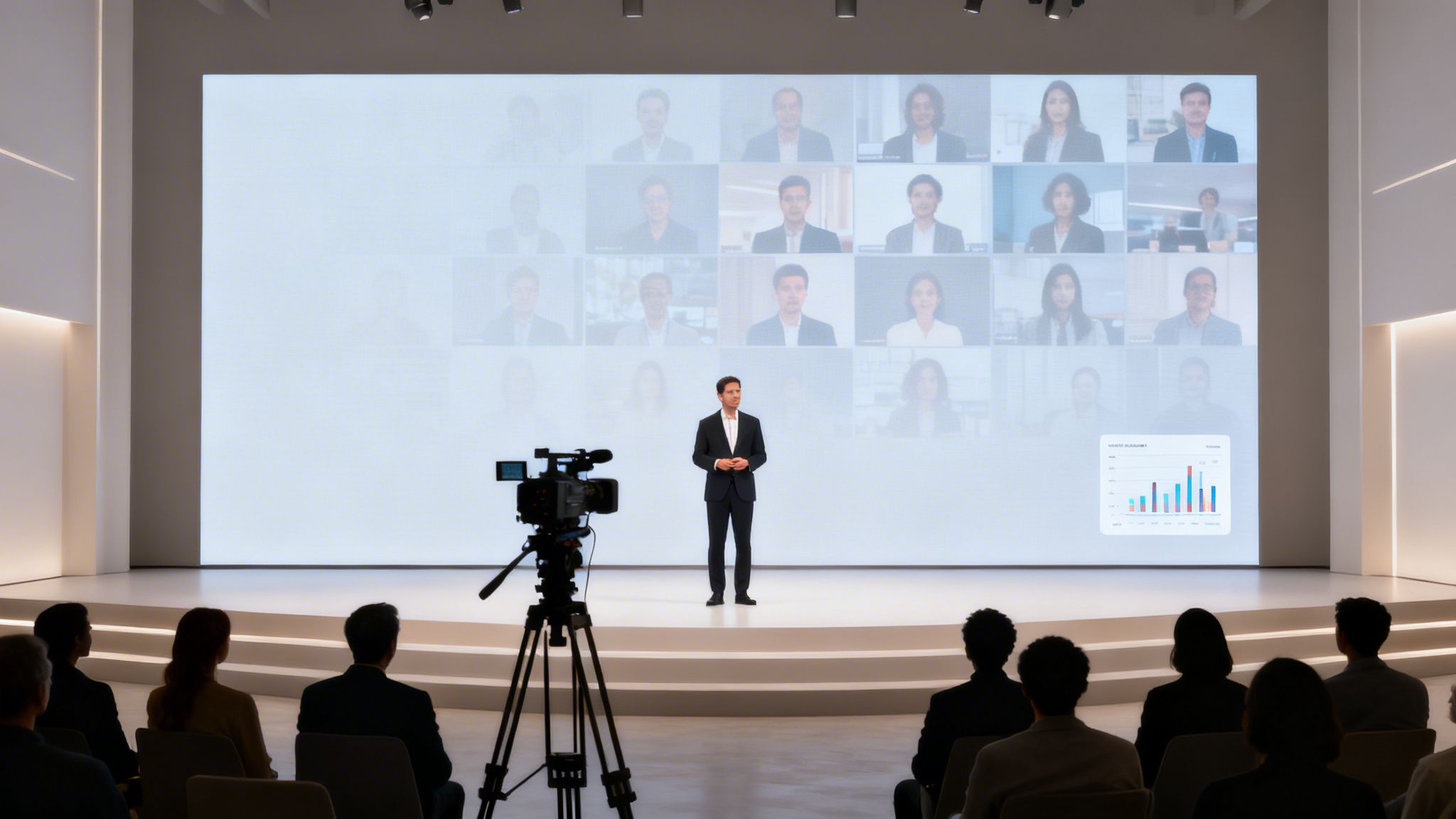
In recent years, UK organisations have recognised the value of live streaming. It is not a passing trend; it is a fundamental shift in how businesses communicate with their stakeholders. This change is driven by the need for greater reach, deeper engagement and a measurable return on investment. A professionally executed stream turns a one-off event into a digital asset that can be used long after the broadcast ends.
The data supports this trend. The UK virtual events market, which is built on live streaming technology, generated USD 5,662.4 million in revenue in 2024. It is forecast to grow to USD 18,031.0 million by 2030. This growth demonstrates how essential live streaming has become for corporate event planners in London and across the country. You can discover more insights about the UK virtual events market and its projected growth.
Expanding Your Reach Beyond Physical Limits
Perhaps the most significant advantage of live streaming is its ability to overcome geographical barriers. A conference in a central London venue is no longer limited to those who can attend in person. With a professional live stream, that same event becomes accessible to a global audience, instantly amplifying its impact.
This creates numerous opportunities:
- Increased Attendance: Individuals unable to attend due to travel costs, scheduling conflicts or other commitments can still participate.
- Global Inclusivity: You can engage international stakeholders, partners and customers, creating a more diverse and connected community around your brand.
- Enhanced Brand Visibility: Broadcasting online demonstrates that your organisation is modern and accessible, improving your profile on a national and international scale.
Deepening Audience Engagement
Modern live streaming is an interactive, two-way medium. By incorporating interactive elements, you can create a dynamic experience that keeps your remote viewers engaged.
It is a common misconception that virtual attendees are easily distracted. With the right tools and planning, a live stream can generate a level of interaction that is often difficult to achieve in a large, crowded venue.
Tools such as live polls, dedicated Q&A sessions and real-time chat give your remote audience a voice. They can join the conversation, ask questions directly and share their thoughts. This transforms them from passive observers into active participants, which significantly improves their experience and retention of key messages. For events like corporate town halls or product launches, this direct line of feedback is invaluable. At London Audio Visual Hire, we specialise in integrating these tools seamlessly into your broadcast.
Choosing the Right Format for Your Live Stream
Selecting the right format for your live stream is a critical decision. It shapes the entire feel of the event, from the pacing and tone to the technical setup. What works for a confidential internal briefing will not be suitable for a major public brand launch.
The first step is to clarify your objectives. What are you trying to achieve? Are you looking to inform shareholders, generate sales leads, teach a specific skill or celebrate an achievement? Each of these goals requires a different approach to content presentation and audience interaction.
Consider this: a high-stakes product launch at a London venue requires a dynamic, polished production that generates excitement. In contrast, an internal all-hands meeting is about clarity, direct communication and ensuring everyone has a voice through a robust Q&A. The cinematic flair is secondary.
To help you navigate these choices, we have prepared a comparison of the most common formats.
Live Stream Event Formats and Their Objectives
This table outlines common live stream types to help you match a format to your specific goals.
| Event Type | Primary Objective | Typical Audience | Key AV Consideration |
|---|---|---|---|
| Product Launch | Generate buzz and drive sales | Customers, press, influencers | Multi-camera angles, high-quality graphics and a flawless stream to build product confidence. |
| AGM / Shareholder Meeting | Inform and facilitate governance | Investors, shareholders, board members | Secure, access-controlled platform with verified voting and impeccable audio clarity. |
| All-Hands / Town Hall | Boost internal alignment and morale | All employees | Interactive tools like moderated Q&A, live polls and a stable platform for a large audience. |
| Webinar / Expert Panel | Educate and capture leads | Niche professional or interest groups | Crystal-clear screen sharing, professional lighting and focused audio on speakers. |
| Awards Ceremony | Celebrate achievement and build prestige | Industry peers, employees, nominees | Multiple cameras to capture reactions, speeches and the overall atmosphere. |
| Charity Fundraiser | Inspire donations and emotional connection | Donors, supporters, general public | Compelling storytelling via video, clear calls-to-action and on-screen donation tickers. |
Choosing the right format is less about what is technically possible and more about what is strategically sound. A simple, well-produced webinar can achieve an educational goal more effectively than a flashy, concert-style stream that does not resonate with its intended audience.
Let us explore these categories in more detail.
Corporate and Internal Communications
When streaming internally, the focus is usually on delivering critical information to a specific group. The main goals are to ensure alignment, maintain transparency and make employees feel connected and heard.
For these events, security and reliability are non-negotiable. Common formats include:
- Annual General Meetings (AGMs): These are formal, structured and require secure platforms. This involves secure access for stakeholders, verified voting systems and flawless audio. The production must reflect the company’s professionalism, with no room for error.
- Town Halls and All-Hands Meetings: The aim here is to bridge the gap between leadership and the wider team. Success depends on creating a genuine two-way conversation, which requires effective tools for moderated Q&A and live polls to make a large workforce feel included.
- Internal Training Sessions: Education is the sole focus. This means you need reliable screen sharing for presentations, the ability to display materials clearly and often breakout rooms for smaller group work. It is all about effective knowledge transfer.
Marketing and Brand-Focused Events
When communicating with customers and the public, the dynamic changes. Your live stream becomes a powerful tool for creating a memorable brand experience. You want to capture attention, generate leads and build a loyal following.
These streams are often public and designed to be shared widely. The production needs to be visually captivating to prevent viewers from disengaging.
“Choosing the correct format is less about what is technically possible and more about what is strategically effective. A well-produced webinar can achieve more for an educational goal than a flashy, concert-style stream that misses the mark with its target audience.”
Here are a few popular formats for marketing:
- Product Launches: These are high-energy events designed to create excitement. They typically feature dynamic speakers, slick product demonstrations and a strong call to action. The stream must look professional to build trust and anticipation around the new product.
- Brand Activations: This is where you can be creative. These are often interactive experiences designed to immerse the audience in your brand’s world. You might see behind-the-scenes tours, collaborations with influencers or live competitions.
- Webinars and Expert Panels: This is an excellent way to position your brand as an authority in its field. By sharing valuable knowledge, you can generate high-quality leads. The setup needs to be clean and professional, keeping the focus on the speakers and their insights. For more information, you can explore our guide on planning effective hybrid streaming events.
Celebratory and Community Events
Finally, some live streams are about celebrating success, recognising individuals and bringing a community together. These events are driven by emotion and creating a shared experience for everyone watching.
- Awards Ceremonies: Your production must match the prestige of the occasion. This means using multiple cameras to capture all the key moments, from the nominees’ reactions to the winners' speeches and the overall atmosphere of the venue. The goal is to make remote viewers feel as if they are in the room.
- Charity Galas and Fundraisers: Here, the objective is to inspire donations. The stream needs to tell a powerful story, using compelling videos and live testimonials. Crucially, you need to make it incredibly easy for the audience to donate in real time with clear, simple instructions.
Your Step-by-Step Live Stream Planning Checklist
A successful live streaming event is the result of careful planning and attention to detail long before any camera goes live. This checklist provides a roadmap, guiding you from the initial concept to a flawless broadcast, ensuring nothing important is overlooked.
Success starts with knowing what you are aiming to achieve. It is not enough to simply "go live". You need to define what success looks like in measurable terms. This means setting clear goals and deciding on the Key Performance Indicators (KPIs) you will use to track them.
Are you trying to generate a certain number of sales leads? Or is your goal centred on audience interaction, measured by the number of questions asked or polls answered? Establishing these targets at the beginning shapes every subsequent decision, from the content you create to the technology you choose.
Define Your Objectives and KPIs
Before you consider cameras and microphones, your team must agree on the event's purpose. Without this clarity, you have no way of knowing if the stream was truly a success.
- Set Clear Goals: What is the main business outcome you are seeking? It could be anything from boosting brand awareness and training staff to driving registrations for another event.
- Establish Measurable KPIs: For every goal, attach a number. If engagement is your aim, a KPI might be an average watch time of 15 minutes or achieving 200 questions during the Q&A.
- Identify Your Audience: Who are you communicating with? Understanding their expectations, their existing knowledge and their technical proficiency is vital for crafting the right content and choosing the best platform.
Getting this foundation right ensures everyone, from your marketing department to our production crew at London Audio Visual Hire, is working towards the same objective.
Develop a Realistic Budget
One of the most common pitfalls is underestimating the true cost of a professional production. A proper budget covers much more than a subscription to a streaming platform. Thorough financial planning prevents last-minute compromises and ensures you do not have to sacrifice quality.
Here are the key areas to account for:
- Technical Production: This is often the largest expense, covering professional cameras, microphones, vision mixers, lighting and all encoding hardware.
- Crewing: You will need skilled people to ensure seamless operation, including a director, camera operators and sound engineers.
- Venue and Connectivity: Remember to factor in the cost of a suitable space and, crucially, a dedicated, high-speed internet connection with a backup plan.
- Platform and Software: Costs can range dramatically, from free options like YouTube to secure, enterprise-level platforms with extensive features.
- Contingency Fund: Always set aside 10-15% of your total budget for unexpected issues. This is a core part of professional event planning.
Create Compelling Content and Scripting
Your content is the heart of your live stream. The most sophisticated technical setup cannot salvage a poorly planned presentation. Every segment needs to have a purpose and be designed to maintain audience engagement.
Start by mapping out the entire event from start to finish. A detailed ‘run-of-show’ document is essential. For each speaker and section, it is wise to develop a full script or, at the very least, detailed talking points. This ensures your key messages are delivered clearly and you do not waste your audience's time.
A script is not intended to make speakers sound robotic. It is about giving them a solid structure so they can deliver their message with confidence. This preparation is what separates a polished, professional broadcast from an amateur one.
Thorough speaker briefings are also essential. Ensure every presenter knows the schedule, their specific timings and how elements like live Q&As or polls will be managed. A prepared speaker is a confident one, and that confidence is evident to the audience.
This flow diagram shows the main categories that most live streams fall into.
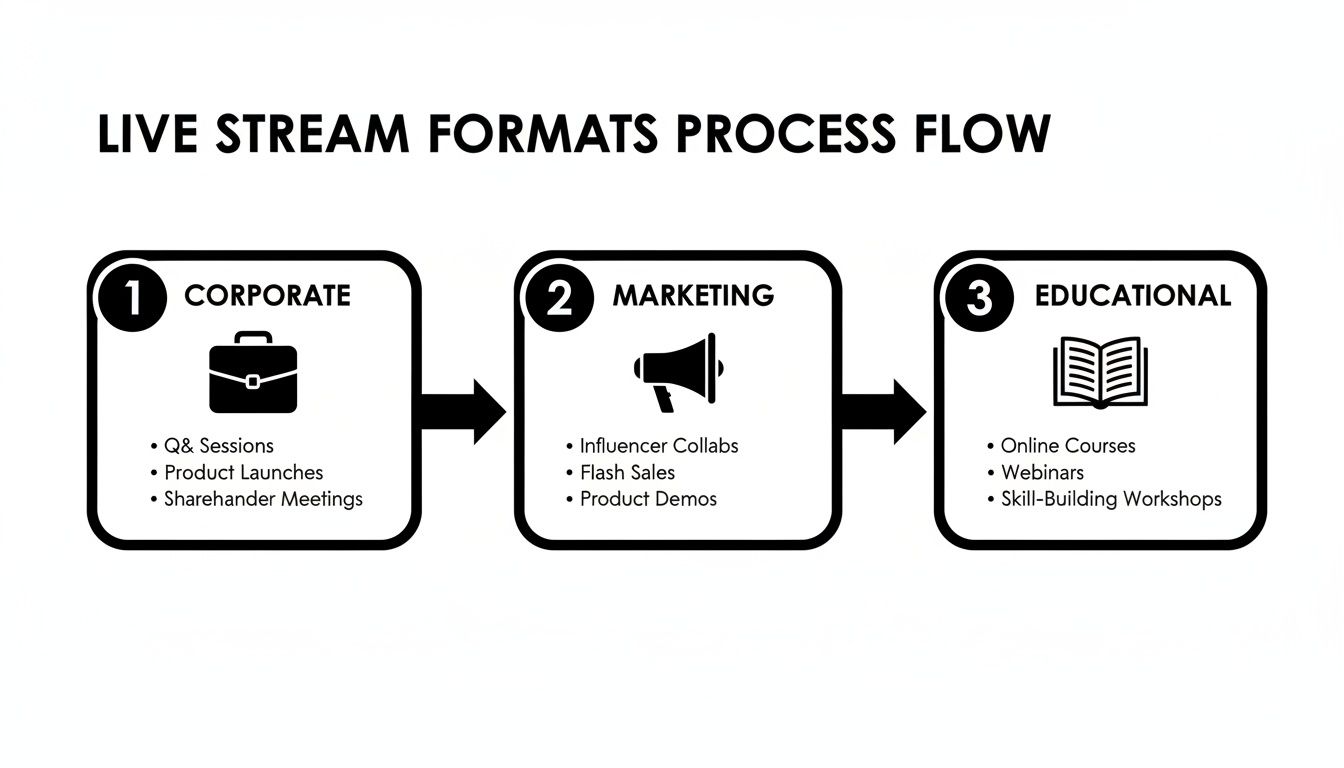
Knowing whether your event is primarily for corporate communications, marketing or education helps you tailor your content to your specific audience's expectations.
Schedule and Promote Your Event
With your content finalised, you need a detailed production schedule. This document should map out every task leading up to, during and after the event, including deadlines for scripts, technical rehearsals and all promotional activity.
Speaking of promotion, you need to start early to build awareness and drive registrations.
- Create a Dedicated Landing Page: This will be your event's online hub. It should contain all key information: the agenda, speaker biographies and the registration form.
- Utilise Email Marketing: Send a series of emails to your contact list, building excitement and sending reminders as the event approaches.
- Leverage Social Media: Use high-quality posts, countdowns and behind-the-scenes content to capture the attention of a wider audience.
- Engage Speakers and Partners: Encourage them to share the event with their own followers. It is a simple way to expand your reach significantly.
By following this detailed checklist, you are not just hoping for the best; you are building a solid foundation for a successful live stream that achieves its goals and presents your brand in the most professional light.
Selecting the Right Technology and Streaming Platform
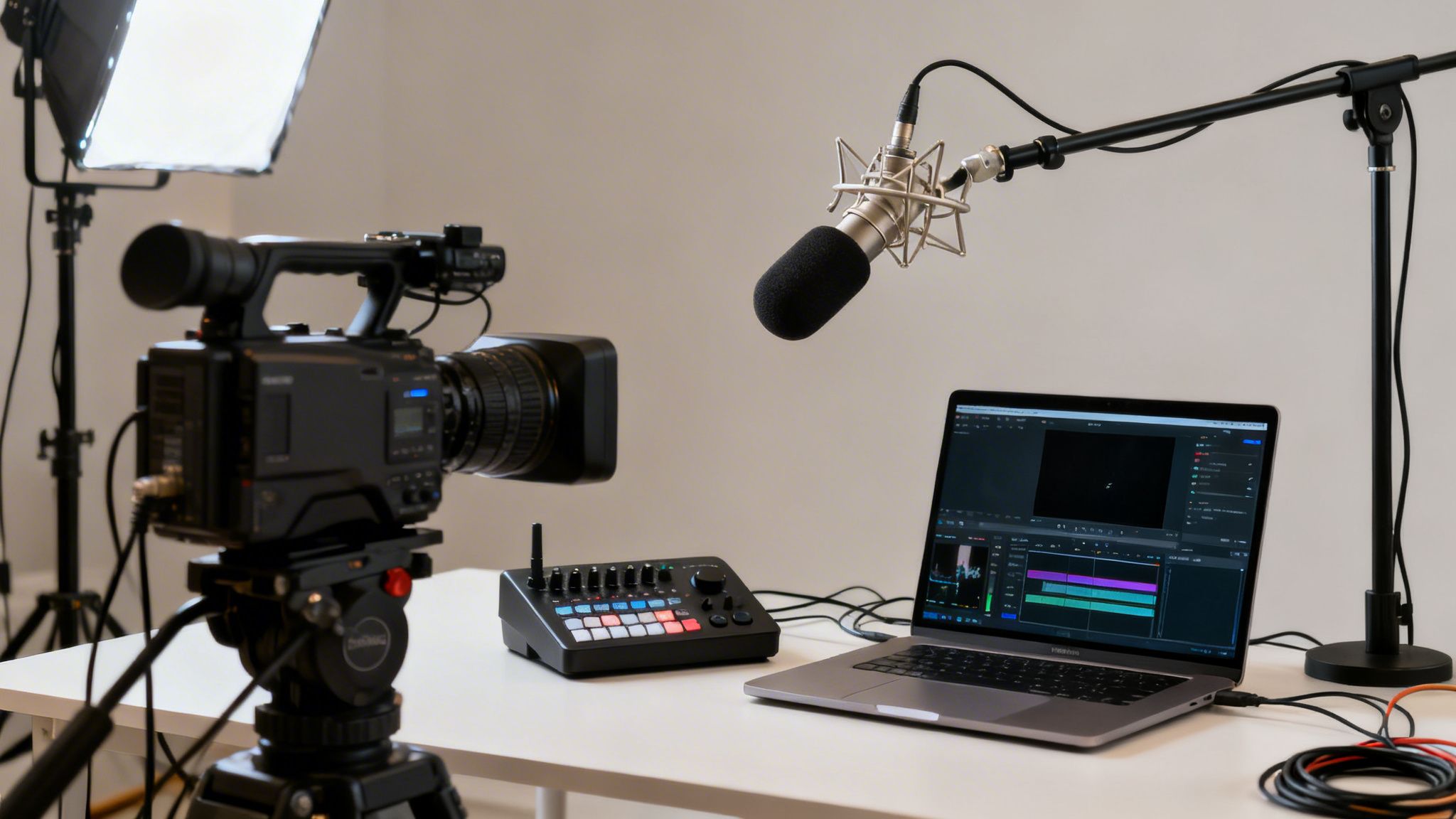
The success of your live stream depends on the technology that powers it. You can have the most compelling message, but if the audio is poor or the video buffers, your audience will disengage. Getting the technical elements right is non-negotiable for delivering a broadcast that reflects your brand's quality.
This is where you need to move beyond a basic laptop and webcam setup. A professional stream is built on a carefully integrated system of broadcast-grade equipment, with each component chosen for a specific function. Without this solid foundation, you risk the success of your event.
Working with a technical expert like London Audio Visual Hire removes this burden. We handle all the equipment, setup and platform integration, so everything works as it should. This frees you up to focus on what you do best: delivering great content to your audience.
Core Equipment for a Professional Broadcast
The quality of your stream is a direct result of the equipment you use. For a polished, professional broadcast, several key components are essential. They work together to capture, mix and deliver your content flawlessly.
- Professional Cameras: Unlike a standard webcam, broadcast cameras deliver far superior image quality. They provide optical zoom and manual controls to adapt to any lighting, ensuring your picture is always crisp and clear.
- High-Quality Microphones: It is often said that clear audio is more important than perfect video. Professional microphones, whether lapel mics for speakers or ambient mics for audience reactions, are vital for capturing rich, intelligible sound.
- Vision Mixer: This is the control centre for any multi-camera production. It allows a director to switch seamlessly between different camera angles, pre-recorded videos and on-screen graphics in real time.
- Professional Lighting: Good lighting is transformative. It eliminates shadows and ensures your speakers are seen clearly, creating a visually appealing and professional look that cannot be achieved with standard office lights.
Understanding what each piece does makes it clear why professional production is so important. If you would like to learn more, we have a detailed guide on what constitutes professional audio visual equipment.
Choosing the Right Streaming Platform
Once you have the right equipment to capture your event, you need to decide where to send the signal. The platform you choose has a significant impact on who can see your stream, how they interact with it and what kind of data you can collect afterwards.
Broadly, you can divide platforms into two categories: public social platforms and private, enterprise-level solutions.
The choice of platform should never be an afterthought. It must align directly with your event's goals, whether that is maximising public reach for a product launch or ensuring complete security for a confidential AGM.
Public platforms like YouTube and Facebook Live are excellent for broadcasting your message to the widest possible audience. Research from YouGov supports this, showing that 33% of UK viewers use these platforms for breaking news and 25% for official events. This is a clear indicator that event planners are using these major channels to maximise visibility.
On the other hand, enterprise-level platforms are built specifically for corporate use, offering a suite of features that public platforms do not have.
Comparing Platform Features
When you are evaluating different platforms, you need to look at the features that matter for your specific event. This quick comparison should help.
| Feature | Public Platforms (e.g., YouTube, Facebook) | Enterprise Platforms (e.g., Vimeo, On24) |
|---|---|---|
| Security | Limited; streams are generally public or unlisted. | High; offers password protection, domain gating and tokenised access. |
| Branding | Minimal; your brand is secondary to the platform’s. | Extensive; allows for fully customised branding on the player and landing page. |
| Audience Analytics | Basic metrics like viewer counts and watch time. | Advanced data on individual user engagement, poll answers and lead scoring. |
| Monetisation | Primarily through ads and platform-specific features. | Direct options like pay-per-view, ticketing and subscription models. |
| Support | Community forums and general help centres. | Dedicated technical support for event setup and troubleshooting. |
For internal meetings or ticketed events, an enterprise solution provides the security and control you need. To make your stream more accessible and engaging for everyone, you should also look into tools that provide real-time speech-to-text for live captioning.
Ultimately, the best platform is the one that meets all your requirements for security, engagement and data. A good technical partner can help you determine your needs and then integrate that platform perfectly with all the on-site production equipment.
Lights, Camera, Action: Managing Production and Your Post-Event Strategy
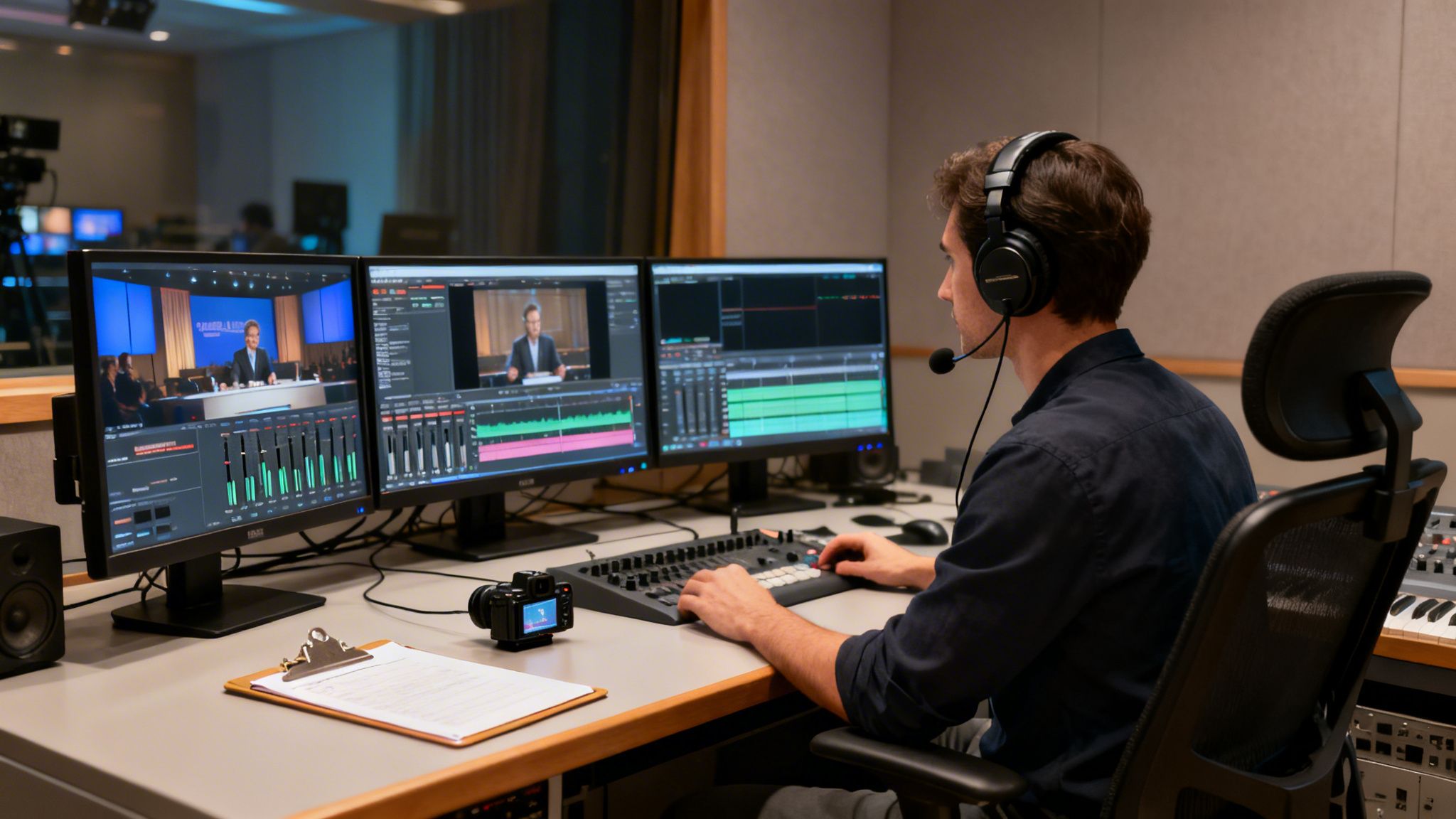
After all the planning, the day of your live stream arrives. This is where a professional production team proves its worth, calmly managing all the technical components to deliver a flawless broadcast for your audience.
The secret to a great live production is having clearly defined roles. A skilled crew works as a coordinated unit, with each person focused on their specific task. It is this coordination that turns potential chaos into a controlled, professional stream.
This teamwork maintains high broadcast quality and allows the team to handle any unexpected issues with speed and expertise.
Key On-Site Production Roles
A professional crew means every technical detail is covered, letting you and your speakers focus completely on delivering your message. While the exact team setup can vary depending on the event, a few roles are essential for a smooth broadcast.
- Project Manager/Director: This is your command centre. They oversee the entire run-of-show, cue speakers and video clips and make critical decisions in real time.
- Vision Mixer: This person is your live editor, switching between camera angles, presentation slides and pre-recorded videos to create a dynamic and visually engaging experience for the viewer.
- Audio Engineer: An often-unsung hero, the audio engineer is dedicated to ensuring crystal-clear sound. They manage all the microphones, balance the audio levels and eliminate any feedback or interference.
- Camera Operators: These skilled operators are your eyes on the ground, capturing high-quality, steady shots and following the action on stage to give the vision mixer the best possible footage to work with.
The Power of a Technical Rehearsal
A full technical rehearsal, or 'dry run', is completely non-negotiable for any high-stakes live event. It is your chance to get the production team, speakers and event organisers together to run through the entire schedule. This is where you resolve any issues before the audience tunes in.
A dry run is not just about checking if the microphones work. It is about building muscle memory for the entire team, ensuring transitions are seamless, cues are hit perfectly and everyone knows exactly what they are doing and when.
During a rehearsal, you will perform sound checks for every speaker, finalise all lighting positions and test the internet connection thoroughly. It is also the perfect time to test your backup plans. What happens if the main internet connection fails? Having a backup source or pre-recorded content ready is the key to a stress-free broadcast.
Getting More from Your Event After It Ends
The value of your live stream does not stop when the broadcast ends. The recording is a significant content asset that can continue to deliver returns for weeks or months if you have a solid post-event strategy. This turns a one-off event into a powerful part of your wider content marketing.
Once your live event is over, using smart content repurposing strategies is the best way to extend its reach and maximise your investment. The original broadcast can be edited and repackaged into various formats to engage different audiences on different platforms.
Consider taking these steps:
- Offer On-Demand Access: Host the full recording on your website behind a simple registration form. This way, the event continues to generate leads long after it has finished.
- Create Highlight Reels: Edit the best parts, such as key announcements or powerful quotes, into short, shareable videos for platforms like LinkedIn and X.
- Develop Blog Posts and Articles: Transcribe key talks or panel discussions. You can use this to create in-depth articles that explore the topics further and improve your website’s SEO.
- Produce Audio Content: Use the audio from keynote speeches or interviews to create podcast episodes. This is a great way to reach people who prefer to listen while on the move.
Finally, ensure you analyse the data. Look at the numbers: peak viewership, average watch time and where your audience engaged most. This data is invaluable. It not only helps you determine the event's return on investment but also provides crucial insights for planning your next one. This data-driven approach is more important than ever, especially as the UK home entertainment market, powered by streaming, is expected to reach a record £5.7 billion in 2025. You can read the full analysis on UK entertainment growth here.
Why Partnering with Professionals is Your Best Insurance Policy
A high-stakes live streaming event can be a source of significant pressure. When your brand's reputation is on the line, even a small technical glitch, such as a crackle in the audio or a stuttering video feed, can disrupt the experience and damage audience trust.
This is why engaging an experienced technical production team is a vital investment. A true professional partner does more than just set up a camera. They understand the entire ecosystem, from meticulous planning weeks in advance to staying calm under pressure and solving problems on the day. That experience is priceless, especially when navigating the unique challenges of London venues where internet connectivity and logistics can be complex.
From Risky Gamble to Guaranteed Quality
A professional team brings more than broadcast-quality cameras and top-tier microphones. They deliver something far more valuable: peace of mind. This comes from creating robust contingency plans for everything that could go wrong. It is a proactive approach that identifies and solves issues long before your audience is even aware of them.
This level of preparation elevates an event from a stressful gamble to a polished, professional broadcast. The difference is clear.
- Access to Elite Equipment: Achieving that crisp, professional look and sound requires the right tools, from vision mixers and lighting rigs to the correct cabling.
- Expert On-Site Crew: Having dedicated engineers and technicians means every technical detail is handled, freeing you to focus on your content and engage with your audience.
- Venue Knowledge: An experienced team that knows London’s event spaces can anticipate and manage logistical hurdles before they become major problems.
In the end, your live stream is a direct reflection of your organisation's standards. Investing in expert execution sends a clear message that you are committed to quality and professionalism.
The real value here is in guaranteeing a successful outcome. At London Audio Visual Hire, our speciality is delivering the technical backbone that high-impact events demand. For an event like an awards ceremony, where prestige is paramount, professional production is essential. You can see how we handle these high-stakes events in our guide to awards show production.
Let's discuss how we can bring that same level of expertise to your next live stream.
Still Have Questions About Live Streaming?
When planning a professional broadcast, many questions arise. We have compiled answers to some of the most common ones we hear from our clients to help you get started.
What is the Real Cost of a Professional Live Stream?
This is usually the first question people ask, and the honest answer is: it depends entirely on your objectives. Filming a simple internal meeting with one camera is very different from producing a multi-camera awards show at a major London venue.
The final price is determined by a few key factors:
- Personnel and Equipment: How many camera operators and sound engineers do you need? What level of cameras, microphones and vision mixing equipment is required to achieve the desired look and feel?
- The Streaming Platform: Are you broadcasting to a public platform like YouTube, or do you need a secure, branded portal with features like registration and detailed analytics?
- Venue Practicalities: The cost is also shaped by on-site logistics. Does the venue have a suitable internet line, or do we need to provide one? Are there complex power requirements or difficult access for equipment?
The best way to get a realistic figure is to start with your goals. Once we know what you want the stream to achieve for your business, we can build a technical solution that fits the brief perfectly, without adding unnecessary costs.
How Good Does the Internet Connection Need to Be?
A solid internet connection is the absolute bedrock of a successful live stream. This is one area where you cannot afford to compromise. Attempting to run a professional broadcast over a shared hotel Wi-Fi network is a recipe for disaster and a risk no professional production company will take.
For a reliable, glitch-free broadcast, a dedicated, hardwired internet connection is non-negotiable. This gives your stream its own private lane of bandwidth, completely separate from venue staff or delegates checking their email.
As a general rule, your upload speed should be at least double the bitrate at which you are streaming. For a crisp, high-definition stream, this means we look for a minimum dedicated upload speed of 10-20 Mbps. We always build in a backup plan, too, often using a cellular bonding unit to create a second, independent connection. This ensures complete peace of mind.
How Can We Keep Our Online Audience from Disengaging?
Engaging a remote audience is a deliberate act. You must remember you are competing with everything else on their screen: emails, social media notifications and other distractions. You cannot just place a camera at the back of the room and hope for the best.
The key is to make them part of the event. We build interactive elements directly into the stream, like live polls that show results in real time or moderated Q&A sessions where online questions are put directly to the speakers. A live chat feed, managed by a community moderator, also works very well.
Having a host or presenter who directly addresses and acknowledges the online audience is crucial. When people watching at home feel seen and heard, they stop being passive viewers and become active participants. It is a small detail that makes a significant difference.
Executing a flawless live streaming event can seem like a daunting task, but you do not have to manage it all yourself. The team at London Audio Visual Hire has extensive experience in this area. We handle all the technical details so you can focus on delivering your message. Get in touch to talk about your event production needs.


