
Deciding whether to hire or buy AV equipment is a pivotal moment in event planning. For most event planners, the answer is almost always the same: hiring is the smarter, more flexible option. It provides access to the latest technology without the significant initial outlay and frees you from the complexities of storage, maintenance and obsolescence.
The Strategic Advantage of Hiring vs Buying AV Equipment
This is not just a line item on a budget; it is a strategic decision that directly affects an event's quality, financial agility and where a team focuses its energy. For corporate and agency planners in the UK, hiring is not just a cost-saving measure. It is about de-risking the entire technical side of your event and guaranteeing you have the best equipment for the job.
When you buy equipment, you commit a large amount of capital to assets that depreciate quickly. Technology moves at great speed. A state-of-the-art LED wall purchased today could feel dated in just a couple of years. You are then left with the ongoing costs of secure storage, insurance, regular maintenance and the need for in-house staff who know how to use it correctly.
Financial Flexibility and Access to Innovation
Hiring turns a major capital expenditure into a predictable operational cost. This frees up budget that can be allocated towards what really matters, such as marketing the event or elevating the guest experience. It also means you can be incredibly agile, scaling your technology up or down for each specific event.
Consider this: a high-impact product launch might demand a massive, high-resolution video wall. Your next event, a smaller conference, might just need a solid PA system and a couple of projectors. Hiring allows you to select the perfect tools for each specific job, rather than being limited to what you happen to own. You are always using the latest technology that can create a genuine impact, not just making do with ageing kit.
More Than Just Equipment: Technical Expertise on Demand
One of the most significant, and often overlooked, benefits of working with a specialist AV hire company is the team that comes with the equipment. You are not just getting boxes delivered to your venue; you are getting project managers, sound engineers and video technicians who know the quirks of London venues inside and out. This expertise is invaluable.
- Problem-Solving: When an issue inevitably arises on-site, experienced technicians handle it calmly and get things back on track without your attendees ever knowing.
- Optimal Setup: They know how to configure equipment to work with a venue's specific acoustics and layout, ensuring everything looks and sounds flawless.
- Health and Safety: A professional crew understands and implements safety protocols, from rigging and cabling to power management, keeping everyone safe.
By hiring, you are not just renting hardware; you are investing in the peace of mind that comes from having a dedicated technical team committed to your event’s success. You can learn more about the specifics by exploring our guide on what is audio visual equipment.
Industry data supports this approach. While the UK Audio & Video Equipment Retailers market reached £500.7 million in 2024, it is forecast to see a slight decline. This trend points to a clear preference for rentals over purchases, a shift driven by both economic realities and the relentless pace of new technology. You can read more about these market trends on ibisworld.com.
Ultimately, hiring allows you to focus on your primary role: crafting an unforgettable experience for your guests. You can leave the technical complexities to the experts.
Hiring vs Buying AV Equipment: A Strategic Comparison
To make the decision clearer, it helps to see the pros and cons laid out side-by-side. This table breaks down the key considerations when weighing up whether to hire or purchase your event technology.
| Consideration | Hiring AV Equipment (Rental) | Buying AV Equipment (Purchase) |
|---|---|---|
| Initial Cost | Low, manageable operational expense. | High, significant capital expenditure. |
| Technology | Access to the latest, state-of-the-art equipment for every event. | Equipment becomes outdated quickly, locking you into older technology. |
| Maintenance & Storage | Handled entirely by the hire company. No extra costs or hassle. | Requires secure storage space, insurance, and ongoing maintenance. |
| Technical Support | Includes expert technicians for setup, operation, and troubleshooting. | Requires in-house trained staff or hiring freelancers separately. |
| Flexibility | Scale up or down and choose the perfect equipment for each event. | Limited to your own inventory, which may not suit every event. |
| Depreciation | No risk of asset depreciation. | The value of the equipment drops significantly over time. |
| Best For | One-off events, varied event types, or those wanting the latest technology. | Venues with a very consistent, high-frequency event schedule. |
As you can see, for the vast majority of corporate and agency events, the flexibility, cost-effectiveness and expert support that comes with hiring make it the undeniable strategic choice. It empowers you to deliver technically flawless events without the financial and logistical burdens of ownership.
Turning Your Event Vision into a Technical Brief
The single most important document in your event production is the AV brief. It is where your creative vision is translated into technical reality. An inaccurate brief can lead to incorrect quotes, last-minute problems and potential on-the-day issues.
A detailed brief is your roadmap. It ensures every supplier is on the same page, quoting for the exact same requirements and fully understands what you are trying to achieve. You do not need to be a technical expert to write one; you just need to answer some fundamental questions about your event's goals, audience and atmosphere. Think of it as providing the 'what' and 'why', so your AV partner can figure out the 'how'.
This process is the foundation of a smooth event, from the first phone call right through to the final de-rig.
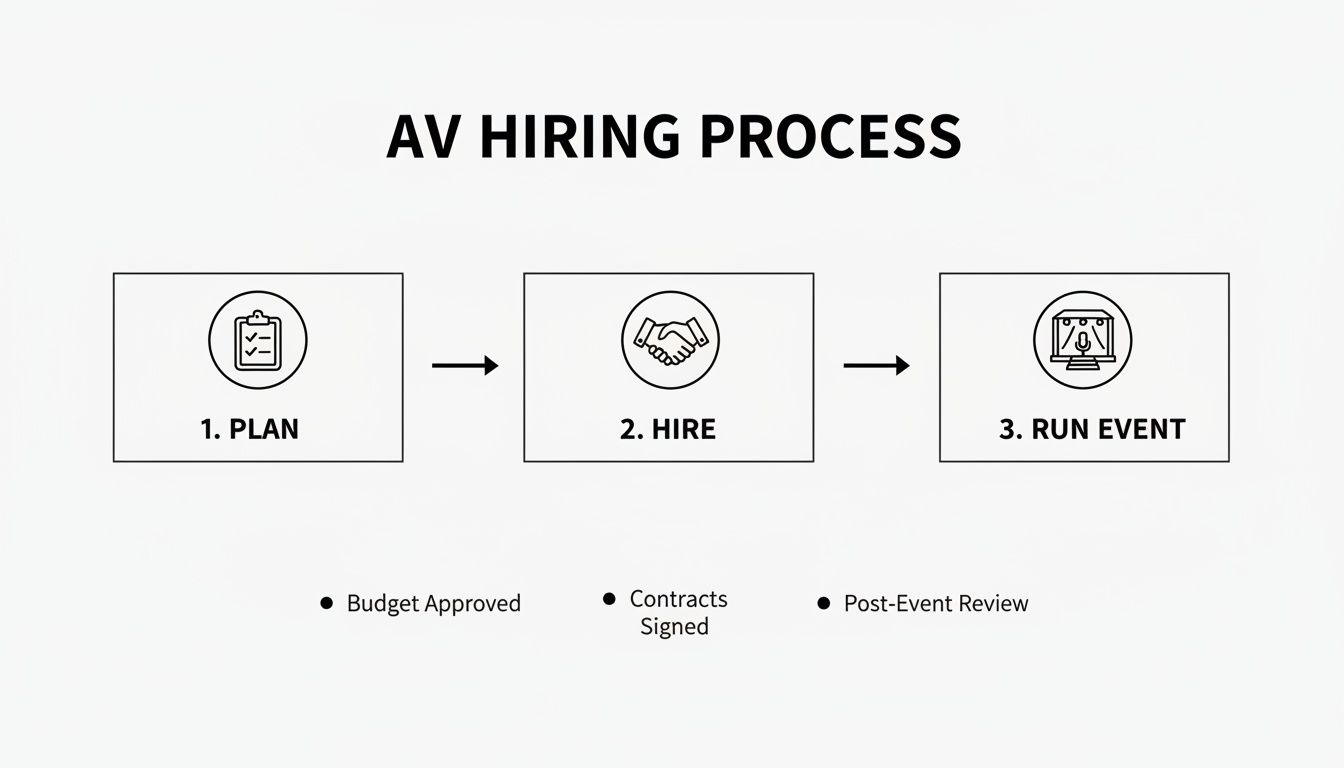
This flowchart shows the journey from planning to showtime. As you can see, a solid brief underpins the entire process.
Defining Your Core Requirements
Before you consider a single microphone or projector, you need to define the experience you want to create. Start with the basics, because these details will dictate the scale and complexity of the entire setup. Answering these questions makes the process of finding the right supplier much more efficient.
Your starting point should always be:
- Audience Size: How many people are attending? A keynote for 50 attendees needs a completely different sound system than one for 500.
- Venue Details: Where is the event? Provide the full name and address. Even better, provide room dimensions, ceiling height and any known issues like limited power or difficult rigging points.
- Event Timings: The full schedule is non-negotiable. When can the AV team get in to set up (load-in)? When does the event start and finish? And crucially, when do they have to be out (load-out)?
This core information gives any AV company an instant snapshot of the job's logistical scope.
Specifying Audio and Visual Needs
Once the core details are finalised, you can move on to the more specific technical elements. This is where you start translating the 'feel' of your event into actual equipment. The key here is to focus on the outcome you want, not necessarily specific model numbers.
For instance, do not just ask for a "microphone." Describe the session. Is it a single speaker at a lectern, or a lively panel discussion with six people and audience questions? That simple context tells a supplier they will need a mix of lectern microphones, table microphones and probably a couple of wireless handhelds for the Q&A.
A well-written brief turns your AV supplier into a proper technical partner. When you clearly communicate your goals, you empower them to suggest the smartest, most efficient solutions. They can often prevent you from specifying equipment you do not actually need.
Think about these key areas for your brief:
- Sound System: What will people be listening to? Is it just the spoken word, or will there be background music, a live band or audio from video clips? Each requires a different audio setup to ensure clarity.
- Visuals and Display: What are you showing? A simple PowerPoint deck has different needs from high-resolution video or a live camera feed of the speaker. This dictates whether you need projectors, LED walls or smaller 'repeater' screens. To get a feel for what is available, you can browse the range of equipment for hire from London Audio Visual Hire.
- Lighting: What is the mood? Do you need simple, functional stage lighting so people can see the speakers? Or are you after atmospheric mood lighting in your brand colours, or even dynamic effects for an awards show?
- Staging: Do your speakers need to be on a raised platform to be seen? Specify the size and height, and mention if it needs any branding, a lectern or furniture.
Considering Content and Interactivity
The type of content you are presenting has a huge impact on the technical plan. If you are planning to live stream the event, for example, that adds a new layer of complexity. You will need dedicated cameras, a vision mixer to switch between them and a robust internet connection for the broadcast.
Similarly, if you have speakers joining remotely, that needs to be flagged from the start. Your AV partner will need to plan for reliable video conferencing integration to ensure the audio and video are seamless for everyone, both in the room and watching from afar. A big part of creating a technical brief is thinking about what could go wrong. That is why a proper risk assessment for events is essential to identify and plan for potential issues before they happen.
Investing the time to create a detailed, thoughtful brief sets your event up for success. It provides total clarity, eliminates guesswork and ensures the quotes you receive are accurate and easy to compare. Ultimately, it is the best way to achieve a flawless execution that brings your vision to life.
How to Budget for Your AV Hire and Understand Pricing

Putting together a realistic budget for AV hire means looking beyond the price tags on the equipment. When a professional AV company sends you a quote, it is not just a shopping list. It is a blueprint for a service designed to ensure your event runs without a single technical hitch.
Understanding what goes into that final figure is the secret to comparing proposals properly and spotting the true value of a reliable technical partner.
The cost is always a blend of three things: the equipment itself, the skilled people who make it all work and the logistics of getting everything to your venue on time. The UK's audio visual hire market is a serious business for a reason. In 2024, it was valued at USD 739.51 million, driven primarily by corporate events. That number is set to climb, which shows just how vital professional AV has become. You can explore more data on this growing market at deepmarketinsights.com.
What is Really Inside an AV Hire Quote?
When a quote arrives, it should break down into three core areas. Knowing what they are helps you see exactly where your money is going.
- Equipment Rental: This is the most straightforward component. It is the daily or weekly cost for every piece of equipment, from microphones and projectors to large LED screens. The quality and specification of the equipment will naturally influence this part of the price.
- Labour and Technical Support: This is often the most critical part of the quote. This covers the expertise of the project managers, sound engineers and video technicians who plan, design, set up, operate and dismantle the entire system.
- Logistics and Transport: This covers the cost of getting all the equipment and the crew to your venue and back again. For events in central London, this can be complex, factoring in considerations like the Congestion Charge, parking and tight loading bay restrictions.
The Major Factors That Drive the Price Up (or Down)
No two events are ever the same, and a few key variables will always have a direct impact on your final bill. If you consider these ahead of time, you can give suppliers a much clearer brief, which means you will get more accurate quotes.
The length of your event is a major factor. A half-day meeting is completely different from a three-day conference with evening receptions, both in terms of equipment and crew hours. The technical complexity also plays a huge part. A simple projector and screen for a presentation is worlds away from a multi-camera live stream with a bespoke lighting design and a giant video wall.
People often focus only on the equipment cost. But the real value is almost always in the crew's expertise. A seasoned team that can solve problems on the fly is priceless when your company’s reputation is on the line.
The venue itself can make a huge difference. A modern conference centre with ample power and built-in rigging points is easier to work in compared to a Grade II-listed building with access issues and power limitations. Even the time of day matters—if your event needs a crew working through the night to set up or dismantle, expect the labour costs to reflect that.
Getting Accurate Quotes and Avoiding Hidden Costs
The key to managing your budget is to eliminate surprises. The best way to do that is to provide a very detailed brief and not be afraid to ask suppliers plenty of questions. A transparent company like London Audio Visual Hire will appreciate this.
Always ask for an itemised quote that splits out the costs for equipment, labour and logistics. It is the only way you can make a true like-for-like comparison between different companies. Be wary of any proposal that bundles everything into one vague figure, as this is often where extra costs are hidden.
Finally, have a conversation about contingency plans. Ask what happens if the event runs late or you suddenly need an extra microphone on the day. A professional partner will have clear processes and pricing for these "what if" scenarios, ensuring you do not get an unpleasant surprise on the final invoice. That kind of foresight is the hallmark of a company you can trust.
Choosing the Right AV Hire Partner for Your Event
Selecting a company to handle your event's audio-visual setup is one of the most critical decisions you will make. This is not just about comparing price lists; it is about finding a partner you can trust with a vital part of your event's success. The right supplier becomes an extension of your own team, bringing the technical knowledge and calm reliability you need for a flawless production.
A great AV partner offers more than just equipment. They bring proactive planning, deep technical knowledge and solid safety protocols to the table. They do not just deliver boxes; they deliver a service designed to prevent problems before they start, ensuring everything runs smoothly so you can focus on your guests.
Evaluating a Potential Supplier’s Track Record
Before you get into the details of equipment, you need to look at a company's history and reputation. An AV firm with a strong track record, especially with events similar to yours, provides a level of confidence a newcomer simply cannot. You are looking for proof of consistent, high-quality work.
Start by examining their portfolio or case studies. Pay close attention to the kinds of events they typically handle and the clients they serve. Are they well-versed in the specific pressures of corporate conferences, brand activations or large-scale awards ceremonies?
Look for these key signs of genuine experience:
- Venue Familiarity: A supplier who has worked in London's top venues knows their quirks, such as power limitations, tricky acoustics or loading bay challenges. This inside knowledge is invaluable and can prevent a host of problems on the day.
- Client Testimonials: Do not just scan for vague praise. Look for detailed feedback that talks about specific challenges, problem-solving skills and the crew's professionalism. That is where the real story is.
- Company Longevity: While not the only factor, a company that has been operating for several years has likely built up a solid base of expertise and client trust for a reason.
Technical Expertise and Equipment Quality
The quality of the team is just as important as the quality of the technology. An impressive inventory of the latest equipment is useless without skilled technicians who know how to deploy and operate it under pressure. When you are talking to potential suppliers, you need to probe the capabilities of their technical team.
Ask direct questions about their staff's experience and qualifications. Professional AV technicians are not just 'roadies'; they are specialists in audio engineering, video systems and lighting design. The team at London Audio Visual Hire, for example, includes dedicated project managers and engineers who live and breathe this work, overseeing every technical detail.
The real test of an AV partner is not the equipment they own, but the problem-solving ability of the people they send to your event. An experienced crew can handle unexpected issues with a calm efficiency that is priceless on a live show day.
Alongside the team's expertise, take a hard look at the quality of their equipment. A reputable company invests in well-maintained, industry-standard brands. They should be able to provide you with detailed specification sheets for everything from microphones and speakers to projectors and LED walls. This attention to detail is non-negotiable, particularly for more complex setups like those needed for hybrid event streaming.
Health, Safety and Project Management
Any professional AV supplier will have an ironclad commitment to health and safety. This is an absolute deal-breaker. They must be able to show you clear documentation of their safety policies, risk assessments and, of course, their public liability insurance.
When you bring an AV company on board, you should treat them just like any other key supplier. Understanding the basics of good contractor management helps you set clear expectations around safety and compliance right from the start. Ask them how they handle safe equipment rigging, secure cable management and adhering to strict venue regulations.
Finally, find out about their project management style. You should have a dedicated project manager as your main point of contact. This person is responsible for turning your vision into a technical reality. They will coordinate all the logistics, manage the on-site crew and keep the lines of communication open, giving you the structured support needed for a stress-free, successful event.
From Setup to De-Rig: Making On-Site Logistics Work
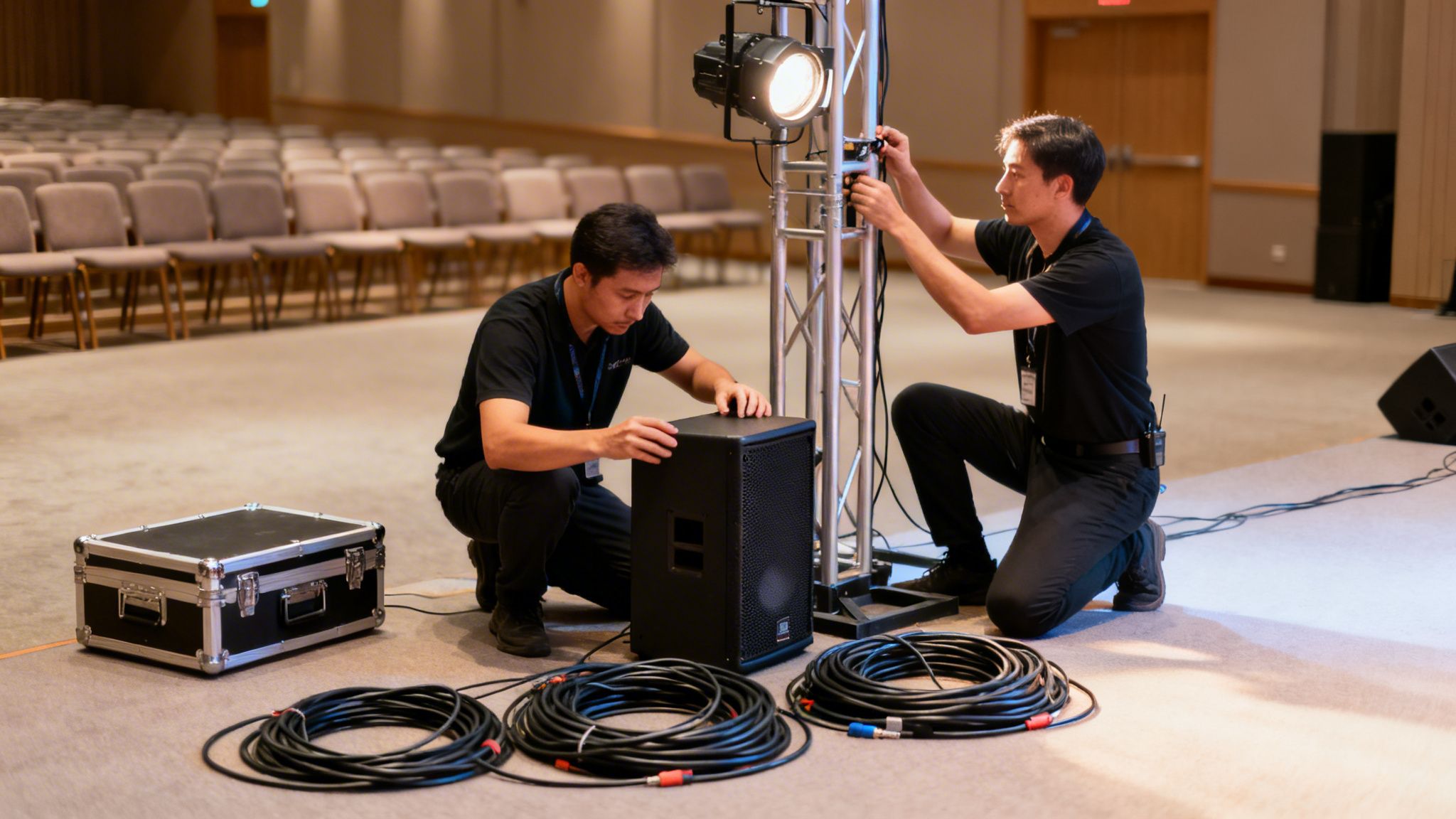
This is where all your careful planning pays off. The success of your event comes down to what happens on the day, from the moment the first flight case arrives until the last cable is packed away. At this stage, it is less about specific equipment and more about the expertise of the crew handling it.
A professional AV partner like London Audio Visual Hire does not just deliver equipment. They provide a fully managed on-site service. This means you get a dedicated project manager and seasoned technicians who handle logistics. They are there to manage all the technical aspects so you can focus on what matters: your delegates and speakers.
Why You Cannot Skip the Site Survey
Before a single piece of equipment is loaded onto a vehicle, a thorough site survey is non-negotiable. Think of it as your technical insurance policy. It is the step that lets the crew get ahead of any potential problems and finalise the production plan. This is not just a quick walk-through; it is a deep dive into the venue's quirks and capabilities.
Here is what a good AV project manager is looking for:
- Access and Egress: They will map out the best routes for bringing in heavy equipment, measuring loading bays and service lifts. Any tight corners or awkward corridors will be spotted now, not on the morning of the setup when time is critical.
- Power: The team will find all available power sources and assess their capacity. They need to calculate the total power draw for every light, speaker and screen to ensure the venue can handle it without any issues.
- Rigging and Structural Points: If you are flying anything, such as lighting trusses or speaker arrays, the crew needs to find and verify the certified rigging points in the ceiling. They will check the safe working load (SWL) for each point to ensure everything is completely secure.
- Room Dynamics: A survey is also about acoustics and layout. It helps pinpoint the perfect spot for speakers to get even sound coverage and identifies potential echo traps in rooms with lots of glass or hard surfaces.
An experienced technician can spot things you would never think of during a site survey, such as not enough plug sockets near the stage or a low ceiling that prevents the use of a large projector screen. That kind of foresight is priceless.
The On-Site Timeline: What to Expect
The on-site phase of any event follows a predictable rhythm. While every event is different, the core stages are always there, ensuring everything is built, tested and ready for showtime. Knowing this flow helps you, your venue contact and the AV crew work together seamlessly.
Here is a rough breakdown of how the day (or days) will go:
- Load-In and Build: The crew arrives, unloads everything and starts the physical build. This is when the stage goes up, sound and lighting systems are rigged and screens or LED walls are put in place, all based on the agreed floor plan.
- Cabling and Testing: With the main hardware in position, the technical work begins. Technicians will run extensive cabling, making sure it is neat and safely taped down. They will patch every audio input, configure video signals and then test every single piece of equipment.
- Rehearsals and Content Checks: This is a crucial window. Your speakers get to have a run-through on stage, the crew will check their microphone levels and you will play any videos or presentations to ensure they look and sound exactly as intended.
- Showtime: During the live event, you will have dedicated technicians running the show from behind the scenes, one on the sound desk, another on lighting and someone managing the presentations. The project manager acts as the show caller, making sure every cue is hit perfectly.
- De-Rig and Load-Out: The moment your event ends, the de-rig begins. The crew works quickly and safely to dismantle everything, pack it away and get it out of the venue, often working to a very tight deadline from the venue manager.
Keeping Everyone on the Same Page
Good communication holds the entire on-site operation together. Your AV project manager is your single point of contact for everything technical. They will be the one talking to the venue manager to coordinate schedules and resolve any logistical issues that arise.
Make things easy by establishing a clear communication channel from the outset. As soon as the AV project manager arrives, introduce them to your main on-site contact. It is a simple step, but it means that if something changes, such as the room layout needing an adjustment, the information gets to the right person instantly, allowing the AV team to adapt without any drama.
Ultimately, navigating the on-site logistics of hiring audio visual equipment is about trusting the professionals you have brought on board. A great crew thrives under pressure, leaving you free to deliver an incredible experience for everyone in the room.
Got Questions About Hiring AV Equipment? We've Got Answers
You are not alone in having questions when it comes to the technical side of your event. To help you feel more confident in your planning, here are the answers to some of the most common queries we receive from clients. Think of it as a quick reference guide for navigating the world of event AV.
How Far in Advance Should I Book Everything?
This is a key question, and the answer really depends on the scale of your event.
For major productions like a multi-day conference or a large awards dinner in a prime London venue, you should look to book three to six months out. This provides the time to conduct proper site visits, secure the best technicians for the job and ensure every piece of high-demand equipment is reserved for you.
If you are planning a smaller corporate meeting or a straightforward presentation, four to six weeks is usually sufficient time. A word of caution: peak seasons in London get booked up very quickly. The best advice is to start the AV conversation as soon as you have your date confirmed. It never hurts to be early.
What is the Difference Between a ‘Dry Hire’ and ‘Full Production’?
Understanding this is crucial for your budget and peace of mind. A ‘dry hire’ is exactly what it sounds like: you are just renting the equipment. You will be responsible for collecting it, setting it up, operating it and returning it. This option really only works if you have a skilled, in-house technical team who knows the equipment inside and out.
‘Full production’ is the all-in-one service we provide at London Audio Visual Hire. We handle everything. From the initial discussion about your ideas and sorting out logistics, to having our engineers on-site running the show and packing it all down at the end. For most corporate events, this is the best option for a seamless, professional result.
What if Something Goes Wrong on the Day?
This is where hiring a professional AV partner really pays for itself. At London Audio Visual Hire, we are focused on preventing problems before they can happen. Every single piece of equipment is rigorously tested and maintained before it leaves our warehouse.
As a standard part of our service, we always bring on-site backups for the most critical items, like a speaker's microphone or the main presentation laptop. More importantly, our technicians are on hand for the entire event. They are expert problem-solvers who can diagnose and fix almost any issue on the spot, so your audience will never even know something was amiss.
Do I Need to Arrange Insurance?
Any reputable AV company will have its own comprehensive cover, and you should definitely ask to see it. We carry full Public Liability and equipment insurance, and we are always happy to provide the policy documents for your peace of mind.
While our service and equipment are fully insured, it is still a good idea to have your own event-specific insurance policy. This protects you against anything that might happen outside the scope of the AV supplier's responsibility. It is always best to have a quick discussion about this with your supplier when you are finalising the contract.
Ready to ensure the technical side of your next event is a resounding success? The team at London Audio Visual Hire is here to help with detailed planning and expert on-site support for corporate events across the capital. Get in touch to discuss your requirements.