

Effective exhibition design is about much more than appearance. It is about turning your stand into a powerful marketing tool, a process that begins with clear, measurable goals. This initial stage involves defining success, understanding your ideal visitor, and establishing the Key Performance Indicators (KPIs) that will prove your investment has delivered a return.
Building Your Booth Strategy from the Ground Up
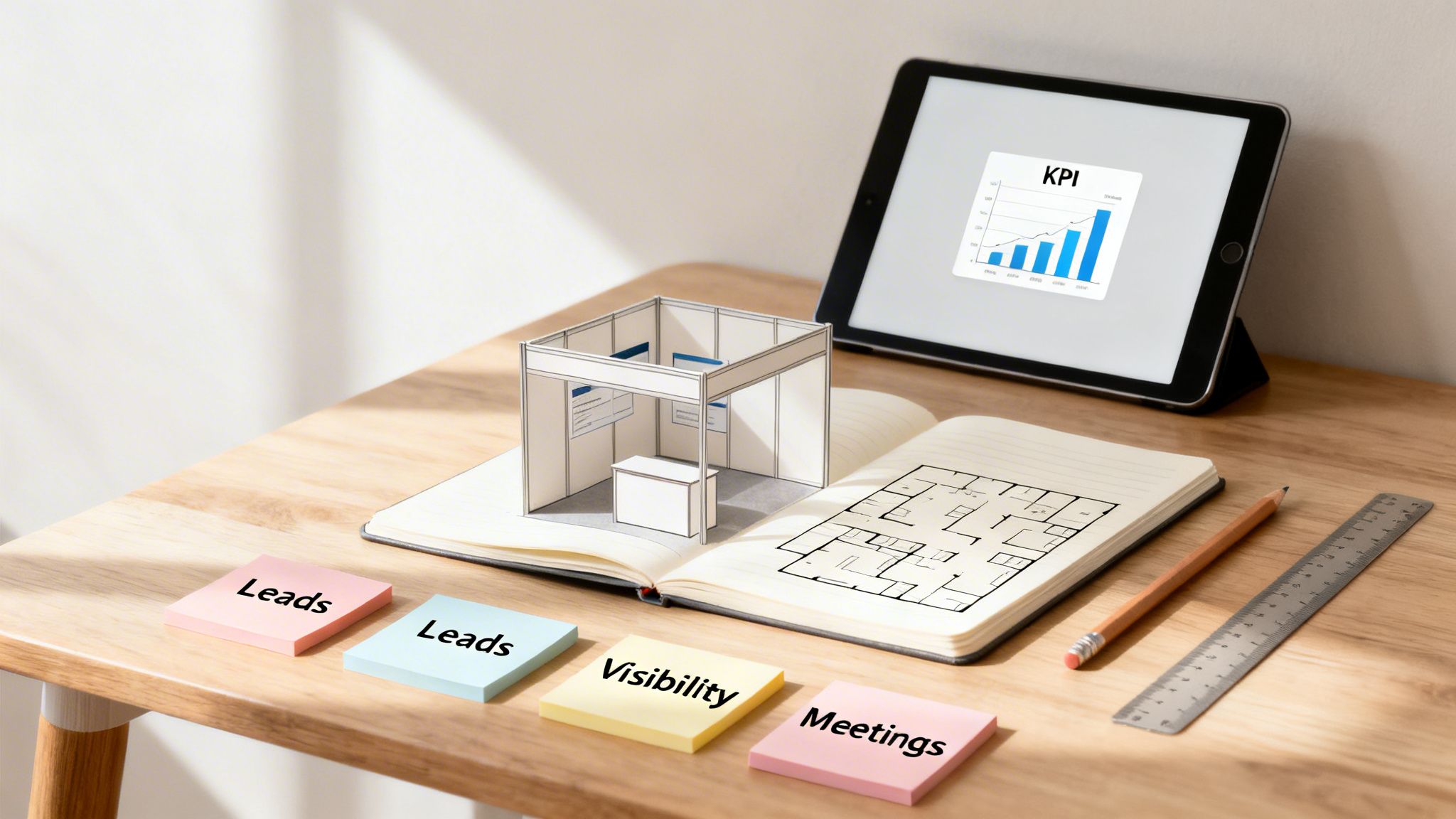
Before sketching a layout or choosing a colour palette, you need a solid strategy. This is the foundation of a successful exhibition presence. A well-considered stand will always outperform a visually impressive but purposeless one, even with a smaller budget. The first step is to be specific. Move beyond vague ideas like "boosting brand awareness" and decide what you want to achieve. These goals will guide every subsequent design choice.
Defining Your Core Objectives
Why are you exhibiting at this show? Are you there to generate sales leads, launch a new product, or strengthen relationships with key clients? Each of these goals demands a different approach to the design and flow of your space.
Consider these tangible goals you can build your strategy around:
- Lead Generation: Aim for a specific number rather than simply "more leads." For example, a goal could be to capture 150 qualified leads over a three-day event. Define what "qualified" means, such as a visitor with a certain budget and decision-making authority.
- Securing Meetings: The real value often comes from face-to-face engagement. A practical KPI would be to schedule 20 one-to-one meetings with key prospects on the stand for the following weeks.
- Product Launch: The objective is to make an impact and secure early interest. Success could be measured by taking 50 pre-orders on the show floor or being featured in three key industry publications.
- Brand Visibility: This can be quantified. Track metrics like an increase in social media followers, a target number of posts using your event hashtag, or a measurable rise in post-show website traffic from the event’s location.
Your primary objective acts as a guide for every decision, preventing distractions from elements that do not serve a purpose. Every component, from the welcome desk to the demonstration station, should work towards that single goal.
Understanding Your Target Visitor
Once you know what you want to achieve, you must identify who you need to attract. Obtain the event's pre-show demographic data. Who is attending? What are their job titles? More importantly, what are their professional challenges?
Design your booth for this specific person. Your messaging, graphics, and the entire experience should speak directly to their needs and present your company as the solution. This is how you attract quality conversations, not just high footfall.
Establishing Measurable KPIs
Your KPIs are how you will prove the show was a success. These must be decided before the event, as this dictates the tools and processes you will need on-site to capture the correct data.
Here are a few essential KPIs for any exhibition:
- Cost Per Lead (CPL): A simple but powerful metric. Divide your total event spend by the number of qualified leads generated.
- Lead-to-Customer Conversion Rate: This is a longer-term measure, but it is the ultimate assessment of ROI. What percentage of the leads you met became paying customers?
- Visitor Dwell Time: How long, on average, did people remain on your stand? Using badge scanners at entry and exit points can provide this data. Longer dwell times almost always indicate higher engagement.
This strategic groundwork is more critical than ever. In 2023, the UK exhibition industry hosted 1,016 exhibitions at its main venues, the highest number since 2017. With the average event attracting 3,000 attendees, simply being present is not enough. You can see the full UK events industry analysis to understand the increasingly competitive environment.
Designing for Engagement and Visitor Flow
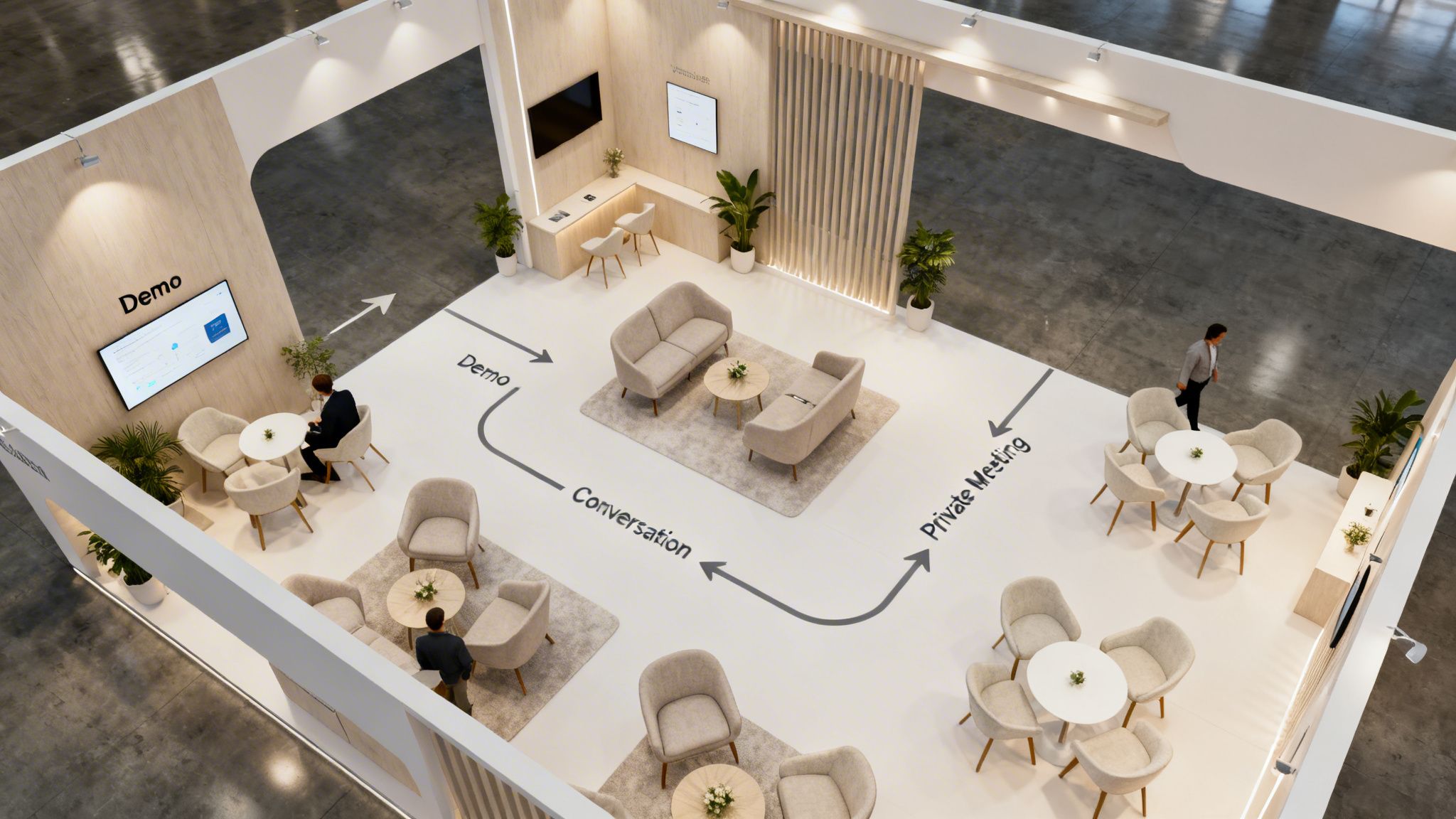
A great exhibition stand is more than an attractive backdrop; it is a carefully choreographed experience. The spatial design, or layout, is what turns a passive glance from the aisle into a meaningful conversation. A stand that feels open, welcoming, and intuitive will always attract more people than one that is cluttered or confusing, regardless of the budget.
The key is to map out a clear visitor journey. Consider the path you want attendees to follow, guiding them from their first sight of your stand towards key engagement zones. When this journey feels natural and effortless, they will stay longer.
Mastering Sightlines and Layouts
The battle for attention is won from a distance. Sightlines, the clear line of vision from the aisle to your stand, are your most powerful initial tool. Your main message and most eye-catching feature must be completely unobstructed, acting as a beacon for your ideal customer.
Consider your stand’s position on the floor plan. A corner plot provides two open sides, doubling your visibility and access points. An island booth, open on all four sides, offers the best opportunity for creating dynamic visitor flow, but it requires a strong central feature to anchor the design and avoid looking sparse.
For inspiration on maximising your space, it is worth exploring innovative trade show display ideas that can transform even a small footprint.
Creating Purposeful Zones
Every square metre of your stand must be functional. By zoning your layout, you can manage different types of conversations simultaneously and avoid creating a single, chaotic space. This approach appears more professional and organised.
Here are the key zones to consider:
- The Welcome Zone: Positioned at the front, this area should feel open and inviting. It is where your team can greet visitors and quickly qualify their interest without causing a blockage.
- The Demonstration Area: This is your stage. It needs enough room to showcase your product or service properly, with good sightlines for a small group to watch comfortably.
- The Conversation Nook: For more in-depth discussions, create semi-private seating areas. Locating them away from the main walkway reduces noise and distractions.
- The Private Meeting Room: For high-value prospects, a fully enclosed or screened-off area is essential for confidential discussions and finalising agreements.
This structured approach allows your team to direct visitors to the right area, making the experience smoother and more productive for everyone.
The table below breaks down these core layout elements and their key considerations.
Key Exhibition Booth Layout Considerations
| Layout Element | Primary Goal | Key Considerations |
|---|---|---|
| Welcome/Reception | Greet and qualify visitors | Keep it open, avoid bottlenecks, position near main aisles. |
| Demo Stations | Showcase products/services | Ensure clear sightlines, adequate space for presenter and audience. |
| Seating Areas | Facilitate deeper conversations | Use comfortable furniture, locate in quieter zones away from traffic. |
| Private Meeting Room | Close deals, confidential talks | Ensure acoustic privacy, adequate lighting, and tech connectivity. |
| Storage | Keep stand tidy and functional | Must be secure, easily accessible for staff but hidden from visitors. |
Getting these elements right is fundamental to creating a space that works as hard as your sales team.
Planning for Practicalities
Beyond the overall concept, practical details are what define the visitor experience. Accessibility is essential. Ensure your stand is welcoming for everyone, with ramps where needed and aisles wide enough for wheelchair access.
The type of stand you have booked will dictate your layout options.
- Shell Scheme: These are standard booths with walls on one, two, or three sides. The challenge is to make the space feel larger than it is. Think vertically with tall graphics, choose slender furniture, and use clever lighting to create a sense of depth.
- Space-Only: This is a blank canvas. It offers complete creative freedom but demands meticulous planning. The design must include everything from walls and flooring to electrics, so visitor flow must be integrated into the initial concept.
Your booth's layout should be an invisible guide. The best designs direct footfall so seamlessly that visitors feel they have discovered everything you have to offer in a logical, engaging sequence.
Ultimately, your exhibitions booth design must be a functional tool that helps you achieve your goals. By focusing on visitor flow, clear sightlines, and purposeful zones, you create an environment that not only attracts attention but also initiates valuable conversations. This is how you turn a simple display into a powerful business-generating platform.
Bringing Your Brand to Life with Cohesive Design
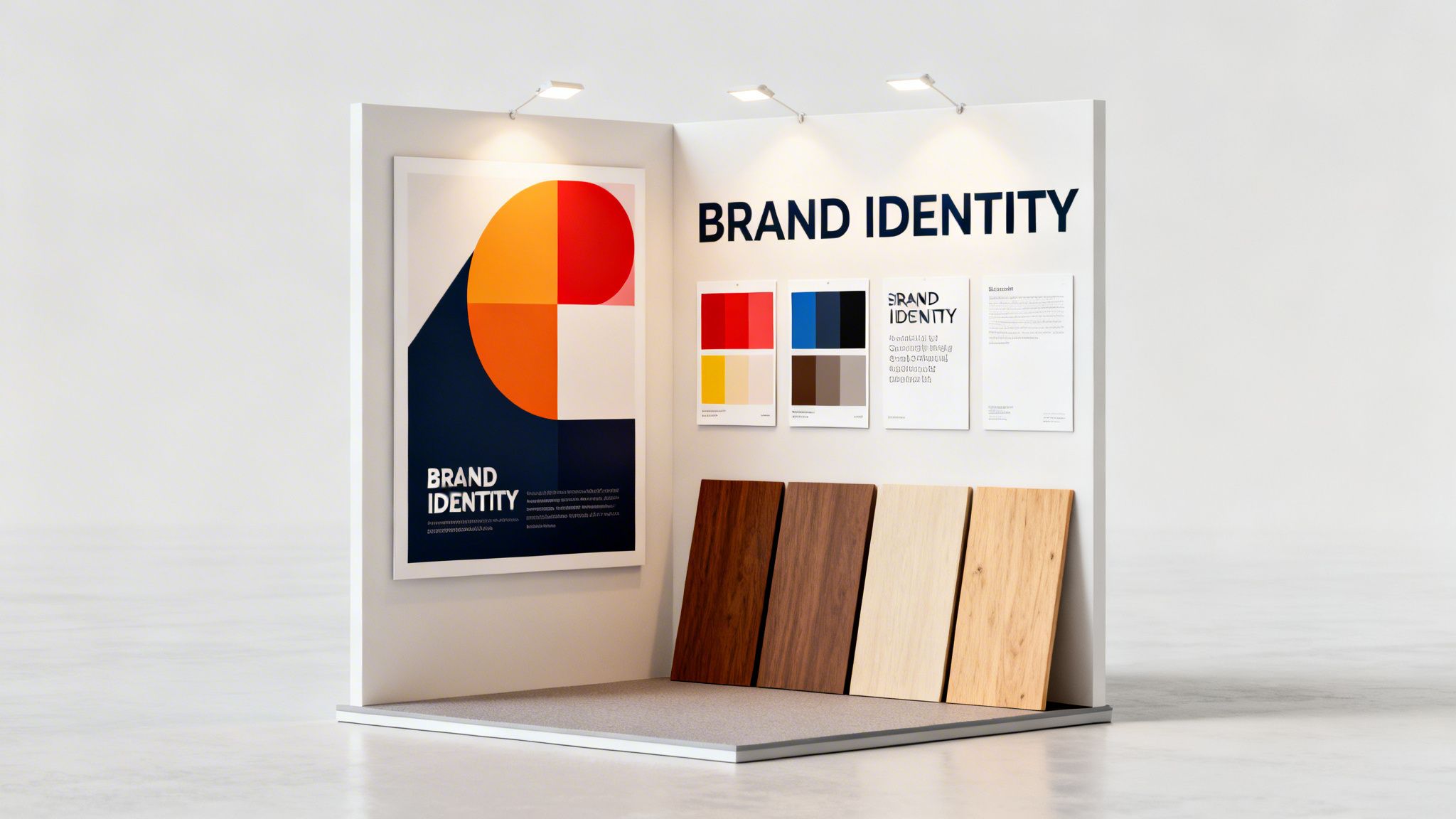
Consider your exhibition stand as a physical extension of your brand, a space where your company’s identity comes to life. The most effective designs translate a brand identity into a physical environment that genuinely connects with visitors.
This involves more than placing logos on surfaces. The goal is to create a cohesive experience where every element, from the graphics to the furniture, works in harmony to tell your brand's story. This is how you make your core message memorable and stand out in a crowded exhibition hall.
Communicating Identity Through Visuals
In a busy exhibition hall, you have about three seconds to make an impression. Your best tools for cutting through the visual noise are large-format graphics, strategic use of colour, and bold typography.
Effective visual branding is critical. You must leverage what makes you different, using your primary brand colours and established visual style to build instant recognition. High-quality graphics and professional signage set the entire tone, giving your booth a polished feel that builds trust immediately.
Your booth's visual identity must be instantly recognisable. The aim is for attendees to grasp your brand and its core purpose within five seconds of seeing your stand, using prominent logos, colours, and concise messaging.
Crafting High-Impact Messaging
While strong visuals attract people, it is your messaging that makes them stay. Resist the temptation to fill your walls with every feature and benefit. A cluttered stand overloaded with text is overwhelming and will be ignored by attendees.
Instead, focus on a single, powerful headline or a key question that speaks directly to the challenges of your ideal customer. This main message should be supported by a few clear, concise bullet points that communicate your value proposition in seconds.
Keep these principles in mind for your on-stand messaging:
- Be Singular: What is the one thing you want visitors to remember? Focus on that.
- Be Clear: Use simple, direct language. Avoid industry jargon that could confuse potential clients.
- Be Visible: Ensure your main headline is large, well-lit, and positioned high enough to be seen from down the aisle.
This disciplined approach ensures your message is not just seen, but understood and remembered.
Reinforcing Values with Materials and Finishes
The physical materials you choose for your stand are a subtle but powerful way to communicate your brand values. They add texture and depth, reinforcing your brand’s personality without words.
For instance, a brand focused on sustainability could use reclaimed wood, recycled materials, and living plant walls. This immediately signals a commitment to environmental responsibility. In contrast, a technology company might use sleek laminates, brushed metal, and integrated LEDs to project a modern, innovative image. To see more on how physical design can boost your marketing, review our guide on effective branding activation.
Do not underestimate the power of touch. When visitors can feel the quality of the materials on your stand, it creates a deeper, more memorable connection. By ensuring every choice, from the colour palette to the finish on the countertop, aligns with your brand, you create a powerful narrative that stays with people long after the show.
Using AV and Lighting to Create an Immersive Experience
In a busy exhibition hall, a static display can easily be overlooked. What distinguishes a memorable stand from a forgettable one is the intelligent use of technology. This means a considered integration of audio-visual (AV) equipment and lighting design that can transform your booth into an immersive environment, drawing attendees in.
This is not simply about placing screens on a wall. It is about using technology with a clear purpose: to tell your story, showcase your capabilities, and engage people. The right combination of AV and lighting can direct attention, set the desired mood, and ensure your message is effectively delivered.
Dynamic Visuals That Tell a Story
Our eyes are naturally drawn to light and movement, which is why video walls and large displays are invaluable on the exhibition floor. A bright, sharp LED video wall can act as a beacon, projecting your brand across the hall and attracting people from the aisles.
Instead of relying solely on printed graphics, consider what you can achieve with moving content:
- Showcase product animations: If you have a complex product, an animation can explain it in a way that is instantly understandable.
- Run customer testimonials: Let your clients advocate for you. Short, powerful video clips build immediate trust.
- Create an ambient backdrop: Use abstract visuals that align with your brand colours to create a sophisticated, professional atmosphere.
The key is to ensure every second of video is high-quality and directly supports your objectives. A visually appealing video loop that is irrelevant to your business will only cause confusion.
Interactive Tech for Deeper Engagement
While large-scale visuals are great for grabbing attention, it is interactive technology that holds it. Allowing people to explore your products and services on their own terms makes the experience more personal and memorable.
Interactive touchscreens are excellent for this purpose. You can load them with digital brochures, in-depth product specifications, or interactive case studies. Visitors can access the information that is most relevant to them, turning your stand from a simple broadcast into a genuine conversation.
Similarly, tablets or iPads are effective for lead capture. They streamline data collection and can be loaded with demonstrations, freeing up your team to move around the stand and engage with visitors. For a truly impactful experience, a Virtual Reality (VR) headset can transport someone directly into your world, offering a powerful demonstration that a physical display cannot match.
Think of AV as creating layers of engagement. A large video wall grabs attention from a distance. Once visitors are closer, interactive touchscreens give them a reason to stay, explore, and begin a conversation.
The Critical Role of Lighting Design
Lighting is often an afterthought, yet it is one of the most powerful tools in exhibitions booth design. Good lighting does more than simply eliminate shadows; it directs focus, builds atmosphere, and makes your space feel welcoming. Poor lighting can make even the most brilliantly designed stand look dull and uninviting.
Here are a few effective lighting tactics:
- Spotlighting Key Products: Use focused spotlights to make your main products the undeniable centre of attention. This tells people exactly where to look.
- Creating Atmosphere: Washing a back wall with coloured LED uplighters can instantly reinforce your brand identity and create a unique mood that helps you stand out.
- Ensuring Readability: Make sure every graphic panel and key message is evenly lit. There is no point having a great tagline if no one can read it from the aisle.
When implemented correctly, lighting guides visitors through your stand and highlights the most important elements. To fully understand the components, it is worth learning what is audio visual equipment and how the different elements work together.
The shift towards technology-heavy stands is clear. Exhibition booth designs in the UK increasingly feature video walls, VR, and touchscreens to boost interaction. At major venues like ExCeL London, exhibitors are leveraging this technology to get noticed, especially since 49% of CMOs now view B2B events as more crucial than they were pre-pandemic. You can find more on the growth of the UK events industry and its implications for exhibitors.
Ultimately, integrating AV and lighting into your design requires planning from the very beginning. Involving professionals early ensures all practicalities, such as power, rigging points, and cabling, are addressed from the start, resulting in a seamless and powerful experience on the day.
Navigating Logistics for a Flawless Execution
A brilliant booth design on paper is one thing; bringing it to life flawlessly in a chaotic exhibition hall is another. The period between design sign-off and the show opening is where meticulous project management becomes critical. It is a complex process of coordinating multiple suppliers, meeting tight deadlines, and navigating venue-specific regulations.
This is where you turn a plan into a reality, transforming potential chaos into a controlled workflow. With a clear roadmap, you can ensure every panel, screen, and chair arrives and is assembled exactly as envisioned, on time and on budget. The goal is simple: your team should walk onto a perfectly finished stand, ready to engage visitors from the moment the doors open.
Coordinating Your Suppliers and Partners
A successful build is a team effort. You are the central point of contact, ensuring your designer, stand builder, and specialist suppliers like London Audio Visual Hire are all synchronised.
From the outset, establish a shared project timeline with clear milestones for everyone involved. Regular, scheduled check-ins are essential for spotting potential issues before they become major problems.
Your timeline must include firm dates for:
- Final design submission: The point at which all creative changes are locked in.
- Graphic artwork deadlines: When high-resolution files must be sent to the printer or stand builder.
- On-site build schedule: A detailed, hour-by-hour plan for the days leading up to the show.
- Breakdown and removal: A plan for a swift, clean exit once the event is over.
This AV integration timeline provides a good overview of the key stages, from initial planning to show day.
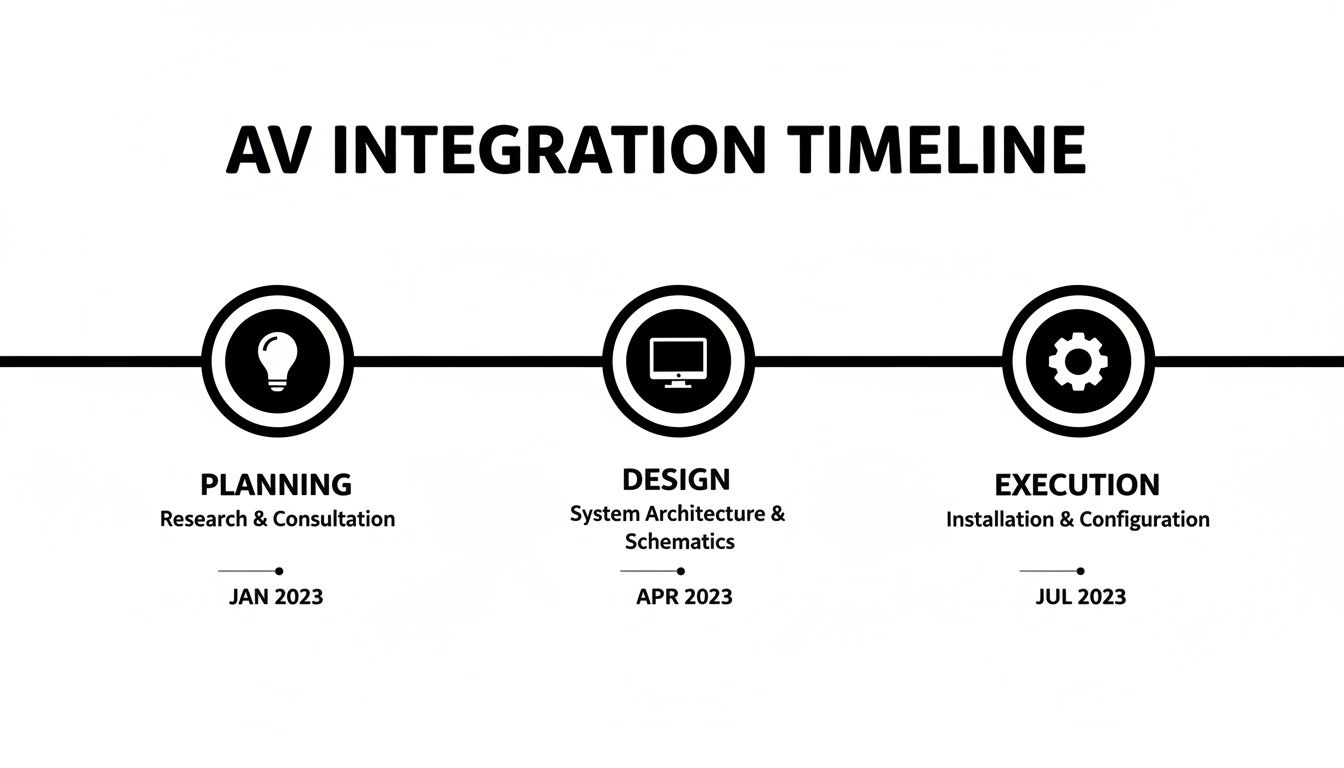
As you can see, a great result depends on your design, technical, and build teams communicating early and often.
Mastering Venue Compliance and Paperwork
Every exhibition venue has its own set of stringent rules and regulations. Ignoring them can lead to costly on-site modifications or, in the worst-case scenario, the organisers halting your build.
Obtain the exhibitor manual from the organisers as early as possible and read it thoroughly. This document is your guide to everything, from height restrictions and flooring requirements to vehicle access times.
You will almost certainly need to submit several key documents for approval:
- Technical Stand Plans: Detailed drawings showing all dimensions, structural elements, and the general layout.
- Risk Assessment: A document identifying potential hazards on your stand and how you will manage them.
- Method Statement: A step-by-step explanation of how your stand will be built and dismantled safely.
- Electrical Plans: A diagram showing the location of all your power outlets and the total load required.
Treat the exhibitor manual as your project guide. Submitting all required paperwork accurately and ahead of schedule is the single best way to ensure a stress-free build.
Planning for On-Site Success
The build phase is always intense. A realistic schedule is vital and needs to account for factors you cannot control, such as vehicle queues or waiting for the venue to connect your electricity. Always build a contingency buffer into your on-site plan for these unexpected delays.
One often-overlooked but critical detail is securing reliable temporary internet services for events. The last thing you need is your payment terminals or interactive demonstrations failing due to a poor connection.
Beyond the build, think about the show itself. Who is responsible for opening and closing the stand each day? Where will staff store their bags and coats? A simple daily checklist can be invaluable, covering small but important tasks like cleaning screens, restocking brochures, and ensuring all your AV equipment is running smoothly.
For a good overview of the technology you might need, you can explore a wide range of AV equipment. By managing the logistics with this level of precision, you are not just building a stand; you are empowering your team to deliver a flawless brand experience.
Got Questions About Exhibition Booth Design?
If you are new to the world of exhibition stands, you will likely have questions. It is a complex process with many moving parts. Here are some of the most common queries from marketing managers and event planners, answered with straightforward, practical advice.
How Far in Advance Should I Start Planning My Stand?
For a full custom-build stand, allow a comfortable lead time of six to nine months before the event. This timeframe is essential for developing the strategy, creating and revising concepts without pressure, and managing fabrication and logistics smoothly.
If you are considering a simpler modular system or dressing a shell scheme, you can usually complete the process in three to four months. The main danger of leaving it too late is that you will be forced to compromise on the design, rush critical decisions, and end up paying premium rates.
What is the Real Difference Between a Custom and a Modular Stand?
A custom-build stand is like a bespoke suit; it is designed and built from scratch, exclusively for you. This provides complete creative freedom to bring your brand to life in a unique way. The structures, finishes, and the entire experience are tailored to your specifications. This option naturally comes with a higher price tag and requires a longer lead time.
A modular stand, on the other hand, is more like high-end ready-to-wear clothing. It uses a system of pre-built components that can be configured in various ways. They are generally quicker to install, often more sustainable due to reusable parts, and strike a good balance between customisation and cost.
The most common mistake is trying to communicate too much information. A stand crammed with excessive text, too many products, and a clutter of graphics creates visual noise. Visitors become confused and simply walk past.
How Can I Measure the ROI of My Exhibition Booth?
Measuring your return on investment (ROI) comes back to the goals you set at the beginning. You cannot prove the value of your participation if you never defined what success looks like. The best approach is to track solid, tangible metrics.
Here is what you should be looking at:
- Cost Per Lead: A simple but effective calculation. Divide your total event spend by the number of qualified leads you captured.
- Lead Conversion: This is the most important metric. You need to track the event leads through your sales pipeline using your CRM to see if they converted into actual business.
- On-Stand Meetings: The number of pre-booked or ad-hoc meetings held with qualified prospects is another excellent indicator of a successful show.
Conducting this post-show analysis is vital. It is how you prove the value of your investment and make a strong case for the following year's event budget. A well-designed stand is a direct driver of these positive results.
At London Audio Visual Hire, we are the technical partners who bring your stand design to life. From eye-catching video walls to lighting that sets the perfect mood, our team ensures your booth has a genuine impact. Find out how we can help with your next event at londonaudiovisualhire.co.uk.


