

An effective event risk assessment template is more than just a document; it is a systematic way to identify, analyse and control potential hazards long before they can disrupt your event. Think of it as your strategic blueprint for keeping everyone safe, staying compliant and delivering a seamless experience.
Why a Solid Event Risk Assessment Is Non-Negotiable
When you are planning an event in London, you know it is about much more than just getting the logistics and aesthetics right. A formal risk assessment is not a bureaucratic box-ticking exercise. It is the very foundation of a safe, professional and smoothly run event.
This process is about making a crucial shift in mindset: from reactively putting out fires to proactively and intelligently managing risks before they ignite.
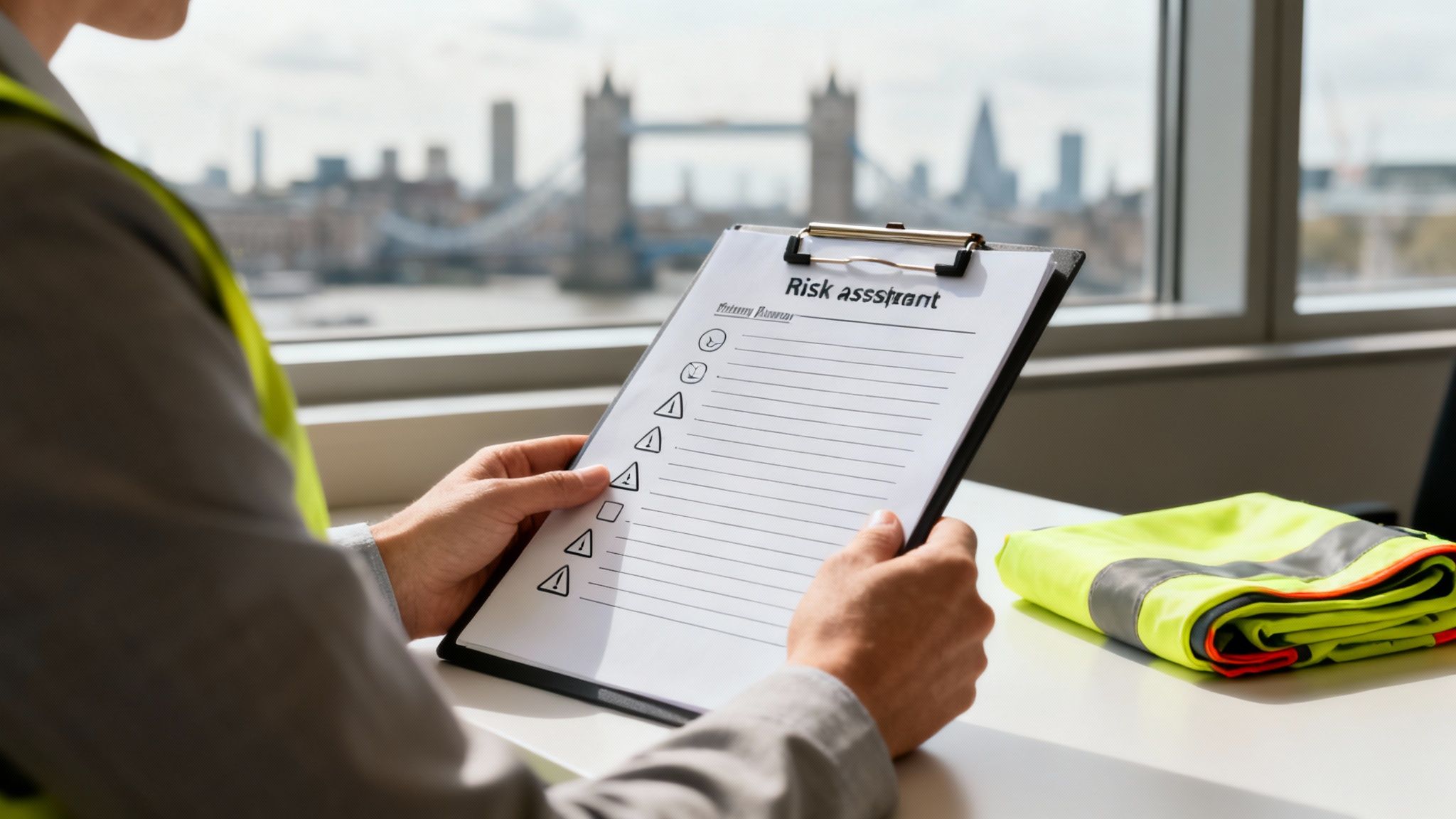
Ultimately, this protects your attendees, staff and contractors. Just as importantly, it safeguards your brand’s reputation. A single, preventable incident can cause lasting damage. A thorough assessment, on the other hand, shows clients, venues and local authorities that you are diligent and professional.
Your Legal Duty of Care
In the UK event industry, risk assessment is a legal requirement. The Health and Safety at Work etc. Act 1974 and the Management of Health and Safety at Work Regulations 1999 place a clear duty on organisers to meticulously evaluate threats before any event gets underway. This applies to everyone involved, from the main planner to specialist suppliers like London Audio Visual Hire handling a corporate conference.
This legal duty is not just about avoiding fines. It is about creating a genuine culture of safety. It means every potential issue, from a trip hazard caused by a loose cable to inadequate emergency lighting, is properly considered and controlled.
A well-executed risk assessment is the difference between hoping for the best and planning for success. It transforms uncertainty into manageable, actionable steps, ensuring you are prepared for challenges long before they arise.
Building a Foundation for Success
A completed risk assessment does more than just list things that could go wrong. It becomes a practical tool that directly contributes to your event's success in several ways:
- Sharper Planning: The process forces you to think through every operational detail, often uncovering logistical gaps you might have otherwise missed.
- Clearer Communication: It serves as a central reference for your team, the venue staff and all your suppliers, ensuring everyone is on the same page about their safety responsibilities.
- Greater Confidence: Knowing you have a solid plan in place frees you and your team to focus on what you do best: delivering an exceptional experience without last-minute safety scrambles.
- Smarter Resource Allocation: It helps you decide where to invest your time and budget for safety, focusing your efforts on the most significant risks first.
Understanding the deep value of a risk assessment shows how much a structured approach can benefit your event's safety and compliance. To dig a bit deeper, it is worth reading about why employing a risk register is essential for effective risk management. This guide will walk you through the practical steps and give you a downloadable template to build this vital tool.
Getting Started With Your Event Risk Assessment Template
So, you have downloaded our free, editable event risk assessment template. That is a great start. Think of this document as your command centre for event safety – a logical framework that takes you from spotting a potential problem to putting a solid fix in place.
Before you start filling it out, take a moment to understand how it is structured. This is not just about ticking boxes; each part of the template is there for a reason, guiding you through the process of thinking critically about what could go wrong and, more importantly, what you are going to do about it.
Anatomy of an Effective Event Risk Assessment Template
Our template is designed to give you a clear, structured way to think through potential risks. We have broken it down into a few key sections, each one building on the last. Getting to grips with this structure is the first step to making your event as safe as it can be.
The table below breaks down the main components you'll find in our template and explains what you should be considering for each one.
| Template Section | Purpose and What to Include |
|---|---|
| Hazard Identification | This is your starting point. List everything that could potentially cause harm, from a trailing cable and wobbly staging to crowd-flow issues or even bad weather. |
| Who Might Be Harmed and How | Be specific here. Who is at risk? Your crew, the public, guest speakers, contractors? And what is the potential harm? A minor trip, a serious injury, or even reputational damage? |
| Existing Control Measures | What are you already doing to manage this risk? This could be anything from using gaffer tape on cables to having security staff in place. Note it all down. |
| Risk Rating (Likelihood x Severity) | Time for some scoring. Using a risk matrix, you will work out how likely the hazard is to cause harm and how severe that harm could be. This helps you prioritise. |
| Additional Control Measures | Based on your risk score, what else do you need to do? This is where you detail the extra steps required to bring the risk down to an acceptable level. |
| Residual Risk Rating | After planning your new controls, you re-evaluate the risk. Has it been reduced enough? This final check is crucial for confirming your plan is effective. |
| Action By / Date | A plan is useless without action. Assign each new control measure to a specific person and give them a clear deadline. This creates accountability. |
This systematic approach ensures you do not miss anything and that your safety plan is built on a solid foundation of careful evaluation.
Think of this template not as a rigid set of rules, but as your playbook. It is a living document you can adapt to build a truly robust safety plan that fits the unique realities of your event.
Making the Template Your Own
Every event is different, and a generic risk assessment just will not suffice. A corporate conference in a sleek Canary Wharf skyscraper has a completely different risk profile to a product launch in a quirky, historic London venue. That is why this template is designed to be flexible. Feel free to add new columns or tweak existing ones to fit your specific needs, whether it is for unique venue rules or specific client requests.
Take a hybrid event, for instance. You are suddenly dealing with a new set of challenges that a purely physical event does not have. You will need to add hazards like streaming technology failing mid-broadcast, potential data security breaches for your online audience, or a remote presenter's connection dropping out. Our team has a wealth of hands-on experience managing these exact scenarios, and you can see more about our technical approach on our hybrid and streaming events page.
Ultimately, the goal is to shape this document into something that genuinely reflects your event. By understanding the logic behind each section, you can confidently customise it. This is what turns a simple template into an indispensable tool for professional event management.
How to Complete Your Event Risk Assessment
Right, you have downloaded the template and have a feel for its layout. Now it is time to turn that blank document into a solid, practical safety plan. The key here is to be methodical; we will work through it logically to make sure nothing gets missed.
This infographic gives you a quick visual of the overall workflow.
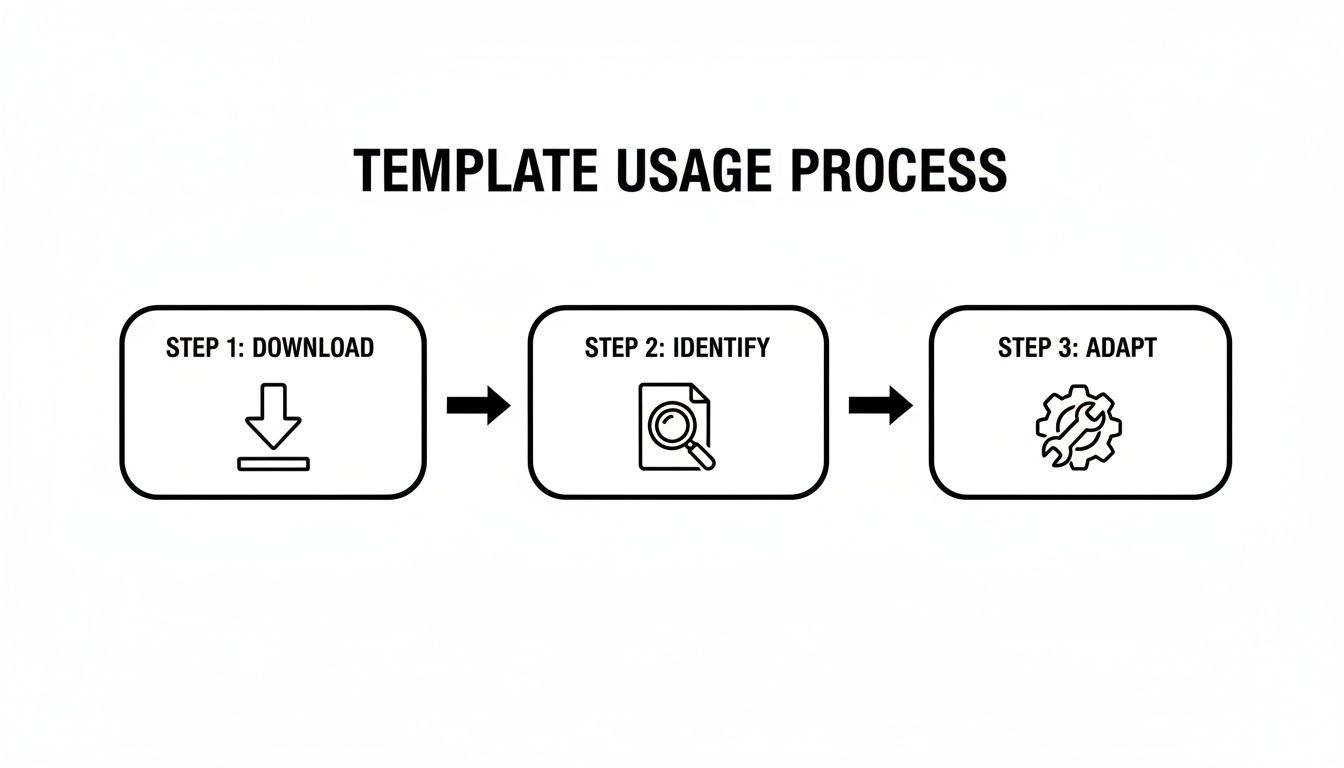
It is a simple but effective process. You start with the template as your base, then dig into the specifics of your event to identify every possible hazard, and finally, you adapt your plan with controls that make sense for your event. This is how you build a safety strategy that actually works.
First, Identify Every Potential Hazard
This is the most important part of the entire process. A hazard is simply anything that could potentially cause harm. You need to do a complete walkthrough of your event, mentally and physically, and list every single thing you can think of, no matter how small it seems.
Do not just think about one thing. Break it down into categories:
- Physical Hazards: These are usually the easiest to spot. Think trailing AV cables, uneven flooring in a historic venue, temporary staging that is not perfectly level, or general trip hazards.
- Environmental Hazards: What about the environment itself? For an outdoor event, this could be anything from high winds to a sudden downpour. For an indoor one, think about poor ventilation making a room too hot, or sound levels being dangerously high near the speaker stacks.
- Operational Hazards: This is all about the running of the event. We're talking about potential overcrowding near the bar, confusing crowd flow that creates bottlenecks, insufficient clear signage, or having too few security staff for the number of guests.
- Technical Hazards: As an AV hire company, this is our area of expertise. It includes everything from equipment overheating and causing a shutdown, a complete power failure, or the worst-case scenario of a lighting rig or video wall failing.
Get your team involved at this stage. Talk to the venue manager, your key suppliers and the crew. Everyone sees things from a different angle, and their input is invaluable for building a truly complete list.
Next, Pinpoint Who Is at Risk
Once you have your list of hazards, you need to think about who could actually be harmed by them, and how. Do not just write down ‘people’, as that is not specific enough.
You need to consider every single group that will be on-site:
- Attendees and Guests: This covers everyone from the general public to your VIPs and conference delegates.
- Staff and Crew: Your own event managers, our AV technicians, security teams, and anyone working for you.
- Contractors and Suppliers: The catering team, the entertainers, even the drivers making deliveries.
- Venue Personnel: The venue will have its own staff on duty, and they need to be considered too.
For each hazard, link it to these groups and describe the potential harm. For example, a trailing cable could cause a guest to trip and get a sprain (a minor injury). But that same cable could cause one of our technicians carrying a heavy flight case to fall and suffer a serious back injury (a major injury). That level of detail is crucial for what comes next.
Now, Evaluate and Score the Risk
This is where you apply objective logic using a risk matrix. Risk is not just about how bad something could be; it's a combination of the likelihood of it happening and the severity of the outcome if it does.
You will give each of these a score, usually from 1 to 5.
- Likelihood: How likely is it that this will happen? (1 = Highly Unlikely, 5 = Highly Likely).
- Severity: If it happens, how bad will it be? (1 = Insignificant, 5 = Catastrophic).
Multiply the two scores to get a Risk Rating. A trip hazard from a loose cable in a busy walkway might get a Likelihood of 4 and a Severity of 2 (potential for a minor injury), giving it a Risk Rating of 8. An insecurely mounted lighting rig might have a low Likelihood of 1, but its Severity would be 5 (catastrophic), giving it a Risk Rating of 5.
This simple calculation immediately shows you what to focus on most. High scores demand immediate, serious action. It’s a similar logic to how national-level risks are managed. For instance, the 2025 National Risk Register (NRR) classifies risks, giving a score of 5 to incidents with a probability greater than 25%. You can apply that same thinking to something like a major power failure at your event. If you want to delve deeper into high-level event security, you can read insights on the 2025 event security strategy.
Then, Implement Control Measures That Work
With your risks scored and prioritised, it's time to decide what you are going to do about them. These actions are your control measures, and they are designed to either eliminate the hazard or reduce the risk to an acceptable level.
Your controls should be sensible and proportionate. Always think in this order (it's called the hierarchy of control):
- Elimination: Can you get rid of the hazard entirely? (e.g., running cables overhead or under flooring instead of across a path).
- Substitution: Can you swap it for something less risky?
- Engineering Controls: Can you use a physical fix? (e.g., using proper cable ramps and protectors).
- Administrative Controls: Can you change how people work? (e.g., clear signage, mandatory crew safety briefings).
- Personal Protective Equipment (PPE): This is the last resort. Think hard hats and high-visibility jackets for crew during the build and breakdown.
Make sure you write down exactly what your chosen control measures are in the template.
The aim is not to create a completely risk-free event, as that is impossible. The goal is to reduce risks to a level that is 'as low as reasonably practicable' (ALARP). This shows you have done your due diligence and are a responsible planner.
Finally, Record and Review Everything
Your completed risk assessment is now an official document. It needs to be signed off by the lead event manager and shared with everyone who needs to see it. Crucially, assign specific people to carry out the control measures and give them deadlines. This creates accountability.
Remember, your event risk assessment template is a living document, not something you do once and forget. If anything significant changes – the venue, the number of guests, a new piece of complex AV equipment – you must go back and review it. Keeping it updated ensures your safety plan is relevant and effective right up to the end of the event.
Real-World Risk Scenarios for London Events
A risk assessment template is just a document. The real value comes from the experience and thinking you apply to it. To bring this to life, let’s walk through how a risk assessment plays out in three very different, but common, London event scenarios.
Each one presents its own unique challenges, demanding a specific approach to managing risk. This is how we, at London Audio Visual Hire, move from a checklist to a practical, on-the-ground safety plan that works.
Scenario 1: Corporate Conference in a Central Hotel
Picture a two-day conference for 500 delegates at a hotel in Canary Wharf. You have a main stage, several smaller breakout rooms and a buzzing networking reception. The challenges here are usually technical and operational.
Identifying the Hazards:
- AV Failure: What happens if the main plenary sound system cuts out, or a projector fails in a key breakout session? The entire schedule could grind to a halt.
- Delegate Logjams: People all move at once. Bottlenecks at registration, coffee stations or in the corridors between sessions are a real trip hazard and can cause access issues.
- Blocked Emergency Exits: With breakout rooms and temporary setups, it is surprisingly easy for a fire exit to become unintentionally blocked.
Assessing and Controlling the Risk:
A total PA system failure is a classic low-likelihood, high-impact risk. You cannot just cross your fingers. Our non-negotiable control measure is a fully redundant backup system: a second mixing desk and spare key microphones, all ready to switch over in seconds.
For the overcrowding, we would advise a staggered registration and work with the venue on the catering layout to encourage a natural flow of people. Sometimes, the simplest controls are the best, like clear, prominent signage to keep everyone moving.
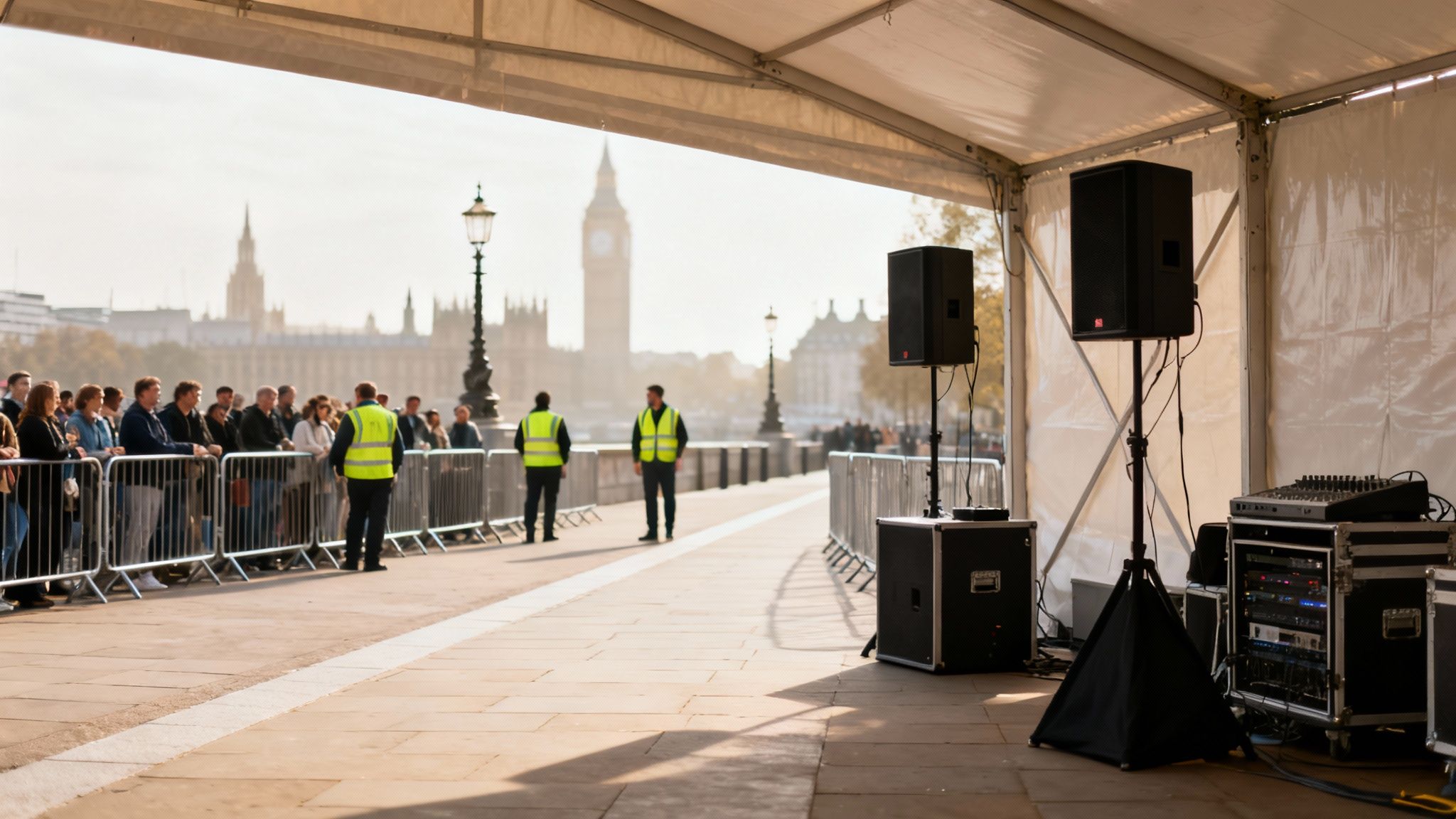
Scenario 2: Outdoor Brand Activation in a Public Square
Now, let's switch to a brand launching a new product in a busy public space like Trafalgar Square. Suddenly, you are dealing with the public and the weather, two things you have very little control over.
Identifying the Hazards:
- The British Weather: A sudden downpour could damage expensive LED screens, and a gust of wind can turn a gazebo into a kite.
- Crowd Control: This is not a ticketed event. Anyone can wander in. Managing the flow of the general public to prevent crushing or surges is a major priority.
- Equipment Security: High-value equipment is a tempting target, especially during the overnight build and breakdown.
Assessing and Controlling the Risk:
The chance of rain in London is never zero. Our plan would involve waterproof covers for all sensitive equipment and weighting down every temporary structure well beyond the manufacturer's minimum. We would also agree on a "weather trigger" with the client: a specific wind speed or rainfall level at which we pause or stop the event for safety.
You cannot control everything at an outdoor event. The focus shifts to having robust contingency plans and being able to react instantly. That is how you turn potential chaos into a managed situation.
To manage the crowds, we would use barrier systems to create a defined event space with clear entry and exit points. Security staff would be briefed to do more than just stand there; they would be actively managing crowd density.
Scenario 3: Gala Dinner in a Historic Venue
Finally, imagine an awards dinner in a stunning Grade I listed building. The atmosphere is incredible, but these venues are often a logistical challenge.
Identifying the Hazards:
- Unreliable Power: Old buildings often have dated wiring that cannot handle the demands of modern production lighting, sound systems and catering equipment.
- Difficult Access: Think narrow corridors, delicate floors and no proper loading bays. Getting heavy equipment inside is a hazard for the crew and the building itself.
- Protecting the Building: The biggest risk can be damaging the irreplaceable venue. Scuffing a 300-year-old floor or overloading a mezzanine is not an option.
Assessing and Controlling the Risk:
The risk of tripping the venue's power is high. The best solution? Do not use it. We would bring in our own silenced generator with a qualified electrician to run a safe, independent power distribution system.
For access, we would measure everything beforehand. Specialised floor coverings and manual handling techniques would replace heavy-duty trolleys on sensitive surfaces. A detailed load-in schedule prevents any one area from becoming a dangerous bottleneck. We might even need a structural engineer’s report to confirm floor loading limits, which is proper due diligence.
Recent data shows why this level of planning is vital. The Bank of England’s H2 2025 survey noted that while only 19% of the public think high-impact events are likely, the number who anticipate medium-likelihood disruptions has jumped to 51%. People are more aware of things going wrong, making a solid event risk assessment template essential for earning your client's trust. You can read more in the UK public survey of risk perception.
Who Is Responsible? Assigning Roles and Fulfilling Legal Duties
An event risk assessment is more than a box-ticking exercise. It's a living document that only works when everyone on the team knows their part. Simply completing a template and filing it away is insufficient; real-world safety comes from clear accountability.
This is where you need to assign specific roles and get a firm grip on your legal responsibilities.
A solid safety plan needs an owner. Without one, it is just a piece of paper. Defining who does what is the only way to make sure every control measure is implemented, monitored and understood by the people on the ground.
Defining Who Does What
While one person should lead, risk management is a team effort. When you bring everyone to the table, you cover all angles, from the venue’s quirks to the specific details from your technical suppliers.
Here is how the key players usually stack up:
- The Event or Production Manager: This is typically your lead. They steer the ship, overseeing the entire risk assessment from start to finish. They will sign off the final document and make sure it is distributed to everyone who needs it.
- The Venue Coordinator: Their input is invaluable. They know the building inside out: its emergency exits, fire systems, power limitations and access points.
- Key Suppliers: You must consult your specialist contractors on the risks they introduce. Our technicians, for example, will provide crucial details on electrical safety, the weight loads for any rigged equipment, and how to manage cables to prevent trip hazards.
- Security and Medical Teams: These teams need to see your assessment to build their own operational plans. They need to know the potential risks to determine the right staffing levels and what to do if things go wrong.
Understanding Your Legal Duties
Beyond just assigning jobs internally, you must understand the legal framework your risk assessment sits within. In the UK, there are several non-negotiable duties you cannot ignore.
First, documentation is key. If your organisation has five or more employees, you are legally required to have a written record of your risk assessment. That is not a helpful tip; it is the law.
A risk assessment is not just a safety plan; it's a legal document. It is your proof that you have done your due diligence and taken reasonable steps to keep people safe.
Furthermore, having the right insurance is both a legal and commercial necessity. Public Liability Insurance is the main one, covering you if a guest is injured or their property is damaged. Your insurer will almost certainly expect to see a thorough risk assessment as a condition of your policy. It shows them you are actively managing your liabilities.
This formal approach also applies to specific hazards like fire safety, where the law clearly defines who is responsible. For a proper deep dive into these obligations, this guide on UK Fire Risk Assessment Legal Requirements Explained is a fantastic resource.
When you blend these legal duties with clearly defined roles, you start to build a real culture of safety. Everyone knows their part, and your plan transforms from a static document into a powerful, active tool for running a safe and successful event.
Answering Your Event Risk Assessment Questions
Even with a solid template, you are bound to have questions as you get into the details. Here are some of the most common queries we get from event planners, with straightforward answers to help you finalise your safety plan.
How Often Should I Review My Risk Assessment?
Think of your risk assessment as a living document. It is not something you write, file and forget. It needs to evolve alongside your event plan.
Any significant change means it is time for a review. This could be a last-minute venue switch, a larger-than-expected guest list, or adding new elements like complex staging or pyrotechnics. Even a shift in the official security threat level should trigger a review. For recurring events, give it a thorough check at least once a year.
Your risk assessment should reflect the reality of your event today, not what you thought it would be six months ago. Constantly revisiting it is not a chore; it is the mark of a professional.
What Is the Difference Between a Hazard and a Risk?
This is a classic distinction, and getting it right is crucial for completing your event risk assessment template properly. The two terms are often confused, but they have distinct meanings in health and safety.
- A hazard is anything with the potential to cause harm. A loose cable across a walkway is a hazard. A sudden downpour at an outdoor event is a hazard. An unsecured lighting rig is a hazard.
- A risk is the likelihood of that hazard actually causing harm, combined with how severe that harm could be. The risk of the loose cable is the high probability of someone tripping, likely resulting in a sprain or a fall.
Identifying hazards is your first step. Analysing the risk is what helps you decide what needs your attention most urgently.
Can I Use One Assessment for Multiple Venues?
No. Every venue is a unique ecosystem with its own layout, fire exits, access points and built-in quirks. A generic risk assessment is practically useless and certainly would not stand up to scrutiny from UK authorities.
You can and should use the same process every time, but the content must be completely bespoke to the location. A risk assessment for a modern conference centre will be worlds away from one for a Grade II listed building or an open-air festival site. You need a fresh, dedicated assessment for every single venue. No shortcuts.
Who Is Legally Responsible for Health and Safety?
In the UK, health and safety is a shared responsibility. While several parties have a 'duty of care', the final responsibility usually rests with the event organiser. You have overall control, and it is your job to ensure a competent person carries out a full and proper risk assessment.
However, you are not alone. Others have legal duties too:
- The Venue: The venue management is responsible for the safety of the building itself, including structural integrity, fire alarms and electrical systems.
- Suppliers and Contractors: Every supplier, from the caterers to your AV team, is responsible for their own staff and equipment. Here at London Audio Visual Hire, we always conduct our own risk assessments for every piece of equipment we bring on-site.
Good, clear communication between all parties is the only way to ensure nothing is missed.
A meticulous risk assessment is the foundation of any safe and successful event. It takes time and a sharp eye for detail, but the peace of mind it provides is invaluable.
If you need a technical partner who puts safety at the centre of event production, talk to the team at London Audio Visual Hire. We are experts in London's venues and bring a rigorous approach to every project. Find out more at https://londonaudiovisualhire.co.uk.


