

Choosing the right event production company in London can be a significant task. With so many options, it is difficult to know where to begin. A strong partner does more than deliver speakers and a screen; they become the technical heartbeat of your event, ensuring every slide is seen, every word is heard, and the atmosphere feels right.
What does a London event production partner do?
Think of a top-tier production company as your strategic technical director. They do not just rent you equipment; they provide a complete service that handles the design, management, and flawless execution of every technical aspect of your event. This approach is the difference between a DIY headache and a seamless, professional experience.
For a corporate planner, this means you can delegate a range of critical elements to one trusted team:
- Audio Management: This involves achieving crystal-clear sound. From presenters' lapel microphones and panel discussion setups to background music that sets the mood, they manage the speakers, mixers, and microphones to ensure perfection.
- Visual Displays: They handle everything presented on screen. This could be a simple projector for a breakout session or a large, high-impact LED video wall that makes your brand stand out.
- Lighting Design: Lighting creates the mood. A good production team can design a scheme that provides crisp, functional light for a conference or something more dynamic and dramatic for a product launch or awards dinner.
- Staging and Set Building: This covers the physical foundation of your event. They build the stage, design custom backdrops, and provide lecterns that are not only on-brand but, crucially, completely safe.
- Technical Direction: On the day, they provide the people who make it all happen. You will have an on-site project manager and a crew of skilled technicians running the show, ready to solve any problem instantly and hit every cue.
The real advantage of hiring a full-service production company is having one expert team manage the entire technical show. Instead of you juggling separate suppliers for sound, video, and lighting, one cohesive crew handles it all. This significantly reduces your stress and dramatically lowers the chances of something going wrong.
This kind of expertise is in high demand in the capital. London is the UK's event powerhouse, attracting a staggering 30% of all event enquiries nationwide, surpassing cities like Birmingham and Manchester. It is precisely why specialists like London Audio Visual Hire are so vital; they know how to navigate the city’s unique venues and logistical quirks to deliver incredible corporate events. You can explore these industry trends and what they mean for event planning.
Understanding the technology and equipment
Ultimately, your event's success depends on the technology. The actual hardware, from the microphones to the video walls, is what defines the experience. Vetting a potential partner’s technical gear is not just a box-ticking exercise; it is fundamental to ensuring everything runs without a hitch.
One of the first things to determine is whether a company owns its own equipment or cross-hires everything from other suppliers. Some cross-hiring for unique, specialised equipment is normal. However, a company that owns and maintains its core inventory, like London Audio Visual Hire, is almost always a safer choice. It means their technicians know the gear inside and out, they control the maintenance, and there are fewer moving parts in the supply chain that could go wrong on the day.
The core pillars: audio, visuals, and lighting
When you speak with potential production companies in London, you need to be specific about the three pillars of any event: audio, visuals, and lighting. The technology required for a product launch is vastly different from what you would specify for a gala dinner, so you must tailor your questions.
Consider a conference. Crystal-clear audio is non-negotiable. You should ask what kind of microphones they have (lapel, handheld, lectern?), the quality of their speakers for covering the room evenly, and which mixing desks they use to manage different sound feeds. If you want to become more familiar with the terminology, this guide on what is audio-visual equipment is a great starting point.
Visuals need the same level of attention. A basic projector might suffice for a small internal meeting, but a major brand event requires something with more impact. Find out what they can offer beyond the basics. Do they work with high-impact display technology like modern LED Video Walls? These can completely transform a space and make your content look incredible.
A production company's equipment list reveals a lot about how seriously they take their craft. Always ask to see it. Do not be shy about asking how old key pieces of equipment are and when they were last serviced. Seeing modern, well-maintained equipment from reputable brands is a very positive sign.
The infographic below gives a solid overview of the main service areas you will be considering.
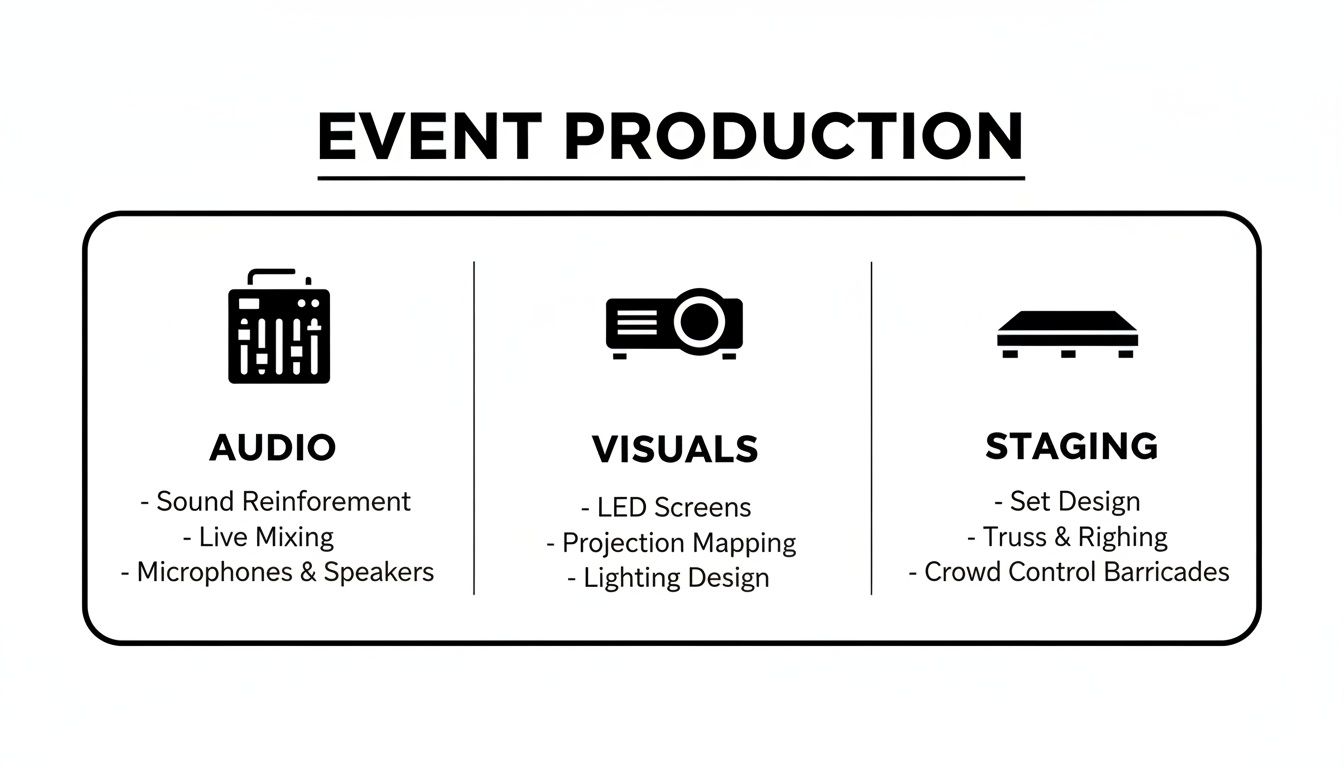
As you can see, it is how the audio, visual, and staging components work together that forms the technical backbone of a great event.
Matching the technology to the task
Great event production is not about using the most expensive gear; it is about using the right gear for the job. Your conversation with a potential supplier should quickly move from what they have in their warehouse to how they would use it to meet your specific goals.
Instead of generic questions, try framing them around your event. Here are a few examples to get you started:
- For a Gala Dinner: "How would you use lighting to create a sophisticated, warm atmosphere in our venue, while ensuring our speakers on stage are perfectly lit?"
- For a Product Launch: "We need a significant 'wow' moment for the reveal. What visual technology would you suggest to make it unforgettable?"
- For a Hybrid Conference: "Talk me through your setup for our remote attendees. What cameras, streaming equipment, and platforms do you rely on to give them an excellent experience?"
When you test them with real-world scenarios, you get a much better sense of their creative thinking and technical expertise. It helps you see if they are just a supplier or a genuine partner who will help bring your vision to life.
Essential AV equipment checklist by event type
To give you a head start, here is a quick-reference table outlining the typical AV equipment you will need for common event types in London. Use this as a starting point for your discussions with potential production partners.
| Event Type | Essential Audio Kit | Essential Visual Kit | Essential Lighting Kit |
|---|---|---|---|
| Conference/Seminar | Lectern mics, lapel mics for speakers, handheld mics for Q&A, PA system with clear speakers, audio mixer. | Large projector screen or LED wall for main stage, confidence monitors for speakers, repeater screens for large rooms. | Stage wash for visibility, lectern spotlights, basic house lighting control. |
| Gala Dinner/Awards | Wireless handheld mics for hosts, background music system, PA system for announcements and speeches. | Branded gobo projections, multiple screens for sponsor loops and winner announcements, live camera feed to screen (IMAG). | Uplighting for atmosphere, intelligent moving lights for awards stings, pin-spotting for table centres. |
| Product Launch | High-impact sound system for reveal sequence, wireless mics for presenters, audio playback for video content. | High-resolution LED Video Walls, projection mapping, interactive displays. | Dramatic stage lighting, colour washes to match branding, moving lights for dynamic effects. |
| Hybrid Event | High-quality broadcast audio mixer, individual mics for all in-room speakers, audio feed for remote presenters. | Multiple broadcast cameras, vision mixer for switching between sources, dedicated streaming encoders and platform. | Professional studio-style lighting for speakers to ensure high-quality video for the online audience. |
Remember, this is just a baseline. A good production company will take this list and build a bespoke solution tailored specifically to your venue, audience, and creative ambition.
Evaluating the crew and their on-site expertise
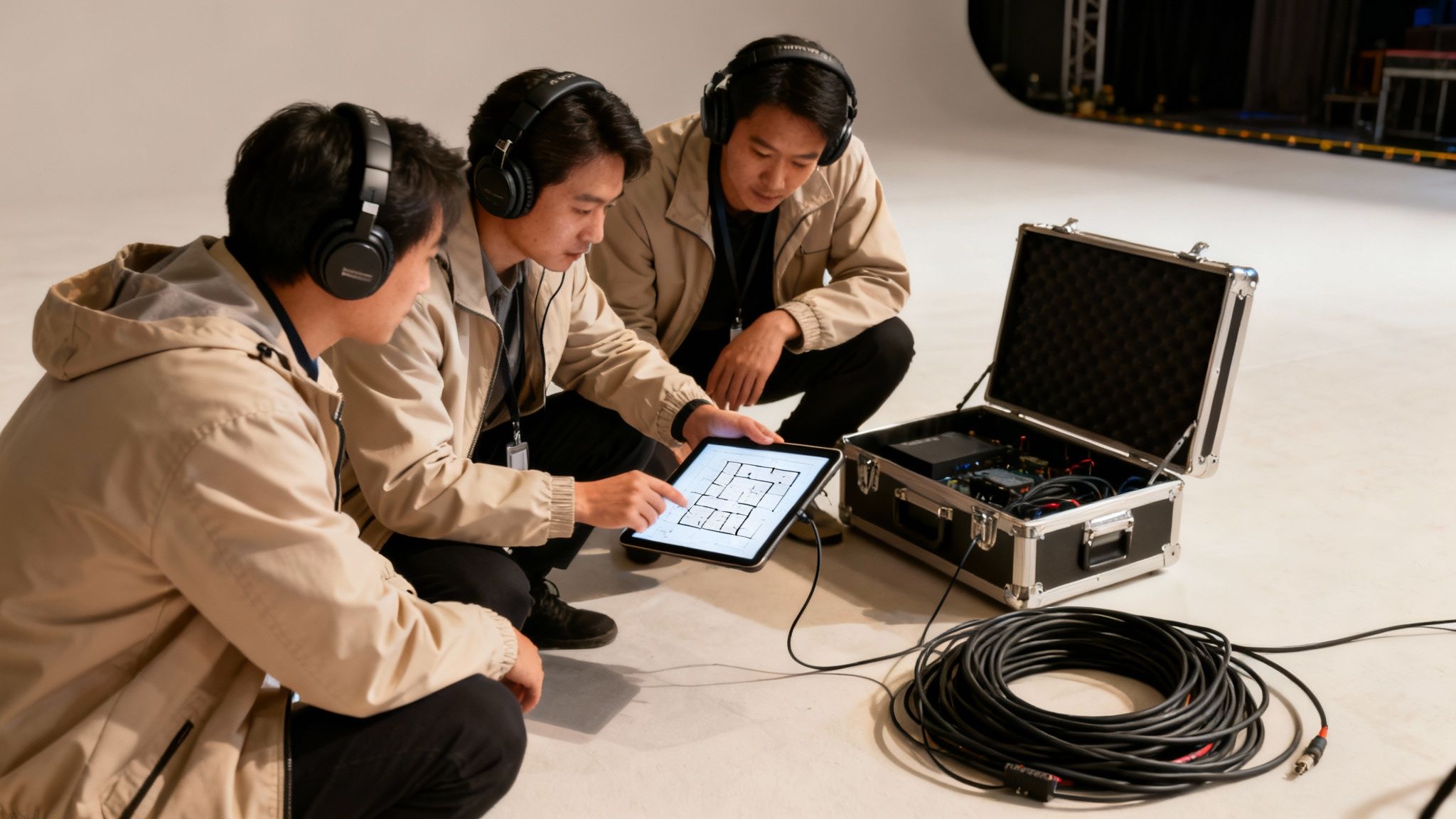
You can have the most advanced equipment in the world, but it is the people behind the mixing desk who truly determine an event's success. The on-site crew are your front line, troubleshooting on the fly and ensuring every cue lands perfectly. When vetting event production companies in London, it is vital to look closely at the experience and structure of their technical team.
A well-organised operation has clearly defined roles, from a dedicated project manager who becomes your single point of contact to the specialist engineers handling sound, light, and video. You will find a significant advantage in working with a company that uses a consistent team of in-house staff or trusted, long-term freelancers, rather than one that hires a random crew from an agency for each job.
This consistency makes everything run more smoothly. People who know how to work together communicate better, which is invaluable on a hectic event day. A cohesive team, like the one at London Audio Visual Hire, already has established communication methods and understands each other’s rhythms, resulting in a far more efficient and less stressful experience for everyone involved.
Gauging experience and problem-solving skills
One of the best indicators of a crew’s expertise is venue familiarity. If they have worked in your chosen London venue before, they will already know its layout, including tricky loading bays, power limitations, and specific rigging points. That kind of inside knowledge saves a great deal of time and helps you avoid last-minute surprises.
Do not be afraid to ask direct questions about how they operate on-site:
- Contingency Planning: "Tell me about a time you had to solve a major technical issue during a live event. What went wrong, and how did your team fix it?"
- Venue Specifics: "Have you worked at [Your Venue] before? What are its biggest technical challenges, and how would you plan to handle them for our event?"
- Communication: "What does your on-site team structure look like? Who is my primary contact on the day, and how do the different crew members stay synchronised?"
Solid on-site communication is non-negotiable. It is worth exploring the reasons to use two-way radios to run your event, as a company that has mastered this is likely committed to seamless coordination and safety.
The value of in-house teams
The UK's Party & Event Planners industry has seen a 19.2% compound annual growth rate over the last five years, expanding into a £2.4 billion market. This growth means skilled technical crews are in high demand across the capital, making a stable, experienced team an incredibly valuable asset for any production partner.
A calm, professional, and proactive on-site crew is arguably the most important element a production company can provide. Their ability to remain composed under pressure directly translates into a seamless experience for you and your attendees, especially during complex events like large-scale conferences.
Ultimately, you are not just hiring equipment; you are hiring a team of problem-solvers. Their experience, especially in the unique high-pressure environments of London events, will determine your success far more than any single piece of equipment. For a deeper look into what these larger events require, our guide on conference production services offers more detailed insight.
Navigating London’s unique logistical challenges
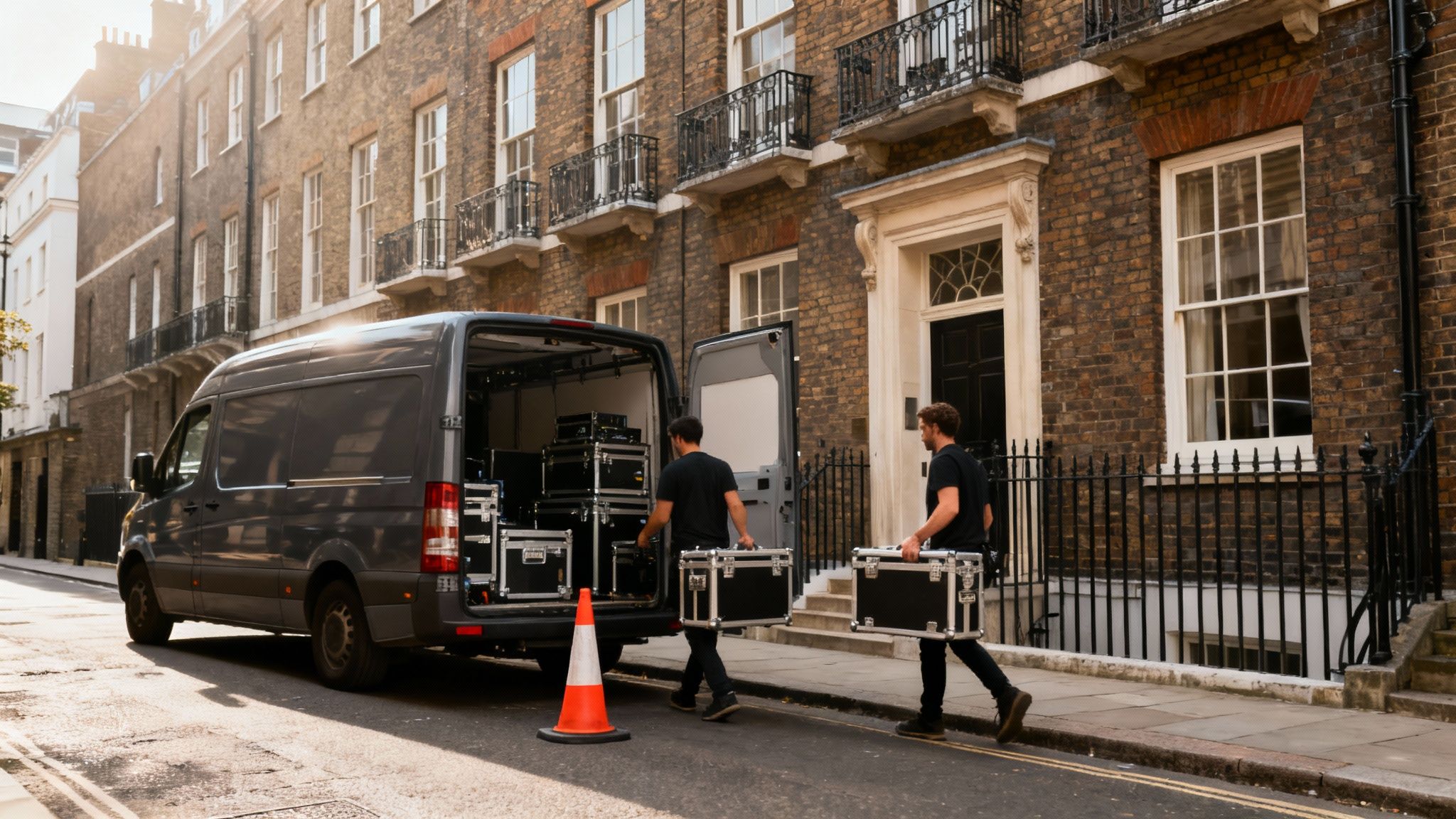
Running an event in London is unlike anywhere else in the UK. The city's density, heritage buildings, and complex regulations mean your production partner needs more than technical skill; they need genuine, hard-won local knowledge. Without it, a manageable task can quickly become a logistical nightmare.
The first hurdle is simply getting around. Any van entering the city centre during the day is subject to both the Congestion Charge and the Ultra Low Emission Zone (ULEZ) charge. A production team that has not factored this in from the start can see their transport costs increase, and that extra cost will inevitably be passed on to your invoice.
Then there is the schedule. London venues are known for their tight load-in and load-out windows. You often have only a few hours, usually late at night, to get everything in and set up. There is no margin for error on such a strict timeline.
Why venue-specific experience is essential
A production company's direct, hands-on experience with your chosen London venue is perhaps their most valuable credential. The plan for a modern conference centre with purpose-built loading bays is entirely different from setting up in a Grade II listed townhouse in Mayfair, which might only have a small service lift and no street parking.
Consider this: a historic venue might have strict rules about floor loading capacities or ban haze machines that could trigger sensitive fire alarms. An experienced partner, like London Audio Visual Hire, knows these quirks before they arrive, saving you from expensive delays or, worse, damage to the property. The variety of unique London venues they have handled demonstrates the breadth of challenges involved.
When a production manager can tell you the exact power amperage available in a specific ballroom or remembers the precise dimensions of a service corridor from memory, it demonstrates practical, on-the-ground knowledge that makes your setup day run efficiently.
Your London logistics checklist
When you are interviewing potential event production companies in London, do not just focus on the creative vision. You need to examine their operational readiness. Their answers to logistical questions are just as important.
Before you sign anything, ask them these questions. Their answers will tell you if they are truly ready for the reality of a London event.
- Vehicle & Route Planning: How do you incorporate ULEZ and Congestion Charges into your transport budget and route planning?
- Parking & Unloading: What is your process for loading in at a venue with no dedicated parking or loading bay?
- Venue Restrictions: Tell me about a time you had to completely rethink a technical plan because of a venue's heritage or structural limitations.
- Scheduling: We have a four-hour overnight load-in. How do you schedule your crew and transport to manage that smoothly?
- Contingency: What is your Plan B if your main equipment van gets stuck in central London traffic and threatens the schedule?
A truly experienced team will have confident, detailed answers. A team that hesitates is likely unprepared. In London, hope is not a strategy.
Understanding quotes, contracts, and insurance
When the quotes start arriving, it can feel like progress. However, the real work is in understanding what is actually on the page. A good proposal is not just a number; it is a roadmap for your event, and a professional company will provide a detailed one.
Never accept a single lump-sum figure, as this is a major red flag. You need a fully itemised quote that breaks everything down: equipment hire, crew day rates, transport (including any Congestion or ULEZ charges), and project management fees. If it is not listed, you cannot be sure you are paying for it.
Reading between the lines
A proper quote from a top-tier London event production company will also account for the work that happens long before the event day. This pre-production phase is crucial and includes tasks like site visits, creating technical drawings, and preparing content. It all requires time and expertise.
Also, look for a contingency line item. A 5-10% buffer is standard and can be a lifesaver. It is there for the small surprises that often arise, preventing a minor issue from derailing your entire budget.
The UK events sector is very active at present. 76% of organisers are dealing with high demand for hybrid events, and 66% are planning more events with bigger budgets. In this market, gaining clarity in your contracts is more important than ever. If you are curious about the latest statistics, you can find more corporate event trends on livegroup.co.uk.
Once you are comfortable with the numbers, it is time to review the contract and insurance details. These documents are your safety net, so never just skim them.
A handshake or a quick email is not sufficient. Your contract is the legally binding document that outlines everything: the scope of work, payment due dates, and what happens if things go wrong. Without it, both parties are exposed.
Any reputable company will have its insurance documents ready. You need to see proof of two key policies:
- Public Liability Insurance: This is non-negotiable. It covers injury to people or damage to property. Most London venues insist on a minimum of £5 million, but many now demand £10 million.
- Equipment Insurance: This covers all the expensive equipment being brought in for your event against damage or theft.
Finalising the agreement
Before you sign, perform one final check. Does the contract list every single deliverable you agreed upon? Does it match the itemised quote perfectly?
Your payment schedule should also be crystal clear. Standard practice is a deposit to secure the booking, an interim payment closer to the event, and the final balance once the job is complete.
Finally, pay very close attention to the cancellation clause. It will spell out exactly what happens financially if you (or they) have to cancel. The charges usually become steeper the closer you get to the event date. A fair contract protects both of you and builds the trust needed for a successful event.
Your questions, answered
Hiring an event production company in London for the first time can raise many questions. Here are some of the most common queries from corporate planners, along with direct answers based on years of experience in the capital.
How far in advance should I book?
This depends on the scale of your event. For a large, multi-day conference or a major brand launch, you should engage a production company three to six months in advance. This provides sufficient time for proper planning, site visits, technical design, and booking the best freelance specialists.
For a smaller corporate meeting with a fairly standard AV setup, four to six weeks' notice is often enough. However, a word of warning: London is an incredibly busy market. To avoid disappointment, especially during the summer and Christmas periods, booking your partner as early as possible is always the best approach.
What is the difference between dry hire and full-service production?
Understanding this distinction is key to your budget and peace of mind. They are two completely different services.
-
Dry Hire: This is essentially equipment rental. You collect the gear, set it up yourself, operate it, and return it. It is a good option if you have a skilled in-house technical team who knows exactly what they are doing.
-
Full-Service Production: This is the complete package and is what specialists like London Audio Visual Hire deliver. You do not just get the equipment; you get the expertise. This includes a dedicated team for technical design, setup, live operation, and breakdown. It is the project management and on-site support that ensures everything runs smoothly.
How can I check if a company truly knows my venue?
Do not just take their word for it. A simple "yes, we've worked there" is not enough. You should ask for evidence.
Request to see case studies, photos, or even videos from events they have previously run at your chosen venue. A company that genuinely knows the space will be able to discuss its quirks without prompting. They will know the power limitations, the best rigging points, sound restrictions, or the challenging load-in route. That detailed knowledge is the real sign of experience.
When a production manager can tell you the exact dimensions of the venue's goods lift or where the main power distribution is located from memory, that is the expertise you are paying for. It is that kind of insight that prevents small issues from becoming big, expensive problems on the day.
What should I look for in a production company's health and safety policy?
A serious commitment to health and safety is non-negotiable and a strong indicator of a company’s professionalism. Any potential partner should be happy to share their Health and Safety policy, as well as specific risk assessments and method statements (RAMS) tailored to your event.
Specifically, you will want to see:
- Proof of regular equipment maintenance and PAT testing certificates.
- Documented procedures for working at height (e.g., rigging lights and speakers).
- Evidence they follow noise at work regulations.
Crucially, you must verify they have adequate Public Liability Insurance. Most major London venues will not allow them on-site without a minimum of £5 million in cover. A solid safety record is not just a desirable quality; it is essential.
At London Audio Visual Hire, we pride ourselves on clear communication and meticulous event production across the capital. Our team knows London's venues inside and out, ensuring your event is a seamless success. Find out how we can support your next project by visiting us at https://londonaudiovisualhire.co.uk.


