

For UK businesses and agencies, viewing event live streaming as a simple add-on is a thing of the past. It is now a core strategic tool that shatters the physical walls of your venue, turning a London-based conference into a global conversation. More than just broadcasting, it is about capturing rich data and creating permanent digital assets that continue to deliver value long after the event.
Why Professional Event Live Streaming Is Now Essential
When discussing 'live streaming' for corporate events, brand activations, or major conferences, there is a significant difference between using a laptop camera and delivering a professional, broadcast-quality production. The latter is a meticulously planned operation, much like a live television broadcast, built on solid strategy, technology, and execution.
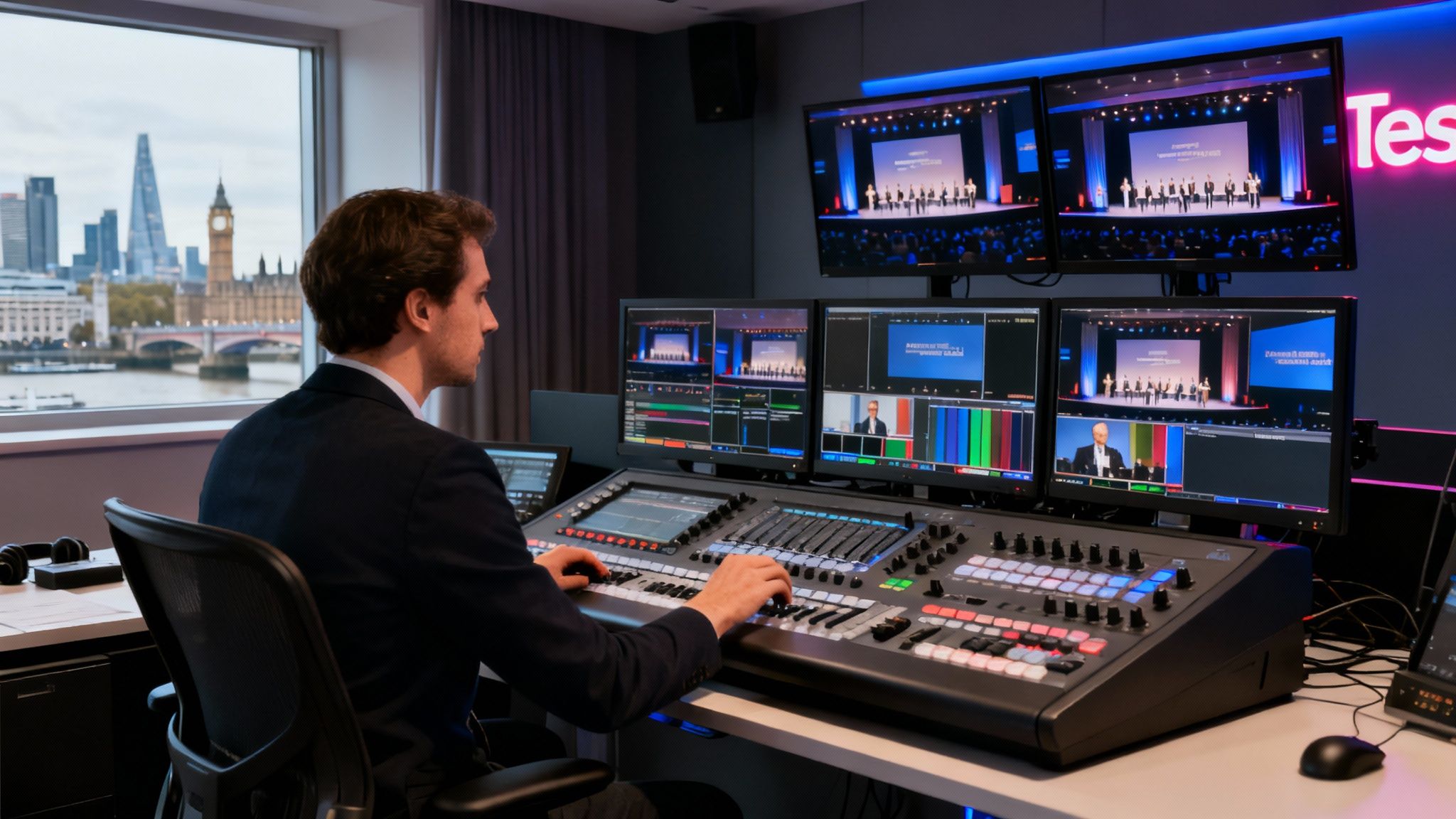
This distinction is important. Your event is a direct reflection of your brand, and a pixelated, unreliable stream sends the wrong message. A polished, reliable broadcast, on the other hand, does more than just reach a wider audience; it actively builds credibility.
The Strategic Value of a Polished Broadcast
A professionally managed stream is about controlling the narrative and guaranteeing quality. It ensures your key messages are delivered with crystal-clear audio and crisp, high-definition video, free from the technical issues that can undermine an otherwise excellent presentation. This focus on flawless execution is how you protect and enhance your brand's reputation. At London Audio Visual Hire, every project is built on a foundation of meticulous planning to guarantee a seamless on-air experience.
Moving Beyond Audience Reach
Extending your audience is a major benefit, but the real power of professional streaming lies in deeper engagement and measurable results.
Here is what you gain:
- Superior Data and ROI: You can capture incredibly detailed analytics on viewer behaviour, such as peak engagement times, audience location, and total watch time. This is not just for show; it is hard data that proves your event's impact and helps you plan more effectively for the next one.
- Increased Sponsor Value: A larger, more engaged online audience creates new, high-value opportunities for your sponsors. This includes branded on-screen graphics, pre-roll video advertisements, and sponsored segments that significantly boost your event's commercial potential.
- Creation of a Permanent Digital Asset: The high-quality recording becomes a valuable resource for on-demand content, marketing clips for social media, and internal training materials, extending your investment much further.
When you stop seeing live streaming as a technical task and start treating it as a core part of your event strategy, you unlock its true potential. It is how you connect meaningfully with audiences, deliver measurable results, and build lasting value for your brand.
Laying the Groundwork for a Flawless Live Stream
The success of any professional event live stream is determined long before the cameras go live. A slick, reliable broadcast is the direct result of painstaking planning and discovery. This is where you resolve potential issues, align your goals with the technical reality, and ensure everyone from the client to the on-site crew is fully aligned.
It all starts by asking the right questions. Before considering any equipment, you need to understand why you are streaming. You must move past a vague desire to "go live" and define what a successful outcome looks like for this specific event.
Defining Your Objectives and What the Audience Sees
First, what is the core purpose? Are you trying to maximise brand reach, deliver vital training to a remote team, or create an exclusive experience for paying virtual attendees? Each of these goals demands a different approach to the production, the platform you choose, and how you engage with the audience.
Gather your stakeholders and establish clear answers to these questions:
- Who is our audience? Are they internal staff, existing clients, or potential new customers? Understanding their technical knowledge and expectations is crucial.
- What is the key takeaway message? This simple question helps focus every decision, from the content to the camera angles, on what truly matters.
- How much interaction is required? Is this a simple broadcast, or are you planning for a live Q&A, audience polls, or a moderated chat? Interaction requires specific technology and often a larger crew.
- What should the viewer experience be? Should it be a polished, TV-style production, an authentic behind-the-scenes look, or something more like an interactive workshop?
Documenting these answers turns a creative vision into a solid technical brief for your production partner. It is the difference between a stream that is technically functional and one that is genuinely effective.
Conducting a Venue Recce
Once the 'why' is clear, it is time to focus on the 'where'. A venue assessment for a live stream is very different from simply checking room capacity. For any event in London, a detailed technical site visit is non-negotiable.
The biggest potential problem is always internet connectivity. You must test the stable upload speed, not the download speed. The venue's standard guest Wi-Fi will not be sufficient for a professional broadcast. For a crisp, high-definition 1080p stream, we consider a dedicated, hardwired connection with a minimum 15-20 Mbps of uncontended upload speed to be the absolute baseline.
A proper venue check also includes:
- Power Distribution: We map out every power outlet, checking its capacity to ensure all production equipment can run safely without tripping a circuit breaker during a keynote.
- Acoustic Analysis: We listen for ambient noise. Is the air conditioning humming? Can you hear traffic from outside or conversation from an adjacent room? These are small details that can ruin your audio.
- Lighting Conditions: We assess the existing light: its source, colour, and intensity. This tells us where we will need to supplement with professional lighting to ensure presenters look their best on camera.
- Logistical Access: We plan the load-in route and identify the best locations for the production desk and cameras to avoid any last-minute issues.
A professional AV team does not hope for the best. We run rigorous on-site tests to find and fix problems weeks in advance. That is how you guarantee a stable broadcast on the day.
Aligning All Stakeholders
A successful live stream depends on seamless coordination between event planners, the marketing team, and the technical crew. Communicating early and often is the only way to prevent last-minute changes that can disrupt a broadcast.
This alignment ensures marketing's vision for on-screen branding is technically feasible, and that the production crew knows which moments are critical to capture. It is about creating a unified plan. This becomes even more vital when planning a hybrid event, where you must guarantee that both your in-person and online audiences receive a first-class experience. You can find out more by exploring our detailed guide to hybrid streaming solutions.
This collaborative approach is more important than ever as audience expectations increase. By putting in the hard work at this foundational stage, you elevate your live stream from a simple broadcast into a powerful, engaging, and reliable tool that delivers measurable results.
Assembling the Right Technology and Crew
Once the initial planning is complete, it is time to address the technical details of the production. A professional live stream combines broadcast-grade equipment with an experienced crew. This is about more than having advanced kit; it is about building a robust system where every component works together to deliver a flawless broadcast.
The entire process hinges on a smart selection of cameras, audio equipment, and the production hub, all operated by a skilled technical team.
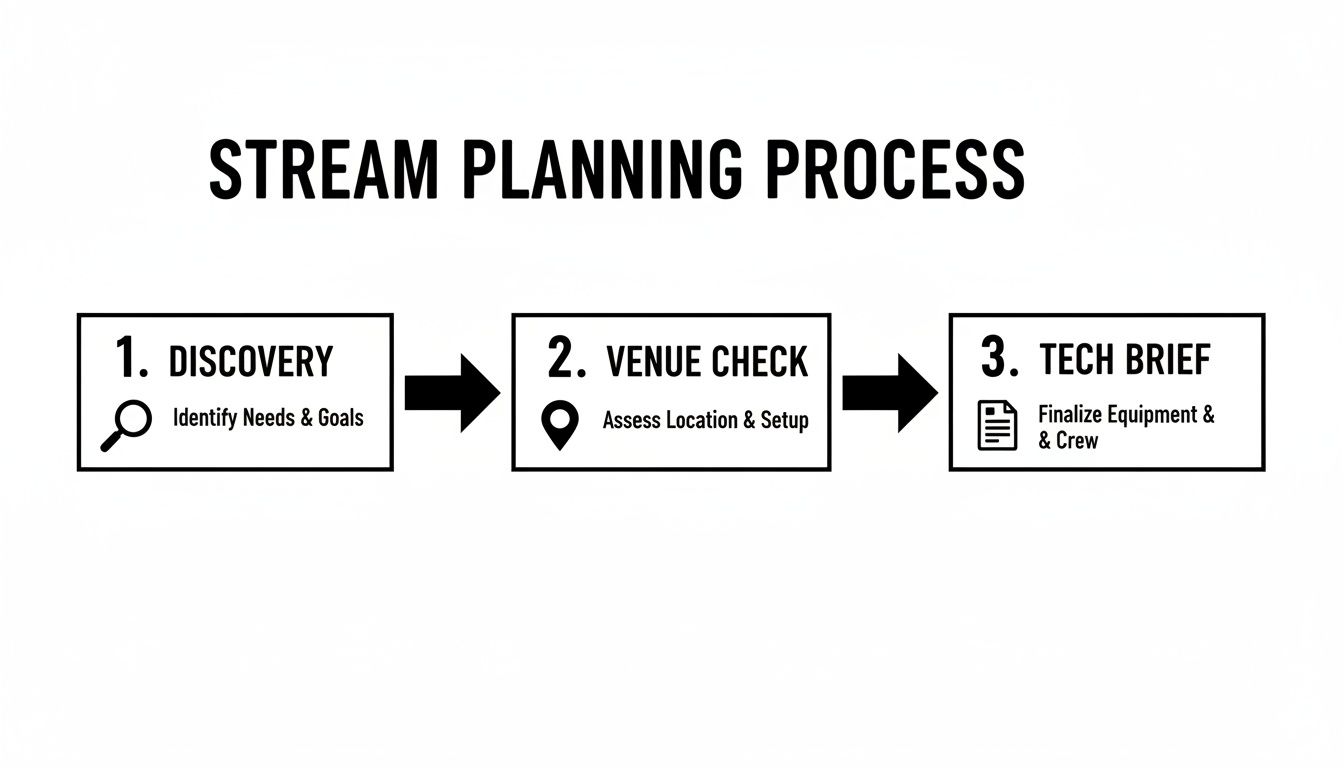
This is why we always start with a clear, methodical process. Everything from the initial discovery call to the venue check feeds directly into the final technical specification.
Deconstructing the Professional Signal Flow
Many people think live streaming is just a camera plugged into a laptop. For a professional event, this is incorrect. We build what is called a signal flow: a carefully engineered chain of equipment designed to capture, mix, and broadcast everything without a single point of failure.
Think of it as the central nervous system of your broadcast. It ensures every video and audio source is perfectly synchronised, managed, and encoded into one stable stream for your audience.
-
Multi-Camera Setups: We almost always use multiple broadcast cameras. This allows for dynamic storytelling. We can cut from a wide shot of the stage to a close-up of the speaker, then to an audience reaction. Each camera provides a separate "feed," giving us creative options.
-
Vision Mixer: This is the heart of the video operation. All camera feeds, presentation slides, pre-recorded videos, and graphics are routed into a vision mixer. A dedicated operator, the Vision Mixer, cuts between these sources in real-time, creating the polished programme everyone sees online.
-
Audio Capture and Mixing: Clear, crisp audio is non-negotiable. We use specific microphones for specific jobs: lapel mics for speakers, lectern mics for presentations, and room mics to capture audience applause. All these signals go to a sound desk, where an engineer balances the levels for perfect clarity.
-
Encoder: This is the last and most critical link in the chain. The encoder is a dedicated piece of hardware or software that takes the final mixed video and audio, then compresses it into the right format for streaming online. We never rely on a laptop’s built-in capabilities for this.
A live stream is only as strong as its weakest link. A professional signal flow is meticulously designed to have no weak links, ensuring every element, from the camera lens to the viewer's screen, is robust and reliable.
The Key Roles On-Site
The technology is only half the story. It is the experienced crew that makes a live stream feel effortless. A professional team works with calm precision, anticipating problems and managing the broadcast without issue. If you are curious about the equipment itself, our guide dives into what audio visual equipment means in a professional context.
Here are the essential people you should expect to see on-site:
-
Technical Director (TD): The TD is the captain of the ship. They oversee the entire technical crew, call the camera shots for the Vision Mixer, and are the primary problem-solver if anything unexpected happens.
-
Vision Mixer: This is the person with their hands on the mixing desk. Their skill is about rhythm and timing, cutting between cameras and graphics to create a broadcast that is visually engaging and easy to watch.
-
Sound Engineer: This specialist focuses on audio. They are responsible for making sure every word is heard clearly, managing all the microphones, and eliminating potential issues like feedback or distracting background noise.
-
Camera Operators: A professional camera operator does much more than point a camera. They are responsible for smooth movements, perfect framing, and keeping everything in sharp focus. They make the broadcast look excellent.
Choosing Your Live Streaming Platform
The destination for your stream is a major decision that affects everything from security and branding to viewer analytics. While platforms like YouTube and Vimeo both deliver video, they are fundamentally different tools built for very different purposes.
Here is a quick breakdown to help you understand the landscape.
Choosing Your Live Streaming Platform
| Platform | Best For | Key Security Features | Branding & Customisation | Typical Use Case |
|---|---|---|---|---|
| Vimeo | High-quality corporate events and internal communications | Password protection, domain-level privacy, AES encryption | Customisable player, branding removal, lead generation forms | Secure all-hands meetings, paid virtual conferences, premium product launches |
| YouTube Live | Maximum public reach and audience discoverability | Public, unlisted, or private stream settings | Channel branding, custom thumbnails, live chat moderation | Brand activations, public-facing announcements, community engagement |
| Custom RTMP | Direct integration with bespoke platforms or event websites | Dependent on the destination platform's capabilities | Fully customisable within the destination environment | Streaming to a custom-built virtual event portal or company intranet |
Ultimately, choosing the right platform means matching its features to your event's goals. For a confidential internal town hall, a secure platform like Vimeo is the obvious choice. For a major brand launch where you want maximum visibility, the reach of YouTube is hard to beat.
Executing a Flawless Live Broadcast
When the event day arrives, all the meticulous planning must pay off. Success is no longer about strategy; it is about process, precision, and the calm expertise of the on-site crew. Executing a flawless live broadcast is a methodical exercise in managing variables and having a solid plan for any potential issues.
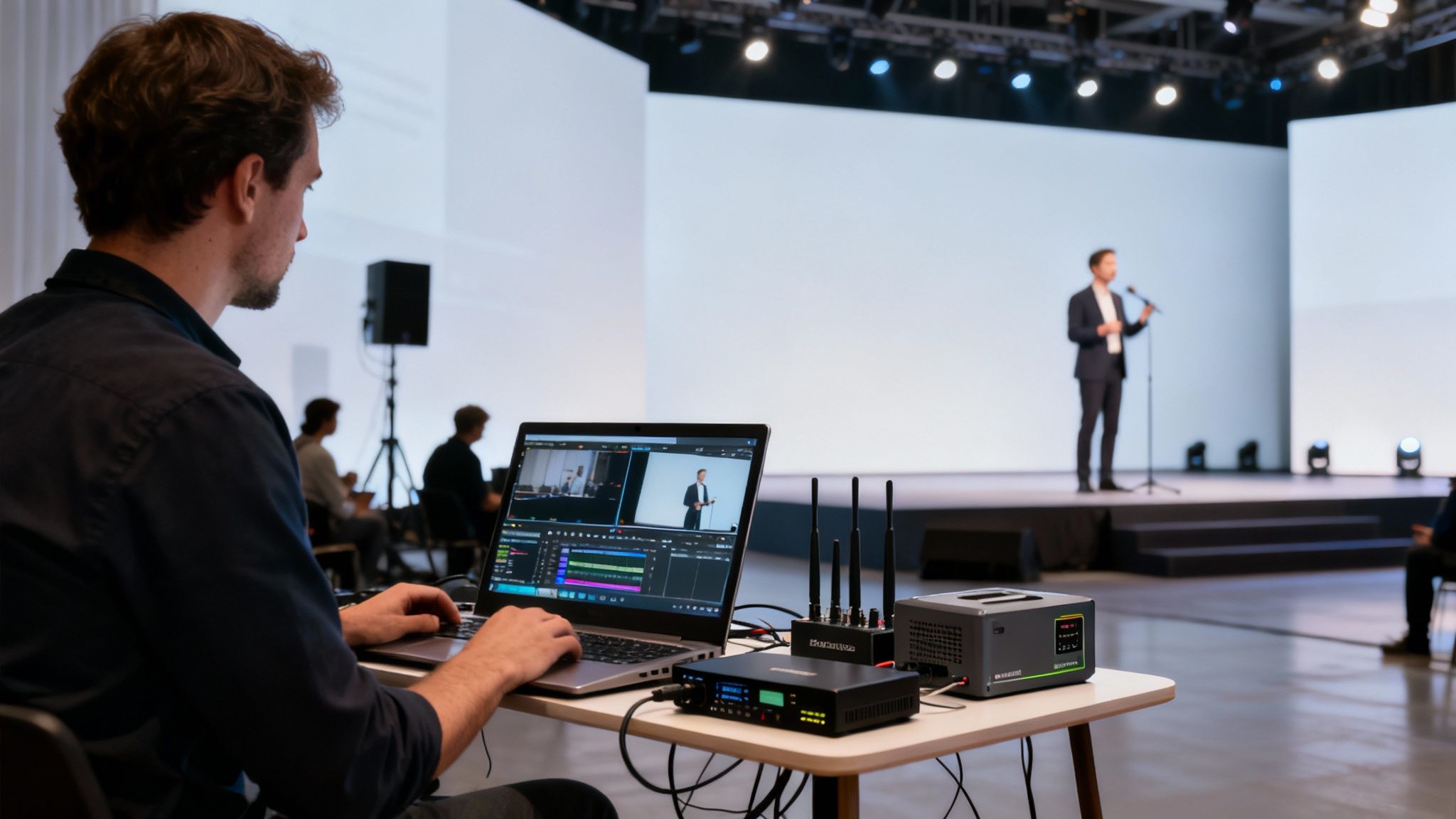
This is where experience is vital. A professional team does not just turn up and start plugging in equipment. They arrive with a detailed run sheet, a clear communications plan, and an unwavering focus on delivering a seamless experience for everyone, from the presenters on stage to the audience watching online.
The Power of Technical Rehearsals
There is no substitute for a full technical rehearsal. It is the single most important step in guaranteeing a smooth live broadcast and is a non-negotiable part of our process. This is where theory meets reality, allowing us to resolve any issues long before the audience tunes in.
A proper rehearsal is much more than a quick microphone check. We run through every element of the show:
- Presenter Run-Throughs: Each speaker gets a chance to become comfortable on stage, test their slides, and get a feel for the setup. It helps to calm nerves and ensures they know exactly what to expect.
- Camera and Audio Checks: We meticulously check every camera angle for perfect framing and focus. We then fine-tune every microphone to deliver crystal-clear audio without any feedback or interference.
- Full Signal Path Test: We push the complete programme feed (video, audio, and graphics) all the way from the cameras through to the live streaming platform. This confirms the entire technical chain is solid from end to end.
This process is critical for building confidence. When the client and presenters see a polished rehearsal, they can relax, knowing the technical side is in safe hands.
Building Robust Redundancy and Contingency Plans
Professional live streaming is about preparing for what could go wrong, not just hoping it will not. Redundancy is the bedrock of a reliable broadcast, so we build multiple layers of protection into every setup to ensure the stream stays live, no matter what.
This safety-first approach means having backups for all critical components:
- Bonded Cellular Connectivity: We never rely solely on a venue's internet. We use bonded cellular technology, which combines multiple 4G/5G mobile networks into a single, ultra-reliable backup connection. If the venue's line drops, our system switches over instantly.
- Dual Encoders: The encoder is the heart of the stream, so we always run two identical encoders in parallel. If the primary one fails, the backup takes over with zero interruption to the broadcast.
- Uninterruptible Power Supplies (UPS): Every piece of essential equipment, from the vision mixer to the encoders, is plugged into a UPS. This battery backup protects against power dips or even a complete outage, buying us precious time to switch to a generator if needed.
A professional crew does not panic when issues arise; they simply execute a pre-planned solution. This level of contingency planning is the difference between a minor hiccup and a broadcast-ending disaster.
Live Monitoring and Audience Interaction
Once we are live, our focus shifts to monitoring and quality assurance. A dedicated technician will watch the public-facing stream on multiple devices (a laptop, a tablet, a smartphone) to ensure the viewer experience is perfect across the board.
Managing audience interaction is another crucial part of the job. For events with a Q&A, a moderator will manage incoming questions, filtering them for relevance and feeding the best ones to the presenter or host. This keeps the segment organised and engaging.
This level of audience participation is a huge driver for virtual attendance, mirroring trends seen in other live formats. The appetite for live sports streaming in the UK, where 82% of internet households tuned into a live sports event last year according to S&P Global Market Intelligence's latest UK consumer insights survey, shows the public's strong preference for real-time, interactive content.
From detailed run-throughs to failsafe technical backups, every step is designed to deliver a smooth, professional broadcast. This meticulous approach to conference production is what ensures that on the day, your event is nothing short of flawless.
What to Do When the Stream Ends: Maximising Your Content's Value
The moment your live stream broadcast finishes is not the end. It is the start of your content’s real journey. The high-quality recording you have captured is a serious digital asset, and a smart post-event plan will extract maximum value from your initial investment.
Leaving that recording in an archive is a missed opportunity. Think of it instead as the raw material for a content campaign that can keep your audience engaged, generate new leads, and reinforce your key messages for weeks or even months.
Turning Your Live Stream into On-Demand Content
First, make the full recording available as an on-demand video. This immediately serves anyone who could not attend the live session and lets original attendees revisit interesting parts. Ensure it is edited cleanly with professional title cards and your branding.
The real value comes from breaking the content down. After your event, do not let your live stream recording sit idle. Discover how to effectively leverage content repurposing strategies to extend its reach and maximise its value.
- Craft a Highlight Reel: Extract the most powerful 2-3 minutes of the event. This could be the final conclusion from your keynote speaker or a lively moment from a panel debate. This becomes your go-to video for your website's homepage or a showreel for promoting future events.
- Create Clips for Social Media: Slice the stream into bite-sized, 30-60 second clips. Each one should focus on a single, compelling idea, a memorable quote, or a great audience question. These are perfect for starting conversations on LinkedIn, X (formerly Twitter), and other social channels.
- Produce Topic-Specific Segments: If your stream covered several different themes, edit each one into its own standalone video. A single 90-minute conference session could become three 30-minute deep-dive videos, instantly building out your library of expert content.
The goal is content atomisation. One live stream can fuel your marketing channels for an entire quarter if you approach it with a repurposing mindset from the beginning.
Analysing Your Data
Your streaming platform’s analytics dashboard is a valuable source of information. While it is easy to fixate on the total view count, the real strategic insights lie deeper.
Here are the metrics to focus on:
- Average Watch Time: This tells you how long you held people's attention. A consistently low watch time may indicate that your content is not engaging or your sessions are too long.
- Audience Engagement Peaks and Dips: Look for moments that generated interaction in the chat or responses to polls. Equally important are the points where you see a significant drop-off in viewers. This is invaluable feedback for shaping the agenda of your next event.
- Geographical Reach: Knowing where your audience is based helps you tailor marketing and content for future events, making it more relevant to specific regions.
A data-driven approach is essential. Audiences, especially in the UK, are sophisticated viewers. They have high expectations for both live and on-demand video.
Post-Event Administration: Accessibility and Compliance
Finally, ensure your on-demand content is accessible to everyone. Providing accurate captions or a full downloadable transcript not only opens up your content to people with hearing impairments but also provides SEO benefits.
On the compliance front, always keep data protection regulations like GDPR in mind, especially if you collected audience data through registrations or interactive tools during the stream.
By treating the live stream as the launchpad, not the landing, you turn a one-day event into an asset that continues to provide value. At London Audio Visual Hire, we work with our clients to do more than just broadcast; we help build a content strategy that delivers demonstrable value long after the cameras are packed away.
Your Live Streaming Questions, Answered
When planning a professional live stream in London, many questions arise. Here are direct answers to some of the most common ones we hear from our corporate and agency clients.
How Much Internet Speed Do We Really Need?
For a solid high-definition (1080p) stream, you need a dedicated, wired internet connection with a stable upload speed of at least 10-15 Mbps. The emphasis is on upload speed, which sends your video out to the world and is often much lower than the download speed a venue advertises.
A proper site visit is non-negotiable. We will rigorously test the venue's connection to determine its actual capabilities. We also never rely on a single connection. We always bring backup solutions, like bonded 4G/5G cellular units, to create a seamless failover if the primary line has an issue.
Is This a Webinar or a Live Stream?
The two are very different. A webinar is usually a simple affair, often involving one person speaking to their laptop camera. It is functional for a quick training session but is not a brand-building experience.
A professional live stream, on the other hand, is a full production. This involves multiple broadcast-quality cameras for different angles, proper lighting, and crystal-clear audio from high-fidelity microphones. Behind the scenes, a technical crew is switching between cameras, playing videos, and adding graphics, much like a live TV show. It is all about creating a polished, engaging broadcast that reflects the quality of your brand.
Can We Keep an Internal Stream Private?
Absolutely. Keeping internal communications secure is paramount. Professional streaming platforms are built for this and offer several layers of protection to secure your content.
Here is how we do it:
- Password Protection: Simple but effective. Only people with the password can access the stream.
- Domain Gating: We can restrict the video player so it only works on approved domains, like your company's intranet.
- AES Encryption: This is the industry standard for scrambling the video signal as it travels across the internet, making it unwatchable to anyone who might intercept it.
We will help you choose a platform that meets your IT department's security requirements, so your confidential information remains that way.
How Far Ahead Do We Need to Start Planning?
For a standard multi-camera production, allow at least four to six weeks. This provides the time needed for proper discovery, venue checks, technical planning, and aligning all key stakeholders.
If you are considering a simple, single-camera stream, two or three weeks can sometimes be sufficient. However, the earlier you involve a production partner like London Audio Visual Hire, the better. It removes stress from the process and allows us to finalise every detail for a perfect broadcast.
Engaging your technical partner early is the single best way to de-risk your event. It transforms the process from a last-minute scramble into a calm, controlled, and collaborative journey towards a successful live broadcast.
At London Audio Visual Hire, we specialise in meticulous planning and flawless technical execution for corporate events. If you are planning a live stream and need expert guidance, get in touch to discuss how we can help. Find out more at https://londonaudiovisualhire.co.uk.


