
Effective branding at events is about more than placing a logo on a banner. It involves creating an immersive experience that resonates with attendees long after the event concludes. This is how you transform a physical space into a powerful brand statement, shaping perception and driving genuine engagement.
Why Strategic Event Branding Matters
In the UK’s competitive events landscape, a meticulously planned brand presence is essential to stand out. The right strategy is the difference between being a forgotten exhibitor and becoming a key talking point.
The objective is to create a multi-sensory environment. Every element, from the lighting that sets the mood to the dynamic content on a video wall, must work in concert to tell a cohesive brand story.
Building Lasting Connections
Successful event branding builds an emotional connection with your audience. People remember how an experience made them feel, and a positive feeling towards your brand can foster customer loyalty. In a crowded market, this connection is a significant advantage.
The data supports this. A significant 85% of participants are more inclined to buy from a brand after engaging with them at a live event. Furthermore, 91% report feeling more optimistic about the company itself, demonstrating the impact of a positive, tangible experience.
Research has also shown that 64% of consumers retain positive impressions of brands they have encountered at live events, proving these interactions have lasting power.
Driving Business Objectives
Beyond creating a positive atmosphere, strategic branding is a practical tool for achieving core business goals. The power of strategic event branding is evident in marketing and promotion, helping you captivate audiences and create memorable moments. For more detailed guidance, it is worth exploring these comprehensive event marketing and promotion strategies.
A well-branded event can achieve several objectives:
- Generate qualified leads: Interactive touchpoints and clear messaging attract the right attention.
- Boost brand awareness: A consistent and memorable presence ensures you are not just seen, but remembered.
- Educate attendees: Immersive demonstrations and presentations can simplify complex products or services.
Ultimately, every audio visual element becomes a storytelling tool. By working with an experienced partner like London Audio Visual Hire, you can transform these tools into the fabric of your event’s identity.
Laying the Groundwork for Your Event Brand
Effective event branding is the result of a carefully considered plan, a blueprint that guides every creative and technical decision. Before considering a single spotlight or LED screen, it is crucial to build this strategic foundation. It ensures every element works together to create a cohesive brand experience.
The process begins with clarifying your objectives. What, precisely, do you need this event to achieve? Are you focused on generating a specific number of sales-qualified leads? Perhaps the goal is to increase brand awareness in a new market, or to educate loyal customers about a new product. Defining these objectives is the most critical first step.
Charting the Attendee's Experience
Once your goals are set, you need to map the entire attendee journey, from their first point of contact to the final follow-up communication. This involves choreographing their experience with your brand.
- Before the Doors Open: Consider their first impression. This includes the initial invitation, the design of the registration page, and the tone of your social media communications.
- On the Day: From the welcome desk and directional signage to the main stage design and networking areas, every physical space is a branding opportunity.
- After the Event: Plan how to continue the conversation. This includes thank-you emails, feedback surveys, and the distribution of on-demand content.
Mapping this journey allows you to see the event from their perspective, helping you to weave a consistent brand narrative through every interaction.
Bringing Your Brand's Personality to Life
With the journey mapped, the next step is to translate your core brand identity into a distinct event theme. This extends beyond using your logo and corporate colours; it is about capturing your brand's essence. Are you innovative and futuristic? Trustworthy and traditional? Luxurious and exclusive?
This theme directs all creative decisions. It informs the colour palette for the lighting design, the motion graphics on video walls, and the text on welcome banners. For outdoor events, elements like well-chosen tents for trade shows must align with this theme. Even a temporary structure should feel like an extension of your brand.
For those looking to take this blueprint from concept to reality, working with a professional brand activation team can be invaluable. They have the expertise to execute your vision precisely.
As this process flow illustrates, a solid plan is what turns branding efforts into measurable ROI by shaping perception and driving engagement.
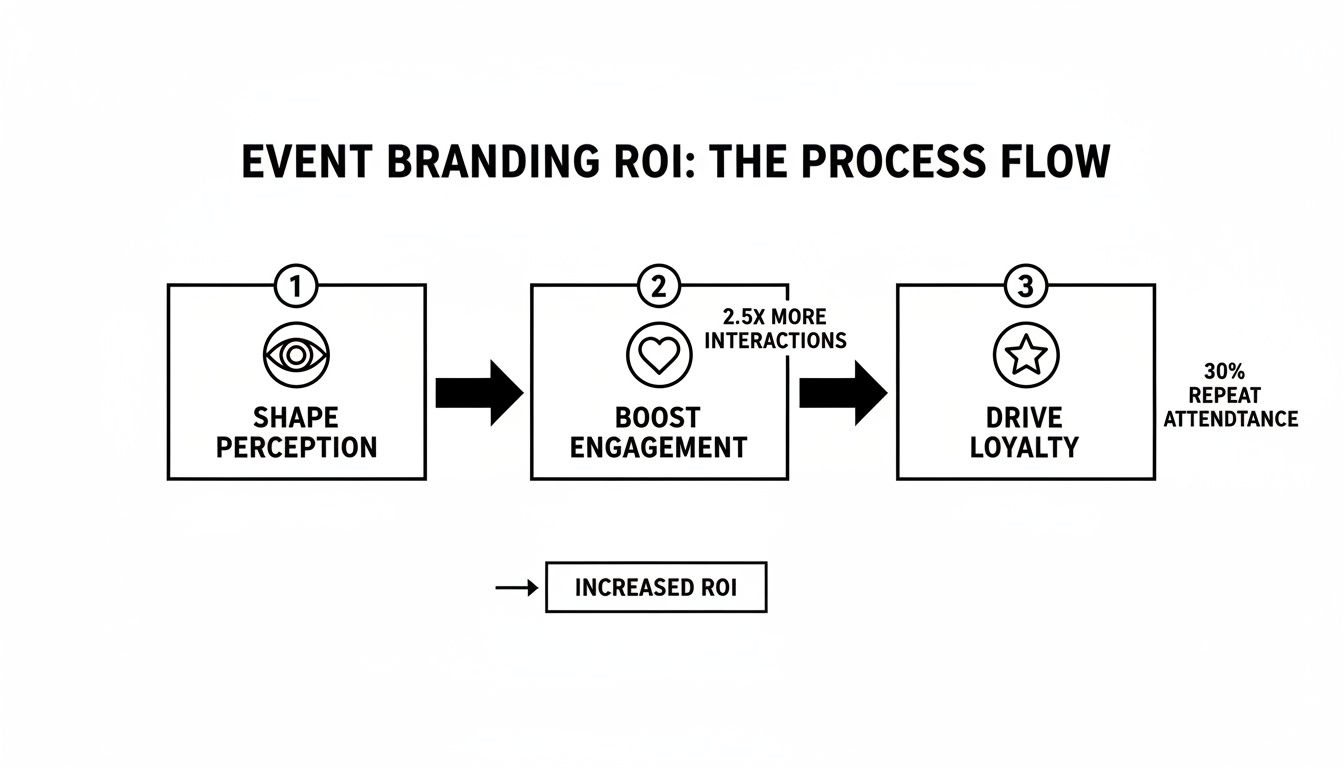
This demonstrates that successful event branding is a deliberate process. Each step builds on the last, leading directly to tangible business results, all starting with that foundational blueprint.
Strategic Branding Approaches by Event Type
The optimal branding strategy is not universal. The type of event you are hosting significantly influences your primary goals and the AV tools required to achieve them. A product launch has different needs compared to an internal company conference.
The table below outlines how to approach branding for different event types, highlighting the AV tactics that deliver the most impact.
| Event Type | Primary Branding Goal | Key AV Tactic | Success Metric |
|---|---|---|---|
| Product Launch | Generate excitement & media buzz | Dynamic video walls, projection mapping | Social media mentions, press coverage |
| Trade Show/Expo | Attract footfall & capture leads | Interactive touchscreens, bright LED signage | Number of booth scans, qualified leads |
| Corporate Conference | Reinforce company culture & vision | Branded stage set, consistent digital signage | Employee feedback, post-event survey scores |
| Gala/Awards Night | Create a prestigious, luxury feel | Gobo lighting with logos, atmospheric uplighting | Attendee social posts, sponsor satisfaction |
| User Conference | Foster community & loyalty | Live streaming, networking app integration | App engagement, repeat attendance |
This comparison shows how crucial it is to align your AV choices directly with your event's core purpose. The right technology not only enhances aesthetics but also actively contributes to achieving key performance indicators.
Using AV to Create Immersive Brand Worlds
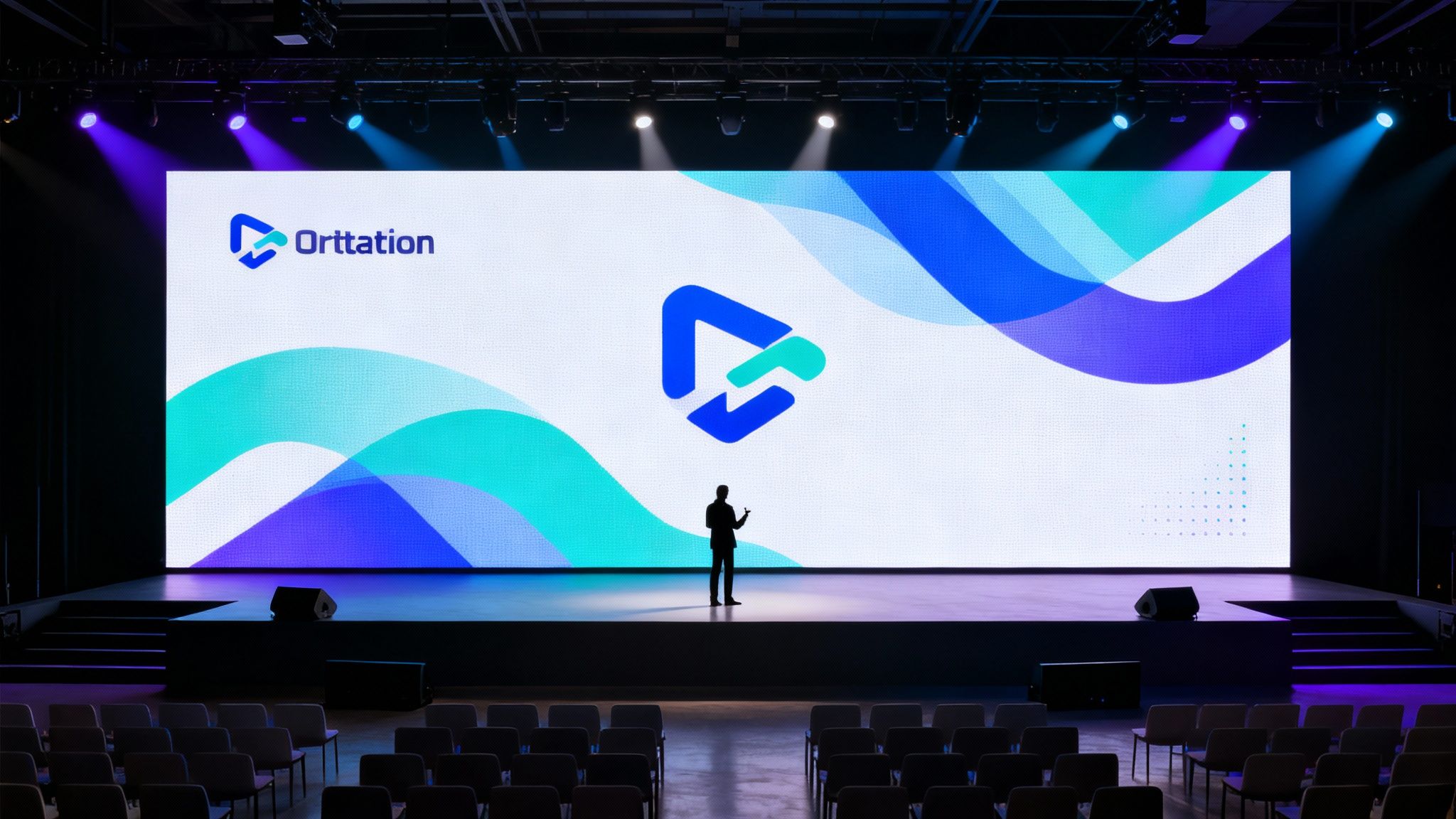
This is where your strategic blueprint becomes a tangible, sensory reality. Effective event branding relies on using audio-visual (AV) technology as more than just functional equipment. It is a creative toolkit for building immersive environments.
By thoughtfully integrating light, sound, and video, you can transform any generic venue into a powerful expression of your brand’s personality. The aim is to move beyond static banners and create an active, engaging experience. Every technical choice should serve a branding purpose, building a cohesive atmosphere that attendees experience from the moment they arrive.
Illuminating Your Brand Identity
Lighting is one of the most powerful and versatile tools in a branding arsenal. It instantly sets the mood, directs attention, and can wash an entire space in your brand’s colour palette. This goes beyond displaying a logo; it makes attendees feel as though they have stepped inside your brand's world.
Here are a few effective techniques:
- Colour Washing: Using LED uplighters to bathe walls, columns, and ceilings in your primary brand colours is a highly effective way to create an immediate, powerful atmosphere.
- Custom Gobos: A gobo is a stencil placed inside a light to project a pattern or image. It is an ideal way to display a crisp, high-impact brand logo on a feature wall, floor, or building exterior.
- Intelligent Lighting: Programmable fixtures can create dynamic effects, such as subtle movement during networking or high-energy sequences to introduce a keynote speaker. This keeps the visual environment fresh and engaging.
When used together, these techniques can turn a venue’s architecture into a living extension of your brand.
Dynamic Messaging with Video Displays
Static signs have their place, but dynamic content on high-resolution video displays commands attention and offers great flexibility. LED video walls have become a cornerstone of modern event design, providing a bright, seamless canvas for high-impact branding.
A large LED wall behind the main stage can serve multiple purposes. It can act as a branded digital backdrop for speakers, display sponsor logos, or play brand videos during breaks. If you are new to the technology, it is useful to understand what is audio visual equipment to appreciate the possibilities. This flexibility ensures your messaging remains relevant throughout the event.
By integrating dynamic video, you are creating a central communication hub that reinforces key messages and maintains a consistent look. The stage becomes the narrative heart of your brand experience.
Consider locations beyond the main stage. Strategically placed digital signage screens throughout the venue are effective for branded wayfinding, displaying session schedules, or sharing a live social media feed with your event hashtag. This creates a digital thread that guides attendees while constantly reinforcing your brand.
Engaging the Senses with Audio and Interactivity
Visuals are only half the story. High-quality audio is fundamental. Your message must be heard and understood. Visually impressive events can be undermined by poor sound, leading to frustration and disengagement. Professional-grade microphones, speakers, and sound mixing ensure every speaker is heard with clarity and impact.
Beyond sound, interactive technology facilitates direct engagement, turning passive attendees into active participants. Consider touchscreen displays for on-demand product information, digital agendas, or interactive games that capture valuable lead data. This hands-on approach forges a more personal and memorable connection with your brand than a static display can.
Coordinating With Venues and AV Partners
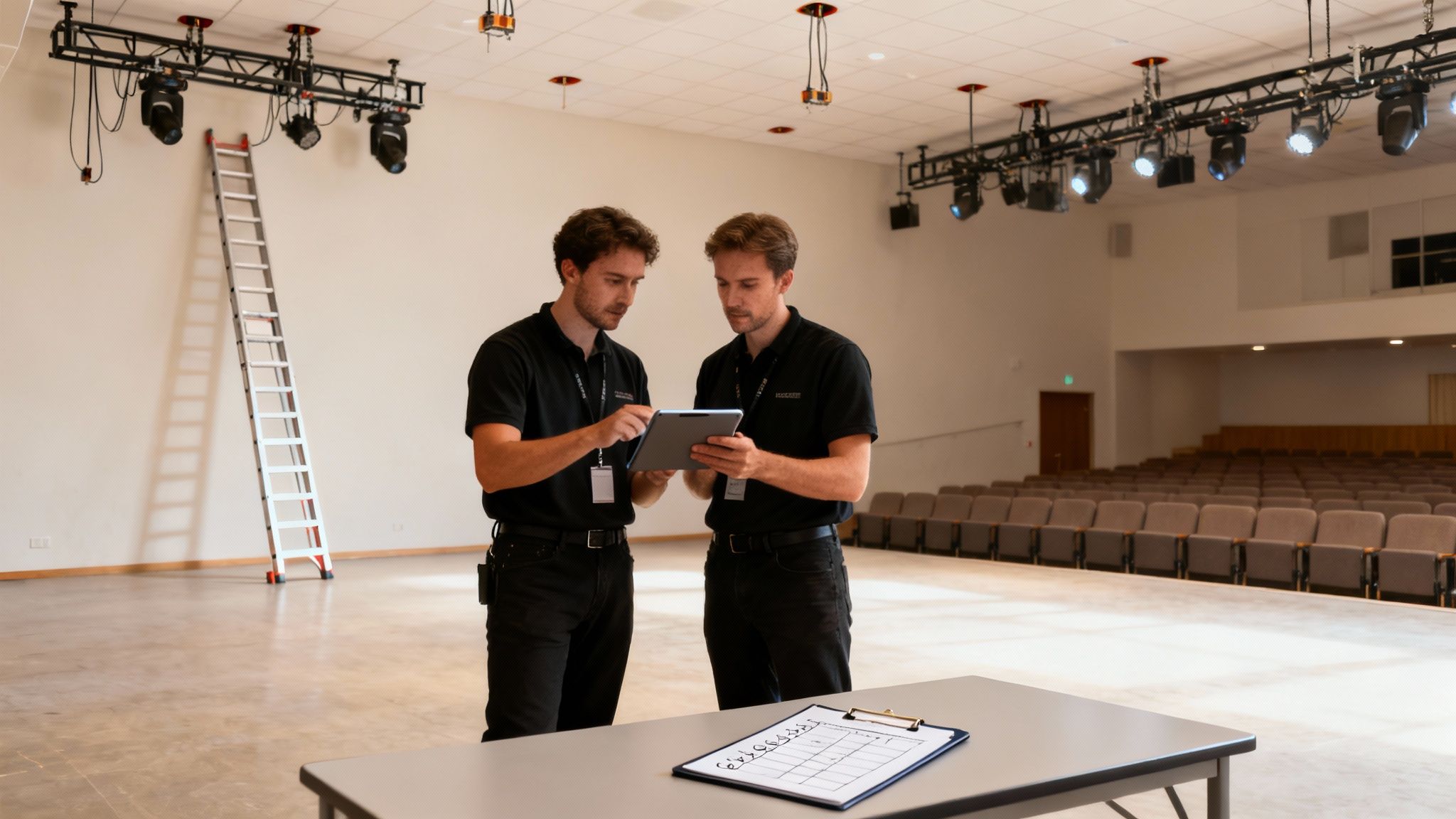
Effective event branding depends on a strong partnership between your team, the venue, and your AV provider. This is the foundation for a smooth execution. When these three parties are not synchronised from the outset, you risk last-minute complications.
Your creative vision is the 'what', but it is entirely dependent on the 'where' and the 'how'. Even the most brilliant branding concept is only an idea until it fits the physical and technical realities of the venue. A skilled AV partner acts as the essential intermediary, translating your brand blueprint into a technical specification that the venue can deliver.
The All-Important Technical Site Visit
Never skip the technical site visit. It is one of the most critical steps in the planning timeline. Arrange for your AV project manager and key venue staff to walk through the space together. The goal is to identify potential problems before they arise.
This is not a casual tour; it is a detailed technical assessment. For instance, an ambitious lighting rig is unfeasible if the ceiling lacks sufficient certified rigging points or cannot bear the weight. Interactive displays will be useless if the venue’s power grid cannot handle the load.
A site visit is about proactive problem-solving. It is far better to adjust a design three months in advance due to a power issue than to discover it during setup.
This single meeting aligns your creative ambitions with the venue’s real-world capabilities, saving you from significant stress and unexpected costs.
Asking the Right Questions: Your Technical Checklist
Effective communication is built on asking the right questions. Before finalising any technical plans, you need clear answers from both the venue and an AV provider like London Audio Visual Hire. To see how different spaces accommodate various AV setups, it is helpful to explore a portfolio of partner venues to understand what is possible.
Here are the non-negotiable points to cover:
- Power Supply: What is the total available amperage? Do they provide 3-phase power, and where are the connections? Is bringing a generator possible or necessary?
- Rigging Capabilities: Request a detailed rigging plot. Where are the certified points, and what are their individual and total weight limits?
- Internet and Connectivity: What is the dedicated bandwidth? Is it a shared network? A hardwired connection is essential for critical functions like live streaming.
- Loading and Access: What are the exact dimensions of the loading bay doors and goods lift? What are the time restrictions for load-in and load-out?
- Venue Restrictions: Are there any noise curfews or decibel limits? What is the policy on haze or smoke machines? Are there any protected or heritage features that must not be altered?
Clarifying these details early ensures your branding at events is implemented correctly, safely, and in compliance with all venue regulations.
Measuring the Impact of Your Event Branding
After investing time, effort, and budget into your event branding and AV integration, how do you prove its value? To justify the expenditure and inform future decisions, you must look beyond simple attendance figures. The real value lies in Key Performance Indicators (KPIs) that connect your event to tangible business results.
Defining how to measure success is not an afterthought; it should begin at the planning stage. You must establish what a successful outcome looks like for your specific event. Whether your aim is to generate leads or boost brand awareness, this goal shapes the data you need to collect. The objective is to translate broad objectives into concrete metrics that stakeholders and finance teams can understand.
Defining Your Measurement Framework
To gain a true sense of your return on investment, you need to examine both quantitative data (the ‘what’) and qualitative feedback (the ‘why’). This mixed approach provides a complete picture of how your branding at events was received by your audience.
Here are some core areas to focus on:
- Social Media Engagement: Look beyond the number of times your event hashtag was used. Analyse the sentiment of the posts. Are people expressing excitement? Are relevant industry influencers sharing your message?
- Brand Recall and Sentiment: This is crucial. Send a post-event survey with direct questions. "Which three brands do you remember most from the event?" is a good starting point. Follow up with, "How did the event change your perception of our brand?" This feedback is invaluable.
- Lead Quality: Not all leads are equal. Analyse the data captured from interactive displays, app polls, or digital kiosks. The most important metric is tracking how many of these leads convert into genuine sales opportunities post-event.
Gathering and Analysing the Data
Data collection must be proactive. Send post-event surveys within 24 hours, while the experience is still fresh in attendees' minds, to improve response rates. A small incentive, such as a discount code or a link to an exclusive presentation, can increase completion rates.
For social media, use a monitoring tool to track your hashtag and analyse sentiment automatically. This saves time and provides clean data for your report. For leads, ensure your event technology is integrated with your company's CRM system from the start.
The ultimate goal is to connect the dots between your branding efforts and business outcomes. A report showing that 40% of high-quality leads engaged with a specific branded interactive display provides a powerful, data-backed justification for the investment.
The final step is to present this data as a clear, compelling story. A report that demonstrates business value not only proves the success of your last event but also builds a strong case for securing the budget for future, more ambitious projects.
Stumbling Blocks: Common Branding Blunders and How to Sidestep Them
Even with a detailed plan, common branding mistakes can occur. Understanding these potential pitfalls is the best way to ensure your investment achieves a powerful, lasting impression. Effective branding at events is about consistency and relevance, not simply being the loudest voice.
Mixed Messages and Brand Confusion
One of the quickest ways to lose your audience is through inconsistent messaging. A disjointed experience, where different areas of the event have conflicting aesthetics or tones, looks unprofessional and weakens your brand identity.
The solution is to create a dedicated brand guide for the event. This document should be the single source of truth for everyone involved, from your AV crew at London Audio VIsual Hire to the caterers. It ensures everyone uses the correct logos, colour palettes, and key phrases, weaving a single, strong narrative throughout the event.
The 'More is More' Trap
Another common error is overwhelming the audience. In an effort to make an impact, it can be tempting to use loud music, constant motion graphics, and bright, flashing lights simultaneously. This sensory overload often causes people to disengage.
The key is to use pacing and contrast, like a film director. Design different zones with distinct energy levels. For example, a high-impact entrance with dynamic visuals can lead to a more relaxed networking space with softer lighting and ambient background audio.
The goal is to guide the attendee's experience, not assault their senses. Smart event design uses AV to create focus, drawing attention to key messages and using moments of quiet to enhance the impact of more dynamic elements.
This strategic approach makes your brand feel confident and deliberate, not chaotic.
When Tech Doesn't Match the Talk
A significant pitfall is choosing technology that does not align with your brand's personality. For instance, a luxury brand known for heritage and craftsmanship using gimmicky, futuristic touchscreens can feel incongruous. Technology should support your story, not become the story itself.
To avoid this mismatch, always return to your core brand values. Before committing to any piece of AV equipment, ask, "Does this reinforce who we are?"
- If you are a tech-forward brand: Interactive projection mapping and large-scale data visualisation walls will feel appropriate.
- If you are an eco-conscious brand: Focus on energy-efficient LED screens and use digital signage to reduce print waste, tangibly demonstrating your values.
- If you are about personal connection: High-quality audio for intimate talks and warm, inviting lighting may be more effective than a large, impersonal video wall.
By ensuring every technical decision reflects your brand’s identity, the entire event will feel authentic and cohesive. Your guests will leave with a clear understanding of who you are and what you represent.
Got Questions About Event Branding? We’ve Got Answers
Here are some of the most common questions we receive about event branding, along with practical advice based on our industry experience.
How Far Out Should I Start Planning the Branding?
For any major event like a conference or large-scale product launch, you should begin planning your branding and AV integration at least three to six months in advance. The earlier, the better.
This lead time allows for proper strategy development, creative ideation, and securing the right technical partners and equipment. Rushing this process often leads to oversights and compromises.
For smaller events, a one to two-month window can be sufficient. However, allowing more time is always advisable to avoid last-minute issues and deliver a polished, professional event.
What's the Smartest Way to Brand a Hired Venue?
When you do not own the space, the objective is to make a significant impact without leaving a permanent mark. The solution is to use high-impact, non-destructive AV solutions to transform a room.
Here is what we find works effectively:
- Intelligent Lighting: This is your most versatile tool. Use modern LED fixtures to wash walls, ceilings, and architectural features in your brand colours to instantly change the atmosphere.
- Custom Gobos: Projecting a sharp, clean version of your logo or a branded pattern onto a floor, stage, or prominent wall is a classic and effective technique.
- Freestanding LED Video Walls: These are excellent for creating a dynamic focal point. You can build a backdrop for your main stage or a welcome display in the entrance, running content from brand stories to sponsor loops.
How Do I Get Attendees to Actually Engage with the Branding?
To create memorable moments, your branding should be interactive. Encourage people to touch, play, and participate. Consider installing touchscreen displays where guests can browse the agenda or explore product specifications. A live social media wall, displaying posts with your event hashtag, is an excellent way to build a sense of community.
You could also run live polls or quizzes on the main screens to involve everyone. For a "wow" factor, look into interactive projection mapping. A floor that reacts to footsteps or a wall that comes alive with branded content is the kind of experience people remember and share online.
Ready to build an experience that truly brings your brand to life? The team at London Audio Visual Hire specialises in turning creative vision into technical reality. Get in touch today and let's talk about your next event.