

Securing the right technical support is a critical step in your event planning. The success of your event hinges on a successful AV technician hire, and that process begins with a clear understanding of your own needs. A detailed brief is not just a document; it is the foundation for a flawless production, ensuring every light, sound, and screen works in perfect harmony with your vision.
Matching Your Event Needs with the Right AV Expertise
Before you can find the right person for the job, you need to translate your event concept into a concrete list of technical requirements. This is more than a simple checklist. It is about anticipating challenges and knowing exactly what each piece of audio visual equipment is supposed to do. A vague request for "a screen and a mic" will not suffice for a professional UK event.
Consider the technical demands for different events. A corporate conference in a Canary Wharf hotel needs pristine audio for keynote speakers and seamless video switching for presentations on multiple screens. Here, the focus is on clarity and reliability.
Conversely, a product launch in a Shoreditch venue might require high-impact video walls, a powerful sound system, and dramatic lighting to create an immersive atmosphere. Each scenario calls for a different set of skills and equipment.
Defining Your Core AV Requirements
To build a brief that works, you need to break down your needs into the main AV categories. This methodical approach ensures you do not miss anything and gives potential technicians a clear picture of your requirements.
-
Audio Needs: How many people will be speaking at once? Do they need discreet lapel mics to move around, or will lectern mics be sufficient? Will you need a handheld microphone for audience questions? Then there is background music, video soundtracks, or even a live band, all of which require different mixing. Do not forget the venue itself; a large, reverberant hall is a different challenge entirely from a small, carpeted meeting room.
-
Visual Elements: What does your audience need to see? This could be as simple as a single projector for a slide deck or as complex as a large LED video wall for high-impact visuals. Will you be showing slides, pre-recorded videos, or live camera feeds? The size, brightness, and resolution of your screens must be appropriate for the venue and the ambient light.
-
Lighting Design: Lighting is more than just visibility. It sets the entire mood and directs the audience's attention. You might just need a basic stage wash to light up your presenters. Or, for something more dynamic, you could need brand-coloured uplighting, moving head lights for dramatic effect, or spotlights to pinpoint key speakers.
-
Streaming and Hybrid Components: If you are including a virtual audience, the technical brief becomes more extensive. You will need to confirm your streaming platform (such as Zoom or YouTube Live), determine how many cameras you need, and plan how to integrate any remote presenters. This requires a technician with specific expertise in live streaming, from vision mixing to troubleshooting broadcast issues in real time.
A well-constructed technical brief does more than just attract the right people; it is a vital planning tool. It forces you to think through the event's technical flow from start to finish, often flagging potential problems before they have a chance to happen.
By mapping all this out, you create a clear roadmap. This document is your power tool for communicating your vision, whether you are hiring a freelance technician or working with a full-service AV partner. For a deeper dive into the equipment itself, it is worth taking a moment to understand what audio visual equipment is. This background knowledge means you can ask the right questions and ultimately make the best hire for your event.
Understanding Different AV Technician Specialisations
The term ‘AV technician’ is a catch-all, which can be misleading. A common mistake event planners make is assuming any technician can handle any job. This is like asking a GP to perform brain surgery; they are both doctors, but you would not want them swapping roles.
To get your AV technician hire right, you must first be clear on what your event actually needs. For a gala dinner with a live band, you need a sound engineer who specialises in live music mixing and knows how to eliminate feedback. For a trade show stand with a large, interactive LED wall, you need a video technician who is an expert in media servers and content mapping. Knowing the difference is essential.
This flowchart can help you map your event's needs to the right kind of technical support.
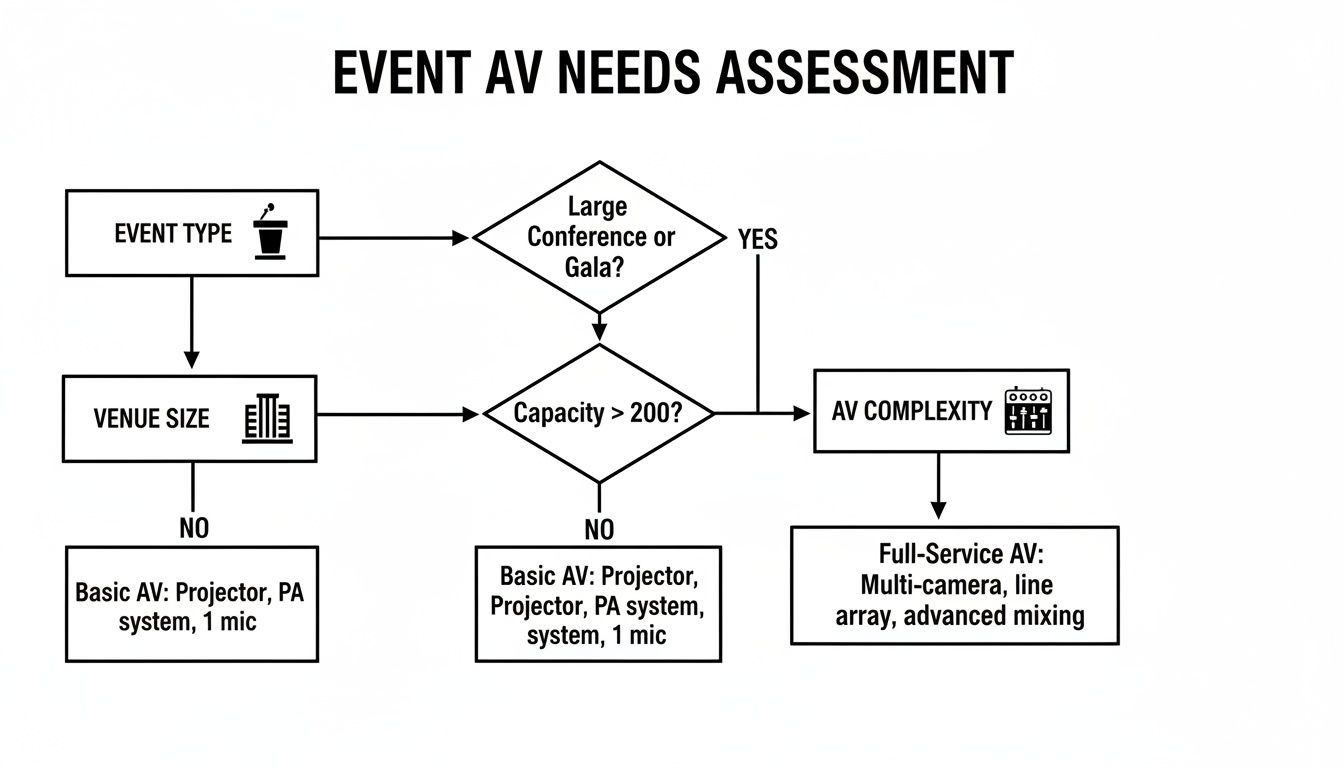
As you can see, a 'simple' event can quickly become complex. The moment you decide to add a live stream, for instance, you enter a new world of technical requirements. Understanding this is the first real step to building a team you can rely on.
Core AV Technician Roles Defined
Let us break down who does what. Understanding these specialisations will help you write a more precise brief and find the right person for the job. Large-scale events nearly always need several of these experts working together.
Here is a quick rundown of the most common AV technician roles you will encounter in the UK event scene.
AV Technician Roles and Key Responsibilities
| AV Technician Role | Primary Responsibilities | Essential for Events Like |
|---|---|---|
| Sound Engineer | Manages microphones, speakers, and mixing desks. Ensures clear audio for speakers and perfect balance for music. | Live music gigs, panel discussions, awards ceremonies, conferences. |
| Video Technician (VJ) | Sets up and operates projectors, LED walls, and screens. Switches between presentations, videos, and live camera feeds. | Product launches, exhibitions, corporate AGMs with complex visuals. |
| Lighting Technician (LD) | Designs and controls the entire lighting system to create mood, direct attention, and reinforce branding. | Gala dinners, fashion shows, large-scale conferences, live performances. |
| Streaming Technician | Manages the end-to-end live stream, from cameras and encoding to broadcast monitoring and remote presenter integration. | Hybrid conferences, virtual summits, global town halls. |
Each of these roles requires a unique set of skills. While there is some overlap, a true specialist brings a depth of knowledge that a generalist cannot match for high-stakes moments.
Differentiating Generalists from Specialists
Many technicians are multi-talented, but knowing when to insist on a dedicated specialist is crucial.
For a straightforward corporate meeting, think a projector, a screen, and a simple PA system for a presenter, a general AV technician is often perfect. They are versatile, resourceful, and great at troubleshooting a bit of everything.
However, the moment your event's success hinges on a specific, complex piece of technology, you absolutely need a specialist. If you are projection mapping onto a historic building, you do not just need a video technician; you need one with specific experience with that exact software and hardware. Broadcasting a high-profile conference to a paying virtual audience demands a dedicated streaming engineer who is comfortable in that high-pressure environment. For a flawless virtual experience, it is worth exploring expert guidance on planning a hybrid streaming event.
The key is to identify the technical heart of your event. What is the one element that has to be perfect? If it is the audio for a keynote speaker, put your energy into finding a seasoned sound engineer. If the 'wow' factor comes from the visuals, a brilliant video technician should be your priority. By pinpointing your event’s technical centre of gravity, you ensure your budget is spent where it will make the biggest difference.
How to Vet and Interview Potential AV Technicians

Finding the right AV crew is about more than scanning a CV. You need to dig deeper to discover what a technician can really do, especially when the pressure is on during a live event. It is about creating a vetting process that tests their knowledge and, more importantly, how they react when things go wrong.
The goal is to move past generic interview questions. We want to see their practical problem-solving skills in action and get a sense of their on-site experience. You are looking for a calm, capable professional who can handle the demands of live production and ensure your event is seamless from the first mic check to the final cue.
Conducting the Technical Interview
A solid technical interview should be a mix of questions about past projects and a few curveballs based on real-world scenarios. This is the best way to gauge not just their technical knowledge, but how they think on their feet.
Start by getting specific about the equipment you listed in your brief. Do not just ask, "Have you used a DiGiCo SD12 desk?" Instead, try, "Tell me about a complex setup you have managed using an SD12." This quickly separates those who have simply seen the equipment from those who genuinely know its quirks and capabilities.
Here are a few questions I always find revealing:
- "Talk me through a time you had to deal with sudden audio feedback during a live conference. What were the first things you did to fix it?" This gets to the heart of their audio fundamentals and shows you how they perform under pressure.
- "Your keynote speaker arrives with their presentation on a USB stick, but the format is incompatible with our system. What is your plan?" This is not just a technical question; it tests their problem-solving, people skills, and ability to manage a stressful client-facing situation.
- "We are live streaming to a global audience and have two remote presenters. What are the essential checks you would run beforehand to make sure their connection is stable?" This is a great one for assessing their grasp of hybrid event technology and networking.
Verifying Credentials and Insurance
This part is non-negotiable. Checking a technician’s qualifications and ensuring they have the right insurance is a crucial step in the av technician hire process. It is about protecting your event, your client, and your own reputation.
Ask to see copies of any industry-recognised certifications. While they are not always a deal-breaker, qualifications from bodies like AVIXA (the Audiovisual and Integrated Experience Association) show a commitment to professional standards. The Certified Technology Specialist (CTS) qualification, for instance, is a respected benchmark for general AV knowledge.
It is absolutely critical to confirm that any freelance technician holds their own Public Liability Insurance. If you are working with a supplier like London Audio Visual Hire, this is usually handled for you, as their company policy covers their crew. But never assume it is in place. Always ask for proof.
Practical and Scenario-Based Testing
For the most important roles, like your lead engineer or show caller, a practical test or a deep-dive scenario discussion can be a game-changer. It does not need to be overly complex, just something that reflects the real demands of the job.
A simple but effective tactic is to give them a stripped-back version of your event’s technical rider and floor plan. Ask them to walk you through it, pointing out any potential red flags or suggesting ways to improve the signal flow. You can learn an enormous amount about their foresight and planning skills from this single exercise.
I also like to use a 'domino effect' problem:
- "Imagine the main stage projector fails ten minutes before the CEO is due on stage. The backup is in a flight case on the other side of the venue. Give me your immediate action plan, including how you communicate with the show producer."
Their answer tells you everything you need to know about their crisis management style. You are listening for someone who prioritises clear communication, stays methodical, and focuses on the solution, not the blame. This is how you find a technician who is not just a gear operator, but a true event professional.
Budgeting for Your Professional AV Technician
Getting your budget right is fundamental to any successful event, and figuring out what to pay for a professional AV technician is a large piece of that puzzle. Rates can vary significantly depending on what you need, so understanding the factors that influence the final cost is essential. It is not just about setting aside a number; it is about understanding the value that skilled, calm technical support brings to your event.
The price for an AV technician is not an arbitrary number. It is a reflection of their experience, their specific skills, and the demands of your event. A technician for a simple conference presentation will have a very different day rate than a video engineer running a massive LED wall for a new car launch. You also need to factor in the total time commitment, which always includes the setup and pack-down days, not just the event itself.
What Determines a Technician's Day Rate?
Several key factors will influence how much you can expect to pay. As you put your budget together, think about how each of these applies to your event to get a more accurate idea of the cost.
-
Years of Experience: A junior technician who is still learning will be cheaper than a senior engineer with a decade of experience in London’s most demanding venues. You are paying for their expertise, their rapid problem-solving skills, and the confidence that comes from knowing they have handled it all before.
-
Specialist Skills: Niche expertise always commands a higher rate. If you need a dedicated live-streaming expert, a lighting designer for complex programming, or a sound engineer for a live band, expect to invest more than you would for a general all-rounder.
-
The Scale of Your Event: A half-day meeting with one microphone and a projector is a world away from a three-day festival with multiple stages. The longer and more complex the event, the more planning, equipment, and sustained focus is required from the crew.
A Look at Typical UK Rates
London is a major global hub for events, and the demand for top-tier technicians is high. This, combined with the higher cost of living, means you will see day rates that are typically higher than in other parts of the UK.
Recent industry figures make this clear. Across the UK, the median daily rate for an Audio Visual Technician hit £225 in the six months to October 2025. That is a 38.46% increase from the previous year. But in the competitive London market, that median figure soars to £373, an 85.09% increase year-on-year. It shows how much premium events rely on skilled local professionals.
When you hire a seasoned technician, you get more than just an extra pair of hands. You are paying for their encyclopaedic knowledge of the city's venues, from knowing the quickest way into a tricky loading bay to understanding the acoustics of a Grade II listed building.
That kind of local insight is priceless and can save you from costly delays and unforeseen problems.
For a more holistic view on planning your event finances, this guide to budgeting for an event is a great starting point. Ultimately, when you book a professional through a trusted company like London Audio Visual Hire, you are buying peace of mind. You know you are getting someone who is vetted, insured, and brilliant at what they do, a true partner in making your event a success.
Getting the Paperwork and On-Site Details Right
You have found your ideal AV technician or crew. Now, the real work begins: turning your technical brief into a flawless on-site reality. This is where meticulous planning and coordination can elevate an event from good to great. A solid contract and clear communication are the bedrock of a stress-free event day.
Think of the agreement you sign as more than a formality; it is the blueprint for success. Whether it is a formal contract or a detailed service level agreement (SLA) from a supplier like London Audio Visual Hire, it must be airtight. This document protects everyone involved, ensuring you and your technicians are on the same page from load-in to pack-down.
Nailing Down the Contract or Service Agreement
A truly comprehensive agreement leaves no stone unturned. The small details you finalise now can prevent major headaches later. Any professional contract will specify key operational terms, getting everyone aligned long before they set foot in the venue.
Your agreement should explicitly state:
- Precise Call Times: Do not just list a start time. Break it down into specific slots for load-in, setup, rehearsals, show start, and the de-rig.
- Key Responsibilities: Who is doing what? Define everything, from who is running the presentation laptop to who is managing the roving mics for the live Q&A.
- Contingency Plans: What is the protocol if a key piece of equipment fails? A good contract outlines the emergency plan.
- Payment Schedule: Be clear about payment terms, including the deposit, final balance, and any potential overtime rates.
Getting this level of detail right is crucial. After all, the demand for skilled technicians is high. In the six months leading up to January 2026, the median annual salary for an Audio Visual Technician in the UK hit £40,000. In London, that figure jumps to a median of £42,500. You can see more salary data for AV technician roles across the UK on IT Jobs Watch, which underscores just how much value is placed on experienced professionals who can execute these agreements without a hitch.
Why the Site Visit and Walkthrough is Non-Negotiable
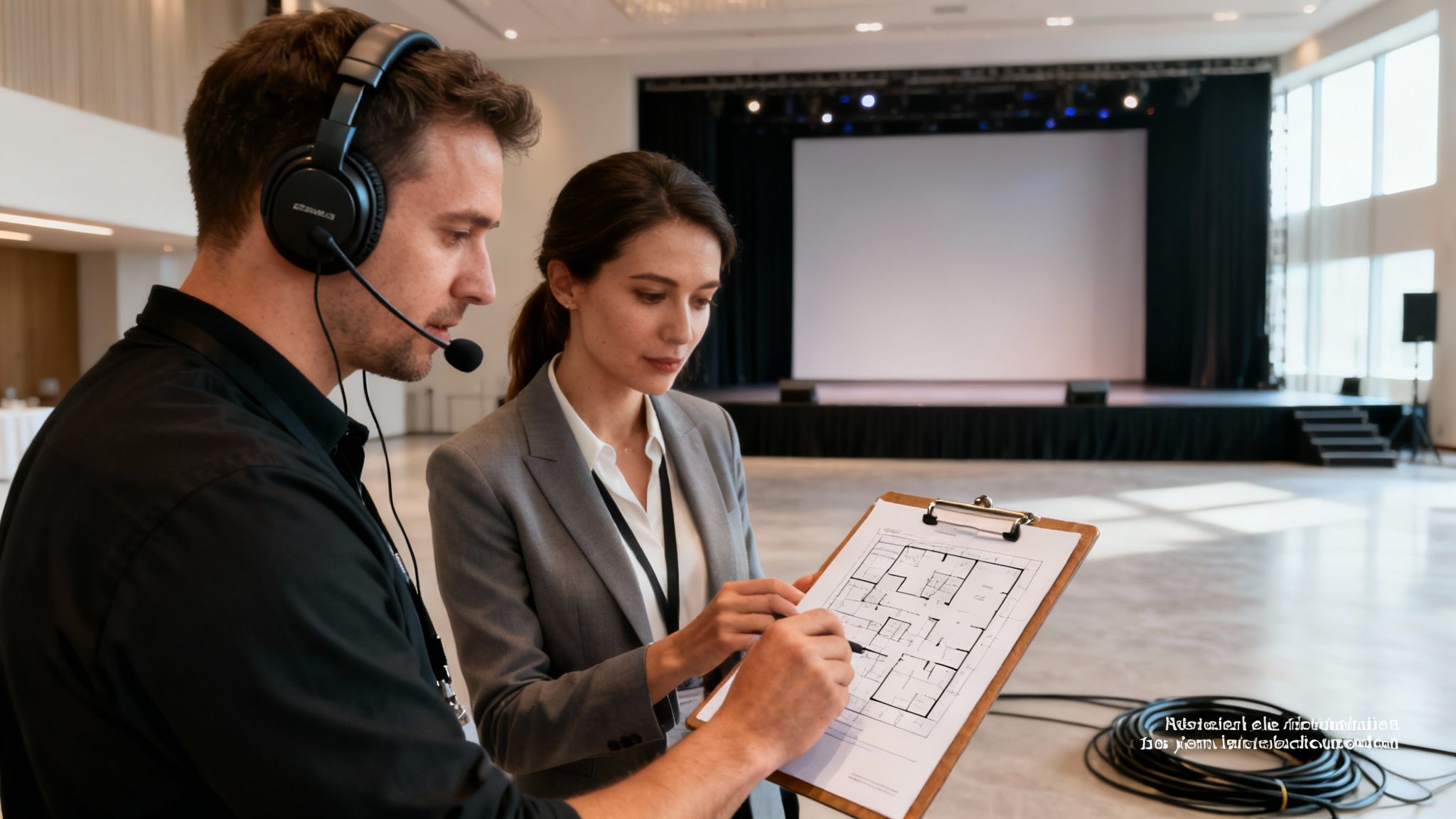
Never skip a pre-event site visit with your lead technician. A floor plan tells you one story, but seeing the space in person is essential for spotting challenges that are invisible on paper. This is your technician's chance to get a real feel for the venue's quirks and conditions.
A thorough site visit is the single best way to prevent day-of surprises. It allows the AV team to spot issues with power distribution, problematic ambient light, or awkward load-in routes long before they become critical problems.
During this walkthrough, your technician is not just admiring the decor. They are checking for specific, practical details: confirming the location and capacity of power sockets, assessing the room's acoustics, and measuring throw distances for projectors. It is also the perfect time to finalise the equipment layout to guarantee clear sightlines for the audience and an efficient workspace for the crew. For any complex event, a deep understanding of the venue is central to our approach to successful conference production.
Day-Of Communication and Coordination
When the event day arrives, seamless communication is everything. The first step is to establish a single point of contact within the technical crew, which is usually the lead technician or an on-site project manager. This simple move prevents confusion and stops conflicting instructions from derailing your schedule.
Agree on your communication method beforehand. It could be a dedicated radio channel for immediate contact or a simple WhatsApp group for quick, non-urgent updates. Finally, always hold a pre-show briefing with the entire event team, including your AV crew. Running through the schedule and key cue points one last time ensures everyone is perfectly synchronised and ready to deliver a professional, polished event.
Common Questions About Hiring AV Technicians
When you are organising a high-stakes event, hiring the right AV support can feel daunting. You have questions, and that is completely normal. To help you get some clarity, we have rounded up some of the most common queries we hear from event planners and provided straightforward answers.
Freelancer vs. AV Company: What's the Difference?
This is probably the first big decision you will face: do you hire a freelancer directly, or partner with a full-service AV company? The best path forward really depends on the scale and complexity of your event.
Hiring a freelance AV technician can work brilliantly for smaller, simpler setups, such as a single speaker with a projector and a microphone. But when you hire a freelancer, remember that you are essentially becoming the project manager. You are responsible for sourcing all equipment, checking their insurance, and handling all the logistics. And what happens if they are ill on the day? That backup plan is on you.
On the other hand, bringing in an established provider like London Audio Visual Hire is a different proposition. You get an integrated solution: the right technicians, the right equipment, transport, and comprehensive project management, all bundled together. Crucially, this route comes with full insurance cover and a single point of contact, which makes communication and accountability simple. For larger corporate events where there is no room for error, that built-in support system is invaluable.
How Far in Advance Should I Book My Crew?
As soon as you possibly can. The UK event calendar is relentless, and the best technicians get booked months in advance.
As a rule of thumb, you should aim to lock in your AV crew at least two to three months before your event. If you are planning something during a peak season, such as the summer or the pre-Christmas period, we suggest booking even earlier. Confirming your team well ahead of time does not just mean you secure top talent; it gives everyone the time needed for proper planning, site visits, and technical run-throughs, all of which contribute to a smooth-running event.
What Should I Include in My Initial Enquiry?
To get a quote that is actually useful, you need to be specific. A vague request like "I need AV for a conference" just leads to back-and-forth communication and a ballpark figure that might be inaccurate. A detailed brief ensures the quote you receive truly reflects what you need.
Make sure your first email covers these essentials:
- The Basics: The confirmed date, the full venue address, and your start and finish times. Do not forget to include access times for setup.
- The Event Profile: What kind of event is it (e.g., conference, awards dinner, product launch)? And how many people are you expecting?
- The Tech Specs: Be as detailed as you can. How many mics do you need, and what kind? What size screens are you considering? Are there any specific lighting looks you require? Do you need the event live-streamed or recorded?
Pro Tip: If you have a venue floor plan or even just a rough sketch of the room layout, attach it to your enquiry. It is incredibly helpful. It lets a technical team immediately visualise the space and spot potential challenges with sightlines, power, or acoustics before they become problems.
Getting this level of detail right from the start helps an AV partner provide a precise quote and kicks off the planning process on the right foot.
At London Audio Visual Hire, our team of technicians and project managers handles all the technical details so you can focus on what matters most: your guests. Get in touch today to discuss your next project.


