
Sourcing the right audio visual equipment in London is what elevates an event from adequate to truly memorable. It is the difference between an audience that is merely present and one that is genuinely engaged. Whether planning a major corporate conference or an exclusive product launch, a skilled AV partner provides the equipment, knowledge, and on-site support to ensure everything runs flawlessly.
Defining Your London Event's AV Needs
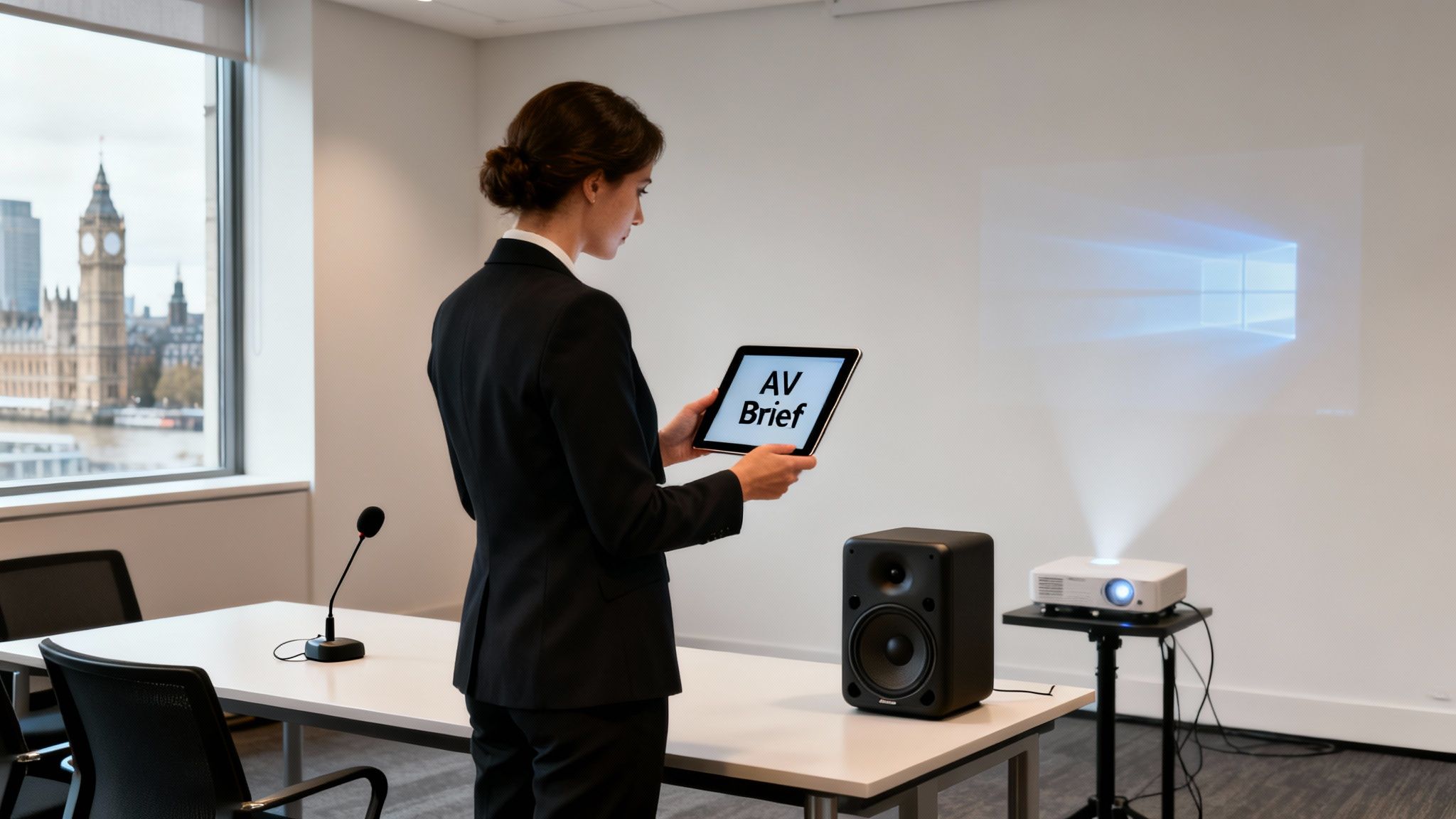
Before considering specific equipment, you must be clear on what you want to achieve. A thorough needs assessment is the best defence against last-minute issues and budget overruns. The process begins by asking simple but crucial questions about the event's core purpose and the desired atmosphere.
Is the objective to inform, entertain, or encourage networking? The answer dictates the technical approach. An immersive brand activation, for example, might require interactive displays and dramatic lighting, while a formal awards dinner depends on flawless sound and sharp, clear projection. These are two entirely different technical challenges.
Aligning Objectives with AV Requirements
The format of your event is the primary driver of the technical specification. Consider a few common scenarios to see how quickly the AV needs diverge:
- Corporate Conferences: These typically require a multi-microphone setup for panel discussions, large screens for presentations, and a reliable live-streaming system for a remote audience.
- Product Launches: Impact is paramount. A high-resolution LED video wall is ideal for showcasing dynamic content, while professional lighting is essential to present the product in the best possible way.
- Intimate Meetings: In this context, less is often more. A single large display, a simple PA system, and a couple of lapel microphones will usually suffice, keeping the focus on the conversation.
Understanding what is audio visual equipment is an excellent starting point. When you match your goals to the right tools, you create an event that feels cohesive and delivers its message effectively.
Factoring in Audience and Venue
Your audience size and your chosen London venue are two of the biggest variables in the equation. A crowd of 500 in a vast space like The Brewery will require a much more powerful sound system than a group of 20 in a hotel meeting room. You must also consider the venue's layout, ambient light, and any in-house technology. These factors will influence decisions on everything from screen size and projector brightness to speaker placement.
A well-defined technical brief is your most valuable tool. It not only clarifies your vision but also allows potential suppliers like London Audio Visual Hire to provide accurate quotes and highlight potential challenges early on.
To ensure your videos and graphics look sharp on the day, it is also worth having a basic understanding video encoding, codecs, and bitrate. This knowledge helps you prepare digital files for perfect playback, avoiding frustrating moments of poor resolution or juddering video that can disengage an audience. Addressing these details from the outset provides a solid foundation for a successful event.
Selecting the Right AV Kit for Your London Venue
Now that you have defined your event's objectives, it is time to discuss the technology. This stage involves matching the right equipment to your specific venue, content, and audience. It is not just about creating a list of equipment; it is about ensuring every component works together to create a seamless, professional experience.
Familiarising yourself with the basic components will enable a more productive conversation with potential suppliers. You will know exactly what you are asking for and why.
Essential Sound Systems
If the sound is not right, the event will not succeed. If your audience cannot hear the speaker, your message is lost. The required equipment depends heavily on the room's acoustics and the type of event.
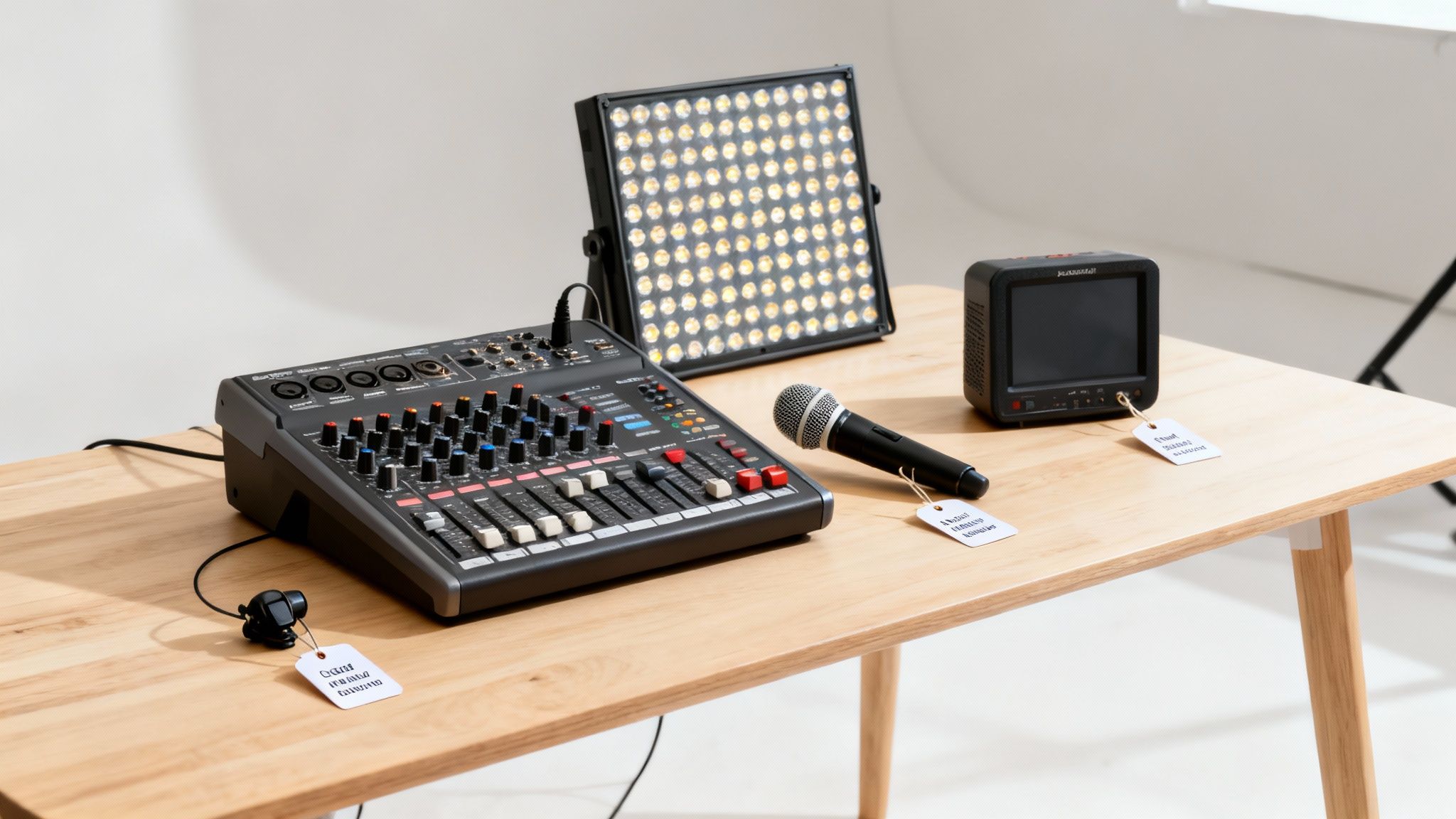
- PA Systems: The Public Address system is the core of your event's audio, comprising speakers, amplifiers, and mixers. The system must be scaled to your venue. A small breakout session might only need a simple portable PA, whereas a large conference hall will demand a full line array system to ensure sound is distributed evenly.
- Microphones: Choosing the right microphone is crucial. Lapel microphones are ideal for presenters who need to move around, as they are discreet and hands-free. Handheld microphones are better for Q&A sessions, and a fixed lectern microphone is perfect for a keynote speaker.
- Mixing Desks: This is the central control point for all audio. A skilled technician uses the mixing desk to manage all audio feeds, balancing sound levels and eliminating feedback. This ensures every word is delivered with clarity.
Creating Visual Impact
Your visuals must make an impact. The key is to choose displays that are appropriate for the venue's lighting. A dimly lit ballroom presents a completely different challenge to a glass-walled conference room flooded with daylight.
The London events market is substantial, hosting over 40,000 business events annually, most of which require quality visual setups. Conferences account for approximately 35% of all AV rentals, and it is easy to see why. Event organisers know that hiring equipment for a single event can be up to 70% more cost-effective than purchasing it.
Here is a simple test for your visual setup: can a person sitting at the very back of the room see everything on screen clearly and without straining? If not, you need to rethink your approach.
A Look at Display Technology
For large-screen displays, there are generally three main options. Each has its own strengths depending on the space and the desired effect.
- Projectors and Screens: This is a popular choice for many corporate events due to its flexibility and cost-effectiveness. The most important specification is the projector's brightness, measured in lumens. In a bright venue, a high-lumen projector is necessary to prevent the image from looking washed out.
- LED Video Walls: For maximum impact and brightness, nothing surpasses an LED wall. They are constructed from modules, allowing for almost any size and shape. They are incredibly bright, even in direct sunlight, which makes them ideal for exhibitions and major product launches.
- Large Format Displays (LFDs): These are essentially very large, high-definition television screens. They work well for smaller audiences, in breakout rooms, or as relay screens in a large venue so people at the back do not miss any details.
To get a feel for specific models and their capabilities, it is a good idea to browse a detailed inventory of event hire equipment. This will help you become familiar with the terminology before you discuss specifics with an AV company.
Understanding Your AV Hire Budget and Quotes
Finalising the budget is a critical task for any event manager. When hiring audio visual equipment in London, the quote you receive is not just a price; it is the technical roadmap for your entire event.
A vague or poorly detailed quote should be a warning sign. You should expect a clear breakdown of every cost component. This transparency is your best defence against unexpected charges and helps you make informed decisions about where to allocate your funds.
What to Look For in a Professional AV Quote
A professional quote from a London AV company will be itemised, leaving no room for ambiguity. It is a good sign when costs are broken down into these core areas.
-
Equipment Rental: This is the base cost for the equipment itself, often referred to as 'dry hire'. You should see individual prices for everything from microphones and projectors to the LED wall. These are typically priced per day.
-
Labour and Crew: You are not just renting equipment; you are hiring the expertise to operate it. This part of the quote covers the skilled technicians, engineers, and project managers who will set up, operate, and dismantle the system.
-
Transport and Logistics: This covers transporting all equipment from the warehouse to your London venue and back again. The cost can vary depending on the venue's location, accessibility (e.g., loading bays vs. stairs), and the volume of equipment.
-
Insurance and Contingency: Any professional firm will include insurance to cover the equipment against damage. A small contingency fee may also be included. This is not an unnecessary extra; it is the mark of an experienced provider who plans for the unexpected.
It is tempting to choose the lowest price, but this is often a false economy. Remember that a top-tier crew from a trusted supplier like London Audio Visual Hire can troubleshoot problems you did not anticipate, saving your event from technical failure. Their expertise is part of the value.
To keep track of everything, a simple checklist can be invaluable. Here is a template to get you started on building a comprehensive AV budget.
AV Hire Budget Component Checklist
| Budget Item | Description | Action Required |
|---|---|---|
| Equipment Dry Hire | Cost for all projectors, screens, microphones, speakers, lighting, etc. | Confirm all necessary equipment is listed and quantities are correct. |
| Technician Labour | Fees for on-site crew (setup, operation, de-rig). | Check day rates, hours included, and overtime costs. |
| Project Management | Cost for a dedicated manager overseeing the AV delivery. | Clarify if this is a separate line item or included in labour. |
| Transport & Delivery | Charges for getting equipment to and from the venue. | Confirm costs for delivery, collection, and potential waiting times. |
| Venue Charges | Any fees the venue charges for using external suppliers (e.g., power). | Check your venue contract and liaise with the venue manager. |
| Insurance | Public Liability and equipment insurance coverage. | Verify that the AV company's insurance is included and adequate. |
| Contingency Fund | A buffer for unforeseen needs (e.g., extra cables, last-minute changes). | Allocate 5-10% of the total AV budget as a safety net. |
| VAT | Value Added Tax on the total cost. | Ensure VAT is clearly stated and factored into your final budget. |
Using a checklist like this ensures nothing is overlooked and you are comparing quotes on a like-for-like basis.
How to Get a Quote You Can Trust
The secret to receiving a reliable, accurate quote is simple: provide an excellent brief. The more detail you give potential suppliers upfront, the more precise their pricing will be.
Think of your brief as the foundation. If it is vague and ambiguous, you are inviting budget problems later on. Be clear about your goals, audience numbers, venue specifics, and the type of content you will be showing. A great brief empowers a supplier to give you a great quote.
When you put in the effort to create a detailed brief, you also simplify your own process. It allows you to compare quotes from different companies accurately, so you can see who is offering the best overall value, not just the lowest price. That is the hallmark of smart event budgeting.
Managing Venue Logistics and Technical Checks
Even the best AV equipment is useless if it does not work in your chosen space. A successful technical setup depends on solid logistical planning and double-checking everything before the event begins. This is the stage where you identify and resolve potential problems long before any of your guests arrive.
Every London venue has its own characteristics. A historic building in Mayfair might have heritage restrictions on rigging and power, while a modern conference centre in Canary Wharf will have the necessary infrastructure but may insist you use their in-house team. This is where an AV partner who knows the city’s venues proves their worth.
Why a Site Visit is Non-Negotiable
There is no substitute for having your event manager and AV project lead conduct a thorough site visit. This is the moment your plan meets the physical reality of the space. Walking the room together is your opportunity to resolve the practical details that can determine the event's success.
When on-site, you must address these points:
- Power Availability: Identifying the location and capacity of power sockets is critical. You need to be certain there is enough stable power for all lighting, sound, and video equipment without overloading the circuit.
- Rigging Points: If you plan to hang heavy items like lighting trusses, large projectors, or line array speakers, you must locate the approved, load-tested rigging points. This is a crucial safety requirement.
- Internet Connectivity: If you plan to live-stream, a quick speed test on a mobile phone is insufficient. You need to test the venue's wired internet connection for stability and, most importantly, upload speed. For more detail, our guide to professional hybrid streaming solutions covers the technical requirements.
- Loading and Access: How will you get the equipment into the venue? Check the loading bay, locate service lifts, and map a clear path, noting any narrow corridors or stairs that could disrupt your setup schedule.
The Importance of a Technical Run-Through
Once all the equipment is in place, a full technical run-through is your final check. This is more than a quick microphone test; it is a full rehearsal of every AV cue in your event's running order. It is your last chance to see presentations on the big screen, balance microphone levels for every speaker, and ensure lighting changes are seamless.
A detailed run-through provides peace of mind on the day of the event. It helps your speakers feel comfortable on stage and gives the technical crew from London Audio Visual Hire one last chance to fine-tune every setting, guaranteeing a flawless live experience.
This methodical process, from the first site visit to the final soundcheck, transforms logistical challenges into a slick, well-executed plan. This attention to detail is what separates a stressful, amateur event from a professional and polished production.
On-Site Operations: Delivery, Setup, and De-Rig
This is where planning becomes reality. The entire process hinges on two critical phases: the load-in and the de-rig. A professional crew is what separates a calm, organised setup from a stressful scramble.
The load-in is a precision-timed operation. Your AV project manager will have already coordinated with the venue to arrange arrival times, loading bay access, and the best route for moving bulky flight cases into the room. This behind-the-scenes work prevents a simple delivery from becoming a last-minute crisis.
Executing the On-Site Setup
Once the equipment is inside, clear and constant communication between your team and the AV lead is vital. The crew will work from a pre-agreed floor plan, so they know exactly where every screen, speaker, and lighting rig should be positioned. This is followed by the essential work of running cables, connecting all components, and conducting initial system checks.
A slick, efficient load-in is the hallmark of a seasoned AV partner. It should be almost invisible to you, freeing up your team to manage presenters, attendees, and other event-day responsibilities without worrying about the technology.
Every piece of equipment, from the CEO's lapel microphone to the main presentation switcher, is tested. First individually, then as a complete, integrated system. This methodical approach is non-negotiable; it guarantees that when your speakers arrive for their final run-through, the technology works perfectly.
This is why the groundwork done weeks before is so important.
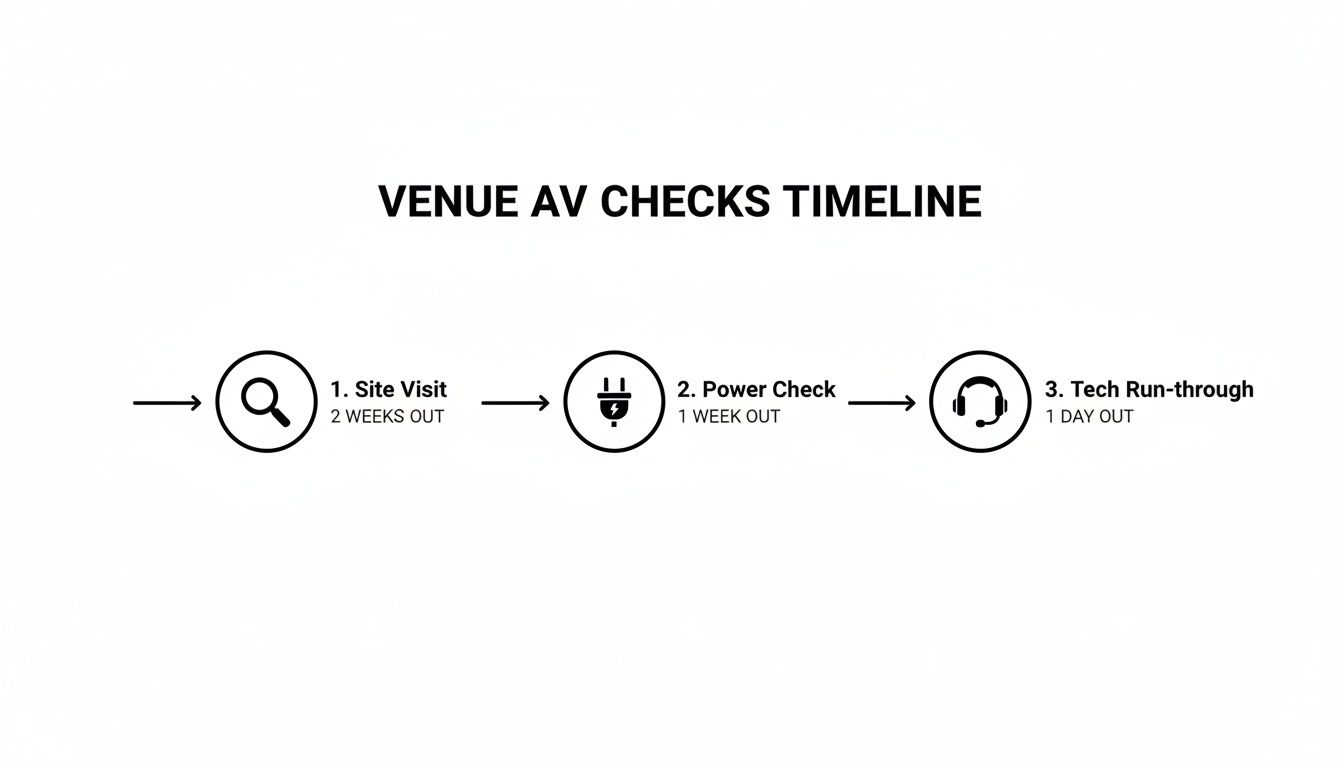
Each of these earlier checks, the site visit, the power assessment, the full technical rehearsal, is a building block designed to prevent any surprises on the day.
It is not just corporate events driving this need for professionalism. Weddings and high-end parties in London are becoming increasingly sophisticated productions. Social events now account for around 20% of the AV hire market. This is part of a global trend, with the AV rental market projected to reach USD 8.4 billion by 2032, driven by a demand for immersive, professionally executed experiences. You can read more about the growth in the AV rental market on dataintelo.com.
The Professional De-Rig: Leaving No Trace
After the event concludes, the de-rig (or load-out) begins. A professional crew works with the same speed and care as they did during setup. They understand that London venues often have tight turnaround schedules, and their process is designed to ensure a timely departure.
Here is a sample timeline to illustrate how a typical conference day might break down for the AV team.
Sample Conference AV Timeline
| Time Slot | AV Team Action | Event Planner Action |
|---|---|---|
| 06:00 – 08:30 | Load-in, rig all equipment, run system checks. | Arrive on-site, liaise with venue manager, finalise registration desk. |
| 08:30 – 09:00 | Final checks with presenters, mic checks, test presentation slides. | Greet speakers, manage their arrival, conduct final briefing. |
| 09:00 – 17:00 | Operate all AV for the live event (sound, visuals, lighting). | Oversee event flow, manage timings, handle delegate queries. |
| 17:00 – 17:30 | Event concludes, AV system safely powered down. | Thank guests and speakers, manage attendee departure. |
| 17:30 – 20:00 | De-rig equipment, pack into flight cases, load out. | Final checks with venue, sign-off on room condition. |
The team systematically powers down all equipment, disconnects all wiring, and packs it away into custom-built flight cases. They remove every cable and piece of rigging, leaving the venue exactly as they found it. This efficient and respectful clear-up is the final component of a top-tier audio visual equipment hire London service, and it leaves both you and the venue manager with a positive lasting impression.
Common Questions About Hiring AV Equipment
Entering the world of audio visual hire in London can feel daunting for newcomers. To help you navigate the process, we have compiled some of the most common questions we hear from event planners. The answers are based on years of practical experience at venues across the city.
This information should help you make smart, confident decisions and ensure every technical detail of your next event is addressed.
What is the minimum hire period?
In London, the industry standard for most professional AV companies, including London Audio Visual Hire, is a one-day minimum hire. This is because the work involved in preparing, delivering, setting up, and collecting the equipment is largely the same whether your event lasts three hours or a full day.
For multi-day conferences or exhibitions, you will almost always receive a better daily rate for consecutive days. It is advisable to provide your supplier with your entire schedule so they can offer a quote that best suits your budget.
How far in advance should I book?
The sooner, the better. While it is sometimes possible to accommodate last-minute requests, providing ample notice is always the best approach. For a typical corporate meeting or small conference, aim to confirm your AV supplier at least four to six weeks ahead of the event.
For larger events, such as a multi-room conference, a major product launch, or anything with complex requirements, you should begin the conversation three months out, or even earlier. This allows sufficient time for site visits, meticulous technical planning, and securing the best crew for the job.
A key benefit of booking early is securing the best people. The most experienced project managers and engineers are often booked well in advance, and they are frequently the secret to a seamless event.
Do I really need to hire technicians?
Unless you are hiring only a basic projector and screen for a small meeting, then yes, absolutely. While you can 'dry hire' (equipment only), the real value and peace of mind come from having an expert on-site.
A skilled technician does much more than operate the equipment. They are there to:
- Ensure a safe and tidy setup, then dismantle it efficiently afterwards.
- Manage the sound, visuals, and presentation cues flawlessly during the event.
- Instantly and discreetly resolve any technical issues that may arise.
The modest additional cost for a professional crew is arguably the best event insurance you can buy. It removes the technical burden from your shoulders, allowing you to focus on your guests and the overall success of the event. Any reputable audio visual equipment hire London service will provide the same advice.
At London Audio Visual Hire, our team is dedicated to supporting your event from the initial consultation to the final de-rig. For clear advice and expert event production, get in touch and let's talk about your event.