

For any event in London, the technical production must be flawless. Professional audio visual equipment hire in London provides access to high-calibre equipment and the technicians who operate it, without the significant capital investment of purchasing it outright. This guide offers a practical overview of how to manage the technical aspects of your event successfully.
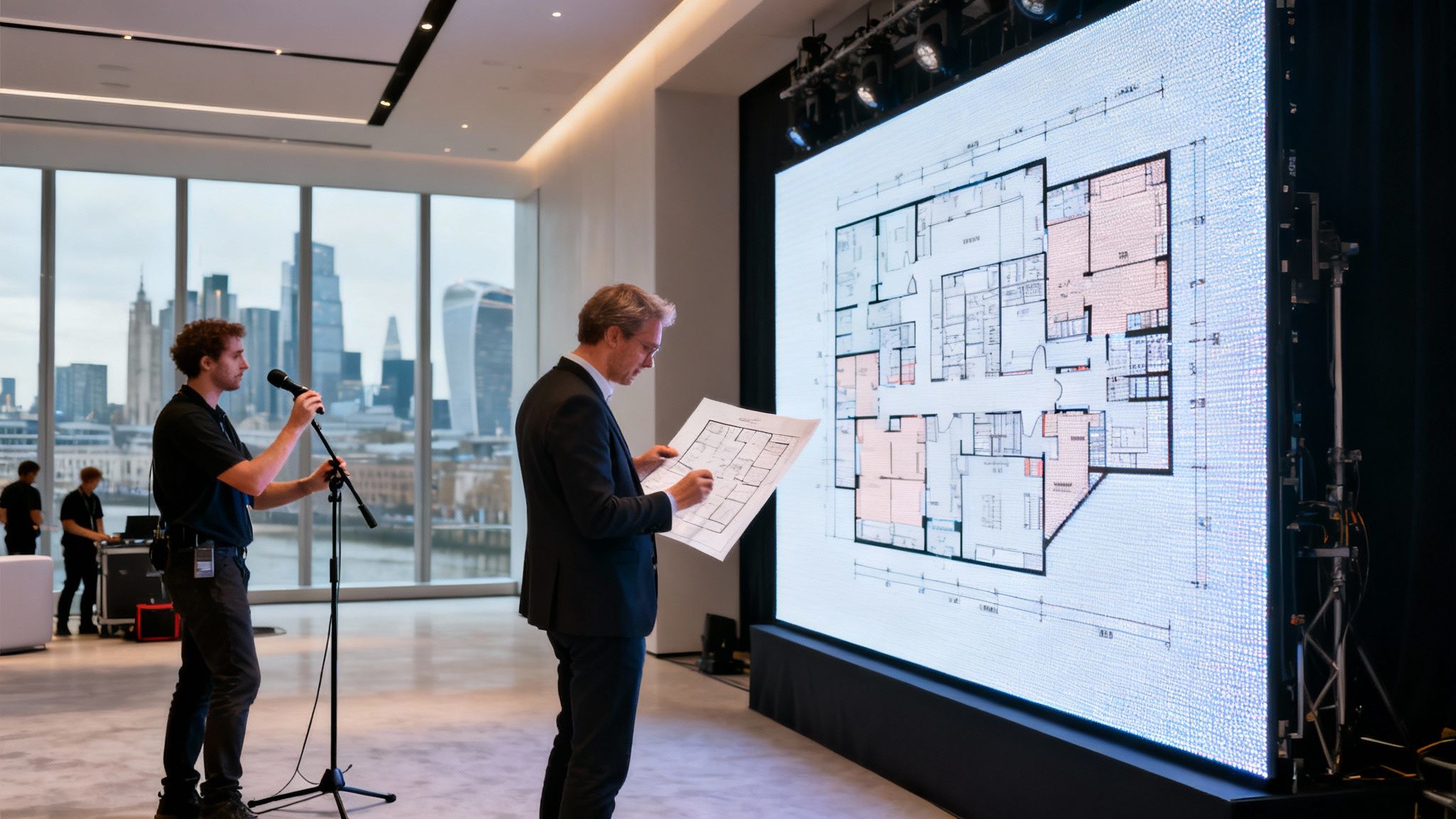
A Professional Approach to Event Production in London
Executing a successful corporate conference, brand launch, or gala dinner requires more than an impressive venue and guest list. The technical details, such as clear audio and sharp visuals, are what ensure your message is delivered effectively. However, buying, storing, and maintaining professional-grade AV equipment is a substantial and often impractical expense for most organisations.
This is where professional AV hire becomes a crucial service for event planners. It resolves a significant logistical challenge by providing a managed service, guaranteeing you have the correct tools for your specific requirements.
The Value of Professional AV Hire
Engaging an experienced AV team is fundamentally different from attempting a DIY setup or relying on a venue's basic in-house system. Here are the core benefits:
- Access to High-Specification Technology: You can utilise the latest projectors, LED walls, microphones, and lighting rigs, all of which are professionally maintained and tested before every event.
- Expert Technical Support: You are not just hiring equipment; you are gaining the support of technicians and project managers with extensive experience in London's diverse venues.
- Cost-Effective Solution: Hiring avoids the significant costs associated with purchasing, insuring, storing, and managing the depreciation of specialist equipment.
- Scalability and Flexibility: Whether you need a simple setup for a boardroom meeting or a full-scale production for a large exhibition, an AV hire company can scale the equipment and crew to match your event's specific needs.
To understand how these elements integrate into the broader process, it is useful to learn more about event production.
This guide aims to demystify the process of hiring AV equipment in London. We will cover selecting the right equipment, navigating the challenges of London venues, and developing a realistic budget. The goal is to equip you with the knowledge to make informed decisions and ensure your event is a seamless success.
Why Hiring AV Equipment is a Strategic Choice
Event managers in London often face the decision of whether to buy or hire audio visual equipment. While ownership may seem like a viable long-term strategy, the rapid evolution of event technology makes hiring the more flexible and financially prudent option in most scenarios.
Opting for professional audio visual equipment hire in London is not merely a matter of convenience. It is a strategic decision that provides access to the best technology without a large capital outlay, allowing you to focus on delivering a successful event.
Financial and Operational Advantages
The most immediate benefit is the avoidance of a large upfront cost. Equipping even a medium-sized conference with LED walls, a professional sound system, and appropriate lighting can be a major capital expense.
Beyond the purchase price, ownership entails numerous ongoing costs:
- Depreciation: The value of technology depreciates quickly. Equipment that is state-of-the-art today will be standard in a few years, making it a poor long-term investment.
- Maintenance and Repairs: Professional AV equipment requires specialist maintenance. Repair costs can be significant and unpredictable.
- Storage and Insurance: Sensitive electronics require secure, climate-controlled storage, which represents an additional ongoing expense.
- Technology Upgrades: To keep events looking current, you would need to invest continually in new equipment, creating a perpetual cycle of expenditure.
Hiring transforms these variable and hidden expenses into a single, predictable cost per event. This simplifies budgeting and frees up capital for other critical event components.
Accessing Expertise and Scalable Solutions
When you work with a company like London Audio Visual Hire, you gain more than equipment. You access a team of experienced professionals who can advise on the optimal setup for your venue, audience, and objectives.
This partnership allows you to scale your technical requirements up or down as needed. One month you may require a projector and screen for a small meeting; the next, you might need a comprehensive production for a major conference. A hire company can adapt to provide precisely what you need for each event.
Hiring transfers responsibility for all technical logistics to specialists. Their role is to ensure the AV production runs flawlessly, allowing your team to concentrate on content, delegates, and overall event management.
Market data supports this trend. London's event industry, from large-scale conferences at ExCeL to corporate events at Olympia, is thriving. The UK's audio equipment rental market was valued at USD 739.51 million and is projected to reach USD 1,369.99 million by 2033, with a compound annual growth rate of 7.14%. This growth indicates a clear industry preference for hiring.
For a foundational understanding of the components involved, our guide on what is audio visual equipment is a helpful resource. Ultimately, hiring provides a significant advantage, enabling you to deliver technically impressive events without the financial and logistical burdens of ownership.
Essential AV Equipment and Staffing Checklists
When planning the technical aspects of an event, a clear and detailed brief is essential. The most effective way to ensure nothing is overlooked is to create two checklists: one for equipment and another for the technical crew. This methodical approach helps to communicate your requirements accurately and enables your audio visual equipment hire London partner to deliver precisely what is needed.
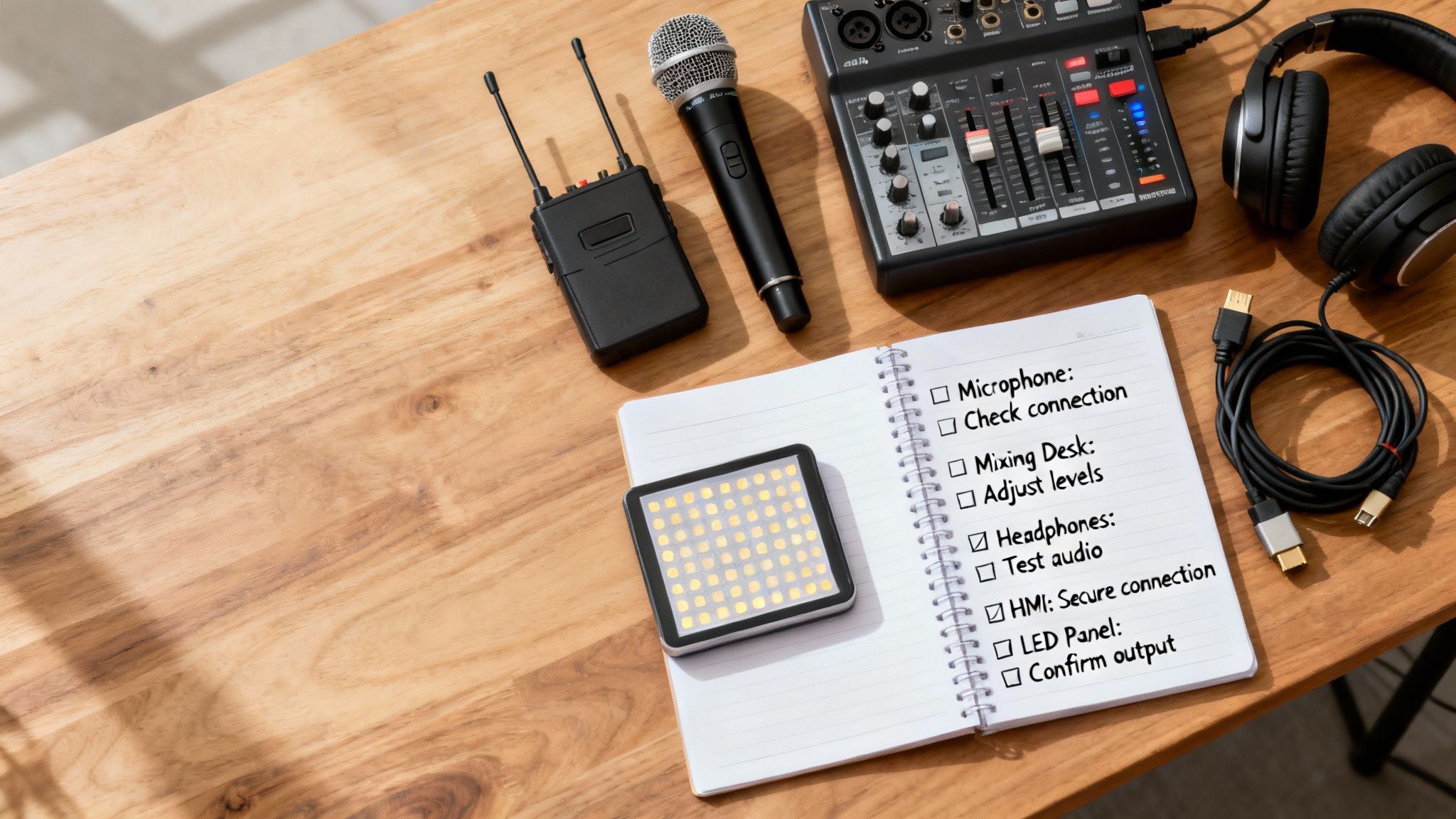
A useful starting point is to consider the format of your event. While each event is unique, certain equipment is standard for specific formats. These lists provide a solid foundation for building your technical specification.
Core Equipment Checklist by Event Type
The right equipment ensures your message is delivered with clarity and impact. Below are the foundational items for common event types in London.
For Conferences, Seminars, and Panel Discussions:
- Audio System: A professional mixing desk, appropriately sized speakers, and a range of microphones are non-negotiable. This typically includes wireless handheld microphones for audience questions, a lectern microphone for the primary speaker, and discreet lapel microphones for panellists.
- Visual Displays: High-definition projectors and screens are the minimum requirement. For larger London venues or detailed presentations, a high-brightness LED wall or multiple repeater screens are necessary to ensure clear visibility for all attendees. A confidence monitor for the speaker is also essential.
- Staging and Lectern: A stage elevates the speaker and improves sightlines. A branded lectern adds a professional finishing touch.
- Presentation Tools: A slide advancer (or 'clicker') is a small but vital tool for ensuring presentations run smoothly.
For Gala Dinners, Awards Ceremonies, and Product Launches:
- Lighting: A well-designed lighting setup is critical for creating the right atmosphere. Stage washes highlight speakers, while uplighters can transform a room with brand colours. Gobos can be used to project logos onto walls or floors for added visual impact.
- Large-Format Visuals: An LED video wall behind the stage is highly effective for displaying nominee videos, sponsor logos, or dynamic brand content.
- Sound System for Entertainment: Beyond microphones for speeches, a powerful PA system is required to handle background music, a live band, or a DJ.
- Live Camera Feed (IMAG): In large venues, projecting a live camera feed of the speaker or award winner onto the main screens (Image Magnification) ensures guests seated further away remain engaged.
A common oversight is underestimating the importance of lighting. It does more than ensure visibility; it dictates mood, directs audience focus, and reinforces brand identity. It is an element that can significantly influence the overall visual experience of an event.
Essential On-Site Staffing Checklist
The best equipment is ineffective without skilled operators. Your technical crew is as important as the equipment itself. For a seamless event, you need the right specialists in the appropriate roles.
While it may seem cost-effective to use a small crew, specialist roles exist for a reason. A dedicated expert for each key discipline ensures every technical element is managed with precision, preventing errors and ensuring a high-quality production.
Here is a breakdown of the key roles for your on-site team.
Essential AV Staffing Roles for London Events
| Role | Key Responsibilities | Essential For Which Events? |
|---|---|---|
| Project Manager | The primary point of contact. Oversees all technical production, from planning and venue liaison to on-site crew management. | All except the simplest events. Crucial for any multi-disciplinary production. |
| Sound Engineer | Manages all microphones, mixes audio levels to prevent feedback, and ensures every word and piece of music is heard clearly. | Any event with microphones, music, or presenters. Essential for conferences and live entertainment. |
| Video Technician | Also known as a Vision Mixer. Manages all visual inputs, including presentations, videos, and live camera feeds, switching between sources seamlessly. | Critical for events with multiple screens, presentations, or live camera work, such as award shows and large conferences. |
| Lighting Technician | Designs and operates the lighting to create atmosphere, spotlight speakers, and execute dynamic lighting cues. | A necessity for galas, award ceremonies, and product launches where mood and visual impact are paramount. |
Having these specialists on-site means you can concentrate on your guests, confident that the technical production is being managed by experts.
To see a full list of available items, you can browse our audio visual equipment inventory. By carefully considering your equipment and staffing needs, you establish the foundation for a professional and memorable event.
Navigating London Venues and Their Technical Constraints
London offers a diverse range of venues, from Grade I listed buildings with strict heritage constraints to modern conference centres with integrated technology. Each type of space presents unique technical challenges that can affect an event's production.
A technical site visit, conducted with your chosen AV hire company, is the most effective way to identify and address these issues in advance. An experienced technician can identify potential problems such as inadequate power supplies, difficult access routes, or a lack of rigging points, allowing for proactive solutions.
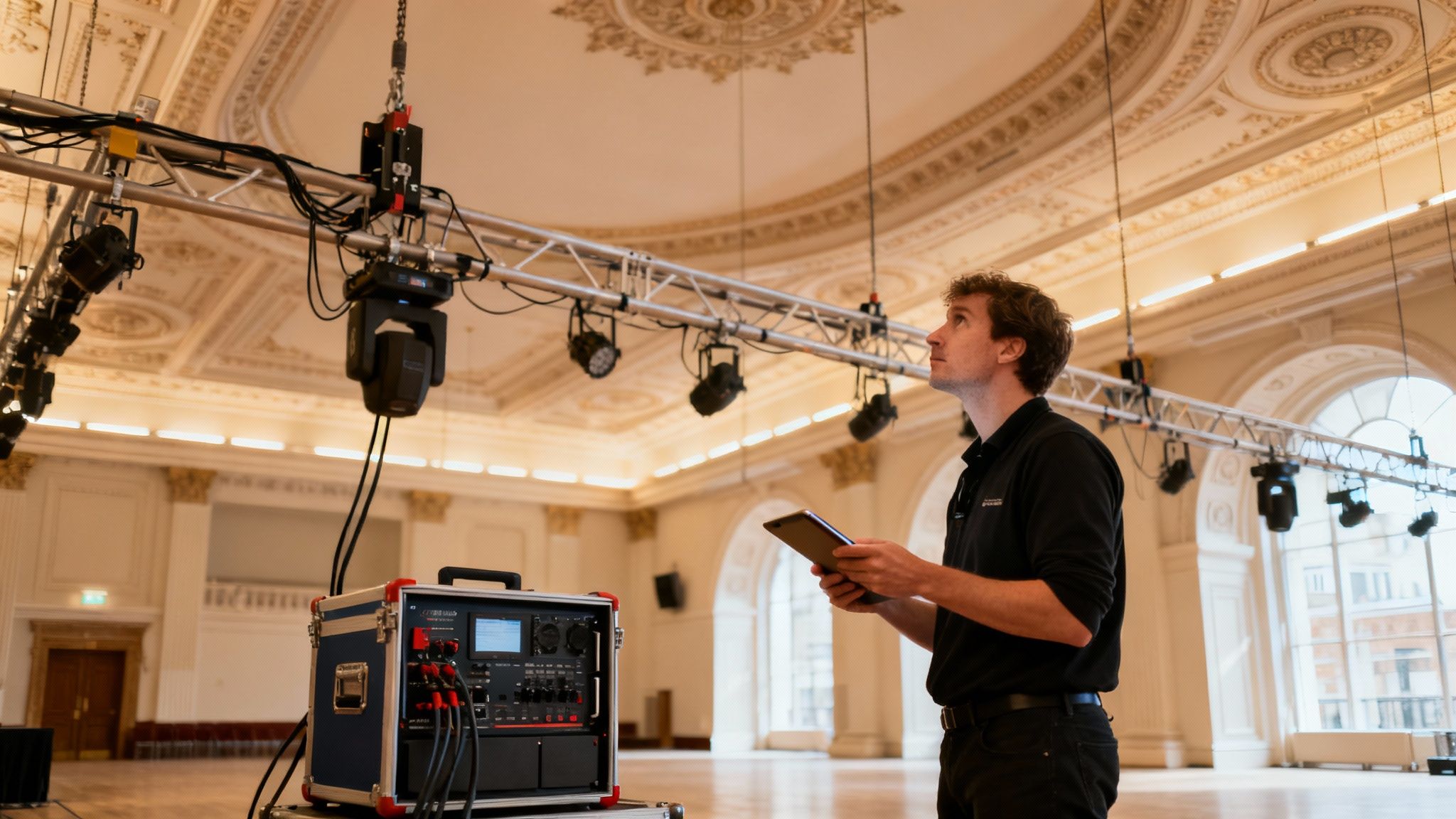
Key Technical Questions for Your Site Visit
A site visit is an opportunity to gather critical information. Arriving with a prepared checklist ensures you leave with the details needed for a smooth production. It is always best to conduct this visit with the venue manager.
Here are the essential questions to ask:
- Power Supply and Distribution: Is there sufficient power for the planned equipment? Locate any 32-amp or 63-amp supplies. It may be necessary to bring in a temporary power distribution board to avoid overloading the venue's circuits, a common and preventable issue.
- Loading and Access: What is the specific route for moving equipment from the vehicle to the event space? Check for loading bay restrictions, lift dimensions, weight limits, and any obstacles like stairs or narrow corridors that could disrupt the schedule.
- Rigging and Structural Points: If you plan to suspend speakers, lights, or screens from the ceiling, you must confirm if this is permissible. Ask about the location and load capacity of any rigging points. Many of London's historic venues have strict no-rigging policies, necessitating ground-supported structures.
- Acoustics and Sound Restrictions: Does the venue have a noise limiter? This is particularly important in residential or built-up areas. Also, assess the room's natural acoustics. A space with many hard, reflective surfaces will require a different audio strategy compared to a carpeted room with soft furnishings.
- Internet and Connectivity: What is the quality of the Wi-Fi, and will it be shared with a large number of attendees? For any activities involving live streaming or video conferencing, a dedicated, hardwired internet connection is the only reliable option.
The most successful events are those where the technical production works in harmony with the venue, respecting its unique characteristics and limitations.
Common Challenges in London Venues
London's mix of historic and modern architecture creates specific technical hurdles. An experienced local AV partner like London Audio Visual Hire will have encountered and solved these problems many times.
Historic and Listed Buildings
These venues are visually stunning but come with numerous restrictions. Power is often limited, rigging is typically forbidden, and access can be challenging. Solutions often involve creative use of battery-powered uplighters, freestanding screen structures, and meticulous cable management to protect the building's integrity.
Modern Conference Centres
While built for events, their scale can present challenges. Large rooms require powerful projectors or large-format LED walls for visual impact. Audio systems must be carefully designed to ensure consistent clarity for all attendees, regardless of their seating position.
Unique and Unconventional Spaces
Events in galleries, warehouses, or on rooftops are memorable but require thorough technical planning. It may be necessary to bring in generators for power, and a professional assessment is vital to determine if existing structures can safely support the weight of a lighting rig.
Considering what to look for in a great music venue can provide useful insights, as many of the principles are transferable.
Ultimately, successful execution depends on meticulous planning. By asking the right questions and partnering with a crew that has extensive knowledge of the city's venues, you can design an AV setup that is perfectly suited to the space.
Budgeting for Your AV Hire in London: What to Expect
A common and critical question is, "How much will this cost?" Establishing a realistic budget from the outset is fundamental to a successful event. When hiring audio visual equipment in London, the cost reflects not just the equipment rental, but also the service, expertise, and assurance that your event will be executed professionally.
The final cost will vary significantly based on the event's scale and complexity. A simple projector and screen for a small meeting will have a very different budget from a full-production gala dinner requiring a large LED wall, complex lighting, and a team of on-site technicians.
What is Included in a Typical AV Hire Quote?
To budget effectively, it is important to understand the components of a standard quotation. A comprehensive quote typically includes several key elements.
Equipment Rental: This covers the physical hire of every microphone, speaker, screen, and lighting fixture required for the event. The cost is determined by the quantity and specification of the equipment.
Technical Crew: Expert technicians are an essential component. The quote will include the cost for the crew who deliver, install, operate, and dismantle the equipment. This covers roles from drivers to specialist sound and video engineers.
Logistics and Transport: Transporting delicate equipment into central London involves navigating congestion charges, restricted loading bays, and specific venue time slots. This part of the quote covers the vehicle, fuel, and labour required for transport.
Planning and Management: For more complex events, considerable work is done before the event day. This can include a project manager conducting site visits, liaising with the venue, and creating detailed technical plans to ensure a seamless installation.
Dry Hire vs. Full Production Service
Understanding the two primary models for hiring equipment is crucial, as they have different implications for your budget and responsibilities.
A dry hire is the most basic option, involving only the rental of equipment. The client is responsible for collection, setup, operation, and return. This is only a suitable option if you or a member of your team has proven expertise with the specific equipment being hired.
In contrast, a full production service, which is the specialism of London Audio Visual Hire, is an all-inclusive solution. It covers consultation, equipment provision, transport, and a dedicated technical team to manage the entire production. While the initial cost is higher, it eliminates risk and guarantees a professional result, making it the standard choice for most corporate events.
A full production service can be viewed as a form of event insurance. You are not just paying for equipment; you are investing in a team of experts whose role is to anticipate and resolve technical issues, ensuring your event proceeds without interruption.
The London events market is highly competitive, and the quality of your audio and visual production is a key differentiator. While the retail market for AV equipment fluctuates, the event hire sector continues to grow. This reflects a business preference for the flexibility and cost-efficiency of hiring, which provides access to the latest technology, such as 4K projectors and modular LED walls, without requiring major capital investment. You can read more about these market trends to see how they are shaping the industry.
The AV Hire Timeline: From Initial Brief to Final De-Rig
The process of hiring an AV company involves more than just equipment delivery on the day of the event. A professional team will guide you through a structured process designed to resolve any potential issues well in advance of your guests' arrival.
Understanding these stages helps you know what to expect and when. From the initial consultation to the final removal of equipment, each step is designed to ensure your event runs smoothly.
This timeline provides a high-level overview of the process.
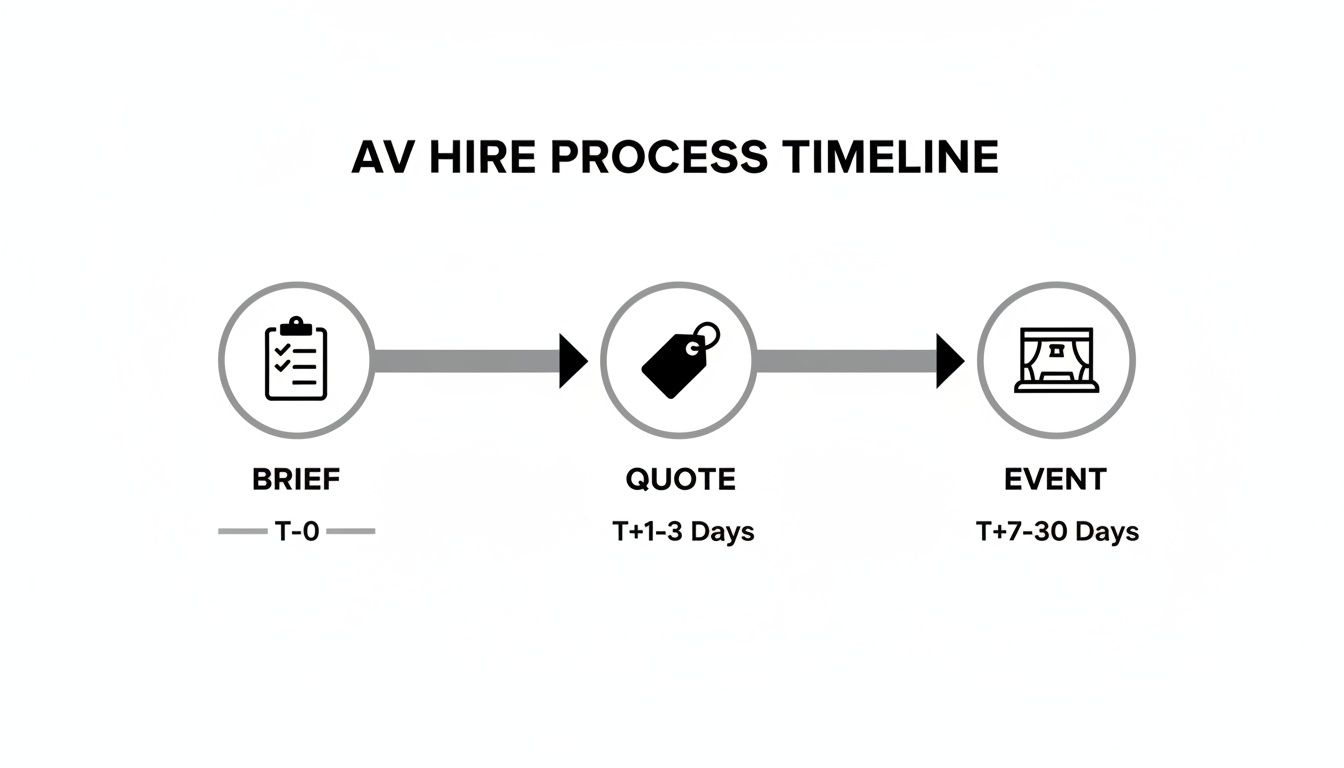
The process is a partnership. Your brief initiates the project, and through careful planning, we deliver the technical production on the day.
The Initial Consultation and Proposal
The process begins with your enquiry. An initial discussion allows us to understand your objectives, audience size, venue, and desired atmosphere.
Following this, you will receive a detailed proposal. This document is more than a price list; it serves as the first technical blueprint for your event, outlining the recommended equipment, crew, and logistics with a transparent cost structure.
Pre-Production: The Foundation for Success
Once the proposal is approved, we move into the pre-production phase. This is the critical preparatory work that ensures the event day runs seamlessly.
- The Site Visit: For most events, a project manager will visit the venue to assess everything from power supplies and loading access to the specific room layout. This allows us to identify opportunities and potential challenges firsthand.
- Finalising the Specification: At this stage, the exact equipment list is confirmed. We often produce technical drawings and floor plans and prepare all necessary health and safety documentation.
- Venue Coordination: We communicate directly with the venue's management team to arrange delivery times, setup schedules, and collection, ensuring our operations align with the overall event plan.
This detailed planning is the key difference between simply renting equipment and delivering a professional production. We address potential problems in advance to avoid surprises on the day.
On the Day: Load-In to De-Rig
On the day of the event, our crew arrives at the scheduled time to begin the 'load-in' and installation. Every microphone, screen, and speaker is positioned, connected, and thoroughly tested to confirm correct operation.
Throughout the event, our technicians manage the sound, visuals, and lighting, allowing you to focus on your attendees.
After the event concludes, the 'de-rig' begins. Our team efficiently and safely dismantles and removes all equipment, leaving the venue as we found it. This complete, end-to-end service is the hallmark of professional audio visual equipment hire in London, providing total peace of mind.
Frequently Asked Questions About AV Hire in London
To assist with your final planning, here are concise answers to the questions we are most frequently asked regarding safety, logistics, and venue collaboration.
What Insurance and Safety Certifications Should I Request?
It is essential to verify that your AV supplier holds comprehensive Public Liability Insurance. You should also request copies of their Portable Appliance Testing (PAT) certificates for all electrical equipment. For any professional supplier, providing health and safety documentation, including risk assessments and method statements (RAMS), is standard practice.
London Audio Visual Hire is fully insured, and our team adheres strictly to compliance standards. Every installation conforms to UK regulations and any venue-specific rules, ensuring a safe and secure environment.
How Far in Advance Do I Need to Book?
London's event schedule is often very busy, so booking as early as possible is advisable. For larger events, such as conferences or awards ceremonies, we recommend making contact 3 to 6 months in advance. This ensures equipment availability and allows ample time for site visits and detailed planning.
For smaller meetings or more straightforward setups, a lead time of 4 to 6 weeks is generally sufficient. However, if you have a last-minute requirement, please do not hesitate to contact us, as we can often accommodate requests depending on our schedule.
Will a Technician Be On-Site During My Event?
Yes. For almost all professional events, we require one of our experienced engineers to be on-site. The technician will be present for the duration of the event to manage all technical aspects, from the audio mix to the smooth running of presentations. This is the only way to guarantee a seamless experience and provide immediate resolution for any technical issues that may arise.
A dedicated technician should be considered an essential part of the service, not an optional extra. It elevates the service from a 'dry hire' of equipment to a fully managed solution, freeing your team to focus on your guests.
Can You Work with a Venue's In-House AV Team?
Yes, we frequently collaborate with in-house teams at London's leading venues. Our project managers are experienced in this type of liaison. We can supplement a venue's existing inventory, for example, by providing a large LED wall or a specific camera system they do not stock, or we can manage the entire technical production. The approach depends entirely on the event's requirements. Clear and professional communication ensures these partnerships are always successful.
If you are planning an event in the capital, the team at London Audio Visual Hire is ready to help you deliver a flawless production. To discuss your requirements and receive a clear, detailed proposal, get in touch with our project managers today.


