
Ensuring professional sound is non-negotiable for a successful event, but owning the necessary equipment is a significant investment. This is why choosing audio equipment for rent is the practical strategy for event planners across the UK. It provides access to high-quality equipment without the high cost of ownership or the complexities of maintenance.
Why Renting Audio Equipment Is the Smart Choice for Events
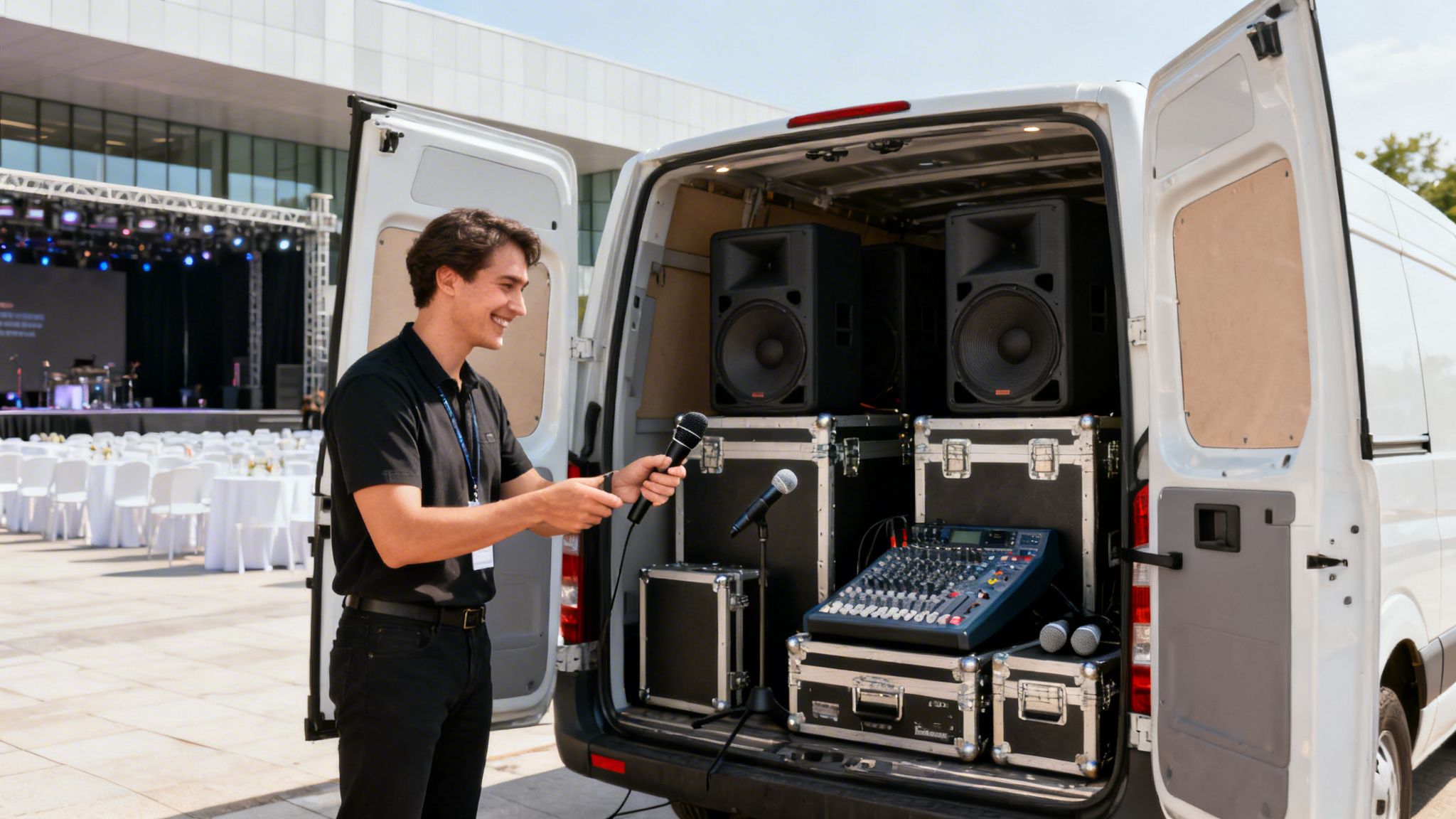
Whether you are running a corporate conference in a London hotel or a large outdoor festival, the quality of your audio can define the event's success. Your message, the music and the entire atmosphere all depend on the sound system. Professional audio technology evolves quickly, and equipment purchased today can become outdated surprisingly fast.
Renting sidesteps this issue. It removes the burden of ownership, allowing you to focus your energy on creating an excellent experience for your attendees.
The Core Benefits of Audio Hire
Opting to hire equipment instead of buying it brings clear advantages for any event organiser. The most obvious is financial; you avoid a large capital outlay on equipment that depreciates and requires specialist maintenance.
Beyond the financial aspect, renting also provides:
- Access to the Best Technology: You can select the latest, highest-specification equipment, perfectly matched to your event’s needs, rather than being limited to what you own.
- Complete Flexibility: Hiring makes it easy to scale your audio setup. You can arrange a simple PA system for a small meeting or a full concert rig for a major show, paying only for what you need.
- No Maintenance or Storage Concerns: The rental company handles all maintenance, testing, and storage. This eliminates the logistical challenges and hidden costs associated with owning delicate electronics.
- Expert Support: When you work with a specialist supplier like London Audio Visual Hire, you also gain their technical expertise, ensuring your setup is planned and executed flawlessly.
By opting for rental, you transform a large capital expenditure into a predictable, manageable operating cost. This approach not only frees up budget but also guarantees your event benefits from professionally maintained, show-ready equipment every time.
This guide serves as a roadmap for renting audio equipment. We will cover everything from selecting the right kit to budgeting and collaborating with your supplier to deliver a seamless event. For a broader perspective on the strategy behind organizing a marketing event, this article may be useful.
Choosing the Right Equipment for Your Event's Needs
Selecting the right audio equipment can seem like navigating a technical minefield, but it does not have to be. Understanding a few core components is key to ensuring your event sounds professional and impressive. It also enables you to have a clear conversation with your hire company, ensuring the final setup perfectly matches your requirements.
The heart of any sound system is the PA system, which stands for Public Address. This is the combination of speakers, amplifiers, and a mixer that takes sound from the stage and makes it loud and clear for everyone in the room. The size and power you need will depend entirely on your venue and audience size, which we will discuss in more detail.
Understanding Key Audio Components
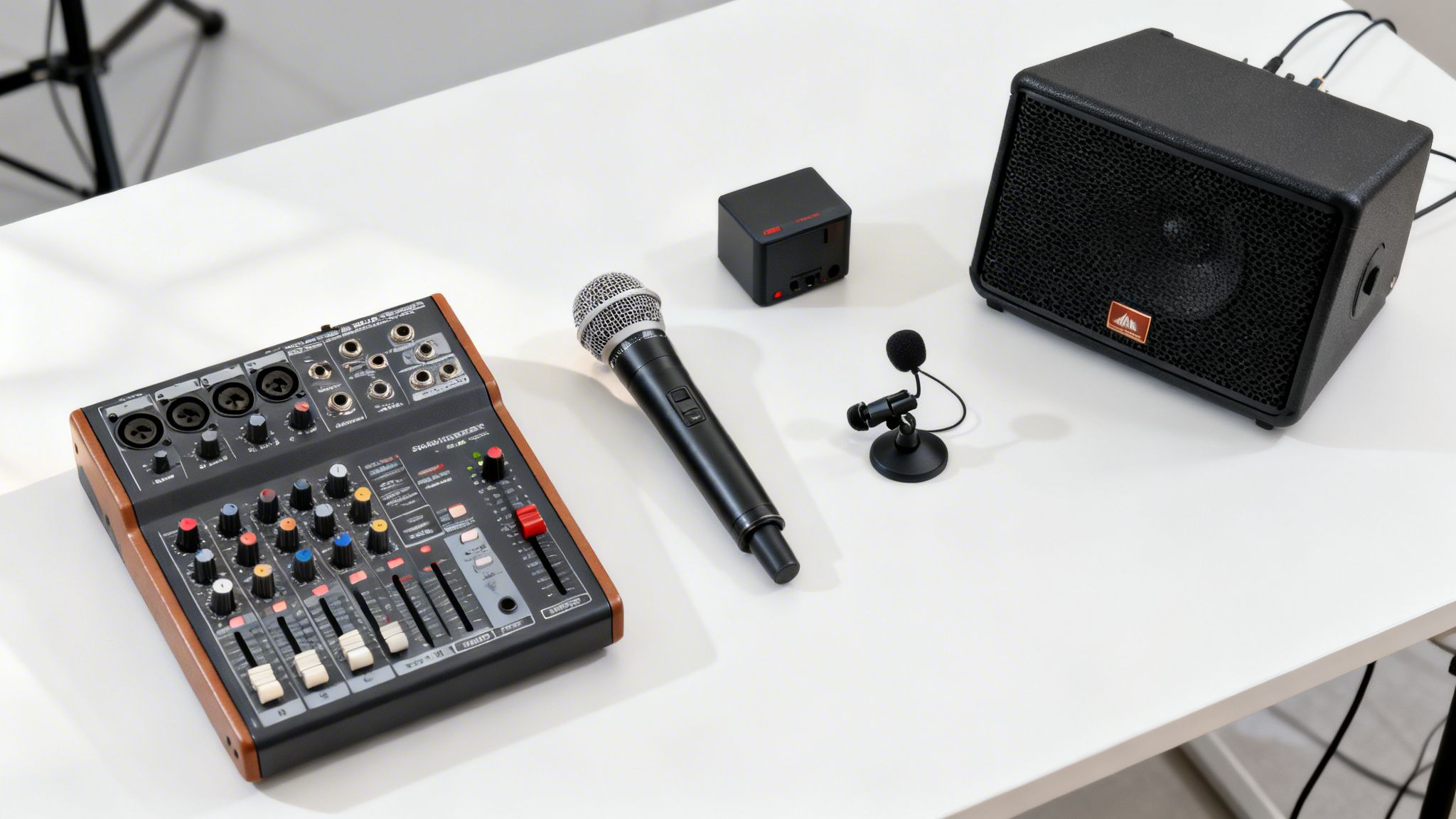
A useful way to think about an audio system is to compare it to the human body. The microphones are the ears, capturing sound. The mixing desk is the brain, processing and directing those sounds. The amplifiers are the muscles, providing power, and the speakers are the mouth, delivering the final, amplified audio to your audience.
PA Speakers: These are the most visible part of the system. A basic setup might just have two main speakers at the front. For larger events, you will need more speakers placed strategically to ensure everyone receives the same clear audio experience, regardless of their location.
Stage Monitors: The smaller, angled speakers on stage are monitors. Their sole function is to allow presenters or performers to hear themselves clearly, which is vital for a confident speech or a tight musical performance.
Mixing Desk (or Mixer): This is the command centre. Every audio source, from microphones to laptops, connects to the mixer. Here, a sound engineer adjusts the volume, tone, and balance of each sound before sending the final mix to the PA speakers and stage monitors.
The mixer is the most critical component for controlling audio quality. You can have the best microphones and speakers in the world, but if they are not properly balanced through a good mixing desk by a skilled operator, the result will be poor.
Matching Microphones to Your Event Type
The type of microphone you choose has a huge effect on sound clarity and the overall feel of your event. Different situations call for different microphones, and using the right tool for the job is the best way to avoid common problems like muffled speech or distracting background noise. Selecting the right microphone is a crucial step when planning your audio equipment for rent.
For example, a handheld microphone is perfect for a Q&A session where it can be passed around the audience. However, it would be a hindrance for a panellist who needs their hands free for notes or gestures.
Choosing the right microphone is not just a technical decision; it's a practical one that directly affects the comfort of your speakers and the clarity of their message. The goal is for the technology to be so seamless that the audience and presenters forget it's even there.
Here is a brief overview of the most common types:
- Handheld Microphones: The classic, all-round choice for presenters, singers, and audience questions. They offer fantastic sound quality but require the user to hold them at a steady distance from their mouth.
- Lapel Microphones (or Lavaliers): These are the small, discreet microphones that clip onto a jacket lapel or shirt. They are the standard for panel discussions and corporate presentations because they allow speakers to keep their hands free and move around naturally.
- Headset Microphones: Offering the best of both worlds, these provide hands-free operation while keeping the microphone in a perfect, fixed position near the mouth. They are ideal for high-energy presenters, fitness instructors, or anyone who needs to move frequently without any risk of the sound quality dropping.
To help you get started, the table below shows what you might need for different types of events.
Quick Guide to Audio Rentals for Common Event Types
Use this table as a starting point to identify the essential audio equipment you will likely need for your event.
| Event Type | Essential PA System | Recommended Microphones | Key Mixing and Support Needs |
|---|---|---|---|
| Small Corporate Meeting (up to 50 people) | 2 x compact speakers on stands | 2 x wireless handhelds for Q&A, 1 x lectern mic | Small 4-6 channel mixer, basic cabling |
| Panel Discussion (50-150 people) | 2 x main speakers, 2 x stage monitors | 4-6 lapel mics for panellists, 2 x handhelds for Q&A | 12-16 channel mixer, technician to manage levels |
| Conference Main Stage (150-500 people) | 4-6 main speakers, front fills, stage monitors | Multiple headset/lapel mics, lectern mics | 24+ channel digital mixer, audio technician, comms system |
| Live Band (Small Venue) | 2 x main speakers, 2 x subwoofers, 4+ monitors | Vocal mics, instrument mics, DI boxes | 16-24 channel mixer, sound engineer |
Remember, this is just a guide. Your specific needs will depend on your venue's acoustics and the precise format of your event.
Ultimately, your choice will come down to the practical activities happening on the day. By considering the needs of your speakers and performers, you can ensure the equipment you hire is perfectly fit for purpose. To explore the full range of options available, feel free to browse our extensive audio equipment inventory for more details.
Matching Your Audio Setup to the Venue and Audience
Great sound is not just about having high-quality equipment; it is about how that equipment performs in a specific room, for a specific group of people. Getting this right means carefully assessing your venue and guest numbers to create the perfect audio environment. Overlooking this step is a common mistake that can lead to distracting echoes or dead spots where your message is lost completely.
Ultimately, a successful event hinges on every single person hearing what is going on. The key is to balance power with the room's natural acoustics, ensuring the sound is clear and present without ever feeling overwhelming.
Tackling Your Venue's Acoustic Challenges
UK venues are varied, and each has its own acoustic personality. From historic buildings with cavernous, echo-prone ceilings to sleek conference centres with glass walls, the physical space itself will dramatically shape how sound behaves.
Sound waves bounce off hard surfaces like stone, glass, and wood, creating echoes and reverb that can turn speech or music into a muddy mess. Conversely, soft furnishings like thick carpets, heavy curtains, and even a room full of people absorb sound. If your system is underpowered, this absorption can make the audio feel flat and lifeless.
An experienced audio supplier doesn't just see a room; they see an acoustic environment. They will spot potential problems like reflective surfaces or awkward layouts and know exactly how to counter them, perhaps by using delay speakers or carefully adjusting placement to deliver crisp, consistent sound to every corner.
Here are a few common acoustic hurdles you might encounter:
- High Ceilings: Found in old halls, churches, and warehouses. These spaces can cause significant echo, making speech difficult to follow.
- Glass Walls: A feature of modern offices and event spaces. Large glass panels are highly reflective and can make audio sound harsh and brittle.
- Irregular Shapes: L-shaped rooms or spaces with columns act as physical barriers, creating quiet zones or "sound shadows" where coverage drops off.
- Outdoor Spaces: With no walls to contain it, sound dissipates quickly. This demands more powerful speakers and strategic positioning to cover the area effectively.
For a deeper dive into how different settings can influence your technical planning, take a look at our guide to working with London venues and their unique characteristics.
Calculating Speaker Power for Your Audience
Once you understand the venue’s acoustics, the next task is to match your speaker system's power to your audience size. We measure this in watts. While it is not an exact science, there are reliable rules of thumb that professionals use. The goal is simple: ensure the person in the back row has the same great audio experience as someone in the front.
It is easy to assume that more watts always means better sound, but that is not the case. You need enough power, but too much in a small, reflective room can be jarring and actually make things worse. The art lies in finding the sweet spot for your specific event.
For example, a spoken-word presentation is all about clarity and can be handled with less power. A live band, however, needs significant headroom to cope with the dynamic peaks and troughs of music.
A Practical Guide to Wattage and Audience Size
To give you a starting point for your conversations with a rental provider like London Audio Visual Hire, here are some general guidelines for estimating your power needs:
Small Meetings & Presentations (up to 50 guests): For a standard indoor event focused on speech, a simple system of around 200-400 watts is usually sufficient. It provides excellent vocal clarity without being overpowering.
Medium Conferences & Seminars (50-150 guests): As the room and audience grow, you will need more power to project the sound to the back. Look for a system in the 500-1000 watt range. For wider rooms, you might even need a few extra "in-fill" speakers.
Large Events & Awards Dinners (150-500+ guests): Large gatherings, especially those with music or video, demand a much more substantial setup. Here, you are looking at systems starting from 1500 watts and going up to 5000 watts or more, often with subwoofers to add low-end punch for music.
These numbers are a helpful starting point. A true audio expert will refine this estimate based on your venue's layout, the event agenda, and the atmosphere you want to create, ensuring you get a sound system that is perfectly tuned to your needs.
Understanding Setup Power and Cabling Logistics
It is easy to focus on major items like speakers and microphones, but the secret to flawless event audio often lies behind the scenes. Power and cabling are the unsung heroes of any professional setup. Get them right, and your event runs smoothly; overlook them, and you risk problems.
Think of your audio system as a chain. It starts with a source: a presenter's microphone, a musician's guitar, or a laptop playing music. From there, the signal travels through cables to the mixing desk for processing. Finally, it is sent through more cables to the amplifiers and out through the speakers. If one link in that chain is weak, the whole system can fail.
This diagram breaks down the thought process of matching the right equipment to the space.
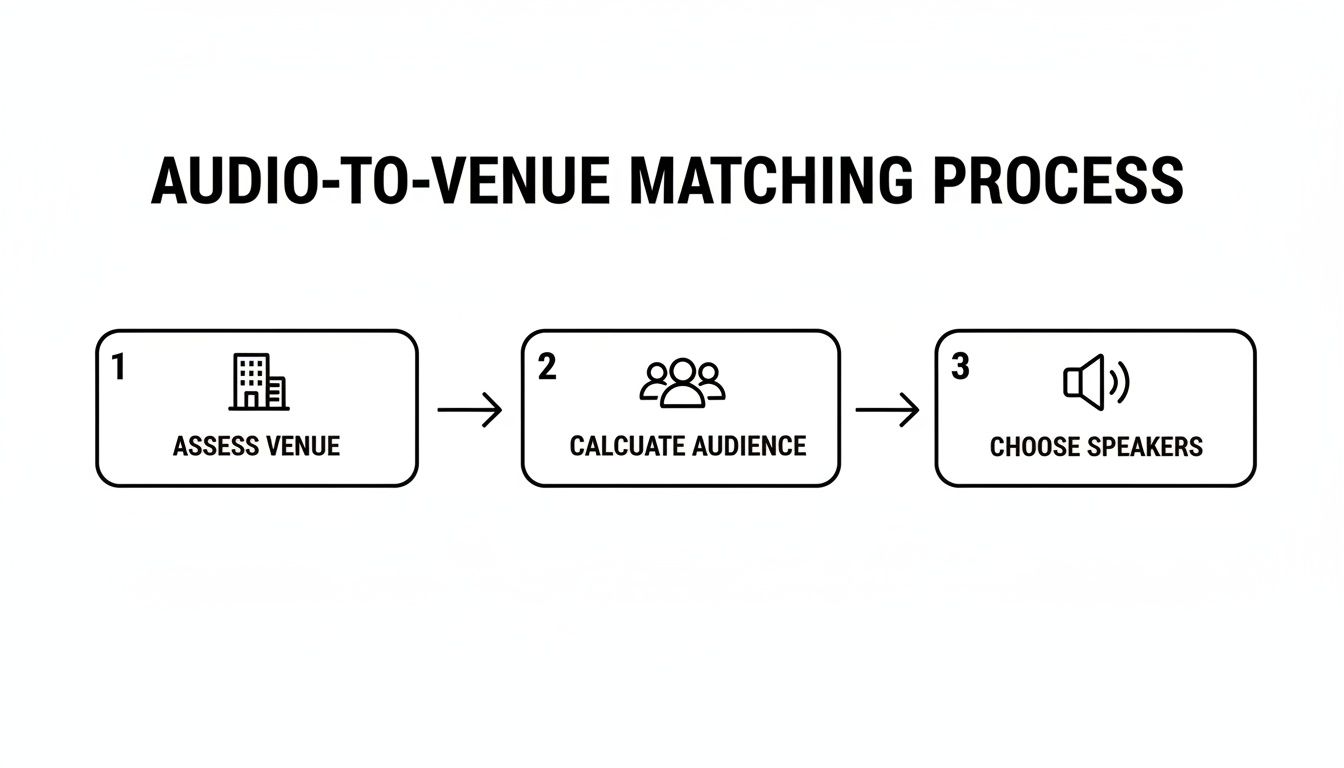
While choosing the right speakers is a key decision, it is irrelevant without the correct power and connections to bring it all to life. This is where a little planning goes a long way.
Assessing Your Venue’s Power Supply
Many audio issues stem from a poor power supply. Professional sound equipment is sensitive and needs a clean, stable source of electricity to perform at its best. If you plug your sound desk into the same circuit as the catering team’s coffee machine or the lighting crew’s strobes, you are inviting problems.
Plugging into a "dirty" power source often introduces electrical interference, which you will hear as an annoying hum or buzz through the speakers. To avoid this, your entire audio setup should run from dedicated power circuits. This means using electrical sockets that are on a separate line, isolated from everything else.
Discuss this with your venue manager and audio supplier early in your planning. A seasoned provider like London Audio Visual Hire will raise this themselves, but showing you have considered it helps everything run more efficiently.
Think of a dedicated power circuit as a VIP lane for your audio. It is not an optional extra; it's essential for guaranteeing clean, professional sound and protecting your event from common and avoidable technical issues.
A Venue Power Checklist
Before you sign a contract with a venue, run through this quick power checklist:
- Socket Locations: Are there enough standard 13-amp sockets near the stage, the mixing desk position, and where the main speakers will be placed?
- Dedicated Circuits: Can the venue guarantee at least one, or ideally two, 'clean' circuits just for the audio equipment?
- Circuit Load: Double-check what else is running on these circuits. You want to be sure they are not shared with kitchens, house lights, or lifts.
- Outdoor Power: If your event is outdoors, how will you get power? Is there a safe, weatherproof source, or do you need to factor in the cost of hiring generators?
Safe and Tidy Cable Management
With your power sorted, the final piece of the puzzle is cabling. A professional setup is not just about plugging everything in; it is about managing cables in a way that is neat, safe, and logical. This is not just about aesthetics, it is a crucial part of your health and safety responsibility.
Any cable that crosses a path where people will be walking must be secured. This means either taping it down firmly with high-quality gaffer tape or covering it with heavy-duty rubber cable ramps. This simple step prevents trip hazards, which can be a serious liability.
Beyond safety, tidy cabling is the hallmark of a professional. A neat loom of cables makes it much easier for a technician to identify and fix a problem if one arises. A chaotic mess of wires, on the other hand, is a red flag and can turn a five-minute fix into a half-hour headache. Working with a supplier who pays attention to these details ensures your event is both professional and safe.
How to Budget for Your Audio Equipment Hire
Determining what you will spend on audio equipment is a vital part of planning your event. Establishing a budget early not only prevents surprises later but also ensures you are investing your money wisely to achieve fantastic sound for your audience. The final quote you receive will be based on a few key factors, and it is about more than just the equipment itself.
Thankfully, pricing for professional audio equipment is not a dark art. It is a logical breakdown based on what you need, how long you need it for, the logistics of getting it to your venue, and whether you require an expert on-site to operate it. Once you understand these components, you can build a realistic budget and make smart choices.
What Shapes the Hire Cost?
Your final bill for audio equipment for rent is a sum of its parts. Each element plays a role in the total cost, and knowing what they are helps you see exactly where your money is going, and where you might be able to make adjustments if needed.
The main cost drivers you will see on a quote are:
- The Equipment Itself: This is the most significant factor. A couple of speakers and a simple microphone for a small presentation will, of course, cost much less than a full concert-style sound system with multiple stage monitors, a complex digital mixer, and a dozen wireless microphones for a large conference.
- The Hire Duration: Hire companies usually charge by the day or by the week. You will have a standard cost for a one-day event, but you will often find that longer hires come with a reduced daily rate after the first day, which can make a significant difference for multi-day events.
- Logistics (Delivery, Setup, and Collection): Getting the equipment to your London venue, setting it all up correctly, and then taking it all away again is a service that is built into the price. This cost can vary depending on the complexity of the setup and your event's location.
- An On-Site Technician: If you need a sound engineer to mix the audio and solve problems in real time, this will be an additional cost. Having a professional on-site is a huge stress reliever and essential for any event with multiple elements. It is an extra line on the budget, but for anything beyond a simple speech, it is money well spent.
Example Hire Costs to Get You Started
To give you a clearer picture, here are some ballpark figures for common event types in London. Use these as a starting point to help you plan.
| Event Scenario | Estimated Hire Cost (Excluding VAT) | What's Typically Included |
|---|---|---|
| Small Meeting or Presentation | £150 – £300+ | A pair of speakers on stands, a small mixer, and a couple of microphones. Perfect for audiences of up to 50 people where you just need to ensure everyone can hear the speakers clearly. |
| Medium Conference or Panel Talk | £450 – £900+ | A larger sound system, a few discreet lapel microphones for the panel, and some handheld microphones for audience Q&A. This price often includes delivery and a basic setup. |
| Awards Dinner or Gala Event | £1,200 – £5,000+ | A comprehensive package. Powerful speakers and subwoofers for music, a sophisticated digital mixing desk, and an on-site technician to run the show smoothly all night. |
There is a good reason hiring has become the preferred financial choice for event organisers. According to one projection, the UK retail market for audio-visual equipment is set to be worth just £490.6 million in 2025. One reason is that event professionals have realised that hiring makes more sense. A recent shift shows that 60% of buyers now choose to rent, which can slash the total cost of using equipment by up to 65% compared to owning it.
Hiring the equipment for that gala might cost £5,000, but buying the same setup outright could easily exceed £25,000. Renting gives you access to the latest technology without the massive capital outlay. You can get more insights on this UK market trend and its impact on equipment retail.
When you hire from a specialist like London Audio Visual Hire, you are not just renting equipment. You're procuring a service. That price includes perfectly maintained, tested, and prepared equipment, expert logistics, and the confidence that the sound for your event is in safe, professional hands.
How to Partner with Your Rental Supplier for Success
Choosing your audio hire company is about much more than just ticking boxes on an equipment list. Think of them as an extension of your own event team. The right partner will not just be a warehouse full of equipment; they will be the experts in your corner, dedicated to making your event sound incredible. This all starts with clear communication.
A great supplier proves their worth from the very first conversation. Instead of just asking "What do you need?", they will ask "What are you trying to achieve?". They will want to know about your audience, your venue, and your vision. This is how they move beyond a simple order-taking role and start offering real value, spotting potential issues before they arise.
This shift towards genuine partnership is happening across the industry. In the UK, the audio equipment for rent market is predicted to grow by a healthy 4.3% CAGR, largely because event planners are demanding higher quality and more reliable sound solutions. Since 2022, rental enquiries have increased by 15-20% year-on-year. In 2024, more than 65% of corporate planners opted for rentals, cutting their capital equipment spending by as much as 70%. You can dig deeper into these key market statistics to see how rentals are changing event budgeting.
Questions to Ask Your Potential Audio Supplier
To find a partner you can truly rely on, you need to do some vetting. A professional company will welcome your questions. Use this checklist to guide your initial conversations and get a real feel for their capabilities.
- Experience and Expertise: How long have you been in business? Can you show me examples of events you have worked on that are similar to mine?
- Equipment Quality and Maintenance: What brands do you stock? And just as importantly, how often is your equipment tested, PAT tested, and serviced?
- Insurance and Safety: Are you fully covered with public liability insurance? What are your health and safety procedures for setup and takedown?
- Logistics and Support: What does your delivery and collection process look like? What kind of on-site support can you offer on the day?
- Contingency Planning: What is the plan if a piece of equipment fails mid-event? Do you have backup equipment ready to go?
The answers you receive will tell you everything you need to know about their professionalism. For more background on the different types of equipment, have a look at our guide on what constitutes audio visual equipment.
The Importance of On-Site Support
One of the biggest decisions you will make is whether to have a technician on-site. A 'dry hire' (where you just get the equipment delivered) might seem cheaper upfront, but having an expert on hand is often the best investment you can make for your event's success.
Think of an on-site technician as your audio insurance policy. They are not just there to push faders. They are there to anticipate problems, actively manage the sound quality, and fix any issues on the spot, ensuring everything runs smoothly for your speakers and your audience.
There are generally three levels of support to consider:
- Delivery and Setup: The hire company delivers the equipment, sets it all up, and performs a sound check to ensure it is working perfectly before they leave. This is fine for simple setups where you are comfortable managing the audio yourself.
- Technician On-Site for the Event: A sound engineer stays for the duration of your event. They will operate the mixing desk, manage all the microphones, play music cues, and be the first responder for any audio issues. This is standard practice for conferences, awards nights, and any kind of live performance.
- Full Production Team: For larger, more complex events, you might need a full crew. This could include a project manager, multiple sound engineers, and stagehands, all managed by your rental partner.
Partnering with a supplier like London Audio Visual Hire is not just about renting speakers and microphones. It is about bringing an experienced, detail-oriented team into your project. That kind of collaboration gives you complete peace of mind, freeing you up to focus on your guests while they handle the technical aspects.
Got Questions About Hiring Audio Equipment? We’ve Got Answers
Even after careful planning, a few final questions often arise when you are about to hire audio equipment. Getting clear, straightforward answers is key to entering your event with confidence, knowing every sound detail is sorted.
Let's address some of the most frequent queries we hear from event planners. It can also be helpful to review some common questions about rental services from the wider events industry for a broader perspective.
How Far in Advance Should I Book?
Our best advice is to lock in your audio equipment at least 4-6 weeks before your event.
If you are planning something more complex that might require a site visit or detailed technical coordination, aim for 8-12 weeks out. This is especially true during busy periods like the summer or Christmas party season. Booking early not only guarantees you get the equipment you need but also gives everyone enough breathing room to plan properly.
Do I Really Need a Sound Engineer?
It depends. For a straightforward speech with a single microphone and a couple of speakers, you can probably manage it yourself. This is known as a 'dry hire'.
However, as soon as your event involves multiple microphones, a live band, or switching between different audio sources (like videos and background music), a professional sound engineer becomes essential. Their job is to balance everything perfectly, eliminate feedback before it starts, and solve any technical issues on the spot. They are the difference between a smooth show and a stressful one.
A good hire company will always supply fully tested, professional-grade equipment to minimise the chances of anything going wrong. In the rare event a piece of equipment does fail, having a technician on-site means they can swap it out with a backup immediately. For dry hires, we always provide a support number you can call for troubleshooting advice.
Can I Rent Equipment for an Outdoor Event?
Absolutely, but outdoor events have their own set of rules. The acoustics are completely different, so you will need a specific speaker setup to ensure the sound carries properly without simply dissipating into the open air.
You also have to think about protecting the equipment from the unpredictable British weather and, crucially, how you are going to power everything. This often means hiring generators. Be sure to bring all this up with your supplier early on, as it is a vital part of the planning.
At London Audio Visual Hire, our team has the experience and high-quality equipment to make your event sound incredible.